To every explorer with his map upside down, to every air-traffic controller suddenly receiving Magic FM through his headphones, to every astronomer whose new planet turns out to be a bit of bran-flake on the eyepiece of his telescope,
Sod's Law says: you are not alone.
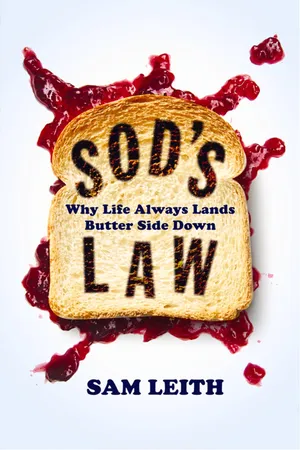
Sam Leith tells the hilarious - and painful - stories of the unsinkable boat that sunk, the unbeatable horse that lost, and the fireproof theatre that burned to the ground.
Sod's Law demonstrates that the entire universe is actually set up to ensure that your toast always lands butter side down and, what's more, that it lands precisely where the cat has shed hair all over the carpet.
In this age of doubt, fewer and fewer of us are able to believe that a higher power takes an interest in our fate. This book reassures us that indeed it does - and that that higher power is hell bent on buggering things up. Only by laughing heartlessly at the misfortunes of others can we make ourselves feel better.
Sod's Law enables us to do just that.
- 166 pages
- English
- ePUB (mobile friendly)
- Available on iOS & Android
eBook - ePub
About this book
Information
Print ISBN
9781848872301
THE ART OF LOSING
In an effort to recreate the televisual magic of Groucho Marx’s You Bet Your Life, the American network CBS screened the premiere of an exciting new game show in January 1961.
You’re in the Picture was hosted by the bumptious comedian Jackie Gleason. The rules were simple. Celebrity guests would stick their heads through life-sized panels of famous scenes, and try to guess what the picture was of by asking Gleason questions.
The show, unfortunately, was an epic flop – such a disaster that some conspiracy theorists believed it had been done deliberately. Nobody had the first idea what picture they were in, and neither host, panellist or audience seemed to care.
The second show was markedly different in format. Gleason – by pointing out that the show had had sponsors – disabused viewers of the hope it had been done deliberately. It really had been as bad as they thought, and it really had been an accident.
‘Ladies and gentlemen,’ he said, ‘I think you’ll notice that there is no panel tonight.’ Instead, the whole thirty-minute show was giving over to Gleason, sitting on a bare stage, swigging from a mug that, he assured viewers, was ‘chock full o’ booze’ and musing on the ‘intangibles of show business’ that had led him to this sorry pass.
The programme, he said, had had nearly three hundred years of showbiz experience behind it – and yet had ‘laid the biggest bomb in history… this would make the H-bomb look like a two-inch salute… you don’t have to be Alexander Graham Bell to pick up a phone and know it’s dead.’
His apology was so successful that the show was renamed The Jackie Gleason Show. It ran on and off for eighteen years.
* * *
‘ABSOLUTELY FIREPROOF’ was what it said in capital letters at the top of the playbills for the matinee performance of Mr Bluebeard, the first play ever to be performed at Chicago’s new Iroquois Theatre. You can guess what happened next, can’t you?
It was 1903, and the new theatre was the pride of the Windy City – intended to rival New York for glamour and sophistication. It was opened in something of a rush, though, and ‘Absolutely Fireproof’ might have better read ‘Theatre-Sized Tinderbox: Take Your Chances’.
The interior was almost entirely made of wood, the fire escapes had not been finished, there was no fire alarm, and the total fire-fighting equipment – no doubt on the grounds that it would never be needed – consisted of just six canisters of a powder extinguisher called Kilfyre. There were no exit signs, the theatre’s architect later explained, because he ‘thought they would spoil the look’.
The theatre’s capacity was 1,602. On 30 December, 1,840 people showed up for the matinee, and were admitted. The doors, which opened inwards, were locked and bolted.
During the big musical number in Act II, a light above the stage shorted and set fire to the drapery. The cast stayed in character. The stagehand who was usually in charge of the fire curtain was, unluckily, off sick and his replacement didn’t know how to operate it. When they finally managed to lower it, it got stuck.
The lead actor, Eddie Foy, advised the audience: ‘Don’t be frightened, go slow, walk out calmly, take your time.’
The cast left character and fled through the scenery doors at the back of the building. Opening these doors had the effect of causing an enormous backdraught that instantly incinerated those who had taken Mr Foy’s advice.
The sensible stampeders who had managed to find an unlocked door found themselves on a platform high above the alley behind the building. Had the fire escape been completed, the platform would have been connected to the ground by a ladder. It was not.
A ladder was produced from the building opposite and extended to bridge the gap. The first man who stepped on it slipped and tumbled to the cobblestones below, taking the ladder with him. The fire brigade showed up and encouraged the remaining people to jump down into the nets they were holding. Thanks to the thick smoke, this tactic had distinctly mixed results. The following day, 125 bodies were recovered from the alleyway.
It was the worst single-building disaster in US fire-fighting history. Six hundred people were killed. ‘THE IROQUOIS FIRE HORROR’ was what it said in capital letters at the top of the Chicago Daily News.
* * *
‘We poets in our youth begin in gladness,’ wrote Wordsworth, ‘but thereof comes in the end despondency and madness.’ This is understandable. Writing poetry is a lonely and difficult task, selling it is next to impossible, and reading from it in public can be exactly as lonely as writing it.
The poet Simon Armitage describes fleeing the scene of a typically dispiriting reading – somnolent audience members, a compèe who doesn’t know who he is, a night listening to amateur poetry in a pube-ridden bedsit – and passing time in the precinct of the railway station while waiting for a train home.
In a second-hand bookshop he notices a first edition of one of his own books. It is marked ‘Signed’ and costs 10p. He opens it. Underneath the signature, in his own handwriting, are the words: ‘To Mum and Dad’.
George Bernard Shaw, incidentally, offers an example of how to deal with this sort of indignity. He came across a copy of one of his books in a bookshop, inscribed in his own hand: ‘To X with esteem, George Bernard Shaw’. He bought it and gave it back to X, amending the inscription to read: ‘To X with renewed esteem, George Bernard Shaw’.
Wordsworth, on the other hand, became Poet Laureate, giving him high public status and ample financial security. He lived to a ripe old age.
* * *
Algernon Swinburne, though a decent enough poet, was a rotter as a houseguest. When staying as a guest of the Master of Balliol College, Oxford – an eminent classicist by the name of Jowett – he cast an eye over his host’s translation of Plato and immediately suggested a correction.
The Master, on the back foot: ‘Of course that is the meaning. You would be a good scholar if you were to study.’ Jowett received another guest, and Swinburne drifted into the next room, nose still in the Plato.
An occasional stagy yelp of laughter could be heard through the door. ‘Another howler, Master!’ Swinburne called merrily.
‘Thank you, dear Algernon,’ Jowett replied, pushing the door firmly to.
* * *
The great actor Sir Donald Wolfit was noted for his somewhat high-handed treatment of more junior members of the company.
He had cast one ambitious younger actor, for season after season and obdurately ignoring pleas for bigger parts, as the spear-carrier Seyton in Macbeth – a character who has fewer than fifty words to speak in the whole play.
Six of those words are quite important, though. When Wolfit’s Macbeth exclaims ‘Wherefore was that cry?’, Seyton reports: ‘The queen, my lord, is dead.’
At this point, Macbeth launches into an impassioned and grief-stricken soliloquy about the meaninglessness of life: ‘Tomorrow, and tomorrow, and tomorrow/ Creeps in this petty pace…’
On the final night of the run, Wolfit delivered his line. Seyton appeared on stage and with a broad grin announced: ‘The queen, my lord, is much, much better!’ He walked off-stage, out of the theatre’s back door, and was never heard from again.
* * *
In early 1993, the novelist Rupert Thomson was wintering in a farmhouse in Siena with his partner Kate. Every ten years, the literary magazine Granta announces its Best of Young British Novelists, a list of twenty writers under forty it tips for future superstardom. It was due to announce its 1993 list that spring, and Thomson was eligible.
While tearing up newspapers to light a fire, Kate chanced on a small black-and-white photograph of Thomson accompanying an article about the announcement. She ran upstairs waving the paper and told him he’d made the list.
Thomson, feverish with excitement, scanned the article for his name. It did not appear. His partner had mistaken his face for Jeanette Winterson’s.
* * *
The American novelist Rick Moody was once described by a critic as ‘the worst writer of his generation’. ‘I apologize for the abruptness of this declaration, its lack of nuance, of any meaning besides the intuitive,’ wrote the critic in question, Dale Peck, ‘but as I made my way through Moody’s oeuvre during the past few months I was unable to come up with any other starting point for a consideration of his accomplishment.’
Mr Moody arranged to settle his differences with Mr Peck by throwing a custard pie into his face.
Mr Peck’s view is not shared by everyone. Mr Moody reports that his own mother used to review his work online: ‘She once reviewed a book by me on Amazon.com and gave me three out of five stars.’
He added: ‘Then she told me it was a positive review.’
* * *
The actor who muffs his lines is a perennial joy in the theatre. Few muff them so inventively as the legendary thespian who was required to exclaim: ‘Hark! I hear a pistol shot!’
Onstage, he declared: ‘Hark! I hear a shostel pit! A shistel pot! A postel shit! Oh shit, I’m shot! Oh fuck, I’m fired.’
* * *
In April 2009, the punk-rock pioneer Iggy Pop (James Osterberg, Jr to his mother) had what observers would identify as his least punk-rock moment ever. In a career that saw him being arrested for drug possession and indecent exposure, surfing into crowds with his chest bleeding from self-inflicted lacerations, and displaying his generously proportioned private parts to complete strangers at the slightest provocation, he was… given a mild ticking off by the Advertising Standards Authority.
Mr Pop – having made the inevitable journey from Stooge to stooge – had appeared in an advertisement for a car insurance company called Swiftcover, in which he had announced to an apathetic nation: ‘I’m Swiftcovered! I’ve got insurance on my insurance!’
This, presumably, was intended to convey that even if you have the sort of drug-addled, wild and crazy rock lifestyle of an Iggy Pop, you can still get insured up to the hilt with Swiftcover. Unfortunately, as the ASA was swift to point out, Iggy didn’t have insurance on his insurance. He didn’t even have insurance, because Swiftcover’s policy terms specifically bar them from taking on anyone who works in the entertainment industry, let alone mentally questionable pharmacological disaster areas like Mr Pop.
The company afterwards said that the advert had been ‘a great success’.
* * *
In 1996, the beer company Molson staged a series of rock concerts in order to raise the profile of its brand. The results were mixed. Chris Cornell of Soundgarden announced to the crowd: ‘We’re here because of some beer company… LABATT’S!’
Courtney Love got the name of the beer right. ‘God bless Molson,’ she said. ‘I douche with it every day.’
* * *
After the 1922 premiere of Igor Stravinsky’s one-act chamber opera Renard, Marcel Proust approached the composer to offer his congratulations. It was the opportunity for a meeting of minds between two of the most innovative artists of the twentieth century.
The conversation went like this.
Proust: ‘Do you like Beethoven?’
Stravinsky: ‘I detest him.’
Proust: ‘But the late quartets?’
Stravinsky: ‘Worst thing he ever wrote.’
Proust: ‘…’
Stravinsky later explained that, actually, he did like Beethoven well enough but ‘it was a commonplace among intellectuals of that time’ to praise him, and he didn’t want to do the predictable thing.
* * *
The great American novelist William Faulkner had a robust attitude to paid employment. He was relieved of his position at the University of Missis...
Table of contents
- Cover
- SOD’S LAW
- Copyright
- Dedication
- Epigraph
- Introduction
- A Note on Sources
- THE PROFESSIONALS
- SOD ON THE ROAD
- THE COURSE OF TRUE LOVE
- SOD’S WAR
- OUT FOR A DUCK
- SOD AND GOD
- SOD AND PLOD
- THE ART OF LOSING
- SODDING POLITICS, SODDING POLITICIANS, AND SODDING PUBLIC LIFE
- THE QUEST FOR KNOWLEDGE
- ODDS AND SODS
Trusted by 375,005 students
Access to over 1.5 million titles for a fair monthly price.
Study more efficiently using our study tools.
Frequently asked questions
Yes, you can cancel anytime from the Subscription tab in your account settings on the Perlego website. Your subscription will stay active until the end of your current billing period. Learn how to cancel your subscription
No, books cannot be downloaded as external files, such as PDFs, for use outside of Perlego. However, you can download books within the Perlego app for offline reading on mobile or tablet. Learn how to download books offline
Perlego offers two plans: Essential and Complete
- Essential is ideal for learners and professionals who enjoy exploring a wide range of subjects. Access the Essential Library with 800,000+ trusted titles and best-sellers across business, personal growth, and the humanities. Includes unlimited reading time and Standard Read Aloud voice.
- Complete: Perfect for advanced learners and researchers needing full, unrestricted access. Unlock 1.5M+ books across hundreds of subjects, including academic and specialized titles. The Complete Plan also includes advanced features like Premium Read Aloud and Research Assistant.
We are an online textbook subscription service, where you can get access to an entire online library for less than the price of a single book per month. With over 1.5 million books across 990+ topics, we’ve got you covered! Learn about our mission
Look out for the read-aloud symbol on your next book to see if you can listen to it. The read-aloud tool reads text aloud for you, highlighting the text as it is being read. You can pause it, speed it up and slow it down. Learn more about Read Aloud
Yes! You can use the Perlego app on both iOS and Android devices to read anytime, anywhere — even offline. Perfect for commutes or when you’re on the go.
Please note we cannot support devices running on iOS 13 and Android 7 or earlier. Learn more about using the app
Please note we cannot support devices running on iOS 13 and Android 7 or earlier. Learn more about using the app
Yes, you can access Sod's Law by Sam Leith in PDF and/or ePUB format. We have over 1.5 million books available in our catalogue for you to explore.