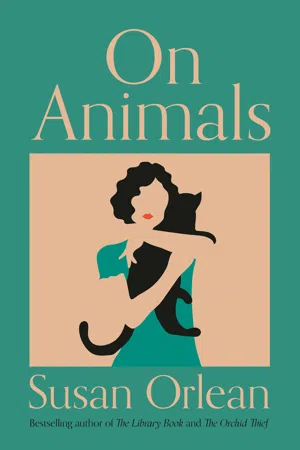
'Every essay in this book is magnificent... Mesmerizing.'
New York Times
'How we interact with animals has preoccupied philosophers, poets, and naturalists for ages,' writes Susan Orlean. Since the age of six, when Orlean wrote and illustrated a book called
Herbert the Near-Sighted Pigeon, she's been drawn to stories about how we live with animals, and how they abide by us. Now, in
On Animals, she examines animal-human relationships through the compelling tales she has written over the course of her celebrated career.
These stories consider a range of creatures
- the household pets we dote on, the animals we raise to end up as meat on our plates, the creatures who could eat us for dinner, the various tamed and untamed animals we share our planet with who are central to human life. In her own backyard, Orlean discovers the delights of keeping chickens. In a different backyard, in New Jersey, she meets a woman who has twenty-three pet tigers
- something none of her neighbours knew about until one of the tigers escapes. In Iceland, the world's most famous whale resists the efforts to set him free; in Morocco, the world's hardest-working donkeys find respite at a special clinic. We meet a show dog and a lost dog and a pigeon who knows exactly how to get home.
Equal parts delightful and profound, enriched by Orlean's stylish prose and precise research, these stories celebrate the meaningful cross-species connections that grace our collective existence.
eBook - ePub
On Animals
About this book
Information
Farmville
Chicken Chores
My day begins with chicken chores. I allow myself coffee, and then I tumble out of the house in my pajamas and a pair of muck boots, hauling a five-gallon container of water. Keeping animals, I have learned, is all about water. Who even knew that chickens drink water? I didn’t, before I moved to my farm in the Hudson Valley and started husbanding chickens. They drink water, and a lot of it. A bigger, fancier farm might have a water line into its chicken coop, but mine doesn’t, so I am the water carrier, lugging as much as I can lug from the spigot at the back of the house to the coop. In the summer, the birds guzzle everything they can get their beaks into, so I fill two five-gallon water dispensers for them, then make a third trip to fill a bowl with water that the ducks can slosh in. Discovery: water weighs a lot. Other discovery: no need to use free weights to tone your biceps when you’re carrying ten gallons of water back and forth every day.
In the winter, the water situation gets more complicated, requiring heated stands for the water dispensers, and resulting in the slickest ice you have ever seen, made by the water the ducks (the world’s sloppiest drinkers and swimmers) manage to splash around. When it rains, you would think my water-carrying chores would be less necessary, but the rain seems to plunk down everywhere except where it would be useful, and on top of that it kicks a mist of mud and gravel into the drinking trough. I have to dump out the dirty water in the rain and fill it up again.
There’s a school of thought that in the modern world we don’t do enough physical labor (see Shop Class as Soulcraft: An Inquiry into the Value of Work, by Matthew B. Crawford, for one good take on the subject). In my very informal poultry-oriented way, I have come to agree. Even at their messiest and most burdensome, these chicken chores please me. It’s a concrete need—water!—to which I can respond specifically— here you go, birds, water!—and the cycle is complete. (Until they need water again, of course.) In so many endeavors, including writing, you are never truly done, and nothing is ever perfect. You are haunted always by the possibility that you could have done more and better. It is a relief sometimes to take on a task and see it through and know it to be wholly sufficient.
Deer Diary
Soon, the snow will melt, the grass will green up, and the fields will be filled again with toffee-colored deer—or, as we affectionately refer to them, Cloven-Hoofed Disease Vectors. From a distance, it is hard to see the tiny ticks that get a free ride on the deer, then drop off into the grass and try to catch an inbound express on a human ankle or animal belly. These ticks are quite often carrying bacteria. In my household alone, we’ve had two bouts of Lyme disease (me), one of ehrlichiosis (my husband), and one case of chronic Lyme (my dog). I can’t even begin to count the friends and neighbors who have gotten one or both diseases, and some of them have become deathly ill.
Lyme is especially vexing, because its symptoms are so vague and diffuse. The first time I had it, I was initially (wrongly) diagnosed with gout, diabetes, a staph infection, a heart irregularity, and a broken toe. The second time, I had gone to the doctor because I was having a flare-up of carpal tunnel syndrome, and on a whim, I asked whether there was any chance that the pain in my arm was actually Lyme again. It was. Or, more correctly, my blood test showed that I did indeed have Lyme disease again, which might or might not have been making my carpal tunnel hurt, but since I have a history of carpal tunnel, I took the belt-and-suspenders approach of doxycycline for the Lyme and anti-inflammatories for the carpal tunnel.
There is not much to do about the ticks. You can spray something awful on your grass, but it’s not very effective, and since infected ticks are everywhere in the Hudson Valley, where I live, I wouldn’t be safe if I ever left home. Last year, I fell for the guinea fowl scam. It’s rumored that these noisy, odd-shaped birds eat ticks by the bushel, so I bought nine of them, and after a period of cooping them up to win their loyalty I set them loose in my yard to clean up the ticks. In a day, the guinea fowl had all disappeared (my guess is that foxes are to guinea fowl what guinea fowl are, supposedly, to ticks). It was an emotional loss but not really a disease-control catastrophe, since everything I read after the birds flew the coop suggested that guinea fowl will eat any bug, and, despite the promotional campaign touting their skills as exterminators, there is no proof that they specifically seek out tiny deer ticks over anything bigger and juicier. Anyway, I realized there are so many ticks in our grass that I would have needed many more than nine guinea fowl to have had any effect at all.
Months after my great guinea fowl fiasco, I came out one morning to find Prince Charles, the male of the lost flock, back at my coop. I bought a female, whom I named Camilla, to keep him company, and the two of them now live in a fenced pen with my chickens, dining on grain and egg-layer pellets. They probably wouldn’t recognize a tick anymore if it bit them. I’m not sure there’s anything else to try on the tick front, so we just muddle through. We get blood tests whenever we have a Lyme-like symptom (a list so long and so general that it barely counts as a list), and we view the arrival of spring, when the ticks reappear, with a mixture of elation and dread.
Strangely enough, even though the deer are the gateway animal for this whole mess, I still love to see them rambling. They are such nuisances, really; besides giving safe harbor to ticks, they eat the prettiest plants in my garden, grind up the grass on their favorite paths, leave scat everywhere, and have managed to collide with my car twice, costing thousands in body work and scaring me half to death. And yet, I love them. I get excited every time I see one, even though I see them all the time. Their talent is in having those sensitive faces and the ballerina’s poise that makes you forgive them almost anything.
Chicken TV
I’m bringing one of my chickens to Manhattan tomorrow, to be on an episode of The Martha Stewart Show, which Martha—a celebrated chicken keeper herself—is devoting to the subject of backyard chickens. My chickens are not seasoned travelers (note to self: maybe don’t use the word “seasoned” when talking about pet chickens?) so I’ve been fretting about the whole enterprise, which will entail driving two hours from my house to the city and then spending several more hours in the studio while we tape the show.
For the last week or so, I’ve been auditioning to see which of my seven chickens would be the most camera-ready and most travel-friendly. My prettiest hen is a Silver Laced Wyandotte named Merry-Go-Round. She’s plump and bosomy, covered with a craze of black and white stripes, and has a brilliant red wrinkly comb. She’d look great on television, but she’s bossy and noisy and given to little fits of temper; pass. Tweed and Mabel Black Label, my Araucana hens, are somewhat antisocial. When I pick either of them up, they eye me with such deep suspicion that I feel like they can smell omelets on my breath. They’re probably not the right chickens for television. My little bantam, Tina Louise, is so fast and frantic that I’m not even sure I’d be able to catch her to put her in the car. Helen Reddy, my Rhode Island Red, is lovely, but she’s the lowest chicken in the social order of my coop, and I’m afraid if I took her away from the flock for a day, she’d lose her position altogether.
My rooster, Laura, is gorgeous and I’d love to show him off, so for a moment I thought of making him the television star. This is a bit of vanity on my part. Most rational people are a little afraid of roosters. Even though they’re not that big, they can pack quite a punch. I have to handle Laura frequently (for instance, I spent a few evenings this winter massaging Vaseline into his comb, to ward off frostbite) and I’ve started fancying myself a bit of a chicken whisperer since he usually lets me pick him up and hold him without incident. The other day, I held him in my arms and started talking to him about the trip, and he was as relaxed as a lapdog. I went back to the house to do something and returned to the coop a few minutes later. This time Laura chased me into the corner, slapped me with his wings, and tried to kill me. Chastened, I scratched him as my TV entry. I’ve finally decided to bring my sweet hen Tookie, the oldest of my chickens, the only one of my original four who is still around. She’ll get a bag of corn for her efforts—and residuals, of course.
Broadcast Chicken
I’m happy to report that my trip to Manhattan to appear on The Martha Stewart Show with Tookie went off without incident. I worried every step of the way. I worried whether Tookie would like the car ride, and whether she’d be happy being in the television studio, and whether she’d act out in some wild chicken-y way on camera. I even worried whether, when she was back home with her flock, the other chickens would sense some fundamental change in her (exposure to the bright lights of New York City and the sizzle of television fame might do that) and, full of doubt and suspicion, turn on her—a sort of chicken version of The Return of Martin Guerre.
It turns out that Tookie is a trouper. She sat quietly in her crate on the ride down and in the nicely appointed Martha Stewart dining room, noshing happily on frozen corn kernels and flicking her head side to side each time a production assistant rushed in, waving microphones and headsets and show breakdown sheets.
The one moment that really unnerved me was when I walked out on the set and realized that there were several dozen chickens there, running around or sitting on audience members’ laps. Chickens, as a rule, are as cliquey as high-school girls, and are quite happy to tear to pieces an unfamiliar bird. The first time I introduced a new chicken into my flock, Tookie was actually the meanest of the mean girls, clucking angrily, making threats, and showing a lot of pointy beak. During my segment on the show, I sat with Tookie on my lap. There were a bunch of chickens scratching and chatting and making a fuss very near us. There was also, within striking distance, a huge feathery Araucana that was lolling in Stewart’s lap. I could hardly breathe, wondering if Tookie would puff up and start pecking at the Araucana, or, worse, at Martha Stewart. But miraculously, she sat regally and calmly through the segment. And better still, now that she’s home again, she has settled right back in with her fellow hens, and they with her, as if she had never been on network television at all.
Wet Feathers
The word “bedraggled” was invented, I’m sure, for chickens and turkeys and guinea fowl in a tropical storm. It’s not just the soggy feathers. It’s that certain look of consummate, abject wetness only poultry can convey. I had worried about how my birds would handle the hurricane that was going to be passing over our area the other day, so I checked on them this morning as the rain started. Most of the chickens were inside their coop, snuggled up. To my surprise, the ducks were inside, too. (I thought ducks like water! What’s up with that?) My female duck was so nonchalant about the whole thing that she even laid an egg while the storm moved in.
The guinea fowl were outside, drenched and pathetic but apparently fine. They were running around in their usual state of hysteria, which I took as a sign of their well-being. My bigger concern was for my turkeys. They’re too big to fit in the chicken coop, so last year, I bartered with a neighbor for her huge castoff doghouse. (My side of the barter was agreeing to take care of her ducks over the winter, but they settled in so nicely that my neighbor decided to leave them with me, so I ended up with both the doghouse and the ducks.) I went to a great deal of trouble to flatten a spot, put down drainage gravel, and set up the house, only to discover that the turkeys had no interest in it. As far as I know, they have never set foot inside. Even on the bitterest nights this winter, they slept out on their roost, huddled and defiant. I kept telling myself that turkeys wouldn’t have survived as a species for billions of years if they didn’t know how to take care of themselves, but still . . . what if they thought the house was actually for a dog and not for them? I’ve heard the story—rural legend, in my opinion—that turkeys will die in a rainstorm because they stand outside, looking up at the rain, and end up drowning. I would hate that. I never expected to have any feelings about turkeys, but I love them. They follow me around like puppies. If I say “gobble” to them, they all start gobbling, in unison. Sometimes they show up outside my office and tap on the windows until I look up at them, and then they wait there, with endless patience, until I come outside and greet them.
At last check, the turkeys were still there, not looking up into the rain like idiots, but simply waiting out the storm with a Patton-like stoicism, their usual somber dignity a little soaked and muddy, but intact. I’m in awe.
Summerscape
July sightings on the farm:
• A porcupine, quills bristling, shuffling down a path with its legs spread wide, as if it were wearing a pair of too-tight pants.
• Last season’s fawns, now plumped out and grown up, their baby spots faded to a copper sheen.
• Snapping turtles, as big as hubcaps.
• Spring tadpoles, now July’s bullfrogs, as wide as a man’s hand, happy to stay up late, burping and thrumming.
• Swallows, diving and careening like drunks.
• Squirrels, so fat they have the beginnings of double chins, yet still capable of a front flip in the pike position—and a stuck landing!—at the bird feeder, where they can enjoy lunch and laugh at the squirrel proofing.
Crow
The rooster problem isn’t going to go away anytime soon. The hen-torooster ratio (at birth) is probably one to one (if my math serves me), but the desirability ratio of hen to rooster is about twenty million to one. Most people who keep chickens want hens so they can get eggs. As a result, the world is filled with redundant roosters.
You don’t need a rooster to get eggs from your hens. For some reason, even people who did well in high school biology ask me whether you need a rooster to have eggs, which is like asking whether a woman needs a boyfriend in order to ovulate. You do need a rooster if you want baby chickens, but you knew that. If you do have a rooster in your flock, he will serve as the chairman of the board, and he will romance the hens indefatigably, and he will perhaps do a little work as the hens’ protector and savior, if so called upon. He will also crow, which some people (me among them) find charming, and others (perhaps a majority) find not so charming. The people who find it not so charming have made roosters illegal in many municipalities that have otherwise permitted chicken-keeping. New York City and Los Angeles, for instance, permit hens but not roosters within city limits. A rooster will also go crazy if he thinks something other than a hen has invaded his personal space—another rooster, for instance, or, problematically, a human being. A mad rooster is nothing to sneeze at. They have nasty spurs on their ankles and a knifeedged beak and nerves of steel.
Unfortunately, you often end up with roosters unexpectedly, because it’s very hard to tell the sex of a chicken until it’s fairly mature. I never wanted a rooster. The first chickens I bought came from a big hatchery with the guarantee that they were girls. Then I started buying chickens here and there, from people who were not certified chicken sexers. For instance, I got four young hens from a guy I met in one of my online chicken groups. Last year, one of the young hens—the demure and delicate Laura—had an impressive growth spurt and then sprouted wattles, spurs, and a bad attitude, and soon made himself known to be a rooster. He was spectacularly beautiful, with blue and black feathers and the face of a killer. We renamed him Lawrence but couldn’t help but persist in calling him Laura—Laura just stuck, the way names do. I’m sure it would have entertained anyone watching to see me quaking in the corner of the coop, yelling, “No, Laura! No, Laura!” as he spurred me angrily. Laura got more and more aggressive, and we couldn’t figure out what to do with him. I thought about offering him for adoption to my online chicken group, but there were surplus roosters being offered there almost every single day, so my hope of finding a home for him was dim. A few friends suggeste...
Table of contents
- Cover
- Title
- Copyright
- Contents
- Introduction: Animalish
- The It Bird
- Show Dog
- The Lady and the Tigers
- Riding High
- Little Wing
- Animal Action
- Where’s Willy?
- Carbonaro and Primavera
- Lifelike
- Lion Whisperer
- The Rabbit Outbreak
- The Perfect Beast
- Lost Dog
- Where Donkeys Deliver
- Farmville
- Acknowledgments
- Essay Credits
- Illustration Credits
Trusted by 375,005 students
Access to over 1.5 million titles for a fair monthly price.
Study more efficiently using our study tools.
Frequently asked questions
Yes, you can cancel anytime from the Subscription tab in your account settings on the Perlego website. Your subscription will stay active until the end of your current billing period. Learn how to cancel your subscription
No, books cannot be downloaded as external files, such as PDFs, for use outside of Perlego. However, you can download books within the Perlego app for offline reading on mobile or tablet. Learn how to download books offline
Perlego offers two plans: Essential and Complete
- Essential is ideal for learners and professionals who enjoy exploring a wide range of subjects. Access the Essential Library with 800,000+ trusted titles and best-sellers across business, personal growth, and the humanities. Includes unlimited reading time and Standard Read Aloud voice.
- Complete: Perfect for advanced learners and researchers needing full, unrestricted access. Unlock 1.5M+ books across hundreds of subjects, including academic and specialized titles. The Complete Plan also includes advanced features like Premium Read Aloud and Research Assistant.
We are an online textbook subscription service, where you can get access to an entire online library for less than the price of a single book per month. With over 1.5 million books across 990+ topics, we’ve got you covered! Learn about our mission
Look out for the read-aloud symbol on your next book to see if you can listen to it. The read-aloud tool reads text aloud for you, highlighting the text as it is being read. You can pause it, speed it up and slow it down. Learn more about Read Aloud
Yes! You can use the Perlego app on both iOS and Android devices to read anytime, anywhere — even offline. Perfect for commutes or when you’re on the go.
Please note we cannot support devices running on iOS 13 and Android 7 or earlier. Learn more about using the app
Please note we cannot support devices running on iOS 13 and Android 7 or earlier. Learn more about using the app
Yes, you can access On Animals by Susan Orlean in PDF and/or ePUB format, as well as other popular books in Literature & Literary Essays. We have over 1.5 million books available in our catalogue for you to explore.