The first unputdownable suspense novel in the bestselling Merrily Watkins series
_________________________
'Few writers blend the ancient and supernatural with the modern and criminal better than Rickman'
GUARDIAN
'A most original sleuth'
THE TIMES
'Brilliantly eerie' PETER JAMES
___________________________
The Merrily Watkins series will have you hooked. Join Merrily in her chilling tales of murder, mystery and intrigue.
The new vicar had never wanted a picture-postcard parish - or a huge and haunted vicarage. Nor had she wanted to walk into a dispute over a controversial play about a seventeenth-century clergyman accused of witchcraft... a story that certain long-established families would rather remained obscure.
But this is Ledwardine, steeped in cider and secrets... A paradise of cobbled streets and timber-framed houses. And also - as Merrily Watkins and her teenage daughter, Jane, discover - a village where horrific murder is a tradition that spans centuries.
_______________________
Readers love Phil Rickman and the Merrily Watkins series...
'Well done, Mr Rickman, well done!'
'Splendidly mixes mystery, suspense and the supernatural'
'The most enjoyable series of books I have ever read'
'The most innovative and unique thriller writer'
'A brilliant start to an excellent series'
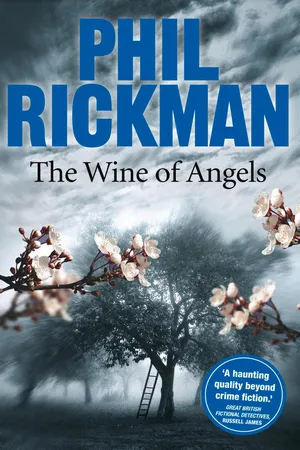
eBook - ePub
Wine of Angels, The
The first gripping novel in the bestselling series from the master of the supernatural thriller
- 4 pages
- English
- ePUB (mobile friendly)
- Available on iOS & Android
eBook - ePub
Wine of Angels, The
The first gripping novel in the bestselling series from the master of the supernatural thriller
About this book
Information
Subtopic
Crime & Mystery LiteratureIndex
LiteraturePart One
Can closed eyes even in the darkest night
See through their lids and be inform’d
with sight?
Thomas Traherne,
Poems of Felicity
Poems of Felicity
1
Third Floor
MERRILY HAD A recurring dream. She’d read somewhere that it was really quite a common dream, with obvious symbolism.
By recurring ... well, she’d have it maybe once every few months, or the gaps might be even longer nowadays.
There was a period, not long before Sean died, when it came almost nightly. Or even, in that intense and suffocating period, twice or three times the same night – she’d close her eyes and the dream would be waiting there like an empty train by a deserted platform. Sometimes it was merely puzzling, sometimes it seemed to open up exciting possibilities. Occasionally, it was very frightening and she awoke shredded with dread.
What happened ... she was in a house. Not always the same house, but it was her own house, and she’d lived there quite some time without realizing. Or sometimes she’d just forgotten, she’d gone on living there, possibly for years, without registering that the house had ... a third floor.
It was clear that she’d lived quite comfortably in this house, which was often bright and pleasant, and that she must have passed the extra staircase thousands of times, either unaware of it or because there was simply no reason to go up there.
In the dream, however, she had to go up. With varying amounts of anticipation or cold dread. Because something up there had made its presence known to her.
She’d nearly always awaken before she made it to the top of the stairs. Either disappointed or trembling with relief. Just occasionally, before her eyes opened, she would glimpse a gloomy, airless landing with a row of grey doors.
In reality, if you excluded flats, she had never lived in a three-storey house.
Now, however ...
‘Jesus,’ Merrily said. ‘We can’t live in this.’
‘Yes, I suppose it is big,’ Uncle Ted conceded. ‘Didn’t think about that. Never a problem for Alf Hayden. Six kids, endless grandchildren ...’
It was big, all right. Seventeenth century, timber-framed, black and white. Seven bedrooms. Absolutely bloody huge if there was just the two of you. Very quaint, but also unexpectedly, depressingly grotty; nothing seemed to have altered since about the 1950s.
‘Of course, it’s church policy these days to flog off these draughty old vicarages,’ Uncle Ted said. ‘Replace them with nice, modern boxes. Worth a lot of money, your old black and whites. Well ... not this one, at present, not in the state it’s in after thirty-odd years of Alf and Betty.’
There was quaint, Merrily thought, and there was horribly old-fashioned. Like the steel-grey four-bar electric fire blocking up the inglenook. Like a kitchen the size of a small abattoir with no real cupboards but endless open shelves and all the pipes coiled under the sink like a nest of cobras.
‘Besides,’ Ted said, ‘we haven’t got any nice, modern boxes to spare. Three applications for housing estates’ve been turned down in as many years. Not in keeping.’ He frowned. ‘Conservation’s a fine idea, but not when it turns a nice, old village into an enclave of the elite.’
In his habitual cardigan and slippers, Ted Clowes, two years retired, didn’t look at all like a lawyer any more. His face had gone ruddy, like a farmer’s, and his body had thickened. He looked as seasoned and solid as one of the oak pillars holding up the vicarage walls.
As senior church warden, Ted had made himself responsible for getting the vicarage into some kind of shape. Negotiating with builders and plumbers and decorators. But, well into April, the work had hardly begun; it looked as though Merrily was going to have to spend the first month of her ministry in a bed-and-breakfast.
She was relieved, in a way. A place this size – it was ridiculous. And an unoccupied third floor, full of dust and echoes.
She stood on the first-floor landing, miserably looking up. ‘All these staircases.’
‘Yeah,’ Jane said thoughtfully. ‘This puts a whole new perspective on the entire scenario.’
‘It does?’
Merrily watched warily as the kid took off up the stairs to the third storey. She’d been sulking, on and off, for three days. She’d quite enjoyed the two years in Birmingham while Merrily was at college, loved the time in Liverpool when Merrily was a curate. Big-city woman now. On the way here, she’d said that if Cheltenham was an old people’s home, rural Herefordshire looked like premature burial.
‘Yes.’ Jane paused halfway up, looking around.
‘You like this?’
‘At least we’ve cleared all those rooms now,’ Ted said. ‘Alf and Betty were generous enough to leave us a quarter of a century’s worth of junk. Yellowing newspapers with pictures of the first moon-landing.’
Jane had a forefinger placed pensively on her chin. ‘Far more rooms than you’d need, Mum, right?’
‘Mmm ... yes.’
‘Even for all your Bible classes and parish meetings and visiting evangelists from Nigeria.’
‘Ye ... es. Unless, of course, they’re travelling with their extended families.’
‘So this whole storey is, in effect, going spare.’
‘Conceivably.’
Her daughter was starting to operate like a slick barrister. (The barrister Merrily might have become had it not been for God’s unexpected little blessing. Would she still eventually have wound up in the Church if Jane hadn’t come along?)
‘Don’t look at me like that, Mum. All I’m saying is I could have a kind of group of rooms up here. Like a suite. Because ... because ... if you think about it, those back stairs come off a separate entrance ... a third door, right?’
Ted chuckled. He knew all about daughters.
‘Right,’ Merrily said. ‘And?’
‘So it would be kind of my own entrance. It would be ... in fact ... like my own flat.’
‘Oh. I see.’
The third door with its own illuminated bell and a card under perspex: Flat One. Ms Jane Watkins. She was fifteen.
‘And you’d pay the heating bills for this, er, suite, would you?’
‘Oh God.’ Jane glared down over the oak banister. ‘Here we go. Mrs bloody Negative.’
‘Or maybe you could sub-let a couple of rooms.’
Jane scowled and flounced off along the short passage. Oak floorboards creaked, a door rattled open. That empty sound.
‘Could be a double-bluff,’ Merrily said, her daughter pacing bare boards overhead, probably working out where to put her stereo speakers for optimum sound. ‘The picture she’s feeding me is that she’s going to be so bored here she’ll have to invite half the young farmers’ club over for wild parties. All these rural Romeos popping pills on the back stairs.’
Ted laughed. ‘Young farmers aren’t pill-popping yet. Well ... none that I know of. Pressure job, now, though. Diminishing returns, EC on your back, quotas for this, quotas for that, a hundred forms to fill in, mad cow disease. Suicide figures are already ... Sorry. Bad memories.’
‘What? Oh.’
‘I seem to remember saying, “If you want an informal picture of village life, why not pop along to this wassailing thing?” Not quite what I had in mind. Awfully sorry, Merrily.’
She looked through the landing window, down into a small, square rose garden, where the pink and orange of the soil seemed more exotic than the flowers. Over a hedge lay the churchyard with its cosy, sandstone graves.
Oddly, that awful, public death hadn’t given her a single nightmare. In her memory it was all too surreal. As though violent death had been an optional climax to the wassailing and, as the oldest shooter in the pack, Edgar Powell had felt obliged to take it.
‘You know, standing in that orchard, covered with that poor old bloke’s blood, that was when I decided to go for it. I clearly remember thinking that nothing so immediate and so utterly shocking ever happened quite that close to me in Liverpool. That maybe, in some ways, this village could actually be the sharp end. I thought, am I going to wash off his blood and walk away?’
‘It always affects you more in the country.’ Ted came to stand beside her at the window. ‘Everything that happens. Because you know everybody. Everybody. And you’ll find, as minister, that you’re regarded as more of a ... a key person. Births and deaths, you really have to be there. Even if nobody from the family’s been to a church service since the war.’
‘That’s fair enough. Far as I’m concerned, belonging to the Church doesn’t have to involve coming to services.’
‘And you’ll find that hills and meadows are far more claustrophobic than housing estates. You see somebody coming across a twelve-acre field towards you, you can’t dodge into a bus shelter.’
‘Fine.’
Ted raised a dubious eyebrow. ‘And everybody gossips,’ he said. ‘For instance, they’ll all tell you Edgar Powell’d been handling that shotgun since for ever.’
‘Making it suicide?’
‘What it looks like, but they haven’t got a motive. Money worries? No more than the average farmer. Isolation? Hardly – not living on the edge of the village. Depression? Hard to say. Perhaps he’d just had enough. Or perhaps he simply wanted to ruin the Cassidys’ olde English soirée. Been a spiteful old bugger in his time.’
‘You are kidding, aren’t you?’
‘Anyway, Garrod Powell’s insisting it was an accident. Came to consult me about it. He’ll be telling the coroner the old chap was simply going soft in the head. Can’t blame him. Who wants a family suicide? I suggested he have a word with young Asprey, get something medical. But it could even be an open verdict.’
‘What’s that mean exactly, Uncle Ted?’
Merrily turned to find Jane sitting on the top stair, elbows on knees, chin cupped in her hands.
‘Means they can’t be entirely sure what happened, Jane,’ Ted said.
‘Wish I’d been there.’
Merrily rolled her eyes. Having made a point of leaving Jane at her mother’s when she’d come to do her bit of undercover surveillance prior to applying – or not – for the post. The kid would’ve given them away in no time.
‘Do you get many suicides in the village?’ Jane asked.
‘Not with audience-participation,’ Ted said dryly.
Merrily was thinking, half-guiltily, how she’d scrubbed and scrubbed at her face that night and had to throw away the old fake Barbour.
They stayed the night at the Black Swan, sharing a room. On the third floor, as it happened, but it was different in a hotel. The Black Swan, like all the major buildings in Ledwardine – with the obvious exception of the vicarage – had been sensitively modernized; the room was ancient but luxurious.
Jane was asleep about thirty seconds after sliding into her bed. Jane could slip into untroubled sleep anywhere. She’d accepted her father’s death with an equanimity that was almost worrying. A blip. Sean had lived in the fast lane and that was precisely where he died. Bang. Gone.
Sadder about the girl in the car with him. She could have been Jane in a few years’ time. Or Merrily herself, ten years or so earlier.
Too many thoughts crowding in, Merrily upended the pillow behind her, leaned into it and lit the last cigarette of the day. Through the deep, oak-sunk window, the crooked, picture-book roofs of the village snuggled into a soft and woolly pale night sky.
Perfect. Too perfect, perhaps. If you actually lived here, with roses round the door, what was there left to dream of?
‘How are things financially, now?’ Ted had asked in the lounge bar, after dinner.
Jane had mooched off into the untypically warm April evening to check out the village. And the local totty, she’d added provocatively.
‘Oh’ – Merrily drank some lager – ‘we get by. Sean’s debts weren’t as awesome as we’d been led to believe. And a few of the debtors seem less eager to collect than they were at first. I think it was meeting me. In the dog collar. It was like ... you know ... dangling a sprig of garlic in front of Dracula. I’m glad I met them. I don...
Table of contents
- Cover
- Author biography
- Title page
- Copyright page
- Epigraph
- Contents
- PROLOGUE
- Twelfth Night
- Part One
- 1 Third Floor
- 2 Black-eyed Dog
- 3 Local History
- 4 Straight Shooter
- 5 Buds
- 6 Cold in the House of God
- 7 Dirty Video
- 8 The After-hours Social Club
- 9 A Night in Suicide Orchard
- 10 Mistress
- 11 Pious Cow
- 12 Sympathetic Magic
- Part Two
- 13 The Feudalist
- 14 Grown Women, or What?
- 15 Hazey Jane
- 16 Like Lace
- 17 Whiteout
- 18 The Little Green Orchard
- 19 The Nighthouse
- 20 Hysterical Women
- 21 Tears
- 22 I, Merrily ...
- 23 Black-eyed Dog II
- 24 Uh-oh ...
- 25 Carnival
- 26 The Mondrian Walls
- Part Three
- 27 High Flier
- 28 Our Kind of Record
- 29 Cogs
- 30 Affliction
- 31 Accessory
- 32 Bastard God
- 33 Superstitious Crap
- 34 Demarcation
- 35 The Little Golden Lights
- 36 Dancing Gates
- 37 Wil’s Play
- 38 Winding Sheet
- 39 Levels
- 40 Bad Year for Apples
- 41 Home Cooking
- 42 The North Side
- 43 Meant
- Part Four
- 44 Pink Moon
- 45 The Eternal Bull
- 46 Pretty Foul
- 47 False Lover
- 48 Thank You, Lord
- 49 Badger Baiting
- 50 Deep Offence
- 51 Vision
- 52 The Loft
- 53 Watching
- 54 Way to Blue
Trusted by 375,005 students
Access to over 1.5 million titles for a fair monthly price.
Study more efficiently using our study tools.
Frequently asked questions
Yes, you can cancel anytime from the Subscription tab in your account settings on the Perlego website. Your subscription will stay active until the end of your current billing period. Learn how to cancel your subscription
No, books cannot be downloaded as external files, such as PDFs, for use outside of Perlego. However, you can download books within the Perlego app for offline reading on mobile or tablet. Learn how to download books offline
We are an online textbook subscription service, where you can get access to an entire online library for less than the price of a single book per month. With over 1.5 million books across 990+ topics, we’ve got you covered! Learn about our mission
Look out for the read-aloud symbol on your next book to see if you can listen to it. The read-aloud tool reads text aloud for you, highlighting the text as it is being read. You can pause it, speed it up and slow it down. Learn more about Read Aloud
Yes! You can use the Perlego app on both iOS and Android devices to read anytime, anywhere — even offline. Perfect for commutes or when you’re on the go.
Please note we cannot support devices running on iOS 13 and Android 7 or earlier. Learn more about using the app
Please note we cannot support devices running on iOS 13 and Android 7 or earlier. Learn more about using the app
Yes, you can access Wine of Angels, The by Phil Rickman in PDF and/or ePUB format, as well as other popular books in Literature & Crime & Mystery Literature. We have over 1.5 million books available in our catalogue for you to explore.