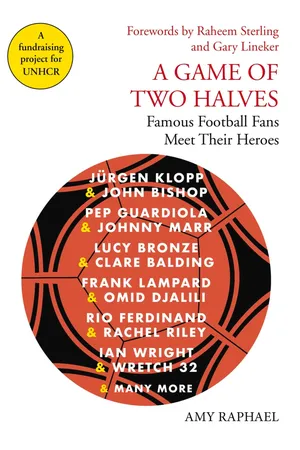
Ever wondered which goal Frank Lampard is proudest of, who Jürgen Klopp thinks will manage Liverpool in the future, what Rio Ferdinand thinks of Man United in the post-Ferguson years or exactly how many grey cashmere jumpers Pep Guardiola owns? In this collection of frank and funny conversations between footballers and their biggest fans, these vital questions (and many more) are finally addressed.
A Game of Two Halves shows a different side to some of the biggest names in football, reminding us of the common ground we all share. This project is published in partnership with UNHCR, the UN Refugee Agency, with the goal of raising both funds for and awareness of their work with child refugees.
Featuring forewords by
Raheem Sterling and
Gary Lineker and interviews between
Jürgen Klopp & John Bishop
Pep Guardiola & Johnny Marr
Lucy Bronze & Clare Balding
Frank Lampard & Omid Djalili
Rio Ferdinand & Rachel Riley
Ian Wright & Wretch 32
Héctor Bellerin & Romesh Ranganathan
Steven Gerrard & David Morrissey
Gary Lineker & Fahd Saleh
Eric Dier & David Lammy
John McGlynn & Val McDermid
Vivianne Miedema & Amy Raphael
- 281 pages
- English
- ePUB (mobile friendly)
- Available on iOS & Android
eBook - ePub
About this book
Information
Print ISBN
9781911630036

David: What was going through your head the first time you came onto the pitch as a first-team player?
Steven: When Phil Thompson shouted me down at the Kop end to come on for the last few minutes, it’s the one time as a footballer where I’ve been close to needing a nappy.
BT Sport, London, October 2017
David Morrissey was born in Liverpool in 1964. He joined the Everyman Theatre at sixteen and, two years later, was cast in the television series One Summer. He attended the Royal Academy of Dramatic Art and spent time both at the RSC and the National Theatre. He found global stardom playing the Governor in The Walking Dead, but in Britain he is rarely off our TV screens, starring in Red Riding, The 7.39, The Missing and Britannia. His acclaimed theatre work includes In A Dark Dark House, Hangman, Macbeth and Julius Caesar. In 2007, he was awarded an Honorary Fellowship for contributions to the performing arts at Liverpool John Moores University. He volunteers for several charities, including The Felix Project and The Bike Project. He is a Goodwill Ambassador for UNHCR.
Steven Gerrard was born in Liverpool in 1980. When he was eight, following a recommendation from his local football team manager, he was fast-tracked into Liverpool’s Centre of Excellence alongside players such as Michael Owen. At sixteen, Gerrard started a two-year training course at Melwood, Liverpool’s training ground. He made his first-team debut on 29 November 1998 against Blackburn Rovers.
Although the Premier League title eluded him, he went on to win two League Cups, two FA Cups, a European Super Cup, UEFA Cup and a UEFA Champions League Cup with Liverpool. Gerrard captained both Liverpool and England, scoring twelve goals in fifty-seven appearances for his country. Aft er playing for Liverpool between the ages of eight and thirty-five. he finished his career playing for LA Galaxy in the Major League Soccer. Gerrard completed his UEFA A Licence and took his first managerial role as Liverpool youth coach, before managing the Under-18s. In June 2018, Gerrard became manager of Rangers.

David Morrissey: Let’s start at the beginning: how old were you when you realized you were different from your mates?
Steven Gerrard: Probably around the age of thirteen; I knew then that I was going to be a professional footballer because I was offered a long contract by Liverpool. A two-year schoolboy contract, a two-year apprenticeship – called the YTS back in the day – and a three-year guaranteed contract after that. I didn’t know I was going to play for Liverpool’s first team back then, but it was the age I said to myself, ‘I must be half decent…’
David: You must have known you were decent when you were knocking a ball around with your mates in the playground?
Steven: I knew I was a level above. A bit different. That sounds big-headed, but I don’t know how else to put it. I just found it really easy. Sometimes I’d play with the ball on my own in the playground because playing with kids my own age wasn’t enough of a challenge.
David: What are you earliest memories of watching football?
Steven: I lived in a street called Ironside Road on the Bluebell Estate and there were always street parties when Liverpool played Everton in a cup final. In May 1986, when I was six years of age, there was a crazy street party for the FA Cup Final. It was probably the first full game I watched.
David: I remember those parties! Are you saying that you got into football for the party?
Steven: Well, that party was certainly an eye-opener! What’s this big occasion, why are we having a street party? I obviously knew my dad and my brother were Liverpool fans, but Everton scored in the first half. A Gary Lineker goal. At which point, I was thinking of being a blue. My mum’s brother was a blue too. It was touch and go if I was going to be a blue or a red. My mum’s side was more blues, my dad’s side was strictly reds. And then obviously the game was turned around on its head in the second half and it ended up being 3-1 to Liverpool. Rushy [Ian Rush] scored a couple and Craig Johnston scored one. At the end of that day, worn out from watching the Cup Final and having enjoyed the street party, I officially became a red.
David: I had a very similar thing with my son, who grew up in north London. The first big game we watched together was Arsenal v Liverpool in 2001. I really talked up Liverpool, determined to make him a red. But when Freddie Ljunberg scored for Arsenal in the seventy-second minute, my son was really torn. He looked so guilty. And then, of course, with just ten minutes of the game left, Michael Owen scored two and Liverpool won. That was it, my son was a Liverpool fan.
Steven: It’s mad how certain moments can decide who you support.
David: How would it have gone down at home if you’d have been a blue instead?
Steven: Not very well, because my older brother is a red as well.
David: I’m from a split family too. My older brother is a blue, as was my dad. My other brother and I are both reds. It’s always tricky.
Steven: To be honest, from the age of six I’ve had a very nice time being a red because Liverpool dominated the city during that period. I think I made the right decision.
David: You absolutely did. What are your memories of being at Liverpool once you’d signed on to their YTS?
Steven: Well, for one thing, we all earned the same: £47.50 a week. I was sixteen, I’d left school and for the first time I had money in my pocket.
David: How did signing on for Liverpool go down with your mates? Did your relationship have to change?
Steven: Slightly, yes. I came from a council estate where gangs of lads used to get up to things that I couldn’t get involved in. I suppose at times I was the boring one. I had to go home early. I was sent home on many occasions by my older brother if he saw me out after a certain time. Or if he saw me around, getting up to no good, I’d normally get a kick up the backside and get sent home. So I had the right people around, telling me what to do before I got involved in the wrong stuff.
David: I assume the club looked after you too, given that you were effectively an investment for them?
Steven: I wasn’t aware of it at the time. But later I spoke to my dad and Steve Heighway [former Liverpool player who became director of Liverpool Academy] about it and Steve was regularly on the phone, asking where I was and what I was up to. He told my dad to keep me off the streets and out of trouble.
David: Were there dietary restrictions too?
Steven: It wasn’t as strict as it is now. At fourteen, young players are now told exactly what to eat. And what not to eat. Whereas we were just told to keep an eye on the fast-food side of it.
David: I presume as a trainee you were expected to do some crappy jobs?
Steven: The jobs at Melwood – there was no Academy then – were organized via a monthly rota. For example, three or four lads were in charge of making sure all the floors were clean. Another three or four would be in charge of the medical department, making sure everything was tidy and the towels were clean. Others would be on laundry duty, cleaning first-team boots or sorting out balls, bibs and cones.
David: Was it pressurized or did you have a laugh?
Steven: There was pressure in the sense that you’d have Ronnie Moran, Sammy Lee and Phil Thompson barking down your ear, telling you that you’re a lazy F-U-C-K. You had to make sure you were on it. We laughed on the job when we were sorting the balls, bibs and cones because they were kept next to the staff toilets. Most of the staff were quite regular of a morning so it used to stink in there. It could be a long month. Big Joe Corrigan always seemed to have been to the toilet ten minutes before we had to start work.
David: How much did you interact with the first team, some of whom were your heroes?
Steven: All my heroes were in the next dressing room. We used to go and watch them on a Saturday. Jamie Redknapp. Robbie Fowler. Before that, when I was a schoolboy, it was the likes of John Barnes and Ian Rush.
David: How were they with you?
Steven: Brilliant. Just great fellas.
David: Very early on in my acting career, I worked at the Everyman Theatre in Liverpool. In the company at that time were actors like Jim Broadbent and the late Pete Postlethwaite. I used to go up to them and ask about acting and they were always great. Rather than telling me to get lost or smacking me around the head, they really encouraged me. I made sure I thanked them when I was older and established.
Steven: Yeah, it’s odd because I ended up sharing a dressing room with all these players. I went from cleaning their boots, putting their kit out for them and being intimidated around them to actually playing with them. It was a big learning curve, learning how you treat people younger than you, who are striving to make it.
David: When you are training with those players and watching them win, lose or draw at the weekend, how did it feel when you turned up at Melwood on a Monday morning?
Steven: There were these benches where all the young apprentices used to stand holding a couple of balls and a couple of shirts. Your responsibility as a trainee was to wait for every first-team player to walk past and make sure they signed the shirts and balls for local charities. If they’d lost at the weekend it was a long ten to fifteen minutes because you could just see by their faces…
David: Not just as a team, but individually?
Steven: Yeah, each of them was carrying the result from the weekend. Whereas, for the majority of us, as sixteen- or seventeen-year-olds, if you lost at the weekend you mostly got over it pretty quick. That’s where football changes. It becomes less enjoyabl...
Table of contents
- Cover
- Title
- Copyright
- Contents
- Refugees
- Foreword by Raheem Sterling
- Foreword by Gary Lineker
- Introduction by Amy Raphael
- 1 David Morrissey & Steven Gerrard
- 2 Romesh Ranganathan & Héctor Bellerín
- 3 Clare Balding & Lucy Bronze
- 4 Gary Lineker & Fahd Saleh
- 5 Johnny Marr & Pep Guardiola
- 6 John Bishop & Jürgen Klopp
- 7 Val McDermid & John McGlynn
- 8 Omid Djalili & Frank Lampard
- 9 Rachel Riley & Rio Ferdinand
- 10 Wretch 32 & Ian Wright
- 11 Amy Raphael & Vivianne Miedema
- 12 David Lammy & Eric Dier
- Acknowledgments
Trusted by 375,005 students
Access to over 1.5 million titles for a fair monthly price.
Study more efficiently using our study tools.