Selected to be read on Radio Four's Book of the Week.
'One of the best books I've read in the last five or ten years... Wild is angry, brave, sad, self-knowing, redemptive, raw, compelling, and brilliantly written, and I think it's destined to be loved by a lot of people, men and women, for a very long time.' --Nick Hornby
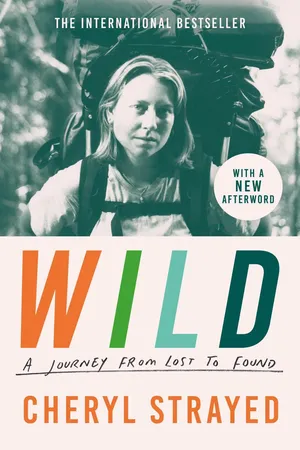
At twenty-six, Cheryl Strayed thought she had lost everything. In the wake of her mother's rapid death from cancer, her family disbanded and her marriage crumbled. With nothing to lose, she made the most impulsive decision of her life: to walk eleven-hundred miles of the west coast of America - from the Mojave Desert, through California and Oregon, and into Washington state - and to do it alone. She had no experience of long-distance hiking and the journey was nothing more than a line on a map. But it held a promise - a promise of piecing together a life that lay in ruins at her feet.
Strayed's account captures the agonies - both mental and physical - of her incredible journey; how it maddened and terrified her, and how, ultimately, it healed her. Wild is a brutal memoir of survival, grief and redemption: a searing portrayal of life at its lowest ebb and at its highest tide.
- English
- ePUB (mobile friendly)
- Available on iOS & Android
eBook - ePub
About this book
Information
Subtopic
Social Science BiographiesCONTENTS
Author’s Note
Map
Prologue
PART ONE. THE TEN THOUSAND THINGS
1 The Ten Thousand Things
2 Splitting
3 Hunching in a Remotely Upright Position
PART TWO. TRACKS
4 The Pacific Crest Trail, Volume 1: California
5 Tracks
6 A Bull in Both Directions
7 The Only Girl in the Woods
PART THREE. RANGE OF LIGHT
8 Corvidology
9 Staying Found
10 Range of Light
PART FOUR. WILD
11 The Lou Out of Lou
12 This Far
13 The Accumulation of Trees
14 Wild
PART FIVE. BOX OF RAIN
15 Box of Rain
16 Mazama
17 Into a Primal Gear
18 Queen of the PCT
19 The Dream of a Common Language
Acknowledgments
Books Burned on the PCT
AUTHOR’S NOTE
To write this book, I relied upon my personal journals, researched facts when I could, consulted with several of the people who appear in the book, and called upon my own memory of these events and this time of my life. I have changed the names of most but not all of the individuals in this book, and in some cases I also modified identifying details in order to preserve anonymity. There are no composite characters or events in this book. I occasionally omitted people and events, but only when that omission had no impact on either the veracity or the substance of the story.

WILD
PROLOGUE
The trees were tall, but I was taller, standing above them on a steep mountain slope in northern California. Moments before, I’d removed my hiking boots and the left one had fallen into those trees, first catapulting into the air when my enormous backpack toppled onto it, then skittering across the gravelly trail and flying over the edge. It bounced off of a rocky outcropping several feet beneath me before disappearing into the forest canopy below, impossible to retrieve. I let out a stunned gasp, though I’d been in the wilderness thirty-eight days and by then I’d come to know that anything could happen and that everything would. But that doesn’t mean I wasn’t shocked when it did.
My boot was gone. Actually gone.
I clutched its mate to my chest like a baby, though of course it was futile. What is one boot without the other boot? It is nothing. It is useless, an orphan forevermore, and I could take no mercy on it. It was a big lug of a thing, of genuine heft, a brown leather Raichle boot with a red lace and silver metal fasts. I lifted it high and threw it with all my might and watched it fall into the lush trees and out of my life.
I was alone. I was barefoot. I was twenty-six years old and an orphan too. An actual stray, a stranger had observed a couple of weeks before, when I’d told him my name and explained how very loose I was in the world. My father left my life when I was six. My mother died when I was twenty-two. In the wake of her death, my stepfather morphed from the person I considered my dad into a man I only occasionally recognized. My two siblings scattered in their grief, in spite of my efforts to hold us together, until I gave up and scattered as well.
In the years before I pitched my boot over the edge of that mountain, I’d been pitching myself over the edge too. I’d ranged and roamed and railed—from Minnesota to New York to Oregon and all across the West—until at last I found myself, bootless, in the summer of 1995, not so much loose in the world as bound to it.
It was a world I’d never been to and yet had known was there all along, one I’d staggered to in sorrow and confusion and fear and hope. A world I thought would both make me into the woman I knew I could become and turn me back into the girl I’d once been. A world that measured two feet wide and 2,663 miles long.
A world called the Pacific Crest Trail.
I’d first heard of it only seven months before, when I was living in Minneapolis, sad and desperate and on the brink of divorcing a man I still loved. I’d been standing in line at an outdoor store waiting to purchase a foldable shovel when I picked up a book called The Pacific Crest Trail, Volume 1: California from a nearby shelf and read the back cover. The PCT, it said, was a continuous wilderness trail that went from the Mexican border in California to just beyond the Canadian border along the crest of nine mountain ranges—the Laguna, San Jacinto, San Bernardino, San Gabriel, Liebre, Tehachapi, Sierra Nevada, Klamath, and Cascades. That distance was a thousand miles as the crow flies, but the trail was more than double that. Traversing the entire length of the states of California, Oregon, and Washington, the PCT passes through national parks and wilderness areas as well as federal, tribal, and privately held lands; through deserts and mountains and rain forests; across rivers and highways. I turned the book over and gazed at its front cover—a boulder-strewn lake surrounded by rocky crags against a blue sky—then placed it back on the shelf, paid for my shovel, and left.
But later I returned and bought the book. The Pacific Crest Trail wasn’t a world to me then. It was an idea, vague and outlandish, full of promise and mystery. Something bloomed inside me as I traced its jagged line with my finger on a map.
I would walk that line, I decided—or at least as much of it as I could in about a hundred days. I was living alone in a studio apartment in Minneapolis, separated from my husband, and working as a waitress, as low and mixed-up as I’d ever been in my life. Each day I felt as if I were looking up from the bottom of a deep well. But from that well, I set about becoming a solo wilderness trekker. And why not? I’d been so many things already. A loving wife and an adulteress. A beloved daughter who now spent holidays alone. An ambitious overachiever and aspiring writer who hopped from one meaningless job to the next while dabbling dangerously with drugs and sleeping with too many men. I was the granddaughter of a Pennsylvania coal miner, the daughter of a steelworker turned salesman. After my parents split up, I lived with my mother, brother, and sister in apartment complexes populated by single mothers and their kids. As a teen, I lived back-to-the-land style in the Minnesota northwoods in a house that didn’t have an indoor toilet, electricity, or running water. In spite of this, I’d become a high school cheerleader and homecoming queen, and then I went off to college and became a left-wing feminist campus radical.
But a woman who walks alone in the wilderness for eleven hundred miles? I’d never been anything like that before. I had nothing to lose by giving it a whirl.
It seemed like years ago now—as I stood barefoot on that mountain in California—in a different lifetime, really, when I’d made the arguably unreasonable decision to take a long walk alone on the PCT in order to save myself. When I believed that all the things I’d been before had prepared me for this journey. But nothing had or could. Each day on the trail was the only possible preparation for the one that followed. And sometimes even the day before didn’t prepare me for what would happen next.
Such as my boots sailing irretrievably off the side of a mountain.
The truth is, I was only half sorry to see them go. In the six weeks I’d spent in those boots, I’d trekked across deserts and snow, past trees and bushes and grasses and flowers of all shapes and sizes and colors, walked up and down mountains and over fields and glades and stretches of land I couldn’t possibly define, except to say that I had been there, passed over it, made it through. And all the while, those boots had blistered my feet and rubbed them raw; they’d caused my nails to blacken and detach themselves excruciatingly from four of my toes. I was done with those boots by the time I lost them and those boots were done with me, though it’s also true that I loved them. They had become not so much inanimate objects to me as extensions of who I was, as had just about everything else I carried that summer—my backpack, tent, sleeping bag, water purifier, ultralight stove, and the little orange whistle that I carried in lieu of a gun. They were the things I knew and could rely upon, the things that got me through.
I looked down at the trees below me, the tall tops of them waving gently in the hot breeze. They could keep my boots, I thought, gazing across the great green expanse. I’d chosen to rest in this place because of the view. It was late afternoon in mid-July, and I was miles from civilization in every direction, days away from the lonely post office where I’d collect my next resupply box. There was a chance someone would come hiking down the trail, but only rarely did that happen. Usually I went days without seeing another person. It didn’t matter whether someone came along anyway. I was in this alone.
I gazed at my bare and battered feet, with their smattering of remaining toenails. They were ghostly pale to the line a few inches above my ankles, where the wool socks I usually wore ended. My calves above them were muscled and golden and hairy, dusted with dirt and a constellation of bruises and scratches. I’d started walking in the Mojave Desert and I didn’t plan to stop until I touched my hand to a bridge that crosses the Columbia River at the Oregon-Washington border with the grandiose name the Bridge of the Gods.
I looked north, in its direction—the very thought of that bridge a beacon to me. I looked south, to where I’d been, to the wild land that had schooled and scorched me, and considered my options. There was only one, I knew. There was always only one.
To keep walking.
PART ONE
THE TEN THOUSAND THINGS
The breaking of so great a thing should make a greater crack.
WILLIAM SHAKESPEARE,
Antony and Cleopatra
1
THE TEN THOUSAND THINGS
My solo three-month hike on the Pacific Crest Trail had many beginnings. There was the first, flip decision to do it, followed by the second, more serious decision to actually do it, and then the long third beginning, composed of weeks of shopping and packing and preparing to do it. There was the quitting my job as a waitress and finalizing my divorce and selling almost everything I owned and saying goodbye to my friends and visiting my mother’s grave one last time. There was the driving across the country from Minneapolis to Portland, Oregon, and, a few days later, catching a flight to Los Angeles and a ride to the town of Mojave and another ride to the place where the PCT crossed a highway.
At which point, at long last, there was the actual doing it, quickly followed by the grim realization of what it meant to do it, followed by the decision to quit doing it because doing it was absurd and pointless and ridiculously difficult and far more than I expected doing it would be and I was profoundly unprepared to do it.
And then there was the real live truly doing it.
The staying and doing it, in spite of everything. In spite of the bears and the rattlesnakes and the scat of the mountain lions I never saw; the blisters and scabs and scrapes and lacerations. The exhaustion and the deprivation; the cold and the heat; the monotony and the pain; the thirst and the hunger; the glory and the ghosts that haunted me as I hiked eleven hundred miles from the Mojave Desert to the state of Washington by myself.
And finally, once I’d actually gone and done it, walked all those miles for all those days, there was the realization that what I’d thought was the beginning had not really been the beginning at all. That in truth my hike on the Pacific Crest Trail hadn’t begun when I made the snap decision to do it. It had begun before I even imagined it, precisely four years, seven months, and three days before, when I’d stood in a little room at the Mayo Clinic in Rochester, Minnesota, and learned that my mother was going to die.
I was wearing green. Green pants, green shirt, green bow in my hair. It was an outfit that my mother had sewn—she’d made clothes for me all of my life. Some of them were just what I dreamed of having, others less so. I wasn’t crazy about the green pantsuit, but I wore it anyway, as a penance, as an offering, as a talisman.
All that day of the green pantsuit, as I accompanied my mother and stepfather, Eddie, from floor to floor of the Mayo Clinic while my mother went from one test to another, a prayer marched through my head, though prayer is not the right word to describe that march. I wasn’t humble before God. I didn’t even believe in God. My prayer was not: Please, God, take mercy on us.
I was not going to ask for mercy. I didn’t need to. My mother was forty-five. She looked fine. For a good number of years she’d mostly been a vegetarian. She’d planted marigolds around her garden to keep bugs away instead of using pesticides. My siblings and I had been made to swallow raw cloves of garlic when we had colds. People like my mother did not get cancer. The tests at the Mayo Clinic would prove that, refuting what the doctors in Duluth had said. I was certain of this. Who were those doctors in Duluth anyway? What was Duluth? Duluth! Duluth was a freezing hick town where doctors who didn’t know what the hell they were talking about told forty-five-year-old vegetarian-ish, garlic-eating, natural-remedy-using nonsmokers that they had late-stage lung cancer, that’s what.
Fuck them.
That was my prayer: Fuckthemfuckthemfuckthem.
And yet, here was my mother at the Mayo Clinic getting worn out if she had to be on her feet for more than three minutes.
“You want a wheelchair?” Eddie asked her when we came upon a row of them in a long carpeted hall.
“She doesn’t need a wheelchair,” I said.
“Just for a minute,” said my mother, almost collapsing into one, her eyes meeting mine before Eddie wheeled her toward the elevator.
I followed behind, not allowing myself to think a thing. We were finally on our way up to see the last doctor. The real doctor, we kept calling him. The one who would gather everything that had been gathered about my mom and tell us what was true. As the elevator car lifted, my mother reached out to tug at my pants, rubbing the green cotton between her fingers proprietarily.
“Perfect,” she said.
I was twenty-two, the same age she was when she’d been pregnant with me. She was going to leave my life at the same moment that I came into hers, I thought. For some reason that sentence came fully formed into my head just then, temporarily blotting out the Fuck them prayer. I almost howled in agony. I almost choked to death on what I knew before I knew. I was going to live the rest of my life without my mother. I pushed the fact of it away with everything in me. I couldn’t let myself believe it then and there in that elevator and also go on breathing, so I let myself believe other things instead. Such as if a doctor told you that you were going to die soon, you’d be taken to a room with a gleaming wooden desk.
This was not so.
We were led into an examining room, where a nurse instructed my mother to remove her shirt and put on a cotton smock with strings that dangled at her sides. When my mother had done so, she climbed onto a padded table with white paper stretched over it. Each time she moved, the room was on fire with the paper ripping and crinkling beneath her. I could see her naked back, the small curve of flesh beneath her waist. She was not going to die. Her naked back seemed proof of that. I was staring at it when the real doctor came into the room and said my mother would be lucky if she lived a year. He explained that they would not attempt to cure her, that she was incurable. There was nothing that could have been done, he told us. Finding it so late was common, when it came to lung cancer.
“But she’s not a smoker,” I countered, as if I could talk him out of the diagnosis, as if cancer moved along reasonable, negotiable lines. “She only smoked when she was younger. She hasn’t had a cigarette for years.”
The doctor shook his head sadly and pressed on. He had a job to do. They could try to ease the pain in her back with radiation, he offered. Radiation might reduce the size of the tumors that were growing along the entire length of her spine.
I did not cry. I only breathed. Horribly. Intentionally. And then forgot to breathe. I’d fainted once—furious, age three, holding my breath because I didn’t want to get out of the bathtub, too young to remember it myself. What did you do? What did you do? I’d asked my mother all through my childhood, making her tell me the story again and again, amazed and delighted by my own impetuous will. She’d held out her hands and watched me turn blue, my mother had always told me. She’d waited me out until my head fell into her palms and I took a breath and came back to life.
Breathe.
“Can I ride my horse?” my mother asked the real doctor. She sat with her hands folded tightly together and her ankles hooked one to the other. Shackled to herself.
In reply, he took a pencil, stood it upright on the edge of the sink, and tapped it hard on the surface. “This is your spine after radiation,” he said. “One jolt and your bones could crumble like a dry cracker.”
We went to the women’s restroom. Each of us locked in separate stalls, weeping. We didn’t exchange a word. Not because we felt so alone in our grief, but because we were...
Table of contents
- Cover
- Title
- Copyright
- Author’s Note
- Map
- Prologue
- Part One – The Ten Thousand Things
- Part Two – Tracks
- Part Three – Range of Light
- Part Four – Wild
- Part Five – Box of Rain
- Afterword
- Acknowledgments
- Books Burned on the PCT
- Note on the Author
Trusted by 375,005 students
Access to over 1.5 million titles for a fair monthly price.
Study more efficiently using our study tools.
Frequently asked questions
Yes, you can cancel anytime from the Subscription tab in your account settings on the Perlego website. Your subscription will stay active until the end of your current billing period. Learn how to cancel your subscription
No, books cannot be downloaded as external files, such as PDFs, for use outside of Perlego. However, you can download books within the Perlego app for offline reading on mobile or tablet. Learn how to download books offline
Perlego offers two plans: Essential and Complete
- Essential is ideal for learners and professionals who enjoy exploring a wide range of subjects. Access the Essential Library with 800,000+ trusted titles and best-sellers across business, personal growth, and the humanities. Includes unlimited reading time and Standard Read Aloud voice.
- Complete: Perfect for advanced learners and researchers needing full, unrestricted access. Unlock 1.5M+ books across hundreds of subjects, including academic and specialized titles. The Complete Plan also includes advanced features like Premium Read Aloud and Research Assistant.
We are an online textbook subscription service, where you can get access to an entire online library for less than the price of a single book per month. With over 1.5 million books across 990+ topics, we’ve got you covered! Learn about our mission
Look out for the read-aloud symbol on your next book to see if you can listen to it. The read-aloud tool reads text aloud for you, highlighting the text as it is being read. You can pause it, speed it up and slow it down. Learn more about Read Aloud
Yes! You can use the Perlego app on both iOS and Android devices to read anytime, anywhere — even offline. Perfect for commutes or when you’re on the go.
Please note we cannot support devices running on iOS 13 and Android 7 or earlier. Learn more about using the app
Please note we cannot support devices running on iOS 13 and Android 7 or earlier. Learn more about using the app
Yes, you can access Wild by Cheryl Strayed in PDF and/or ePUB format. We have over 1.5 million books available in our catalogue for you to explore.