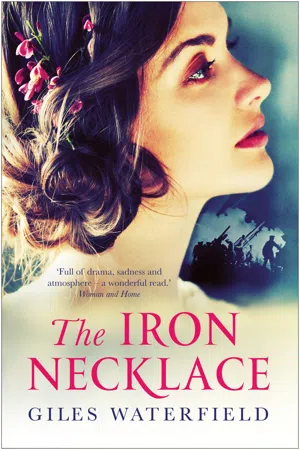
The wedding of Thomas, an idealistic German architect, and Irene, an English artist, brings together the Curtius and Benson families. But their new lives are soon shattered by the outbreak of war in Europe.
While Irene struggles to survive in a country where she is the enemy, her sister Sophia faces the war as a nurse on the Western Front. For their brother Mark, diplomatic service sees him moving between London, Washington and Copenhagen, all the while struggling to confront his own identity.
Against a backdrop of war and its aftermath relationships are tested, sacrifices are made and Irene and her siblings strive to find their place in an evolving world.
- English
- ePUB (mobile friendly)
- Available on iOS & Android
eBook - ePub
The Iron Necklace
About this book
Information
1
The afternoon was idyllic, the warmth tempered by the faintest breeze, with only the tiniest clouds scudding through the sky. London was looking as handsome as it could. On the way to the church the wedding guests glimpsed the park, the riders in Rotten Row, the great houses on Park Lane, and every window box in Wilton Row was crammed with flowers: the whole city seemed to be celebrating the happy occasion.
As the guests filled the church, you could hardly imagine a mere two families could have so many friends, but the ushers were well prepared. English on the left, Germans on the right. Like two armies. That was the principle, but there were so many more English that after a while the ushers put the bride’s friends on the bridegroom’s side. ‘Let’s invade Germany,’ the English ushers muttered to one another, amused.
They were the nicest sort of Germans, you could see that at once. Watching the groom’s family arriving, the congregation agreed that you’d hardly know they weren’t English. Their clothes were almost exactly right: the men’s tail coats fitted immaculately, the women’s clothes were all they should be, the bridegroom’s mother had chosen the ideal hat for a woman of her years, dark blue with a discreet display of ostrich feathers that suited her serene features and her fine black hair. It was evidently a large family, led by the short and undeniably stout but amiable-looking father and this dignified mother. There were at least two brothers and several sisters, and men who must be brothers-in-law. The German ushers had beautiful manners, and spoke excellent English. Only their hair showed they were not English; it was cut unusually, in a straight wave over the head, with precisely delineated edges.
The groom was most presentable, tall and fair. The best man had to be one of his brothers, a slightly shorter, cheerful-looking version of him. They chatted easily to one another. Their morning coats were impeccable and must have been made in London. The bridegroom had apparently spent years in England studying architecture, it was not surprising he understood English ways. Irene Benson could hardly have done better, that was the consensus. It was said the groom’s father occupied a position at the Kaiser’s court, his mother came from a landed family. How could one believe the stories about war with Germany when one saw such a family?
‘They’re so like us,’ they murmured in the pews.
‘And look at our own royal family. . .’
‘And our beautiful new Queen Mary, such a fine young woman, and as German as can be.’
On the other side of the aisle sat the Bensons. Mrs Benson – small and slender, her face recalling youthful prettiness, her hair richly auburn – was extravagantly dressed. Her green hat was assertive, its ostrich feathers sweeping dashingly upwards so that when she moved, the upper extremities shook. Her dark green costume opened to reveal a handsomely embroidered blouse secured at the neck with a bronze-coloured neckband.
There was much whispering about her clothes.
‘She does look fine, doesn’t she? What a beautiful dress, most fashionable. Do you think she found it in Woollands? Or could she have gone to Paris, to Worth, even?’
‘It’s quite possible. They live very comfortably, you know. They say he is doing very well at the Bar. . .’
‘Yes, you’re always seeing his name in the papers – big cases. . .’
Mrs Benson gazed ahead, suppressing tears that were not due until later. Her son, a slight-looking young man, came to sit beside her, and there were some aunts and uncles and cousins. Clustered together was a group of young people who must be Irene’s artistic friends, the women in ill-fitting sludge-coloured dresses with fussy embroidery, and soft velvet hats, who surprised the congregation’s wandering gaze.
‘What odd-looking people. Who can they be?’
‘She was at the Slade, you know. She must have met them there.’
‘Look at that long hair, some of the men have hair on their shoulders. Artists, yes, I suppose they must be.’
‘Not even wearing morning dress. It’s too bad.’
‘I’ve heard she refused to be presented at court.’
‘Well, at least she agreed to a proper wedding.’
Everyone was set to enjoy the occasion. Why, complete strangers spoke to their neighbours in the pews, so friendly was the atmosphere.
The church was full. Even in St Paul’s Knightsbridge with its hundreds of seats there was hardly a spare place. The building trembled with polite rustling, waving of hands, craning of necks, whispering to spouses. The people in the galleries – the Bensons’ long-serving maids, clerks from his chambers, that sort of person – stared downwards. The guests below never looked up.
Ten minutes late, there was a bustle at the west entrance. The whispering gave way to an eager hush, the organ burst into a matrimonial march. The west doors were thrown open to admit Mr William Benson, with his daughter on his arm. His saturnine face was as composed as though he were entering a law court – appropriately for a King’s Counsel. But at the sight of the silks and muslins and feathers of the ladies spreading among the black morning coats like wild flowers across a ploughed field, the faces in the galleries merging into a single eager countenance, the white lilies in long silver vases, the sunlight transmuted into patterns of blue and pink and striking the face of groom and best man, his features softened. Though many could not see Irene’s face, they could all admire her tall slender figure in white satin stitched with pearls, and the lace cascading from the chaplet of flowers. She was followed by two little girls and a taller girl, all in gold dresses, and two small pages, their soft complexions adorned with drops of sweat, like little jewels.
Thomas Curtius turned and looked down the aisle. He looked concerned; it was a serious moment. The bride, encumbered by the drooping richness of satin, was a long while walking up the aisle. She moved proudly, upright and elegant. When she reached the front of the church she turned towards her family and gave the tiniest wave. Finally she reached the bridegroom. Then she threw back her veil in a bold, careless gesture, the lace tumbling round her, reached her hand towards him, smiled. Who would not be happy to receive such a smile, so frank, trusting, loving? Silently but powerfully, the congregation expressed its approval. They were a beautiful couple. They were clearly destined for happiness.
At St Paul’s they celebrated weddings almost every week, and the machinery was faultless. The vicar – handsome, urbane, silver-haired, as much at home in a drawing room as at an altar – assumed the air of kindly dignity, subtly modulated to fit the couple’s social status, that he had refined over several hundred ceremonies. The choirboys, hair smoothed, faces shining, rapidly inspected bride and bridesmaids before languidly surveying the congregation. They sang with melting beauty. The best man produced the ring at precisely the right moment. The couple’s responses were clear and confident. It was a perfect wedding. Except for the bird.
The bird was only a little bird – a swift, could it be? – but a noticeable one. People became aware of a faint fluttering that turned out to be beating wings. During the exchange of vows, a dark shape flew towards the middle of the church, and for a moment hung in the air. People involuntarily followed its progress round the church. The vicar, while smoothly intoning ‘. . . let no man put asunder. . .’, thought, I told Sturgess not to leave the gallery window open, it really is maddening. Then the bird halted, somewhere. It had not gone. As the organ burst into the ‘Wedding March’, it re-emerged and flew towards the chancel, landed on the altar rail to the amusement of the choristers, set out on another flight, its wings beating hard, narrowly avoided the altar, aimed for the east window. As though seeking escape, it flew against the glass, once, and then again, and then once more.
As the bridal pair reached the west door, the bird fell heavily into a mysterious space behind the altar, and did not reappear.
2
‘Pandora, darling, I asked you to tea for a reason. I wanted to show you the Golden Boxes. I think we should look at them together.’
‘Ah, the famous Golden Boxes. I thought you’d seen them all, with Granny.’
‘Only some of them. The history of her life was contained in those boxes, but she thought it best to forget. . .’ Dorothea sighs. ‘Have you had enough tea? And enough lemon cake? You must take it away with you, I know the young never have enough to eat. . .’ She pats the sofa beside her.
‘Someone might want to write her biography, I suppose. Could they do that from these boxes?’
‘Oh I hope not, at least not while I’m around, it would be too hurtful. Still, let’s look at the first box. Mother loved to keep things. . . Will you draw the curtains and turn on that light? And come and sit beside me.’ She peers at the fire. ‘That is, if you are interested.’ Reaching down, Dorothea pulls a piece of silk off a large box. ‘Well, here it is. The first of the Golden Boxes.’ She dusts it vaguely.
‘Does it need dusting, Ma? You’re always dusting. . .’ And Pandora laughs.
‘Oh that’s my métier. No, it doesn’t need dusting, you’re right. The studio was as clean as could possibly be. This box, it’s nearly all photograph albums.’ She pulls out a large leather-bound album. ‘This is Mother’s first album. Nicely labelled, you see, 1910. Mother was always precise about such things, she liked to keep her life in order.’
3
Nobody at the wedding reception seemed to read anything into the bird.
His parents had rented a house in Belgrave Square for the reception. They seemed mildly ill at ease in this pretend home, with its white and gold hall and its handsome staircase leading to the drawing rooms. But Mark, who at Cambridge had acquired a taste for uncomfortable grandeur, enjoyed the rooms and wondered if he would ever inhabit such a place himself.
The two families had hurried there for the photographs. There were pictures of the bride and groom on their own, with parents, with attendants, with their entire families. They took a long time to set up, particularly the last picture, which showed all thirty of them, arranged according to etiquette and height. Sophia made a fuss about being photographed, said she looked ugly and fat.
Keen to study the arriving guests, Mark had earmarked a vantage point halfway up the stairs. He loved to be an observer. Up the stairs the guests progressed, chattering like macaws. He supposed that, as a diplomat, he’d attend events like this all the time. He was excited by the idea of the Diplomatic Service. When Sir Ernest had taken him to lunch at the Travellers’ Club, it was flattering to be told he seemed wholly suitable. Sir Ernest could drop a word. ‘They still listen to me. I have a brief to look out for the right kind of fellow. . . You seem ideal: intelligent, a good First, you say; good background, character. No vicious tastes, I imagine?’ They laughed.
His little sister squeezed her way down the stairs, as though in search of something. This turned out to be him. ‘Do come out from there. It’s too unreasonable of you to hide. I’m having to work ever so hard and you’re a grown-up, you should be helping. Do come, Mark.’ He waved her away.
He had no friends of his own here. Of course, when he was married, he’d invite friends by the hundred. Not that he had hundreds of friends yet, but he planned to. If he could participate in the Season, he’d meet people like those glowingly confident young men one met from Trinity and King’s. These guests were not the sort of people he had in mind: lawyers and their wives, figures from the City, dons, one or two celebrated authors and several who scraped a living writing initialled reviews in John O’London’s Weekly, clever women who wrote pamphlets on the poor. And of course his mother’s new smart friends like Lady Belfield, about whom she was perpetually talking, though he wasn’t convinced they were as smart as she supposed.
In the reception line, Thomas was friendly and brisk. Irene spoke at length to the guests, particularly her artistic set. The Berlin contingent were easily recognisable, with their cultivated faces, different from the mild, untidy Saxons among whom Mark had lived last year. He’d been intrigued by Paul, one of Thomas’s brothers, whom he’d met the evening before. Paul was his own age, a student at Heidelberg. He had apparently mastered not only classical and German philosophy and literature, but English philosophy, literature and history as well.
Edward Jenkinson came up the stairs, talking to a dark, striking-looking girl Mark did not recognise. Edward, or Teddy, it was not clear which, was a new phenomenon in their family life. He seemed cheerful: clearly he liked a party. He waved jovially. ‘Hello there, not joining in?’
Mark could see his mother gesturing at him. She liked him to be seen, since, as she often told him, he ought to be less shy; he was special, people would enjoy meeting him. It really was time to emerge, into the friendly company of Uncle George and Aunt Lavinia and their children. They were a lively, good-humoured family; their optimism always encouraged him.
The reception was engulfed in vivacious noise. The hospitality was lavish. There was champagne, champagne, champagne, and Mosel provided by Thomas’s family, and vast quantities of little sandwiches and cakes from Searcy’s. By the time they were ready for speeches everyone was a little tipsy, glowing in the balmy afternoon, the long windows having been opened onto the deep balcony and the plane trees in the square.
Everyone enjoyed the speeches. Mr Benson was characteristically dry. He said he would miss his daughter but at last he’d be able to finish the book he’d been working on for ten years as his younger children were less demanding. He welcomed so many friends from abroad. He thanked his wife, his constant helpmeet. She laughed and cried at the same time.
Friedrich, the best man, apologised for his bad English – ‘I want to make better my English,’ he stated, ‘but not with an audience of five hundred people!’ He laughed at his own jokes, it was hard to resist. He said, in capturing Irene Benson, his brother had won Germany’s finest victory since Waterloo – ‘though the fighting was hardly less violent, and when finally my brother wins the battle, we are all thinking, will he ever win such a battle again? But Thomas adores England – do you know about this? When he is young, he comes to London to study the architecture – always the architecture, ...
Table of contents
- COVER PAGE
- ABOUT THE AUTHOR
- TITLE PAGE
- COPYRIGHT PAGE
- CONTENTS
- PART ONE
- PART TWO
- PART THREE
- PART FOUR
- ACKNOWLEDGEMENTS
Trusted by 375,005 students
Access to over 1.5 million titles for a fair monthly price.
Study more efficiently using our study tools.
Frequently asked questions
Yes, you can cancel anytime from the Subscription tab in your account settings on the Perlego website. Your subscription will stay active until the end of your current billing period. Learn how to cancel your subscription
No, books cannot be downloaded as external files, such as PDFs, for use outside of Perlego. However, you can download books within the Perlego app for offline reading on mobile or tablet. Learn how to download books offline
Perlego offers two plans: Essential and Complete
- Essential is ideal for learners and professionals who enjoy exploring a wide range of subjects. Access the Essential Library with 800,000+ trusted titles and best-sellers across business, personal growth, and the humanities. Includes unlimited reading time and Standard Read Aloud voice.
- Complete: Perfect for advanced learners and researchers needing full, unrestricted access. Unlock 1.5M+ books across hundreds of subjects, including academic and specialized titles. The Complete Plan also includes advanced features like Premium Read Aloud and Research Assistant.
We are an online textbook subscription service, where you can get access to an entire online library for less than the price of a single book per month. With over 1.5 million books across 990+ topics, we’ve got you covered! Learn about our mission
Look out for the read-aloud symbol on your next book to see if you can listen to it. The read-aloud tool reads text aloud for you, highlighting the text as it is being read. You can pause it, speed it up and slow it down. Learn more about Read Aloud
Yes! You can use the Perlego app on both iOS and Android devices to read anytime, anywhere — even offline. Perfect for commutes or when you’re on the go.
Please note we cannot support devices running on iOS 13 and Android 7 or earlier. Learn more about using the app
Please note we cannot support devices running on iOS 13 and Android 7 or earlier. Learn more about using the app
Yes, you can access The Iron Necklace by Giles Waterfield in PDF and/or ePUB format, as well as other popular books in Literature & Literature General. We have over 1.5 million books available in our catalogue for you to explore.