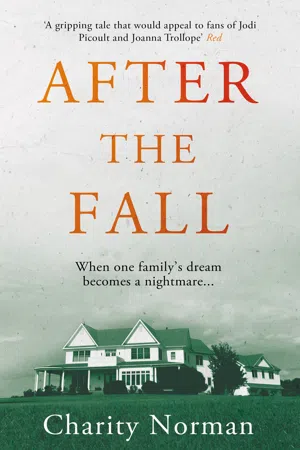
In the quiet of a New Zealand winter's night, a rescue helicopter is sent to airlift a five-year-old boy with severe internal injuries. He's fallen from the upstairs veranda of an isolated farmhouse, and his condition is critical. At first, Finn's fall looks like a horrible accident; after all, he's prone to sleepwalking. Only his frantic mother, Martha McNamara, knows how it happened. And she isn't telling. Not yet. Maybe not ever.
Tragedy isn't what the McNamara family expected when they moved to New Zealand. For Martha, it was an escape. For her artist husband Kit, it was a dream. For their small twin boys, it was an adventure. For sixteen-year-old Sacha, it was the start of a nightmare.
They end up on the isolated east coast of the North Island, seemingly in the middle of a New Zealand tourism campaign. But their peaceful idyll is soon shattered as the choices Sacha makes lead the family down a path which threatens to destroy them all.
Martha finds herself facing a series of impossible decisions, each with devastating consequences for her family.
eBook - ePub
After the Fall
About this book
Information
Print ISBN
9781743314890
Subtopic
Women in FictionThirty-two
Kit was on his way to Dublin.
Our place was chaos in the week before he left. We’d never have managed without Pamela. She telephoned the airline and found out exactly how to transport the canvases he was taking with him. With her help they were meticulously wrapped, covered in Fragile stickers and stowed in the car for their journey to Auckland airport. Kit had booked the cheapest flights possible because our budget didn’t run to luxury; of course, this meant multiple stopovers. There were a thousand technical problems to solve in transporting the paintings, but he thrived on every one. He was alight, alert, incandescent with excitement. It was like living with a sparkler.
On his last evening, I’d shut the office door at Capeview with a sigh of pleasure. I’d booked a stretch of leave and was feeling demob happy. It was dark when I arrived home. The Colberts’ blue pick-up was parked under the tree. I heard quiet voices from beyond the woolshed, then a plaintive, feeble snickering.
Rounding the corner I came upon a scene straight out of a children’s storybook: in a makeshift pen a paraffin lamp rested on the ground, casting a yellow pool of light. Finn was kneeling in the straw, his back very straight. Charlie was jammed up against his brother while Kit and Jean leaned on a fence nearby. Resting on tiny knees and sucking on a bottle in Finn’s hands was the smallest lamb I have ever seen. I made an amazed face at Kit as I tiptoed closer. The tiny creature sucked, bleated, butted Finn and sucked again. I could hear slurping and bubbling as the milk left the bottle.
Jean’s eyebrows arched in comical kindness. ‘I hope you don’t mind, Martha. A baby girl for your menagerie.’
I looked at the lamb, whose tail was wagging ecstatically. ‘No mother?’
‘Died,’ declared Finn knowledgeably, as though he’d lived seventy years on a farm. ‘They do sometimes, y’know. It happens.’
‘She’s Bleater,’ said Charlie. ‘Bleater Brown. Is it my turn yet, Jean?’
Jean gave a theatrical start. ‘Oh yes, I forgot. Master Charlie’s turn.’
Finn handed the bottle to Charlie, but the milk was almost gone and Bleater was soon enthusiastically sucking at an empty bottle.
‘Here,’ murmured Jean. ‘You sit like this, young fellow. Stick your legs out in front. That’s it.’ He gathered the animal in his arms and laid her in Charlie’s lap where she lay still, eyes drooping.
‘She’s a day old,’ whispered Charlie. ‘Come and touch her, Mummy.’
I crouched beside him and fingered the warm, springy topknot. The lamb smelled of milk and lanolin. ‘She’s falling asleep,’ I said. ‘Little motherless baby. Can we eat her with mint sauce?’
‘Not funny,’ scolded Finn, kicking me quite angrily. It hurt, but I didn’t complain. I probably deserved it.
‘We have to feed her every four hours,’ said Kit.
‘We? I suppose you mean the royal we, Kit McNamara, since you’re on a nice restful plane to Dublin tomorrow.’
‘No need to feed her at night.’ Jean picked up the empty bottle. ‘One at your bedtime and another first thing is fine. When she’s much older, she will have lambs of her own and the boys will sell them and be very rich.’
‘Sell them where?’ I asked, which was a silly question.
‘Well, let’s cross that bridge when we come to it, shall we?’ suggested Jean. The adults began to wander inside, leaving two boys and their baby in a huddle. ‘Farming is red in tooth and claw, Martha. Lambs are generally bound for the meatworks. Perhaps the male offspring could rejoin my flock and then . . . well, quietly disappear.’
As we rounded the corner of the shed, a wind came galloping to meet us. Jean glanced up at the sky. ‘Blowing up there, see?’ he said, pointing at clouds spread thin like butter on toast. ‘Better get your washing off the line tonight, or it will fly to Auckland with Kit.’
‘You’ll stay for a beer, to wish him bon voyage?’
‘I should be honoured.’ Our neighbour stepped out of his gumboots, and we followed him into the kitchen.
‘I’m ready for Dublin,’ said Kit. ‘So I can have a drink, at last.’
Jean looked around hopefully. ‘Sacha not home yet?’
I was looking in the fridge for three bottles of beer—it seemed an agricultural sort of occasion, calling for something a trifle earthier than sauvignon. ‘In her room, I should think,’ I replied absently. ‘She generally works up there after school. Tui or Steinlager?’
‘Oh—I forgot to tell you. Sacha phoned,’ said Kit. ‘She’s got an audition for High School Musical. Said she’d catch a lift and be home by seven.’
I stared at him. ‘She phoned? When?’
‘It’s fine.’ Kit took a step closer, eyes covertly swivelling in Jean’s direction. ‘It’s fine, Martha. She’ll be almost home by now. She’s going to text you when she gets near, and I’ll meet her at the road gate.’
Jean was busily opening beer bottles, but he’d caught the tension. There was a bird-bright glance from under those clown’s eyebrows.
Kit began to explain that he’d been on the wagon. ‘I promised Martha,’ he said, smiling at me. ‘But I’m looking forward to this one! Cheers.’
I found my gaze straying to the clock. Six fifty. It was all right. Sacha would be home soon. Perhaps she’d got a part in the school play—now, that would be fantastic. I imagined her face at the window of a car: smooth, soft cheeks and long lashes. She’d be holding her phone in one hand, waiting for a signal so that she could text us: 5 mins away.
The boys burst in, screaming with laughter, and shot upstairs. I followed, ran the bath and bribed them into it with snorkels and masks. As I trotted back to the kitchen I could hear splashing and squeaking as they slid around on the porcelain.
No sign of Sacha. I sent a text: where are you?
Jean was talking about the South Island. He and Pamela were about to take William for a skiing holiday in Queenstown. ‘Just hope I don’t break my neck! It’s been a few years and now—well, there is more of me to fall.’ He patted his paunch.
Five past seven. I sent another text: ????? Then I called her.
Hi, this is Sacha, don’t bother to leave a message.
‘They’ve had a ton of snow down there, haven’t they?’ Kit opened a packet of crisps and poured them into a bowl. ‘All the newborn lambs are dying.’
They were off, then—the weather, the high dollar, commodity prices. And all the while a stone of dread sank down, down, out of my chest and into my bowels. I couldn’t concentrate, couldn’t think. I could only dread.
‘Isn’t it, Martha?’ said Kit.
‘Mm?’ I forced a weak smile. ‘Sorry, blonde moment. Didn’t catch that.’
‘Too expensive for us all to go back to the UK for a holiday,’ Kit enunciated the words with exaggerated slowness, as though I was a deaf centenarian. ‘Maybe a hearing aid would help, old girl.’
Pulling myself together, I flicked him on the ear. ‘Don’t be bloody cheeky. You’re the one with the grey hair.’
‘One!’ Kit held up a single finger. ‘One grey hair doth not a dodderer make!’
This inspired Jean to embark on a story about how his grandfather, a watchmaker in Rouen, had his head shaved after a drunken bet. In his animation, Jean’s eyebrows virtually climbed on top of his head, as though he’d pushed them up like a pair of sunglasses. It was a good story, but the clock was ticking.
‘His wife’s eyes flew open—my grandmother Agnes was a terrifying female, like a charging rhinoceros—and she looked across at him on the pillow.’ Jean made a wrathful rhino face. ‘ “Henri! What has happened to your head?”’
‘You think your grandmother was a holy terror,’ chuckled Kit, opening another couple of beers. ‘It was my Great-Aunt Sibella taught me to play the piano. If I made a mistake she’d drop the lid on my fingers.’
The laughter and companionship seemed far away. Kit and Jean had receded into the background, like a telly with the sound turned down. The only reality was that Sacha had gone off the radar. Mum was banging a saucepan lid, chanting, Late. She’s late. She’s late . . . Wedgwood teapot, bracelet, flu . . .
‘Kit,’ I said loudly, breaking into their revelry. ‘Look at the time.’
He took a glance at the clock—seven thirty—and stiffened. ‘Have you tried her mobile?’
I was calling her phone for the tenth time when Sacha flung herself into the house, breathing hard.
‘Whew,’ she panted cheerfully, sliding her schoolbag off her back. ‘Helluva wind! I’ve run all the way from the road gate. Oh hello, Jean! Salut! Ça va?’
Jean was replying with a cordial bow when I interrupted. ‘You were going to text us,’ I said. ‘It doesn’t take a moment to—’
‘Well I didn’t need to text you, did I, because I didn’t want collecting from the gate.’ Sacha spoke over me in a high, sarcastic voice, waggling her head like a puppet. ‘I thought I’d very kindly save you the trouble. And anyway there’s no signal and anyway I forgot and anyway I don’t really think it’s reasonable for you to keep tabs on me every minute of my frigging life. Do you?’
Before I could respond, before I’d even understood the question, she was off again. ‘I mean, why not put a trace on me, and you and Kit can sit in an operations room and watch a screen and I’ll go beep beep beep and you’ll see this little coloured dot moving around.’ She dug her hand into the crisps, talking at the speed of a bullet train. ‘Look, there’s Sacha heading for the science block, ooh dear, she’s a minute late . . . there’s Sacha going into the toilets . . . she can wipe her own bottom, thank heavens for that . . . she’s getting a tampon out of the machine . . . oh, look! There’s Sacha—’
‘Stop! Please,’ I begged, with a meaningful glance at Jean, who’d been watching this exchange, his forehead corrugated in concern and embarrassment. I leaned close and breathed in her ear, ‘Have you taken something? ’
She slipped her arm around Jean’s shoulders. The gesture was overly familiar. ‘Jean doesn’t mind. He’s seen family fallouts before, haven’t you, Jean?’
‘I’d better go,’ mumbled our poor neighbour, extricating himself from under her elbow.
‘You’ve just ruined half an hour of your mother’s life,’ said Kit softly. ‘It’s time to apologise.’
She shrugged and stuffed a handful of crisps messily into her mouth. ‘That’s her problem,’ she said, spitting bits. ‘Nosey bitch. I never asked her to—’
Kit was on his feet, his jaw tight. ‘I think you’d better go...
Table of contents
- COVER PAGE
- TITLE PAGE
- COPYRIGHT PAGE
- DEDICATION
- CONTENTS
- ONE
- TWO
- THREE
- FOUR
- FIVE
- SIX
- SEVEN
- EIGHT
- NINE
- TEN
- ELEVEN
- TWELVE
- THIRTEEN
- FOURTEEN
- FIFTEEN
- SIXTEEN
- SEVENTEEN
- EIGHTEEN
- NINETEEN
- TWENTY
- TWENTY-ONE
- TWENTY-TWO
- TWENTY-THREE
- TWENTY-FOUR
- TWENTY-FIVE
- TWENTY-SIX
- TWENTY-SEVEN
- TWENTY-EIGHT
- TWENTY-NINE
- THIRTY
- THIRTY-ONE
- THIRTY-TWO
- THIRTY-THREE
- THIRTY-FOUR
- THIRTY-FIVE
- THIRTY-SIX
- THIRTY-SEVEN
- THIRTY-EIGHT
- THIRTY-NINE
- FORTY
- FORTY-ONE
- FORTY-TWO
Trusted by 375,005 students
Access to over 1.5 million titles for a fair monthly price.
Study more efficiently using our study tools.
Frequently asked questions
Yes, you can cancel anytime from the Subscription tab in your account settings on the Perlego website. Your subscription will stay active until the end of your current billing period. Learn how to cancel your subscription
No, books cannot be downloaded as external files, such as PDFs, for use outside of Perlego. However, you can download books within the Perlego app for offline reading on mobile or tablet. Learn how to download books offline
Perlego offers two plans: Essential and Complete
- Essential is ideal for learners and professionals who enjoy exploring a wide range of subjects. Access the Essential Library with 800,000+ trusted titles and best-sellers across business, personal growth, and the humanities. Includes unlimited reading time and Standard Read Aloud voice.
- Complete: Perfect for advanced learners and researchers needing full, unrestricted access. Unlock 1.5M+ books across hundreds of subjects, including academic and specialized titles. The Complete Plan also includes advanced features like Premium Read Aloud and Research Assistant.
We are an online textbook subscription service, where you can get access to an entire online library for less than the price of a single book per month. With over 1.5 million books across 990+ topics, we’ve got you covered! Learn about our mission
Look out for the read-aloud symbol on your next book to see if you can listen to it. The read-aloud tool reads text aloud for you, highlighting the text as it is being read. You can pause it, speed it up and slow it down. Learn more about Read Aloud
Yes! You can use the Perlego app on both iOS and Android devices to read anytime, anywhere — even offline. Perfect for commutes or when you’re on the go.
Please note we cannot support devices running on iOS 13 and Android 7 or earlier. Learn more about using the app
Please note we cannot support devices running on iOS 13 and Android 7 or earlier. Learn more about using the app
Yes, you can access After the Fall by Charity Norman in PDF and/or ePUB format. We have over 1.5 million books available in our catalogue for you to explore.