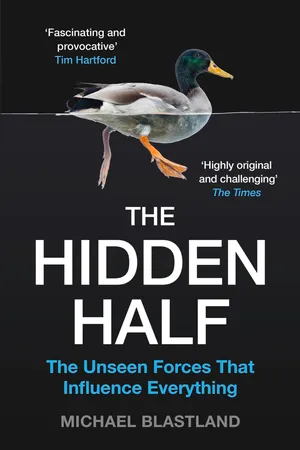
Why does one smoker die of lung cancer but another live to 100? The answer is 'The Hidden Half' - those random, unknowable variables that mess up our attempts to comprehend the world.
We humans are very clever creatures - but we're idiots about how clever we really are. In this entertaining and ingenious book, Blastland reveals how in our quest to make the world more understandable, we lose sight of how unexplainable it often is. The result - from GDP figures to medicine - is that experts know a lot less than they think.
Filled with compelling stories from economics, genetics, business, and science,
The Hidden Half is a warning that an explanation which works in one arena may not work in another. Entertaining and provocative, it will change how you view the world.
- 296 pages
- English
- ePUB (mobile friendly)
- Available on iOS & Android
eBook - ePub
About this book
Information
1. Bill is not Ben
Hidden influences on the path through life
Pause you who read this, and think for a moment of the long chain of iron or gold, of thorns or flowers, that would never have bound you, but for the formation of the first link on one memorable day.
Charles Dickens, Great Expectations, 1861
You’re sceptical. The marmorkrebs are surprisingly irregular, that’s true, and leave a lot of unanswered questions, but they’re just a weird species of crayfish. They’re not people and might not be anything like people. We don’t know how the marmorkrebs think – so far as they think at all – we can’t interrogate them to learn their reasoning, or see closely enough what happens to them to pick out patterns of decisive influence, cause and effect. It’s unsurprising that the source of the variation in their lives is hidden – at least from us.
Then let’s turn to people, in whom we are compulsive pattern spotters. Maybe in people we can uncover at least some of the missing causes we can’t see in crayfish, not least because people – unlike marmorkrebs – can talk about how their experiences shape them.
The question we seek to answer as we look for patterns of cause and effect in human experience is how far these patterns are real. To what extent are they regular and consistent, and therefore examples of useful knowledge that will travel? Or is there, between people as between cloned crayfish, a hidden half of enigmatic variation that subverts our understanding?
To find out, we’ll look in this chapter at a variety of human cases where you might expect the patterns and order to be clear, then see how well that order holds up. And we’ll begin with the life of Mike Tyson, the former boxer who has a lot to say about how he was shaped by his childhood, which might help us to think about the patterns of cause and effect that make people turn out the way they do.
It’s all because. . .
Mike Tyson was born on the wrong side of the tracks. His early life included a father who wasn’t really his father who soon fled the coop anyway, serial homes in condemned buildings and a heavy-drinking mother who could be violent to anyone who crossed her, children included.
In a profile in Rolling Stone magazine, Tyson is described as ‘finding his identity’ by robbing houses, beating people up and doing drugs. He first snorted coke when he was 11 and, by 13, had been arrested 38 times. He finished up in the Tryon School for Boys, an institution described elsewhere as New York’s most infamous juvenile prison. As he sums it up in his autobiography: ‘I did a lot of bad sh**’.1
Is it any wonder Mike Tyson grew up to become the self-styled baddest man on the planet, with a rap sheet that kept growing? As an adult, he bit off part of another boxer’s ear and was imprisoned for rape. But how else was he likely to turn out? He is among the first to say that his entire life, even beyond boxing, was defined by violence. Except, there is also the case of Mike Tyson’s brother.
‘Once, my mother was fighting with this guy, Eddie’, said ‘Iron Mike’ Tyson himself in another interview, ‘and it’s barbaric. Eddie knocked out her gold tooth and me and Denise [his sister] are screaming. But my mother’s real slick. She puts on a pot of boiling water. The next thing I know she’s pouring boiling water over Eddie. He was screaming, his back and face covered in blisters.’
The former heavyweight world champion regards these influences as formative: ‘I used to look upon women as equal in physical confrontation. I didn’t grow up around frightened women. If you sleep they might kill you.’ Without excusing Tyson’s behaviour, we might say this is how it is if your life begins in brutality: history is destiny. That is, we might be tempted to say so, except for Mike Tyson’s brother.
Mike Tyson’s brother, Rodney Tyson – who features in stories of childhood theft and arrest in Mike’s autobiography where he is described confronting Mike with a gun2 – became a specialist surgical assistant in a hospital trauma department in Los Angeles, where his job included helping to patch up the victims of crime.3
How does that affect our view of the power of a criminal childhood to shape a young person’s future? Maybe it changes little. Maybe we start compiling a mental list of ifs and buts that might explain the difference. Maybe we change tack and wonder if Rodney Tyson is also haunted by his past but, unlike Mike, reacted against it, rejecting the norms of his background, rejecting the violence and crime in his home and neighbourhood, committing his life to trying to heal wounds. You see, he was shaped by his past too, like his brother, but in an opposite, compassionate direction.
But if the same background causes brothers to become so different, how do we say which way that background points? Misogynist thug or vocation to help? When paths that begin in the same extreme place end so far apart, how far can we say the same beginning in crime has any consistent effect at all?
There are other complicating facts. In his teenage years Mike Tyson was taken under the wing of a paternalistic boxing coach who showed him a life of privilege and high expectation. Apparently, he lived in a large Victorian house described in places as a mansion. His life became disciplined, if still motivated by vicious intent. The Mike Tyson story is easy to fit – if we’re inclined – into a world of big causes. But which is the precise cause and effect now?
Maybe you say that by the time he met his boxing coach it was too late. Maybe you say it was the very privilege, suddenly conferred, that did the damage, or that the coach’s motivational fighting talk made things worse. Maybe dreams of a world of wealth and women at his teenage feet put the last touches to a monster. Or maybe this pigeon-fancying, self-proclaimed shy and frightened child grew up misunderstood. And after all that, maybe you still insist that, nine times out of ten, anyone who grew up like Mike Tyson would remain in some way like Mike Tyson.
While there might be truth in some of this, let’s also consider the limitations, because doubt also creeps into speculations like these. How much is storytelling after the fact? Are we really spotting order, a pattern of cause and effect, or are we weaving together selective details to justify whatever pet theory we hold about child and adolescent development?
A question then, to test the limits of our knowledge: if a boy is delinquent, how reliably can we tell whether he will be a criminal adult? Is there a type that persists, and a type that desists? Can anything in their background help us? To be clear, we are looking not at how young people get into crime, but at how that most extreme of early experiences – a criminal childhood – shapes adult life.
You are, by the way, welcome to consider even the most high-rate chronic offenders. If being the worst-case kid on the block gives any indication of whether or when someone will go straight as an adult, or if there is anything else distinctive in the lives of those who are still burgling houses in their 60s compared with those who stop 40 years earlier, we can say there’s at least some semblance of pattern. Can we?
The extent to which the patterns are real is explored in an extraordinary study of delinquent boys by John Laub and Robert Sampson, called Shared Beginnings, Divergent Lives: Delinquent Boys to Age 70.4
The story goes that these two professors of social science happened one day on some dusty boxes of data in the basement of the Harvard Law School in the US that contained studies of 500 men who had been in serious trouble in childhood – plus another 500 who despite similar backgrounds had not. It was a wonderful find. The original study5 followed the men from birth in Boston between 1928 and 1930, up to age 32. John Laub and Robert Sampson analysed that data and then picked up where it left off to complete their own study, tracking down as many of the men as they reasonably could for the longest life-course study of criminal behaviour ever conducted. The crimes, thousands of them, ranged from fraud to armed robbery and serious physical violence. The first recorded arrest was at age 7; the last was at age 69.
Simply finding the men was a detective story. The last known addresses were 35 years old. Social security records were patchy, phone numbers scarce and usually useless. Some men turned up through guesses that they’d Americanized their names – found by changing the search from Pasquale to Patrick, for instance. In the end, the researchers enlisted the help of a lieutenant detective on Boston Police homicide department’s cold-case squad.
When found, some men didn’t want to talk. For a few it was too long ago. For others, it was too current. One – thought to have connections with organized crime – told them in plain language to stop bothering him. Some had died. They interviewed the men in their homes, in burger bars, in ‘Daddy’s Donuts’, in the Kennedy library, in ‘a beat-up old, brown Ford that reeked of cigarette smoke’, and in prison.
This huge effort, remarkable in itself, was motivated by their earnest belief that they’d be able to identify precisely the influences that might guide attempts to turn criminals straight. If we know the mechanism, maybe we can use it for good.
But for all their efforts, they hit a problem. They realized – ‘to our fascination and simultaneous horror’6 – that they simply couldn’t tell from the mass of data at their disposal whether any particular person would continue to be criminal in adulthood. Nothing turned up. While it seemed to be true that some tended to become set on certain paths, there was abundant evidence that others could change. But who would become set, who would change and when, was another matter. As they compared the life-courses of criminals with others whose early lives were much the same but later became law-abiding, and they scoured those divergent lives and experiences for clues about the future, they found they couldn’t pinpoint anything that would have told them which path anyone would take. Some delinquents stopped, some carried on, some zig-zagged. Nothing in their background suggested why. Hence the title of the book: Shared Beginnings, Divergent Lives. All that we know is that most desist eventually. But the gradient of giving up is about the same for any group you care to define, while that part of the story for any individual seems unpredictable.
Their conclusion was stark, and complete:
[We] reject the idea that childhood experiences such as early involvement in antisocial behaviour, growing up in poverty, and woeful school performance are sturdy markers for predicting long-term patterns of offending. . . that individual ‘traits’ such as poor verbal skills, low selfcontrol, and difficult temperament can explain long-term patterns of juvenile delinquents. . . [and] that offenders can be neatly grouped into distinct categories, each displaying a unique trajectory and etiology of offending.
Likewise, they ‘reject the idea of determinism and lawful predictability from childhood factors. . . there are simply too many outcomes that cannot be explained by focusing on the past’. As John Laub has said elsewhere: ‘I am repeatedly reminded of the words of the poet Galway Kinnell – “future tramples all prediction”.’7
Their verdict stands for even the most serious cases: ‘Life-course persistent offenders (serious, high-rate, chronic offenders) are difficult if not impossible to identify prospectively using a wide variety of adolescent and childhood risk factors,’ they said. As one reviewer commented: ‘the childhood traits of the persistent offenders. . . were the same as the childhood traits of those who desisted from crime’.
In one way, the research was encouraging: ‘Childhood is not a destiny’, Robert Sampson has said. Frustration for research, in this case at least, means hope for people: ‘The delinquent boys all had the same disadvantaged backgrounds – they were poor; they had criminal records; many had been thrown into the same reform school – yet some of them turned out to work 30 years without missing a day, while others were in prison at age 55 for committing armed robbery.’8
After the fact, it’s easy to confabulate – to find plausible reasons why people’s adult behaviour was forged by some salient element of their past. Beforehand, spotting the causal influences on the criminal juveniles who become persistent criminal adults turns out to be surprisingly hopeless. Who will continue offending? Who will go straight? We’ve little idea beyond saying that most quit eventually. The reason we’ve no idea is not a cognitive fault. It’s the fog of life.
The problem, they say, is captured by an old adage: that lives are lived forwards but can only be understood backwards. Though life is shaped by various forces, as we know, it is also shaped by living – by particular experience as it unfolds – and experience, as Henry James once wrote, is ‘an immense sensibility whose shining particulars can be infinite’.
It’s not that we know nothing about background and crime, and it’s vital to say so. This book refers to the hidden half, not the hidden whole. John Laub and Robert Sampson themselves find persuasive evidence that children in families with what they refer to as ‘poor supervision, erratic/threatening discipline and weak parental ...
Table of contents
- Cover
- Title
- Copyright
- Contents
- Prologue: The marmorkrebs and the hidden half
- 1. Bill is not Ben: Hidden influences on the path through life
- 2. I am not constant: Unsuspected causes of belief and choice
- 3. Here is not there, now is not then: Obscure differences that subvert knowledge
- 4. One path is not enough: What ‘finding out’ through research doesn’t see
- 5. The principle isn’t practical: Big ideas and the small print
- 6. Big is not small: The hidden limits of what’s probable
- 7. Big is not clear: Hidden complexity in simple stories
- 8. The ignorant chicken: On ignoring the hidden half
- 9. What to do
- Postscript: Why the hidden half?
- Acknowledgements
- Endnotes
- Index
Trusted by 375,005 students
Access to over 1.5 million titles for a fair monthly price.
Study more efficiently using our study tools.
Frequently asked questions
Yes, you can cancel anytime from the Subscription tab in your account settings on the Perlego website. Your subscription will stay active until the end of your current billing period. Learn how to cancel your subscription
No, books cannot be downloaded as external files, such as PDFs, for use outside of Perlego. However, you can download books within the Perlego app for offline reading on mobile or tablet. Learn how to download books offline
Perlego offers two plans: Essential and Complete
- Essential is ideal for learners and professionals who enjoy exploring a wide range of subjects. Access the Essential Library with 800,000+ trusted titles and best-sellers across business, personal growth, and the humanities. Includes unlimited reading time and Standard Read Aloud voice.
- Complete: Perfect for advanced learners and researchers needing full, unrestricted access. Unlock 1.5M+ books across hundreds of subjects, including academic and specialized titles. The Complete Plan also includes advanced features like Premium Read Aloud and Research Assistant.
We are an online textbook subscription service, where you can get access to an entire online library for less than the price of a single book per month. With over 1.5 million books across 990+ topics, we’ve got you covered! Learn about our mission
Look out for the read-aloud symbol on your next book to see if you can listen to it. The read-aloud tool reads text aloud for you, highlighting the text as it is being read. You can pause it, speed it up and slow it down. Learn more about Read Aloud
Yes! You can use the Perlego app on both iOS and Android devices to read anytime, anywhere — even offline. Perfect for commutes or when you’re on the go.
Please note we cannot support devices running on iOS 13 and Android 7 or earlier. Learn more about using the app
Please note we cannot support devices running on iOS 13 and Android 7 or earlier. Learn more about using the app
Yes, you can access The Hidden Half by Michael Blastland in PDF and/or ePUB format, as well as other popular books in Psychology & Business General. We have over 1.5 million books available in our catalogue for you to explore.