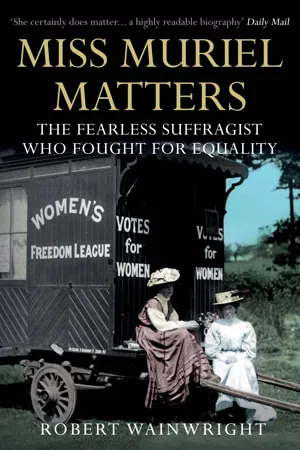
In 1908 Muriel Matters, known as 'that daring Australian girl', chained herself to an iron grille in the House of Commons to demand votes for women, thus becoming the first woman to make a speech in the House. The following year she made headlines around the world when she took to the sky over the Houses of Parliament in an airship emblazoned with 'Votes for Women'.
A trailblazer in the suffrage movement, Muriel toured England in a horse-drawn caravan to promote the cause. But feminism was just one of her passions: Muriel's zeal for social change also saw her run for Parliament, campaign for prison reform, promote Maria Montessori's teaching methods and defend the poor. In this inspiring and long-overdue biography, bestselling author Robert Wainwright introduces us to an intelligent, spirited and brave woman who fought tirelessly for others in a world far from equal.
- English
- ePUB (mobile friendly)
- Available on iOS & Android
eBook - ePub
About this book
Information
Subtopic
Historical Biographies1.
THE COW LADY OF BOWDEN
Mary Matters, a widow with four children and an ageing mother, wrote asking permission to depasture her cow on the parklands free of charge. Communications favourable to the request were received from Mrs Gawler and Dr Whittell. Referred to finance committee.
– South Australian Register, August 10, 1862
The request made of the Adelaide Municipal Council seemed reasonable enough. Even a neighbour, a Mrs Gawler, and a respected GP, Horatio Whittell, a man of ‘high character, integrity and ability’, according to the same newspaper, felt compelled to support Mrs Matters’ case for recognition of hardship, but the men of the council took a different view.
As trifling a matter as it appeared to be for a council in charge of a growing city, the widow’s request was shunted off to a committee where it would be denied out of hand, the august body of gentlemen deaf to the plea of an enterprising woman with no husband that she be allowed to feed her only asset – a cow – on public land, even though it would help keep the grass down.
It was a mean-spirited decision by the male political elders of a colonial city supposedly rooted in a spirit of entrepreneurial endeavour and equity. The travails and challenges of a widow seemed to have no bearing on their considerations. If anything, it annoyed them that a woman would seek to challenge laws enacted by men.
Adelaide, capital of the freely settled colony of South Australia, had been founded less than three decades before, designed by the Surveyor-General Colonel William Light in a grid pattern on either side of the Torrens River: broad avenues, narrower streets and public squares surrounded by great parklands filled with trees that would help keep the air clean, in contrast to the poor light and dank, polluted air that permeated most overcrowded European cities.
The genius of Light’s design was matched by the utopian impulses fuelling both his garden city’s construction and the settlement of the colony. Adelaide was not to be built on the back of convict labour, like the east coast capitals of Sydney and Melbourne, but as a free settlement, financed by selling investment parcels of land to the wealthy in faraway Britain. The proceeds from the sales (to largely absentee landlords) would fund the cost of shipping a ready-made working-class population from the United Kingdom to build the new city.
‘The great experiment in the art of colonisation’ was considered an immediate success. The initial land release sold quickly and a campaign was launched in London to lure settlers across the seas with promises of a paradise: a new society that championed civil liberties, tolerance and religious freedom, far from the human crush and crime-filled streets of the Mother Country. So bright was this beacon that no jail had been planned, let alone built, for the city named by William IV after his German wife.
Free passage was offered to men aged under forty-five, single or married, who were skilled farm labourers, shepherds or copper miners, interested in living and working in the rich agricultural regions opening up outside the city. There was also room for men good with their hands who could help build the city that was fast rising from the riverbanks – bricklayers, stonemasons, farriers, gardeners, sawyers, carpenters, mechanics, wheelwrights and the like, provided they were ‘sober, industrious, of general good moral character … free of all bodily and mental defects’.1
Women were welcome too, single or married, particularly those with experience as domestic servants, farm girls, plain cooks or nurses. A letter from the Bishop of Adelaide offering advice to emigrants to the colony painted a rosy picture: ‘Wages are high and there is no fear of starvation,’ he wrote. ‘Respectable servant girls are sure to find employment.’ There was even the enticement of land ownership, via a scheme under which a man could buy his own plot of land and put aside wages to pay it off.
In 1852, Mary Matters and her husband, Thomas, heeded the call, leaving a settled if crowded life in the port city of Plymouth to start afresh. Thomas was a 32-year-old stonemason with the ideal combination of youth and trade experience required in the fledgling community.
His wife, although six years older, fitted the criteria for ‘acceptable’ women. Mary was the eldest of twelve children of a struggling Devon farm worker. With little chance of an education, she had followed her mother into domestic service and helped raise her siblings, and was thirty-three before she found a husband.
The marriage certificate sheds no light on how Mary Adams met Thomas Matters. They lived in towns fifty kilometres apart and their families had no obvious connection. The only link appears to be religion, both families being devout followers of the Methodist philosophy of John Wesley. It would be a driving moral force for several future generations.
Mary had only stopped working after the birth of her third child, a daughter to follow two sons, which meant financial pressure was growing as much as the family’s need for space, crammed as they were into three rooms of a five-room house near the city docks. A fresh start seemed a godsend and too good to refuse, even if it was on the other side of the world.
Mary wasn’t the only member of her family to emigrate. A younger brother, John, had already left for South Australia, and three unwed sisters and her widowed mother would follow a few months later. Another brother would settle in New Zealand and a third in Victoria.
On August 24 Thomas and Mary packed their children – Charles, Thomas and baby Mary – along with a small bundle of clothing and personal effects and joined 339 other souls aboard the three-masted barque Sea Park to set sail for the unknown.2 It was the seventy-ninth such government-funded ship to make the trip carrying the future citizens of Adelaide, whose population now stood at about 50,000. Most of the family’s belongings had to be left behind, traded for a new beginning. They would never return.
* * *
Mary had turned forty by the time the family stepped ashore in Adelaide almost four months later. Port Adelaide, where the Sea Park lay at anchor, must have appeared a little like Plymouth, with its bustle and grime, but nothing else gave the family any sense of being in the soft environs and gentle light of England.
They had arrived in the early heat of an Australian summer, into a landscape they could not have imagined with its open spaces, wild glaring skies and remorseless sunshine. Here the roads were dry and dusty, the fine, pale sand blown by hot, swirling winds. Men working outside hid beneath large straw hats to keep the baking sun from their faces and spoke with a strange ‘independence of manners’, a frankness that jarred British sensibilities.3
Yet it was clearly a place of prospect and plenty, the storehouses in the centre of the now bustling city stocked with an abundance of fruit and vegetables – grapes, tomatoes, plums, peaches, apples and more. The talk in the streets was of opportunity rather than hardship, and of mineral and grazing riches beyond the blue-grey hills that ringed the mangroves and the coastal plain on which the city had been so carefully placed.
It was also a blessed relief to be free of the squalid living conditions and putrid food aboard ship, for there was great sadness amid the excitement and anticipation of their arrival, a few weeks before Christmas. Mary’s infant namesake daughter was among the fourteen babies and young children who had died from infection and illness at sea. By contrast there had been nine births.
And Mary was pregnant again, the conception almost certainly occurring on August 23, the night before the family sailed from Plymouth – a celebration of a new life ahead in so many ways.
The welcome was promising. In the first days after arrival, families like the Matters were housed in cottages along the harbour foreshore and the ‘Stranger Friend Society’ was on hand to relieve distress among the newly arrived. It all seemed too good to be true. Thomas secured work within days, and the family leased a house constructed of pisé, a form of rammed earth, with a dirt floor and tin roof, in the village of Bowden on the northern fringe of the city. The small outpost had been roughly cleared and chopped up into irregular lots set along nameless streets.
The lease came with the inducement of the prospect of securing a mortgage to buy the modest, four-room house, squeezed onto its tiny allotment, perhaps as small as one-sixteenth of an acre and sized to maximise profit for its developer rather than create amenity for the lessee. The Matters’ neighbours were labourers and tradespeople: tanners, millers, lime-burners and bricklayers with skills but little money, grateful for the work and security that sprang from a city still largely under construction.
Few would make the change from lessee to landowner. A developer named Eckley owned 117 properties in Bowden and the rest were held by half a dozen individuals. Families made the homes their own by planting fruit trees and vines and digging tiny vegetable plots into the bushland, creating a little Europe amid the native wattles and gums, mallees, myrtles and quandongs. Pigs and goats wandered freely in the village that soon had five hotels, a dozen stores, a collection of brickworks and tanneries and even a modest schoolhouse.4
In May 1853 Mary gave birth to a third son, John Leonard, a renewal of sorts and an event that went some way to ease the pain of her baby daughter’s death. But life was fragile and the fates cruel. In February 1857, barely four years after arriving in the colony, Thomas Matters was dead from gastric fever. He was just thirty-seven. The funeral notice would say it had been sudden, the stonemason passing away at home after a ‘short illness’. A fortnight later his grieving widow gave birth to their fourth child – another son. The promise of a new, wondrous life had now turned to despair.
Although Mary had familial support, resources would not stretch to financial help because her sisters and mother were living hand to mouth. Nor could her brother John, who had his own family to feed, spare any money. At the age of forty-five, with four young children and no likely marriage prospects, Mary Matters was on her own in a city that wanted contributors, not passengers.
The cow therefore took on an extra significance, bought from the little money Mary could scrape together and symbolic of her resourcefulness and determination amid the setbacks of colonial life.
* * *
On a clear, bright summer morning in late 1865, a man climbed the rickety scaffolding around the almost completed Adelaide Town Hall. He carried a heavy bag and tripod, and on reaching the top braced himself, faced north and began to take photographs. For the next hour or so, Townsend Duryea, an American mining engineer turned photographer, carefully made his way around the tower in an anti-clockwise fashion to avoid the sun’s sharp rays shining into his lens while he took fourteen photographs, creating the world’s first photographic panorama.5
The result showed the precision and success of the Adelaide experiment. Each point of the compass was dominated by a wide avenue, splitting rows of modest housing and timber-framed shopfronts, grand sandstone public buildings and neat parks of carefully planted trees that would one day spread to cover the flat landscape to help the city ‘breathe’.
But behind the innovative photography lay another, more complex story. The system of land title, so carefully plotted, had been rorted and botched in the early years of the colony and had stunted its development until the Real Property Act, which would revolutionise land ownership not only in Adelaide but around the world, was passed in the South Australian parliament.
In the distance, just beyond the range of Duryea’s camera, lay the ring of villages that would one day merge to become suburbs all the way to the sea. Among them was Bowden, where the Matters family lived, and the village of Croydon where ‘Mary Matters of Bowden’ had recently applied to have four housing allotments registered in her name under the new Torrens title system.
Croydon had been carved out of the bush by two investors who named it, as so many did, after their home town in England, but the land remained largely unsold because of the confusion about land ownership. Mary had seen her chance to acquire land cheaply and build a future for her family. Significantly, hers was the only female name on the registry.
Aged fifty, she had also established a small business run from her home, hand sewing hessian sacks that she sold to farmers to hold their produce. The business prospered, if slowly. There was more than a single cow too, the profits from sack-making poured into increasing the herd. By the mid 1860s she was described as a ‘cow-keeper’ in official documents when her animals occasionally strayed onto public verges and caught the attention of the ranger and she was dragged before the courts to face a fine of a few shillings and a lecture from a pious magistrate.
The land purchase would be a turning point in her life, and turn adversity into triumph. Through the next three decades she would buy and sell land and cottages, mainly in and around Bowden, using some to house family members and others to provide an income – ‘a good stone house of four rooms let at 10s per week’, as one newspaper advertisement would note.6
Mary would only move from Bowden in the later years of her life, buying a large house at Semaphore, within sight of the beach where the Sea Park had arrived with her young family, full of hope, more than three decades before. She had survived and thrived in spite of circumstances and social attitudes and raised four sons.
* * *
The true legacy of Mary Matters did not lie in a bank balance or a row of houses, a cow or a pile of hessian sacks, but in her determination for self-improvement, a desire apparently embedded in the religious ethos of her upbringing and carried not only into her own life but into those of her children and grandchildren.
Her father, Leonard Adams, may have been a struggling farm worker, but he was also a man of God, a follower of the founder of the Methodist Church, John Wesley, who preached personal accountability, championed social issues such as prison reform, railed against slavery in the United States and believed in a greater role for women in the Church. Mary held the same philosophies, and despite having no formal schooling herself, decided that it was important for her own children to benefit from a good education, even though, economically, sending her boys out to work would have made more sense in the early years of her widowhood.
She chose Whinham College, a school that had sprung from modest beginnings. John Whinham was a self-taugh...
Table of contents
- Cover
- Title Page
- Dedication
- Contents
- List of Illustrations
- Prologue
- 1. The Cow Lady of Bowden
- 2. Role Models and Inspirations
- 3. ‘The Woman Question’
- 4. The Stage Beckons
- 5. First Love, First Vote
- 6. London Bound
- 7. Art and Life
- 8. The Pankhurst Factor
- 9. A Wonderful, Magical Voice
- 10. An Agitator is Born
- 11. Miss Matters Goes Vanning
- 12. Tillie
- 13. A Poetic Licence
- 14. Chain Gang
- 15. Heroine of the Grille
- 16. Holloway
- 17. A Pair of Divas
- 18. Muriel Takes Flight
- 19. Acclaim Across the Atlantic
- 20. Rice, Potatoes and Sods
- 21. A Voyage Home
- 22. Flesh and Blood, Bricks and Mortar
- 23. The Fiance
- 24. Pilgrims and Guerrillists
- 25. A Husband
- 26. War and Peace
- 27. Mother’s Arms
- 28. A Measure of Justice
- 29. A Final Journey Home
- 30. An Unconventional Candidate
- 31. Oliver
- 32. A Window by the Sea
- Notes on Sources and Acknowledgments
- Endnotes
- Index
- Picture Section
- Copyright
Trusted by 375,005 students
Access to over 1.5 million titles for a fair monthly price.
Study more efficiently using our study tools.
Frequently asked questions
Yes, you can cancel anytime from the Subscription tab in your account settings on the Perlego website. Your subscription will stay active until the end of your current billing period. Learn how to cancel your subscription
No, books cannot be downloaded as external files, such as PDFs, for use outside of Perlego. However, you can download books within the Perlego app for offline reading on mobile or tablet. Learn how to download books offline
Perlego offers two plans: Essential and Complete
- Essential is ideal for learners and professionals who enjoy exploring a wide range of subjects. Access the Essential Library with 800,000+ trusted titles and best-sellers across business, personal growth, and the humanities. Includes unlimited reading time and Standard Read Aloud voice.
- Complete: Perfect for advanced learners and researchers needing full, unrestricted access. Unlock 1.5M+ books across hundreds of subjects, including academic and specialized titles. The Complete Plan also includes advanced features like Premium Read Aloud and Research Assistant.
We are an online textbook subscription service, where you can get access to an entire online library for less than the price of a single book per month. With over 1.5 million books across 990+ topics, we’ve got you covered! Learn about our mission
Look out for the read-aloud symbol on your next book to see if you can listen to it. The read-aloud tool reads text aloud for you, highlighting the text as it is being read. You can pause it, speed it up and slow it down. Learn more about Read Aloud
Yes! You can use the Perlego app on both iOS and Android devices to read anytime, anywhere — even offline. Perfect for commutes or when you’re on the go.
Please note we cannot support devices running on iOS 13 and Android 7 or earlier. Learn more about using the app
Please note we cannot support devices running on iOS 13 and Android 7 or earlier. Learn more about using the app
Yes, you can access Miss Muriel Matters by Robert Wainwright in PDF and/or ePUB format. We have over 1.5 million books available in our catalogue for you to explore.