On the night of December 2, 1943, the Luftwaffe bombed a critical Allied port in Bari, Italy, sinking seventeen ships and killing over a thousand servicemen and hundreds of civilians. Caught in the surprise air raid was the John Harvey,
an American Liberty ship carrying a top-secret cargo of 2,000 mustard bombs to be used in retaliation if the Germans resorted to gas warfare.
After young sailors began suddenly dying with mysterious symptoms, Lieutenant Colonel Stewart Alexander, a doctor and chemical weapons expert, was dispatched to investigate. He quickly diagnosed mustard gas exposure, which Churchill denied. Undaunted, Alexander defied British officials and persevered with his investigation. His final report on the Bari casualties was immediately classified, but not before his breakthrough observations about the toxic effects of mustard on white blood cells caught the attention of Colonel Cornelius P. Rhoads - a pioneering physician and research scientist as brilliant as he was arrogant and self-destructive - who recognized that the poison was both a killer and a cure, and ushered in a new era of cancer research.
Deeply researched and beautifully written,
The Great Secret is the remarkable story of how horrific tragedy gave birth to medical triumph.
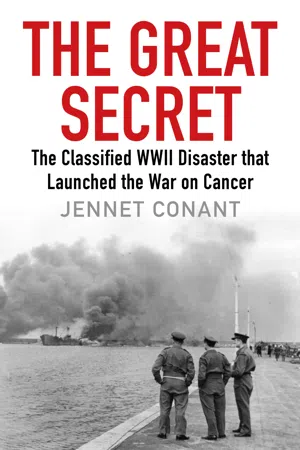
eBook - ePub
The Great Secret
The Classified World War II Disaster that Launched the War on Cancer
- English
- ePUB (mobile friendly)
- Available on iOS & Android
eBook - ePub
About this book
Information
Topic
MedicineCHAPTER ONE

“A Regiment of Wizards”
The summons came in the middle of the night. He was awake at the first harsh jangle of the telephone. The next insistent ring had him on his feet. It was second nature to him. Always a light sleeper, Lieutenant Colonel Stewart Francis Alexander attributed the trait to his father, an old-fashioned family practitioner whose response to every late-night distress call was to reach automatically for his raincoat and medical bag. A doctor’s son through and through, he was dressed and ready to go in under ten minutes.
The clipped voice on the other end of the line ordered him to report at once to his boss, Brigadier General Frederick A. Blesse, chief surgeon for the Fifth Army and the North African Theater of Operations at Algiers. The briefing was cursory, amounting to little more than the recitation of a handful of facts. There appeared to be a developing medical situation in Bari following the December 2 air strike. Too many men were dying, too quickly, of unexplained causes. The symptoms were unlike anything the physicians in the local military hospitals had seen before, and they had begun to suspect the Germans had used some new, unknown poison gas. When the number of mysterious deaths increased rapidly with each successive day, the British placed a “red light” call alerting Allied Force Headquarters (AFHQ) at Algiers. There was an urgent request for assistance. “Expert advice” was the way Blesse had put it. Fortunately, they had just the man for the job. Alexander, a twenty-nine-year-old medical officer attached to Eisenhower’s staff, had received special training in chemical warfare. He was being dispatched immediately to the scene of the disaster.
Alexander looked young for a combat doctor. Five feet eight, skinny, with close-cropped fair hair and hazel eyes, he had the kind of open, honest face that people invariably described as earnest. The dimple in his chin added to his choirboy appearance, and it was only the fact that his hair had started to thin at the temples that lent him any air of authority. Gentle and soft-spoken, he was popular with the troops, though some patients kidded him that his bedside manner was better suited to a pediatrician than someone who had by choice seen more than his fair share of war. But he had come over with Operation Torch under the command of no less a figure than Major General George S. Patton, and he had been through the brutal invasion assault on North Africa. Despite his quiet modesty, Alexander had proven himself to be confident, determined, and resourceful. He had a good head on his shoulders and knew how to handle himself.
The day after the attack on Bari, Eisenhower’s headquarters had been buzzing with the news that the Luftwaffe’s hit-and-run raid had pummeled the unsuspecting harbor. The first reports described a scene of utter devastation. Parts of the town and port were still on fire. The carcasses of burned-out ships, their towering masts and funnels smashed, were smoldering and belching black smoke. The basin was so crowded with sunken wrecks that the rescue tugs could hardly work their way around the length of the seawall to search for survivors. Casualties were said to be enormous. Grotesquely charred and bloated bodies bobbed to the surface and were fished out of the water in nets. The grisly remains were laid out on the dock in full view—arms, legs, and torsos, already nibbled by crabs. Most of the sailors and merchant seamen who perished would never be found. There would be no way to identify the dead. No way to give them a proper burial.
SITTING IN HIS SUNBAKED OFFICE in the medical department at AFHQ, Alexander shuddered to think how the overstretched hospitals in Bari would cope with the masses of injured men. From the reports stacked on his desk, he knew that every Allied facility in the region—British, New Zealand, Indian, and Italian—was already loaded with wounded from the months of continuous combat and operating far beyond normal capacity. His mind flashed back over familiar scenes from battalion aid stations following a major assault: litter bearers, moving with swift efficiency, carrying in the wounded; surgeons in blood-spattered coveralls patching torn flesh and binding shattered limbs for further procedures once they had been evacuated; nurses hooking up copious bottles of plasma to sustain failing bodies; then clearing the decks as quickly as possible to make room for the next round of incoming. At Bari, they would be doing all that and more, only the numbers would be staggering.
But that had been just one of his concerns. He had been dismayed to learn that among the tons of lost cargo was the long-overdue equipment to outfit five planned American field hospitals, one of them a thousand-bed unit. All of the medical supplies had been aboard the Liberty ship Samuel J. Tilden, which was destroyed in the enemy attack. The newly arrived personnel were all safe, having bivouacked some distance from town, but everything they needed to provide assistance in the emergency, from bandages to syringes and morphine, was at the bottom of the harbor. Under the circumstances, the American 26th General Hospital had scrambled to open on December 4 to care for some of the bombing victims, assembling a medical wing and borrowing a hundred beds, plus linens and pajamas, from the Italians. A few surgical instruments and small amounts of dressings were scrounged from an Air Force storage depot. Complicating matters, the town’s communication system, which was knocked out in the attack, was still down, making the relief effort that much more difficult. The grim reality was that the shortage of medical supplies was going to compound the tragedy. Alexander’s initial orders had been clear. One way or another, Blesse had told him, they were going to have to find a way to replace the lost inventory in one hell of a hurry.
Now, he realized, that might turn out to be the least of their worries.
The white city of Algiers, shimmering in the soft morning light, seemed far from the ravages of war. The half-moon harbor below looked like a picture postcard, with boats of every size and shape nestled along the bay. Alexander hastened to the waiting jeep that would whisk him to Maison Blanche Airfield on the outskirts of town. Arrangements were being made for a plane to take him to Bari. He was the expert and he was going alone, without staff.
ALEXANDER’S PRESENCE IN ALGIERS was no accident. It was fortuitous, a result of Gen. Eisenhower’s foresight and his own willfulness. When he later looked back on the sequence of events that led to his being there, it always seemed to him to be more than mere coincidence, one of those serendipitous events in which it is impossible not to see the hand of fate.
Quiet and scholarly by nature, he could have sat out the war in a stateside hospital or research laboratory. At the start of the conflict, it was easy enough for a doctor to claim he could not be spared from his civilian occupation. He had heard of more than one colleague who had been categorized as “essential” and exempted from conscription. From the first, however, Alexander felt that this was a war in which he had to participate, and he had enlisted early of his own initiative.
The desire to serve ran deep. He was from self-made, self-reliant immigrant stock, part of the wave of Eastern European Jews who had journeyed to the United States in the 1880s, fleeing famine, unemployment, and political and religious persecution. His grandfather came from Bratislava in the Austro-Hungarian Empire, now the Czech Republic, as a boy without a penny to his name. He struggled to earn the passage funds for each of his siblings and parents, bringing them over one by one. He put his hand to dozens of odd jobs, determined to prosper and provide his family with a better life. Poor but proud, he embraced all things American, especially baseball, which he played with gusto and without a glove, despite breaking several fingers. He inculcated in his eight children a profound sense of obligation to the new land that had given them so much. Samuel, the oldest son, began working at the age of five, selling newspapers. By dint of hard work, long hours, and night classes, he put himself through college and medical school. He eventually rose from a humble small-town doctor to become a pillar of the community in Park Ridge, New Jersey, building a large obstetric practice and delivering hundreds of babies over four decades, as well as founding the state’s first county hospital. He became president of the state medical society, president of the local bank, and served several terms as mayor.
Having spent his childhood going on rounds with his boundlessly energetic and gregarious father, conspicuous in the neighborhood as the doc’s bright boy, Stewart Alexander had only one ambition: to follow in his father’s footsteps. Born on August 30, 1914, in a small stone house that also served as his father’s office and surgery, he raced along the path set out for him. His mother, a teacher, recognized that her boy was a fast learner when he refused to go to kindergarten, declaring it a waste of time. Always the youngest and smallest in his class, he skipped several grades at the public school across the street and consistently earned top marks. In need of a greater challenge, and perhaps a bit of toughening up, he was packed off to the Staunton Military Academy in Virginia for his last two years of high school. He entered Dartmouth College at the age of fifteen, excelled at his scientific studies, and was allowed to advance directly to medical school at the start of his senior year, graduating at the top of his class in 1935. As Dartmouth only had a two-year program, he went on to earn his MD from Columbia University College of Physicians and Surgeons in New York and then did postgraduate work in chest diseases and neurology at Bellevue Hospital. He declined an offer to stay on—the big city held little allure for him. After completing his internship and residency training, he returned to Park Ridge and proudly hung out his shingle next to his father’s.
He had only a few months to enjoy their shared dream of practicing medicine together. By the spring of 1940, Germany was on the march, conquering France, Belgium, Luxembourg, and the Netherlands. Any real hope of avoiding the conflict evaporated as President Franklin D. Roosevelt began to urge the country toward a new, more serious phase of preparedness. Alexander, who had joined the Reserve Officer Training Corps the day he finished medical school, notified the draft board he was “available any time.” He was called up in November and inducted into the Army Medical Corps as a first lieutenant. Despite his disappointment, his father would not have had it any other way. During World War I, he had tried in vain to volunteer for the Army Medical Corps, but, to his everlasting shame and regret, he was repeatedly rejected because of a deviated septum, even after undergoing an operation to correct it. Dedication and duty—to his patients, community, and country—were the animating principles of his life. He had always taught his son: “We must do those things we ought to do.” The young Dr. Alexander absorbed the lesson, and, conscious of his old man’s thwarted efforts to serve, felt all the more compelled to do his part.
His bags were packed, good-byes said and done, when he went for the routine physical, only to be told he had flunked the exam. Like father, like son. He, too, was deemed ineligible because of a minor hereditary defect—in his case, compound myopia, or nearsightedness. In truth, he was almost blind without glasses. While the Army physician was explaining that his vision was 20/100 and “well below the minimum standard,” Alexander, looking over his shoulder at the eye chart, quickly committed the lines of random letters to memory. Insisting there must be some mistake, he removed his glasses again and demanded to be retested. This time, he passed with flying colors and was duly accepted into the service. It was a trivial incident, and the episode would have soon been forgotten had it not given rise to a new concern about whether his impaired vision would be a handicap at the front. Almost as quickly, it set him thinking about what could be done to help soldiers like himself headed for combat.
He continued to mull over the problem during the first few months he spent in the medical detachment of the 16th Infantry Regiment, First Division, at Gunpowder Creek, near Edgewood Arsenal in Maryland. Green and jittery, the new recruits were naturally apprehensive about what they would encounter in the field. The barracks were rife with rumors that sooner or later the enemy would resort to chemical warfare. Poison gas had been Germany’s weapon of choice in World War I, and it was widely believed that if the war went badly and Hitler’s back was to the wall, he would retaliate by unleashing a chemical attack, even though the use of chemical and biological weapons had been banned by the 1925 Geneva Protocol. They had all read about the agonizing deaths caused by artillery shells packed with toxins, and asphyxiating gases that smothered soldiers in the trenches before they could escape. The fear was real and pervasive.
Faced with this familiar threat, it struck Alexander that if the men were confident there were good safeguards in place to counter the gas menace, they might be less nervous. He had his own misgivings, dating back to his days as a reserve officer. During routine gas drills, he had discovered that the gas mask supplied by the Army did not fit over the metal frames of his spectacles, forcing him to go without them. His poor performance on the eye exam had only exacerbated his anxieties, reminding him of the not-inconsiderable risk of having to choose breathing over seeing in the event of a gas attack. Moreover, as a doctor, he felt it was his responsibility to make sure that none of the soldiers in his care were sent into battle with anything less than complete protection. He decided to write to the Chemical Warfare Service about the problem and proposed a solution, sending along several sketches. His letter so impressed the CWS’s technical team that he was invited to make a presentation at their research and development center at Edgewood. After further correspondence, and a number of modifications, Alexander succeeded in devising a new form of spectacles that could be worn within the molded facepiece of the mask. He was granted a patent on his design, but he turned over all the rights to the Army. The new glasses soon became standard service issue.
Not long afterward, he was contacted by Colonel William D. Fleming, chief of the Medical Research Division of the Chemical Warfare Service, who inquired into his background and then, apparently satisfied with his CV, announced, “I really think you belong here with us.” It took several months for Fleming to disentangle him from the First Division, but, in the fall of 1941, Alexander was transferred to the CWS at Edgewood Arsenal. After a soggy year of amphibious landing exercises that had taken his regiment from the freezing waters of Maryland to the wilting heat of Puerto Rico and Martinique, and had most recently put them ashore in the Carolinas, he was not sorry to be moving on. He hoped, at least, that he had gained a better understanding of some of the hazards of combat, including possibly the biggest hazard—bullheaded officers who tried to drown half their company in the name of training. The mulishness of one battalion major determined to “harden” the men despite subzero temperatures inspired special fury. Alexander had not joined the Army to treat needless and debilitating bouts of bronchitis and pneumonia. With half the men sick, the executive officer, Colonel Charles Van Way, had advised him to intervene.
“Won’t I get into trouble for doing that?” Alexander asked, taken aback.
“Maybe,” he replied, “but there isn’t anyone else who can do it.”
Alexander promptly placed the entire battalion under quarantine, suspended the training exercises, and wrote a memorandum to the Surgeon General of the Army, explaining that if the cold did not kill the men, the major would. The medical inspector who reviewed the case agreed and closed down the operation.
When the wire came through with his travel orders to Edgewood, Alexander was more than ready to go. Told he could leave that day, he did. He knew almost nothing about chemical weapons, only that the chance to be part of a classified program to defend against toxic agents sounded “exciting.”
The Chemical Warfare Service—created in 1918 to organize the production of poison gas and defensive equipment during World War I—built a vast complex of munitions works on the grounds of Edgewood Arsenal. Congress made it a permanent part of the US Army in 1920, with duties to continue the “investigation, development, manufacture or procurement and supply of all smoke and incendiary materials, all toxic gases, and all gas defense appliances.” The unit later received approval for its distinctive insignia, a green dragon breathing flames, and its motto—Elementis Regamus Proelium—“Let Us Rule the Battle by Means of the Elements.” Over the next two decades, despite almost continuous debate about its peacetime preparations, the CWS focused on refining its production of lethal compounds and creating better delivery systems. Primarily, the service was expected to maintain what Roosevelt, with evident distaste, called the “defensive necessities” of the United States—in other words, maintain a state of readiness for chemical warfare.
Although bordered by beautiful woods and a sparkling river, the Edgewood facility was a somewhat uninviting place where, in the words of Major General William N. Porter, chief of the CWS, “every living soul must stay within five minutes of his gas mask.” The acrid smell that permanently hung in the air around the manufacturing plants was enough to make anyone nervous. Assigned to the Medical Research Laboratory, Alexander quickly became proficient in the field of poison gases. With characteristic drive and intensity of purpose, he spent weeks educating himself in the library. He read everything he could find about the principal killing agents: chlorine (a powerful irritant that damaged the eyes, nose, and throat), phosgene (cheap and deadly, it attacked the lungs with no effective treatment after prolonged exposure), and sulfur mustard (a liquid that vaporized, and lethal in both forms). The cornerstone of Germany’s chemical arsenal, mustard gas—the so-called king of battle gases—killed more than a hundred thousand men in World War I and badly injured a million more. The most potent gas, lewisite, developed at the end of the last war, was a new type of blister agent, or severe vesicant, that quickly penetrated the body.
He learned to identify the different toxins by their telltale odors—the pungent aroma of an indoor pool (chlorine), the fragrant but pernicious smell of newly mown hay (phosgene), the nose-tickling bouquet of garlic (mustard gas), and the faint, sickly sweet scent of geraniums (lewisite). There was no practical method of detecting most gases other than via the sense of smell, but it was a hazardous and uncertain business. Soldiers needed a quick, foolproof test. When Alexander first arrived, the lab was in the process of perfecti...
Table of contents
- Cover
- Title
- Copyright
- Contents
- Prologue: “Little Pearl Harbor”
- Chapter One: “A Regiment of Wizards”
- Chapter Two: “The Die Is Cast”
- Chapter Three: “Angels in Long Underwear”
- Chapter Four: “Journey into the Nightmare”
- Chapter Five: “A Special Affinity”
- Chapter Six: “Recommendation to Secrecy”
- Chapter Seven: “Magnum Opus”
- Chapter Eight: “Forgotten Front”
- Chapter Nine: “A Riddle Wrapped in a Mystery”
- Chapter Ten: “Frontal Attack”
- Chapter Eleven: Trials and Tribulations
- Chapter Twelve: “The Sword and the Ploughshare”
- Epilogue: Belated Justice
- Acknowledgments
- Notes
- Archives and Libraries
- Select Bibliography
- Illustration Credits
- Index
- Picture Sections
Trusted by 375,005 students
Access to over 1.5 million titles for a fair monthly price.
Study more efficiently using our study tools.
Frequently asked questions
Yes, you can cancel anytime from the Subscription tab in your account settings on the Perlego website. Your subscription will stay active until the end of your current billing period. Learn how to cancel your subscription
No, books cannot be downloaded as external files, such as PDFs, for use outside of Perlego. However, you can download books within the Perlego app for offline reading on mobile or tablet. Learn how to download books offline
Perlego offers two plans: Essential and Complete
- Essential is ideal for learners and professionals who enjoy exploring a wide range of subjects. Access the Essential Library with 800,000+ trusted titles and best-sellers across business, personal growth, and the humanities. Includes unlimited reading time and Standard Read Aloud voice.
- Complete: Perfect for advanced learners and researchers needing full, unrestricted access. Unlock 1.5M+ books across hundreds of subjects, including academic and specialized titles. The Complete Plan also includes advanced features like Premium Read Aloud and Research Assistant.
We are an online textbook subscription service, where you can get access to an entire online library for less than the price of a single book per month. With over 1.5 million books across 990+ topics, we’ve got you covered! Learn about our mission
Look out for the read-aloud symbol on your next book to see if you can listen to it. The read-aloud tool reads text aloud for you, highlighting the text as it is being read. You can pause it, speed it up and slow it down. Learn more about Read Aloud
Yes! You can use the Perlego app on both iOS and Android devices to read anytime, anywhere — even offline. Perfect for commutes or when you’re on the go.
Please note we cannot support devices running on iOS 13 and Android 7 or earlier. Learn more about using the app
Please note we cannot support devices running on iOS 13 and Android 7 or earlier. Learn more about using the app
Yes, you can access The Great Secret by Jennet Conant in PDF and/or ePUB format, as well as other popular books in Medicine & Medical Theory, Practice & Reference. We have over 1.5 million books available in our catalogue for you to explore.