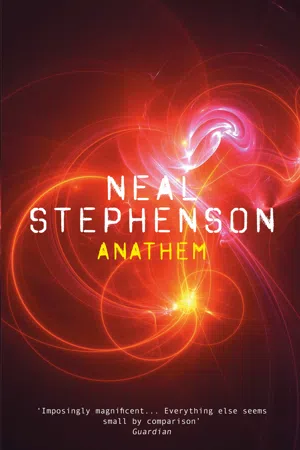
The latest magnificent creation from the award-winning author of
Cryptonomicon and the
Baroque Cycle trilogy.
Erasmas, 'Raz', is a young avout living in the Concent, a sanctuary for mathematicians, scientists, and philosophers. Three times during history's darkest epochs, violence has invaded and devastated the cloistered community. Yet the avout have always managed to adapt in the wake of catastrophe.
But they now prepare to open the Concent's gates to the outside world, in celebration of a once-a-decade rite. Suddenly, Erasmas finds himself a major player in a drama that will determine the future of his world - as he sets out on an extraordinary odyssey that will carry him to the most dangerous, inhospitable corners of the planet...and beyond.
eBook - ePub
Anathem
About this book
Information
Print ISBN
9781843549178
Subtopic
Science FictionPart 1

PROVENER
Extramuros: (1) In Old Orth, literally “outside the walls.” Often used in reference to the walled city-states of that age. (2) In Middle Orth, the non-mathic world; the turbulent and violent state of affairs that prevailed after the Fall of Baz. (3) In Praxic Orth, geographical regions or social classes not yet enlightened by the resurgent wisdom of the mathic world. (4) In New Orth, similar to sense 2 above, but often used to denote those settlements immediately surrounding the walls of a math, implying comparative prosperity, stability, etc.
—THE DICTIONARY, 4th edition, A.R. 3000

Do your neighbors burn one another alive?” was how Fraa Orolo began his conversation with Artisan Flec.
Embarrassment befell me. Embarrassment is something I can feel in my flesh, like a handful of sun-warmed mud clapped on my head.
“Do your shamans walk around on stilts?” Fraa Orolo asked, reading from a leaf that, judging by its brownness, was at least five centuries old. Then he looked up and added helpfully, “You might call them pastors or witch doctors.”
The embarrassment had turned runny. It was horrifying my scalp along a spreading frontier.
“When a child gets sick, do you pray? Sacrifice to a painted stick? Or blame it on an old lady?”
Now it was sheeting warm down my face, clogging my ears and sanding my eyes. I could barely hear Fraa Orolo’s questions: “Do you fancy you will see your dead dogs and cats in some sort of afterlife?”
Orolo had asked me along to serve as amanuensis. It was an impressive word, so I’d said yes.
He had heard that an artisan from extramuros had been allowed into the New Library to fix a rotted rafter that we could not reach with our ladders; it had only just been noticed, and we didn’t have time to erect proper scaffolding before Apert. Orolo meant to interview that artisan, and he wanted me to write down what happened.
Through drizzly eyes, I looked at the leaf in front of me. It was as blank as my brain. I was failing.
But it was more important to take notes of what the artisan said. So far, nothing. When the interview had begun, he had been dragging an insufficiently sharp thing over a flat rock. Now he was just staring at Orolo.
“Has anyone you know ever been ritually mutilated because they were seen reading a book?”
Artisan Flec closed his mouth for the first time in quite a while. I could tell that the next time he opened it, he’d have something to say. I scratched at the edge of the leaf just to prove that my quill had not dried up. Fraa Orolo had gone quiet, and was looking at the artisan as if he were a new-found nebula in the eyepiece of a telescope.
Artisan Flec asked, “Why don’t you just speel in?”
“Speel in,” Fraa Orolo repeated to me, a few times, as I was writing it down.
I spoke in bursts because I was trying to write and talk at the same time: “When I came—that is, before I was Collected—we—I mean, they—had a thing called a speely … We didn’t say ‘speel in’—we said ‘cruise the speely.’ ” Out of consideration for the artisan, I chose to speak in Fluccish, and so this staggering drunk of a sentence only sounded half as bad as if I’d said it in Orth. “It was a sort of—”
“Moving picture,” Orolo guessed. He looked to the artisan, and switched to Fluccish. “We have guessed that ‘to speel in’ means to partake of some moving picture praxis—what you would call technology—that prevails out there.”
“Moving picture, that’s a funny way to say it,” said the artisan. He stared out a window, as if it were a speely showing a historical documentary. He quivered with a silent laugh.
“It is Praxic Orth and so it sounds quaint to your ears,” Fraa Orolo admitted.
“Why don’t you just call it by its real name?”
“Speeling in?”
“Yeah.”
“Because when Fraa Erasmas, here, came into the math ten years ago, it was called ‘cruising the speely’ and when I came in almost thirty years ago we called it ‘Farspark.’ The avout who live on the other side of yonder wall, who celebrate Apert only once every hundred years, would know it by some other name. I would not be able to talk to them.”
Artisan Flec had not taken in a word after Farspark. “Farspark is completely different!” he said. “You can’t watch Farspark content on a speely, you have to up-convert it and re-parse the format… .”
Fraa Orolo was as bored by that as the artisan was by talk of the Hundreders, and so conversation thudded to a stop long enough for me to scratch it down. My embarrassment had gone away without my noticing it, as with hic-cups. Artisan Flec, believing that the conversation was finally over, turned to look at the scaffolding that his men had erected beneath the bad rafter.
“To answer your question,” Fraa Orolo began.
“What question?”
“The one you posed just a minute ago—if I want to know what things are like extramuros, why don’t I just speel in?”
“Oh,” said the artisan, a little confounded by the length of Fra Orolo’s attention span. I suffer from attention surplus disorder, Fraa Orolo liked to say, as if it were funny.
“First of all,” Fraa Orolo said, “we don’t have a speely-device.”
“Speely-device?”
Waving his hand as if this would dispel clouds of linguistic confusion, Orolo said, “Whatever artifact you use to speel in.”
“If you have an old Farspark resonator, I could bring you a down-converter that’s been sitting in my junk pile—”
“We don’t have a Farspark resonator either,” said Fraa Orolo.
“Why don’t you just buy one?”
This gave Orolo pause. I could sense a new set of embarrassing questions stacking up in his mind: “do you believe that we have money? That the reason we are protected by the Sæcular Power is because we are sitting on a treasure hoard? That our Millenarians know how to convert base metals to gold?” But Fraa Orolo mastered the urge. “Living as we do under the Cartasian Discipline, our only media are chalk, ink, and stone,” he said. “But there is another reason too.”
“Yeah, what is it?” demanded Artisan Flec, very provoked by Fraa Orolo’s freakish habit of announcing what he was about to say instead of just coming out and saying it.
“It’s hard to explain, but, for me, just aiming a speely input device, or a Farspark chambre, or whatever you call it …”
“A speelycaptor.”
“… at something doesn’t collect what is meaningful to me. I need someone to gather it in with all their senses, mix it round in their head, and make it over into words.”
“Words,” the artisan echoed, and then aimed sharp looks all round the library. “Tomorrow, Quin’s coming instead of me,” he announced, then added, a little bit defensively, “I have to counter-strafe the new clanex recompensators—the fan-out tree’s starting to look a bit clumpy, if you ask me.”
“I have no idea what that means,” Orolo marveled.
“Never mind. You ask him all your questions. He’s got the gift of gab.” And for the third time in as many minutes, the artisan looked at the screen of his jeejah. We’d insisted he shut down all of its communications functions, but it still served as a pocket-watch. He didn’t seem to realize that in plain sight out the window was a clock five hundred feet high.
I put a full stop at the end of the sentence and aimed my face at a bookshelf, because I was afraid that I might look amused. There was something in the way he’d said Quin’s coming instead of me that made it seem he’d just decided it on the spot. Fraa Orolo had probably caught it too. If I made the mistake of looking at him, I would laugh, and he wouldn’t.
The clock began chiming Provener. “That’s me,” I said. Then I added, for the benefit of the artisan: “Apologies, I must go wind the clock.”
“I was wondering—” he said. He reached into his tool-box and took out a poly bag, blew off sawdust, undid its seal (which was of a type I had never seen before), and withdrew a silver tube the size of his finger. Then he looked at Fraa Orolo hopefully.
“I don’t know what that is and I don’t understand what you want,” said Fraa Orolo.
“A speelycaptor!”
“Ah. You have heard about Provener, and as long as you are here, you’d like to view it and make a moving picture?”
The artisan nodded.
“That will be acceptable, provided you stand where you are told. Don’t turn it on!” Fraa Orolo raised his hands, and got ready to avert his gaze. “The Warden Regulant will hear of it—she’ll make me do penance! I’ll send you to the Ita. They’ll show you where to go.”
And more in this vein, for the Discipline was made up of many rules, and we had already made a muddle of them, in Artisan Flec’s mind, by allowing him to venture into the Decenarian math.
Cloister: (1) In Old Orth, any closed, locked-up space (Thelenes was confined in one prior to his execution, but, confusingly to younger fids, it did not then have the mathic connotations of senses 2, etc., below). (2) In Early Middle Orth, the math as a whole. (3) In Late Middle Orth, a garden or court surrounded by buildings, thought of as the heart or center of the math. (4) In New Orth, any quiet, contemplative space insulated from distractions and disturbances.
—THE DICTIONARY, 4th edition, A.R. 3000
I’d been using my sphere as a stool. I traced counterclockwise circles on it with my fingertips and it shrank until I could palm it. My bolt had shifted while I’d been sitting. I pulled it up and yanked the pleats straight as I careered around tables, chairs, globes, and slow-moving fraas. I passed under a stone arch into the Scriptorium. The place smelled richly of ink. Maybe it was because an ancient fraa and his two fids were copying out books there. But I wondered how long it would take to stop smelling that way if no one ever used it at all; a lot of ink had been spent there, and the wet smell of it must be deep into everything.
At the other end, a smaller doorway led to the Old Library, which was one of the original buildings that stood right on the Cloister. Its stone floor, 2300 years older than that of the New Library, was so smooth under the soles of my feet that I could scarcely feel it. I could have found my way with my eyes closed by letting my feet read the memory worn into it by those gone before.
The Cloister was a roofed gallery around the perimeter of a rectangular garden. On the inner side, nothing separated it from the weather except the row of columns that held up its roof. On the outer side it was bounded by a wall, openings in which gave way to buildings such as the Old Library, the Refectory, and various chalk halls.
Every object I passed—the carven bookcase-ends, the stones locked together to make the floor, the frames of the windows, the forged hinges of the doors and the hand-made nails that fastened them to the wood, the capitals of the columns that surrounded the Cloister, the paths and beds of the garden itself—every one had been made in a particular form by a clever person a long time ago. Some of them, such as the doors of the Old Library, had consumed the whole lifetimes of those who had wrought them. Others looked as though they’d been tossed off in an idle afternoon, but with such upsight that they had been cherished for hundreds or thousands of years. Some were founded on pure simple geometry. Others reveled in complication and it was a sort of riddle whether there was any rule governing their forms. Still others were depictions of actual people who had lived and thought interesting things at one time or another—or, barring that, of general types: the Deolater, the Physiologer, the Burger and the Sline. If someone had asked, I might have been able to explain a quarter of them. One day I’d be able to explain them all.
Sunlight crashed into the Cloister garden, where grass and gravel paths were interwoven among stands of herbs, shrubs, and the occasional tree. I reached back over my shoulder, caught the selvage end of my bolt, and drew it up over my head. I tugged down on the half of the bolt that hung below my chord, so that its fraying edge swept the ground and covered my feet. I thrust my hands together in the folds at my waist, just above the chord, and stepped out onto the grass. This was pale green and prickly, as the weather had been hot. As I came out into the open, I looked to the south dial of the clock. Ten minutes to go.
“Fraa Lio,” I said, “I do not think that slashberry is among the One Hundred and Sixty-four.” Meaning the list of plants that were allowed to be cultivated under the Second New Revised Book of Discipline.
Lio was stockier than I. When younger he had been chubby, but now he was just solid. On a patch of disturbed earth in the shade of an apple tree, he was squatting, hypnotized by the dirt. He had wrapped the selvage end of his bolt around his waist and between his thighs in the basic modesty knot. The remainder he had rolled up into a tight cylinder which he had tied at each end with his chord and then slung diagonally on his back, like a bedroll. He had invented this wrap. No one else had followed his lead. I had to admit that it looked comfortable, if stupid, on a warm day. His bottom was ten inches off the ground: he had made his sphere about the size of his head, and was balancing on it.
“Fraa Lio!” I said again. But Lio had a funny mind that sometimes did not respond to words. A slashberry cane arched across my path. I found a few thornless inches, closed my hand around it, jerked it up by its roots, and swung it round until the tiny flowers at its tip grazed Fraa Lio’s stubbly scalp. “Thistlehead!” I said, at the same moment.
Lio tumbled backward as if I’d smacked...
Table of contents
- Cover
- ANATHEM
- Also by Neal Stephenson
- Copyright
- Dedication
- Epigraph
- Note to the Reader
- Part 1: Provener
- Part 2: Apert
- Part 3: Eliger
- Part 4: Anathem
- Part 5: Voco
- Part 6: Peregrin
- Part 7: Feral
- Part 8: Orithena
- Part 9: Inbrase
- Part 10: Messal
- Part 11: Advent
- Part 12: Requiem
- Part 13: Reconstitution
- Glossary
- CALCA 1: Cutting the Cake
- CALCA 2: Hemn (Configuration) Space
- CALCA 3: Complex Versus Simple Protism
- Acknowledgements
Trusted by 375,005 students
Access to over 1.5 million titles for a fair monthly price.
Study more efficiently using our study tools.
Frequently asked questions
Yes, you can cancel anytime from the Subscription tab in your account settings on the Perlego website. Your subscription will stay active until the end of your current billing period. Learn how to cancel your subscription
No, books cannot be downloaded as external files, such as PDFs, for use outside of Perlego. However, you can download books within the Perlego app for offline reading on mobile or tablet. Learn how to download books offline
Perlego offers two plans: Essential and Complete
- Essential is ideal for learners and professionals who enjoy exploring a wide range of subjects. Access the Essential Library with 800,000+ trusted titles and best-sellers across business, personal growth, and the humanities. Includes unlimited reading time and Standard Read Aloud voice.
- Complete: Perfect for advanced learners and researchers needing full, unrestricted access. Unlock 1.5M+ books across hundreds of subjects, including academic and specialized titles. The Complete Plan also includes advanced features like Premium Read Aloud and Research Assistant.
We are an online textbook subscription service, where you can get access to an entire online library for less than the price of a single book per month. With over 1.5 million books across 990+ topics, we’ve got you covered! Learn about our mission
Look out for the read-aloud symbol on your next book to see if you can listen to it. The read-aloud tool reads text aloud for you, highlighting the text as it is being read. You can pause it, speed it up and slow it down. Learn more about Read Aloud
Yes! You can use the Perlego app on both iOS and Android devices to read anytime, anywhere — even offline. Perfect for commutes or when you’re on the go.
Please note we cannot support devices running on iOS 13 and Android 7 or earlier. Learn more about using the app
Please note we cannot support devices running on iOS 13 and Android 7 or earlier. Learn more about using the app
Yes, you can access Anathem by Neal Stephenson in PDF and/or ePUB format. We have over 1.5 million books available in our catalogue for you to explore.