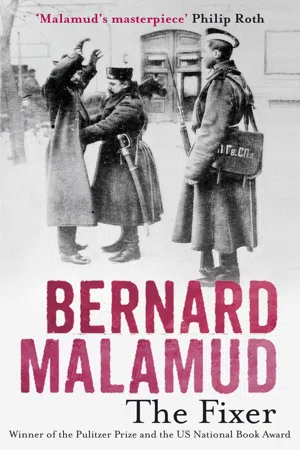
Winner of the 1966 Pulitzer Prize and National Book Award
Kiev, 1911. When a twelve-year-old Russian boy is found stabbed to death, his body drained of blood, the accusation of ritual murder is levelled at the Jews. Yakov Bok - a handyman hiding his Jewish identity from his anti-Semitic employer - is first outed and blamed. Arrested and imprisoned, Bok refuses to confess to a crime that he did not commit. What becomes of this man under pressure, for whom acquittal is made to seem as hopeless as conviction, is the subject of a terrifying masterpiece of twentieth-century fiction.
Acclaim for Malamud:
'Malamud is a rich original of the first rank'
Saul Bellow
'Malamud has never produced a mediocre novel... He is always profoundly convincing'
Anthony Burgess
'One of Malamud's extraordinary gifts has always been for lifting the realistic world up, into the realm of metaphysical fantasy. Another has been to take life, lives, seriously'
Malcolm Bradbury
'One of those rare writers who makes other writers eat their hearts out'
Melvyn Bragg
Of Malamud's short stories:
'I have discovered a short-story writer who is better than any of them, including myself'
Flannery O'Connor
eBook - ePub
The Fixer
About this book
Information
Contents
Epigraph
Introduction
The Fixer
Chapter I
Chapter II
Chapter III
Chapter IV
Chapter V
Chapter VI
Chapter VII
Chapter VIII
Chapter IX
Note on the Author
‘Irrational streams of blood are staining earth …’
YEATS
‘O yonge Hugh of Lyncoln – slayn also
With cursed Jewes, as it is notable,
For it is but a litel while ago –
Preye eek for us, we synful folk unstable,
…’
With cursed Jewes, as it is notable,
For it is but a litel while ago –
Preye eek for us, we synful folk unstable,
…’
CHAUCER
Introduction
What’s the difference between a good book and a great book? Good books can be engrossing, insightful, and new. Good books often receive critical praise, and some even stand the test of time. Good books are sometimes better – in the commonly used senses of readability and craftsmanship – than great books. (Just ask anyone who admires a great book without ever having finished it.) Great books are what our world needs, but good books are what our culture desires, so good books are what most authors, most of the time, aspire to write.
Bernard Malamud’s fourth novel, The Fixer, has all the makings of a good book. Its characters evoke empathy, its style admiration. The winner of both the National Book Award and the Pulitzer Prize in 1967, it is still widely read. (And it’s hard to imagine the reader taking more than a day or two to get to its dramatic end.) Yet what makes it a great book, above and beyond its glowing goodness, has to do with something else altogether: its necessity.
Yakov Bok, the hero of the novel, is a fixer. If a window is broken, he replaces the glass. If a stair creaks, he silences it. But his story is one of existential fixing. ‘If I have any philosophy,’ he remarks, ‘it’s that life could be better than it is.’ After his wife leaves him, thereby ending their loveless, childless marriage, Yakov decides to try his luck in ‘the world.’ Maybe his good fortune can be found outside of the provincial shtetl where he has floundered all his life.
‘The world’ of the book is Kiev of 1911 – this is between the 1905 revolution and the overthrow of Russia’s last Tsar – and the precarious political climate has created a culture of paranoia. Latent fears and hatreds have become explicit and aggressive. When a twelve-year-old Russian boy is found stabbed to death and drained of his blood, Yakov – a nonpracticing, unbelieving Jew – is accused of ritual murder. (Such accusations were not uncommon in the Christian milieu of the period.) As the charges against him grow and deform, Yakov becomes a Job-like figure in a Kafkaesque nightmare. And his predicament becomes a symbol – not only of the Jewish epic (which would make for a simple, good book), but of the world itself.
The world is the broken thing.
The fear and hatred that Malamud evokes are familiar. That lack of humanity is not only contemporary, it is our own. It’s hard to read the paper these days without becoming paralyzed.
Good books often remind us of our troubled world.
Great books go a step further: they remind us of our humanity. And it’s only our humanity that can fix the world.
Yakov suffers, but he suffers and thinks, and suffers and struggles, and suffers and challenges his suffering. In prison, Yakov is aided by a noble gentile whose assistance is given at profound personal risk. As a chained Yakov is marched through the streets of Kiev on the way to his trial, some of those watching wave, and a few even shout his name. It’s the most they can do, and it’s a lot. The seemingly ambiguous climax is not ambiguous at all. Regardless of Yakov’s ultimate fate, a few good people have expressed their solidarity with him, and hence their humanity, and his.
When I finished reading this novel, I felt castigated and inspired. Grumbling about the state of the world suddenly wasn’t enough. And excusing myself from political activity felt wrong. In light of this book, my inaction felt immoral. While The Fixer isn’t a book about morality, it is a moral book. That is, rather than offering a flimsy directive, it presents the reader with a forceful question: Why aren’t you doing anything?
Novels that imitate sitcoms can be good, but they aren’t necessary.
Novels about heaven can be good, as can thrilling novels that imitate the movies that will be made of them, as can sassy, fashionable novels.
Our world – our desperate, broken world – needs existential novels, novels that give us something more valuable than hope: a call to action. The real fixer isn’t Yakov Bok. (He’s a character in that world.) And it isn’t Bernard Malamud. (He’s the bridge between that world and this one.) The real fixer is each of us. We must do something. That’s what this novel, like all great novels, reminds us.
THE FIXER
I
From the small crossed window of his room above the stable in the brickyard, Yakov Bok saw people in their long overcoats running somewhere early that morning, everybody in the same direction. Vey iz mir, he thought uneasily, something bad has happened. The Russians, coming from streets around the cemetery, were hurrying, singly or in groups, in the spring snow in the direction of the caves in the ravine, some running in the middle of the slushy cobblestone streets. Yakov hastily hid the small tin can in which he saved silver rubles, then rushed down to the yard to find out what the excitement was about. He asked Proshko, the foreman, loitering near the smoky brickkilns, but Proshko spat and said nothing. Outside the yard a black-shawled, bony-faced peasant woman, thickly dressed, told him the dead body of a child had been found nearby. ‘Where?’ Yakov asked. ‘How old a child?’ but she said she didn’t know and hurried away. The next day the Kievlyanin reported that in a damp cave in a ravine not more than a verst and a half from the brickworks, the body of a murdered Russian boy, Zhenia Golov, twelve years old, had been found by two older boys, both fifteen, Kazimir Selivanov and Ivan Shestinsky. Zhenia, dead more than a week, was covered with stab wounds, his body bled white. After the funeral in the cemetery close by the brick factory, Richter, one of the drivers, brought in a handful of leaflets accusing the Jews of the murder. They had been printed, Yakov saw when he examined one, by the Black Hundreds organizations. Their emblem, the Imperial double-headed eagle, was imprinted on the cover, and under it: SAVE RUSSIA FROM THE JEWS. In his room that night, Yakov, in fascination, read that the boy had been bled to death for religious purposes so that the Jews could collect his blood and deliver it to the synagogue for the making of Passover matzos. Though this was ridiculous he was frightened. He got up, sat down, and got up again. He went to the window, then returned hastily and continued to read the newspaper. He was worried because the brick factory where he worked was in the Lukianovsky District, one in which Jews were forbidden to live. He had been living there for months under an assumed name and without a residence certificate. And he was frightened of the pogrom threatened in the newspaper. His own father had been killed in an incident not more than a year after Yakov’s birth – something less than a pogrom, and less than useless: two drunken soldiers shot the first three Jews in their path, his father had been the second. But the son had lived through a pogrom when he was a schoolboy, a three-day Cossack raid. On the third morning when the houses were still smoldering and he was led, with a half dozen other children, out of a cellar where they had been hiding he saw a black-bearded Jew with a white sausage stuffed into his mouth, lying in the road on a pile of bloody feathers, a peasant’s pig devouring his arm.
2
Five months ago, on a mild Friday in early November, before the first snow had snowed on the shtetl, Yakov’s father-in-law, a skinny worried man in clothes about to fall apart, who looked as though he had been assembled out of sticks and whipped air, drove up with his skeletal horse and rickety wagon. They sat in the thin cold house – gone to seed two months after Raisl, the faithless wife, had fled – and drank a last glass of tea together. Shmuel, long since sixty, with tousled gray beard, rheumy eyes, and deeply creased forehead – dug into his caftan pocket for half a yellow sugar lump and offered it to Yakov who shook his head. The peddler – he was his daughter’s dowry, had had nothing to give so he gave favors, service if possible – sucked tea through sugar but his son-in-law drank his unsweetened. It tasted bitter and he blamed existence. The old man from time to time commented on life without accusing anyone, or asked harmless questions, but Yakov was silent or short with answers.
After he had sipped through half his glass of tea, Shmuel, sighing, said, ‘Nobody has to be a Prophet to know you’re blaming me for my daughter Raisl.’ He spoke in sadness, wearing a hard hat he had found in a barrel in a neighboring town. When he sweated it stuck to his head, but being a religious man he didn’t mind. Otherwise he had on a patched and padded caftan from which his skinny hands hung out. And very roomy shoes, not boots, which he ran in, and around in.
‘Who said anything? You’re blaming yourself for having brought up a whore.’
Shmuel, without a word, pulled out a soiled blue handkerchief and wept.
‘So why, if you’ll excuse me, did you stop sleeping with her for months? Is that a way to treat a wife?’
‘It was more like weeks but how long can a man sleep with a barren woman? I got tired of trying.’
‘Why didn’t you go to the rabbi when I begged you?’
‘Let him stay out of my business and I’ll stay out of his. All in all he’s an ignorant man.’
‘Charity you were always short of,’ the peddler said.
Yakov rose, enraged. ‘Don’t talk to me about charity. What have I had all my life? What have I got to give away? I was practically born an orphan – my mother dead ten minutes later, and you know what happened to my poor father. If somebody said Kaddish for them it wasn’t me till years later. If they were waiting outside the gates of heaven it was a long cold wait, if they’re not still waiting. Throughout my miserable childhood I lived in a stinking orphans’ home, barely existing. In my dreams I ate and I ate my dreams. Torah I had little of and Talmud less, though I learned Hebrew because I’ve got an ear for language. Anyway, I knew the Psalms. They taught me a trade and apprenticed me five minutes after age ten – not that I regret it. So I work – let’s call it work – with my hands, and some call me “common” but the truth of it is few people know who is really common. As for those that look like they got class, take another look. Viskover, the Nogid, is in my eyes a common man. All he’s got is rubles and when he opens his mouth you can hear them clink. On my own I studied different subjects, and even before I was taken into the army I taught myself a decent Russian, much better than we pick up from the peasants. What little I know I learned on my own – some history and geography, a little science, arithmetic, and a book or two of Spinoza’s. Not much but better than nothing.’
‘Though most is treyf I give you credit—’ said Shmuel.
‘Let me finish. I’ve had to dig with my fingernails for a living. What can anybody do without capital? What they can do I can do but it’s not much. I fix what’s broken – except in the heart. In this shtetl everything is falling apart – who bothers with leaks in his roof if he’s peeking through the cracks to spy on God? And who can pay to have it fixed let’s say he wants it, which he doesn’t. If he does, half the time I work for nothing. If I’m lucky, a dish of noodles. Opportunity here is born dead. I’m frankly in a foul mood.’
‘Opportunity you don’t have to tell me about—’
‘They conscripted me for the Russo-Japanese War but it was over before I got in. Thank God. When I got sick they booted me out. An asthmatic Jew wasn’t worth the trouble. Thank God. When I got back I scraped again with my broken nails. After a long run-around which started when I met her, I married your daughter, who couldn’t get pregnant in five and a half years. She bore me no children so who could I look in the eye? And now she runs off with some stranger she met at the inn – a goy I’m positive. So that’s enough – who needs more? I don’t want people pitying me or wondering what I did to be so cursed. I did nothing. It was a gift. I’m innocent. I’ve been an orphan too long. All I have to my name after thirty years in this graveyard is sixteen rubles that I got from selling everything I own. So please don’t mention charity because I have no charity to give.’
‘Charity you can give even when you haven’t got. I don’t mean money. I meant for my daughter.’
‘Your daughter deserves nothing.’
‘She ran from one rabbi to another in every town I took her, but nobody could promise her a child. She ran to the doctors too when she had a ruble, but they told her the same thing. It was cheaper with the rabbis. So she ran away – may God protect her. Even a sinner belongs to Him. She sinned but she was desperate.’
‘May she run forever.’
‘She was a true wife to you for years. She shared your every misfortune.’
‘What she caused she shared. She was a true wife to the last minute, or the last month, or the month before that, and that makes her untrue, a black cholera on her!’
‘God forbid,’ cried Shmuel, rising. ‘On you!’
Eyes agitated, he thickly cursed the fixer and fled from the house.
Yakov had sold everything but the clothes on his back, which he wore as peasants do – embroidered shirt belted outside his trousers, whose legs were stuffed into wrinkled high boots. And a peasant’s worn and patched, brown sheepskin coat, which could, on occasion, smell of sheep. He had kept his tools and a few books: Smirnovsky’s Russian Grammar, an elementary biology book, Selections from Spinoza, and a battered atlas at least twenty-five years old. He had made a small bundle of the books with a piece of knotted twine. The tools were in a flour sack tied at the neck, the crosscut blade protruding. There was also some food in a cone of newspaper. He was leaving behind his few ruined sticks of furniture – a junkman had wanted to be paid to take them – and two sets of cracked dishes, also uns...
Table of contents
- Cover
- By Bernard Malamud
- Title Page
- Copyright Page
- Dedication Page
- Contents
- Note on the Author
Trusted by 375,005 students
Access to over 1.5 million titles for a fair monthly price.
Study more efficiently using our study tools.
Frequently asked questions
Yes, you can cancel anytime from the Subscription tab in your account settings on the Perlego website. Your subscription will stay active until the end of your current billing period. Learn how to cancel your subscription
No, books cannot be downloaded as external files, such as PDFs, for use outside of Perlego. However, you can download books within the Perlego app for offline reading on mobile or tablet. Learn how to download books offline
Perlego offers two plans: Essential and Complete
- Essential is ideal for learners and professionals who enjoy exploring a wide range of subjects. Access the Essential Library with 800,000+ trusted titles and best-sellers across business, personal growth, and the humanities. Includes unlimited reading time and Standard Read Aloud voice.
- Complete: Perfect for advanced learners and researchers needing full, unrestricted access. Unlock 1.5M+ books across hundreds of subjects, including academic and specialized titles. The Complete Plan also includes advanced features like Premium Read Aloud and Research Assistant.
We are an online textbook subscription service, where you can get access to an entire online library for less than the price of a single book per month. With over 1.5 million books across 990+ topics, we’ve got you covered! Learn about our mission
Look out for the read-aloud symbol on your next book to see if you can listen to it. The read-aloud tool reads text aloud for you, highlighting the text as it is being read. You can pause it, speed it up and slow it down. Learn more about Read Aloud
Yes! You can use the Perlego app on both iOS and Android devices to read anytime, anywhere — even offline. Perfect for commutes or when you’re on the go.
Please note we cannot support devices running on iOS 13 and Android 7 or earlier. Learn more about using the app
Please note we cannot support devices running on iOS 13 and Android 7 or earlier. Learn more about using the app
Yes, you can access The Fixer by Bernard Malamud in PDF and/or ePUB format, as well as other popular books in Literature & Literature General. We have over 1.5 million books available in our catalogue for you to explore.