- English
- ePUB (mobile friendly)
- Available on iOS & Android
eBook - ePub
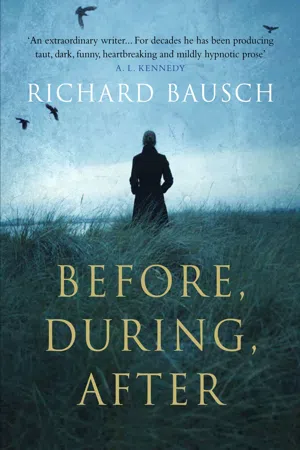
Before, During, After
About this book
Natasha, a lonely congressional aide, meets Michael Faulk, a priest struggling with his faith. Love blossoms over the spring and summer of 2001. A month before their wedding, Natasha is on a trip in Jamaica and Michael is in New York when the World Trade Center is attacked. That same day, Natasha endures a private trauma of her own: she is raped by a young man on the shores of the Caribbean. She and Michael are soon reunited, but the horror of that day, and Natasha's inability to speak of it, means that there will forever be a sharp line that divides their relationship into before and after.
Information
Contents
Before
Ms. Barrett and Father Faulk
Love Life
Fire
During
Islands
After
Natasha and Michael
These Two
Do You Take This Woman
Mr. and Mrs. Faulk
Do You Take This Man
Acknowledgments
Ms. Barrett and Father Faulk
1
Not to be lonely, not to look back with regret, not to miss anything, always to be awake and aware. And to paint. Beautifully.
Natasha Barrett had written this in her journal when she was seventeen.
Favorite watercolorists: Sargent and Gramatky. Favorite sculptors: Bernini, Donatello. Favorite book: The Age of Innocence by Edith Wharton. Favorite music: rock, particularly Men at Work, the Police, Dylan; and also for music: jazz, especially Chet Baker and Billie Holiday. Biggest fear: rejection. Biggest ambition: to travel and to know the world by heart.
Seventeen. And she had come upon it this past winter, years away. You could be a little proud, looking back. You could even find some comfort in the recollection.
In early April of the year she was to turn thirty-two, what she thought of as the chastened later version of that young woman attended a fund-raising dinner hosted by her employer, Senator Tom Norland of Mississippi, at his mansion in Arlington. The mansion was on a high bluff overlooking the Potomac River, and from the road it was just visible at its roofline after you crossed into Virginia—an immense redbrick Colonial. She had visited several times before, and there was always something warm and welcoming about it in spite of its imposing size. Behind the house was a flagstone patio, and walking paths wound through the tall oaks that stood at the edge of the bluff above the river. Along the paths, iron benches were placed decorously amid flower beds and statuary. People would gather in this wide shady space when the senator was entertaining guests.
This evening she arrived late and was greeted by Norland’s tall pretty wife, Greta. “Come right in, darling.” Greta smiled her white smile and then frowned. “Are you all right? You look a bit downhearted.”
“Oh, no, I’m fine,” Natasha said. “Just tired.”
“Well, good to see you, honey. Go right through.”
The younger woman reflected that there were people for whom cheerfulness was a trait, something they were blessed with like good bone structure and silky blond hair. She went along the polished hardwood floor of the hall and stepped out onto the patio. Cocktails and wine were being served to the left of the entrance, a young dark man standing behind a table there. Natasha asked for red wine, and his gaze went over her. She could have imagined this.
Moving away from the crowd and out onto the lawn, she walked among the statues—small, delicate-looking angelic figures in supplicating poses. Please, they all seemed to be saying.
The winter had been long, colored by the aftermath of the end of an affair. She was in no mood for a party and had wanted very badly to find an excuse not to come. But it was Friday, still part of the workweek, and her presence was required: the gathering was for the benefit of the Human Relations Conference, one of the senator’s pet projects. She was his chief organizer.
Wandering back to the patio, she stood sipping her glass of wine, surrounded by people whose evident curiosity about the senator’s “assistant”—two people actually referred to her that way—made her irritable and cross. She wasn’t there five minutes before she found herself desiring with adolescent fervor to disappear into the rooms of the house. She kept forcing a smile, listening politely to what was said to her. The guests, many of them local celebrities, were talking about the upcoming conference and about politics—the new president’s withdrawal from the Kyoto Protocol on global warming. It was a signal, someone said, about where things were headed with the Republicans back in power. Others speculated about all that. Someone else remarked on the perfect weather, trying to change the subject. To Natasha it all began to seem depressingly automatic, like the chatter of birds on a shoreline. Species noise.
The weather was indeed fine: clear and cool, breezes stirring like whispered secrets in the leaves of the oaks bordering the property, the new leaves gold daubed with sun, nearly translucent. The gravel and flagstone walks skirting the edge of the bluff afforded a lovely view of the dark green river far below, with its ranks of sculling boats from Georgetown. The air was flower scented.
Norland approached through the confusion of others, grasping the upper arm of a man who seemed reluctant to be handled in that way. She saw that the man wore a clerical collar. “Natasha,” Norland said. “You grew up in Memphis.”
The senator had a gift for tautology.
She nodded and smiled at him.
“I’d like you to meet Father Michael Faulk, pastor of Grace Episcopal Church in Memphis, Tennessee.”
Father Faulk was tall, solid looking, bulky through the shoulders. She saw his dark brown eyes and, when they shook hands, felt the roughness of his palm.
“Actually, I grew up in Collierville,” she said to him.
“Collierville. I don’t get out that way much.”
“In Memphis people decide not to go somewhere if it’s more than five minutes away. I had Memphis friends who would talk about Collierville as if it was Knoxville, four hundred miles down the road instead of fifteen.”
“You say you had Memphis friends.” His black hair was receding. He looked to be in his late forties or early fifties.
She said, “Former friends, yes.”
“I won’t ask.”
“They all moved to other cities?” she said in the tone of someone speculating.
“I’m still not asking.”
They talked a little about Graceland and other attractions. It was the usual informal kindness of social occasions. She did not feel up to it.
“I’ve never really thought about the distance to Collierville,” he went on. “Is it fifteen miles?”
“Fifteen miles from Beale Street to where I lived growing up.” She turned to acknowledge the greeting of a coworker, Janice Layne, who was the senator’s press secretary. Father Faulk moved off, having been pulled in another direction by one of the donors to the event—and perhaps having sensed her reluctance to chat. Janice frowned slightly. “Mmm. Who’s the one in the pretty collar?” That was Janice, boy crazy by her own account, and probably, secretly, nothing of the kind. Natasha had an indulgent sense of knowing affection for her.
“I’ve just been introduced. You don’t know him?”
“He does look a little familiar. And he’s hot. And Episcopal. I already got that much. And so if he’s single, he’s fair game. I’ll find out for us.”
“Go, girl,” Natasha said automatically. She was already beginning to forget him.
But they got seated next to each other at the dinner, and he turned a charmingly sidelong smile her way, talking about how he could never get used to the grandeur of places such as this—with its atrium and its wide entrances and the original Rembrandt on the wall in the next room. He had been raised in Biloxi, in a decidedly middle-class environment, though his mother, just after he turned seventeen, was the recipient of a large inheritance from a great-uncle who had made a lot of money building houses. “Most of my boyhood,” he said, “was spent so far from this. Anyway, I don’t think I’ll ever get used to it.”
The humor in his face and the rich timbre of his voice brought her out of herself. He asked, through the smile, if she liked Washington. “I do,” she told him. “Mostly.”
“Exactly how I feel about Memphis.”
“How long have you been there?”
“A long time, now. I went north out of high school. College in Boston—not Harvard.” The smile widened. “Went to seminary in Saint Louis, and then down to Memphis.”
“Your family still in Biloxi?”
“My mother died three years ago,” he said. “My father lives in Little Rock. I have an aunt here in Washington.”
She leaned toward him and murmured, “The, um, senator’s press secretary wants to know if you’re married.”
He looked down the table toward Senator Norland and Janice Layne. “You mean Ms. Layne.”
“The very lady.”
He grinned. “Divorced.”
“I’m sorry. But she’ll be glad to hear it.”
“Not interested.”
This occasioned a pause, and they watched the others talking and sipping their wine. She thought she might have stepped over some line. He was gazing at the room, evidently far away now, hands folded at his chin.
She said, “Did you like Biloxi?”
And he seemed to come to himself. “I did. Very much. Yes.”
Another pause.
“How about you?” he asked. “Does the senator’s press secretary want to know if you’re married?”
“Janice was just curious,” Natasha told him.
“I was joking.”
“She was, too—a little.”
He grinned. “Actually, my former wife is getting remarried. It’s happening in the next couple of days.”
“How’s that make you feel?”
“It’s—as we say—in everyone’s best interest.”
Natasha nodded, unexpectedly on edge now. She thought of excusing herself. But there wasn’t anywhere to go in this place without being seen leaving. She watched the senator talking to a big florid man about Virginia horse country and drank down her wine. It left an almost-syrupy aftertaste.
“I never feel comfortable at this kind of gathering.” Father Faulk spoke softly, only to her.
“I can’t help seeing it all as a series of gestures,” she said. “Makes me feel judgmental.”
“Not us. We’re too cool.”
It was pleasurable to be included in that way, even jokingly.
“Want to talk about Collierville?” he asked.
“Sure.”
He waited.
“Do you like bluegrass?”
“Don’t know much about it, but I like it.”
She described summer evenings when people would gather in the charming old town center to play music.
“I have seen that,” he said. “Wonderful. I like the antiques shops, too, and the old train station museum. I should go out there more often.”
“I guess it’s different if a person lives there.”
“You couldn’t wait to get away.”
“No,” she said. “Not really. It was just—you know—it was home.”
He had an appealing weathered look. Realizing her own growing interest in him, she experienced a surprising stir of anticipation. It had been months since she had felt much of anything but weariness. She sipped the ice water before her, and her hand shook a little when she set the glass down. She wanted more wine. He was talking across the table about the Rembrandt to a narrow-faced middle-aged woman who had spectacles hanging from a little chain around her neck. “I joked about all the cracks in the original painting,” he told her, “you kno...
Table of contents
- Cover
- Title Page
- Copyright page
- Dedication page
- Contents
Trusted by 375,005 students
Access to over 1.5 million titles for a fair monthly price.
Study more efficiently using our study tools.
Frequently asked questions
Yes, you can cancel anytime from the Subscription tab in your account settings on the Perlego website. Your subscription will stay active until the end of your current billing period. Learn how to cancel your subscription
No, books cannot be downloaded as external files, such as PDFs, for use outside of Perlego. However, you can download books within the Perlego app for offline reading on mobile or tablet. Learn how to download books offline
Perlego offers two plans: Essential and Complete
- Essential is ideal for learners and professionals who enjoy exploring a wide range of subjects. Access the Essential Library with 800,000+ trusted titles and best-sellers across business, personal growth, and the humanities. Includes unlimited reading time and Standard Read Aloud voice.
- Complete: Perfect for advanced learners and researchers needing full, unrestricted access. Unlock 1.5M+ books across hundreds of subjects, including academic and specialized titles. The Complete Plan also includes advanced features like Premium Read Aloud and Research Assistant.
We are an online textbook subscription service, where you can get access to an entire online library for less than the price of a single book per month. With over 1.5 million books across 990+ topics, we’ve got you covered! Learn about our mission
Look out for the read-aloud symbol on your next book to see if you can listen to it. The read-aloud tool reads text aloud for you, highlighting the text as it is being read. You can pause it, speed it up and slow it down. Learn more about Read Aloud
Yes! You can use the Perlego app on both iOS and Android devices to read anytime, anywhere — even offline. Perfect for commutes or when you’re on the go.
Please note we cannot support devices running on iOS 13 and Android 7 or earlier. Learn more about using the app
Please note we cannot support devices running on iOS 13 and Android 7 or earlier. Learn more about using the app
Yes, you can access Before, During, After by Richard Bausch in PDF and/or ePUB format, as well as other popular books in Literature & Literature General. We have over 1.5 million books available in our catalogue for you to explore.