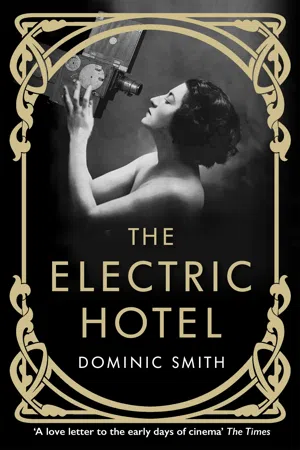
From the award-winning author of the acclaimed bestseller
The Last Painting of Sara de Vos comes a radiant new novel tracing the intertwined fates of a silent film director and his muse.
The Electric Hotel winds through the nascent days of cinema in Paris and Fort Lee, New Jersey - America's first movie town - and the battlefields of Belgium during World War I. A sweeping work of historical fiction, it shimmers between past and present as it tells the story of the rise and fall of a prodigious film studio and one man's doomed obsession with all that passes in front of the viewfinder.
For nearly half a century, Claude Ballard has been living at the Hollywood Knickerbocker Hotel. A French pioneer of silent films, who started out as a concession agent for the Lumière brothers, the inventors of cinema, Claude now spends his days taking photographs of Sunset Boulevard. But when a film-history student comes to interview Claude about
The Electric Hotel - the lost masterpiece that bankrupted him and ended the career of his muse, Sabine Montrose - the past comes surging back. In his run-down hotel suite, the ravages of the past are waiting to be excavated: celluloid fragments and reels in desperate need of restoration, and Claude's memories of the woman who inspired and beguiled him.
The Electric Hotel is a portrait of a man entranced by the magic of movie-making, a luminous romance and a whirlwind trip through the heady, endlessly inventive days of early cinema.
eBook - ePub
The Electric Hotel
About this book
Information
1
____________
The Knickerbocker

Each morning, for more than thirty years, Claude Ballard returned to the hotel lobby with two cameras strapped across his chest and a tote bag full of foraged mushrooms and herbs. His long walking circuit took in Little Armenia, where he photographed rug sellers smoking cigarettes in the dawning light or, more recently, the homeless college dropouts and beatniks along Sunset Boulevard, striplings, the doorman called them, the ambassadors of Hollywood ruin. This morning—a crisp sunny day in December of 1962—he’d also foraged up into the hills and canyons and now sat in his usual chair, leaning over a coffee table with a pair of nail scissors, trimming the stems of oyster mushrooms and the lacy fronds of wild fennel. He wore a threadbare glen plaid suit with Swiss mountaineering boots, a crumpled white handkerchief flaming like a moth orchid from his breast pocket.
•
His appointment was late so he began to delicately insert the trimmed plants into envelopes, the hotel manager’s English setter, Elsie, nuzzled and sleeping at his feet. Claude could remember a lineage of hotel setters and bloodhounds, purebreds that slept in the lobby and rode the lifts when they were bored or hungry. Speck, the first mascot, was a forager in his own right, moving between the eleven floors where residents and guests left out their breakfast dishes. D.W. Griffith, who’d made the first American epic, used to coax Speck into his room with bacon and eggs. When he died of a stroke under the lobby chandelier in 1948, all but forgotten, the dog kept vigil outside his room every morning for a month.
Claude watched Elsie breathe and twitch at his feet, transported into a dream chase, he imagined, by the smell of damp underbrush and ragweed that clung to his trousers and boots. He looked out through the glass doors for a sign of his visitor, but only the doorman, Sid, was standing there in his gold-trimmed cap and epaulets. From this vantage point, he appeared to Claude like a war-weary admiral standing alone on a dock, staring out to sea, hands clasped behind his back. He still dressed as if he opened doors for Bob Hope and Jack Benny.
But the truth was the Knickerbocker Hotel’s best days were far behind it. If the lobby had once resembled an elegant Spanish Colonial outpost, with its stencilled, hand-painted ceilings and Moorish tapestries, it now resembled a Madrid funeral home on hard times. Frayed cordovan carpets, dusty ferns in copper pots, velvet gondola couches marooned in pools of fifteen-watt lamplight. Celebrities once sat in easy chairs smoking cigars or reading Variety, but now an unemployed screenwriter was taking his pet iguana for a morning stroll and Susan Berg, an actress of the silent era, stood in her robe whispering a monologue to an empty chaise longue.
Over the rim of Claude’s bifocals, Susan appeared as a winking silhouette, a corona of daylight streaming in behind her from the street. Her words were mostly lost, her face turned away, her voice soft and worn. She delivered this speech a few mornings a week, always in the same alcove, where insurance clerks or secretaries on their way to the Guaranty Office Building might glimpse her through the front windows. These were the last lines she’d ever spoken on camera, dialogue intended not to be heard but to be printed on intertitle cards. Claude sometimes caught a single phrase or word from the murmured speech, and the line Why single me out for revenge? had stayed with him. She’d told him that it was from a 1922 Western called Comanche Bride, but Claude couldn’t recall it. By the time of its release, his directing days were over and the medium was dead to him.
There were other refugees of the silent era still living at the hotel—a one-time makeup artist who cut hair in her room, a master carpenter who did odd jobs around the neighbourhood, a widowed British actor who’d barricaded himself in his two-room suite during the Cuban missile crisis back in October. Claude kept an eye out for them, offered to pick up prescriptions or newspapers on his walks, brought takeout up from the lobby when one of them was under the weather, but although they were friendly they never talked about the old days. And they never mentioned Susan Berg’s lobby monologues or the silent era memorabilia Claude had stashed away in his small suite.
•
When Claude thought about the hotel’s heyday, he remembered the house band, the Hungarian Symphonette, playing out on the Lido patio while celebrities danced or, later, Houdini’s widow holding a séance on the rooftop to commune with the escape artist, or the time that Elvis recorded ‘Love Me Tender’ in room 1016. He’d witnessed and photographed the passing of a golden, burnished epoch. A passenger sitting at the window on a train at dusk, it seemed to him now. In 1954, Claude had met Marilyn Monroe in the lift after she’d eloped with Joe DiMaggio, a canvas bag of mushrooms hung over Claude’s shoulder, and she’d been kind enough to ask him about his foraging expeditions. Somewhere in his suite, he had an undeveloped negative of the actress holding up a black elfin saddle mushroom as if it were a dead mouse. Later, in the lobby, she blew him a kiss and called him the mushroom hunter from the lift, oblivious to the fact that he was a film pioneer.
When the newspapers reported Marilyn Monroe’s suicide in her Brentwood home back in August, he’d thought about her in the lift, imagined her forever rising between floors toward the sundeck. He remembered her holding a towel and a transistor radio, smelling of rose-hip shampoo and cigarettes, girlish and shy behind her oversized sunglasses. That was how history showed up at the Knickerbocker, fleetingly and behind smoked glass. The hotel was once a place to be seen and now it was a place to hide or disappear, sometimes forever.
For the most part, the suicides on the eleventh floor were gruesomely quiet affairs—barbiturate overdoses or the lancing of arteries in a bathtub. But in November, a costume designer had left the world noisily and it rattled Claude in a way he couldn’t explain. He’d been out on the footpath talking to Sid, returning from one of his walks, perhaps holding up an exemplary sprig of chervil into the sunlight, when he looked up and saw Irene Lentz—he would learn her name later—sitting on the ledge of a bathroom window on the top floor. She sat there calmly for a moment, kicking her bare feet back and forth, testing the air as if it were a swimming pool, and then she edged off the sill. She shot down toward the concrete awning, flailing and screaming, and Claude felt his hands rise involuntarily above his head as she fell. She landed right behind the neon Hollywood sign with a sound that left nothing to the imagination.
1962 had already featured a man going into space orbit and the Russians pointing nuclear missiles at Florida, but it was somehow the sight of Irene Lentz’s covered body being lowered by medics on a gurney with ropes that shook something loose in him. For months, he’d been reading but not responding to the earnest, flattering letters of a film graduate student, and it was the afternoon of the suicide when he finally wrote back to suggest a meeting. It was time to tell the story of how he’d ended up on this desolate shoreline, time to wave back at the spinning world.
In one of his letters, Martin Embry had referred to Claude’s first silent feature, The Electric Hotel, as a lost masterpiece, and now Claude found it difficult to square that phrasing with the fact that his correspondent was fifteen minutes late. Did one keep an eighty-five-year-old master waiting? As if summoned by this thought, Sid opened one of the glass doors for a shaggy blonde man in his twenties, wearing a tan suede coat and a bolo tie. The doorman pointed in Claude’s direction and then fell in behind the visitor. Claude busied himself with his mushrooms and fennel fronds because it was bad manners to be late but it was worse manners to notice.
Claude looked up and smiled when he heard the sound of boot heels on the terra-cotta tiles. He sometimes photographed this kind of apparition out on Hollywood Boulevard, among the music and creative types, the urban cowboy with the unruly sideburns and big belt buckle who’s just moved out of his parent’s basement in Van Nuys. To Claude’s mind he didn’t look anything like a Ph.D. student in film history. The doorman gestured to Claude, and the man in western wear grinned and nodded.
—Mr Claude Ballard, in the flesh, said Sid. Cinematic genius, forager of edible plants and permanent resident of this fine establishment since 1929.
—You’re making me feel like I’m part of a museum exhibition, said Claude.
—I’m Martin Embry. It is an enormous and distinct pleasure.
He extended his hand to Claude and they shook. Sid picked up a newspaper and returned to his post at the front doors.
—Please, have a seat, Claude said.
Martin sat in the armchair opposite and leaned down to rub Elsie’s rump. The dog quivered but continued to sleep.
—She is dreaming of chasing a rabbit, Claude said, which I am inclined to think always ends with a meal. Before she got so old I used to take her out foraging.
—I grew up with dogs. I miss them out here.
—You are not from here?
—Texas. I moved out here for graduate school.
A silence settled between them as they both watched the sleeping dog.
—I must apologise for not replying to your letters sooner, Claude said. You see, I have been out of the correspondence business for many years.
—I understand completely.
—Very kind. Would you mind terribly if I took some footage of you?
—Are you making a film?
—I like to document what happens to me each day. Call it an old habit.
Claude lifted the 16 mm Bell & Howell from around his chest and filmed several seconds of Martin blinking and smiling into the lens. Then he took out a small spiral notebook from his jacket and jotted down the date, time and subject.
—I wondered if I might take you out for breakfast. I’d love to ask you about your career.
—There’s a diner around the corner, Claude said. I have trained them to make omelettes the way I like them....
Table of contents
- Cover
- Title
- Copyright
- 1 The Knickerbocker
- 2 The Silver Quickening
- 3 A Magnificent Outburst
- 4 The Fiery Splash
- 5 The Bender Bijoux
- 6 The Lost Film
- 7 Across the River
- 8 The Idea
- 9 The Feature
- 10 The Actress Prepares
- 11 The Widow
- 12 Filming Begins
- 13 The Comet
- 14 The Proposal
- 15 The Mansion of Happiness
- 16 The Old Neighbourhood
- 17 Last Day of Shooting
- 18 The Premiere
- 19 Edison’s Attack
- 20 The Monogrammed Suitcase
- 21 The First Escape
- 22 War Correspondents
- 23 The Belgian Woods
- 24 The Château
- 25 The Sack of Louvain
- 26 Antwerp
- 27 Exile
- 28 The Blackout
- 29 The Messenger
- 30 Faux Paris
- 31 Andorra
- 32 Return to the River
- Acknowledgments
- Illustration Credits
Trusted by 375,005 students
Access to over 1.5 million titles for a fair monthly price.
Study more efficiently using our study tools.
Frequently asked questions
Yes, you can cancel anytime from the Subscription tab in your account settings on the Perlego website. Your subscription will stay active until the end of your current billing period. Learn how to cancel your subscription
No, books cannot be downloaded as external files, such as PDFs, for use outside of Perlego. However, you can download books within the Perlego app for offline reading on mobile or tablet. Learn how to download books offline
Perlego offers two plans: Essential and Complete
- Essential is ideal for learners and professionals who enjoy exploring a wide range of subjects. Access the Essential Library with 800,000+ trusted titles and best-sellers across business, personal growth, and the humanities. Includes unlimited reading time and Standard Read Aloud voice.
- Complete: Perfect for advanced learners and researchers needing full, unrestricted access. Unlock 1.5M+ books across hundreds of subjects, including academic and specialized titles. The Complete Plan also includes advanced features like Premium Read Aloud and Research Assistant.
We are an online textbook subscription service, where you can get access to an entire online library for less than the price of a single book per month. With over 1.5 million books across 990+ topics, we’ve got you covered! Learn about our mission
Look out for the read-aloud symbol on your next book to see if you can listen to it. The read-aloud tool reads text aloud for you, highlighting the text as it is being read. You can pause it, speed it up and slow it down. Learn more about Read Aloud
Yes! You can use the Perlego app on both iOS and Android devices to read anytime, anywhere — even offline. Perfect for commutes or when you’re on the go.
Please note we cannot support devices running on iOS 13 and Android 7 or earlier. Learn more about using the app
Please note we cannot support devices running on iOS 13 and Android 7 or earlier. Learn more about using the app
Yes, you can access The Electric Hotel by Dominic Smith in PDF and/or ePUB format, as well as other popular books in Literature & Literature General. We have over 1.5 million books available in our catalogue for you to explore.