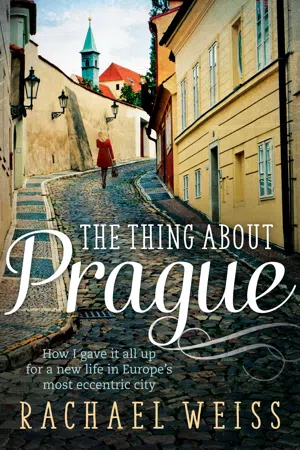
When Rachael Weiss left a good job, Thelma the cat and a normal life in Sydney for the romantic dream of being a writer in Prague she intended to stay forever. She lasted just three years, exasperated by the eccentricities of her ancestral city and its mind-boggling bureaucracy and customs.
In this surprising and generous memoir full of warmth and unstoppable sociability, Rachael attempts to write her great novel, buy an apartment (any apartment!), dodge unscrupulous employers, and perhaps find love. She gets lost in the woods with a Kyrgyzstani software engineer who wants to eat humans, finds herself leading services at the Spanish synagogue with no real idea of what she is doing and spends long nights drinking beer with a colourful cast of crazy, warm and slightly mad locals and expats.
Rich in absurdities and gentle humour,
The Thing About Prague... is rife with insight, culture clashes, friendships and above all charm.
eBook - ePub
The Thing About Prague...
How I Gave It All Up For a New Life in Europe's Most Eccentric City
- English
- ePUB (mobile friendly)
- Available on iOS & Android
eBook - ePub
The Thing About Prague...
How I Gave It All Up For a New Life in Europe's Most Eccentric City
About this book
Information
1
In 2005, I took a year out of my life to live in romantic Prague and write a novel of literary genius. I returned to Sydney after my year was up with a manila folder full of scribbled notes and half-formed ideas, no nearer to joining Kafka in the literary canon, but at least having produced a light travelogue about my year abroad. I resumed my ordinary life, fully expecting to simply pick up where I had left off. Life did return to its normal rhythm but something was not sitting right—I was restless. I was forty-one, still unmarried and childless. I made my living as a mid-level administrator—I had a nice boss and engaging work managing a team of personal assistants. It’s not a bad life, being an administrator, but it’s not the most exciting life either.
It was a visit to my doctor that decided me. I was there for my annual check-up.
‘Are you exercising?’ she asked, her eyes on the blood pressure valve.
‘Yes,’ I replied.
‘What do you do?’
‘Yoga twice a week and I walk to work.’ I felt like I used to at school when I’d done my homework—proud, and relieved that I could give the right answer.
‘That’s good,’ she said, still gazing at the valve and twitching her hand on the pump. ‘A regular exercise routine is important in middle age. Sets you up for a good old age.’
There was a stunned silence. At least, I was stunned. The doctor seemed to think nothing had happened. Did she just call me ‘middle-aged’? Did she just say old age?! So I’m middle-aged, with old age just around the corner?
In the office bathroom the next day, somewhat hungover, I noticed in the mirror that my eyelashes were holding up my eyelids. I put a thumb under my eyebrows and lifted. The lids lifted too. I slowly let the pressure off. The lids dropped back, exhausted, onto my lashes.
Up to then I had thought my year’s stay in Prague had been the same as my years anywhere else, just surrounded by castles. But as I poked fruitlessly at my eyebrows, thinking, aging is just one daily indignity after another, isn’t it? it occurred to me that if I had to cope with varicose veins, with crease lines from my pillow staying on my cheek until mid-morning, with mysteriously swelling feet (I don’t even want to think what that’s all about), with, in fact, middle age, I’d rather do it somewhere with romantic cobbled streets, midnight-blue evenings, snowflakes and cheap beer. Not in a dreary office block in Sydney. I felt that if I stayed here I might just as well choose a plot at Rookwood Cemetery and get it over with.
I’d like to say that my decision to move to Prague permanently was based on something grand and noble—a desire to trace my roots, a sense of adventure, my literary heart yearning to burst into flower in the sweet soil of Old Europe—but I can’t. The truth is that I had nothing better to do. If anyone asked me why I was going (and everyone did), I said airily, ‘Oh, you know, to cast my bread upon the waters and see what happens—do something different.’ Giving them the impression that I was brave and adventurous beyond words when in fact I was simply rudderless beyond words and frightened of getting old.
The decision, once made, brought with it a raft of other decisions. What should I take? What would I do when I got there? Should I tell my mother, or wait until I landed and then give her a phone call? All of them too difficult to contemplate.
I looked around at my belongings. My sister, who had once spent a year in London, had had a garage sale—‘I made a thousand dollars, just like that!’ A thousand dollars would come in handy. Mind you, my sister had had a house full of interesting artefacts from Africa, top quality china, vases, silver spoons and children’s toys. I had a few bookshelves made of particle board held together with the red paint I’d used on them fifteen years ago when I picked them up off the street, plus some aluminium pots and pans, an unused Mixmaster I’d won in a trivia quiz, a couple of pot plants and a cat.
I’d picked up Thelma along with the bookshelves and what to do with her was quite a problem. I loved that little cat. She and I had been together for most of my adult life and all of hers. She’d been a tiny scrap no bigger than the palm of my hand when I found her and had started purring the instant I stroked her little ears.
Thelma had been abandoned, poor little mite, so I took her in and loved her. I read somewhere that feral animals become domestic after five generations of being bred as domestic. My little Thelma took one. She was a cat who loved to snuggle up by the fireside, snooze through Saturday morning on my bed, and eat. A lap only had to form in the house and Thelma was on it.
She had a special affection for men, the little minx. The only people she wouldn’t sit on were people who adored cats and wanted nothing more than for Thelma to sit on them their entire stay.
What to do with Thelma was my first problem. I really didn’t feel I could take her with me, as much as I wanted to. She was fifteen years old and I worried that the trip would kill her. Also, I didn’t know where I was going to live when I got there and I didn’t want her having to change locations too many times. We’d moved a lot when she was little but in her old age we’d stayed put, mainly because I noticed she was finding it harder and harder to orient herself when we moved. She’d stay at home for weeks before she ventured out and, even when she did, she didn’t go very far.
I had vowed I wouldn’t move her again. I could see her getting happier and happier as the months passed and she made the territory her own. What would she do in an entirely new country? And what about the snow? Thelma thought the heater should go on as soon as she saw a cloud in the sky. If she was like that in Sydney, how would she cope in a Czech winter? No, Thelma would have to stay.
She had boarded at her Aunt Cynthia’s place when I went to Prague the first time. Thelma’s Aunt Cynthia had two other cats, both of whom lived like kings. They had their own baskets with a special electric warming pad each, and Cynthia, who worked from home, spent her days moving their baskets around the verandah, the cats sitting superbly within, following the sun.
I told myself that sending Thelma to live there was like putting her in a luxury retirement home. I took her over, put her in her special basket, stayed and chatted for a bit, then stood up to leave.
Never will I forget that moment. I opened the front door and walked out. Thelma came pounding up the hall and Cynthia quickly shut the screen door. Thelma scrabbled at the mesh frantically, panic stricken. As she saw me move away, saying goodbye, not coming back to rescue her, she stayed at the door, her front paws pressed against the mesh, her eyes huge and glued to me—betrayed.
For the first time it occurred to me that the decision ‘I will move countries’ had unforeseen consequences. To this day I’m haunted by that look on Thelma’s face. She’d never panicked like that when I left her with her Aunt Cynthia for holidays. I don’t know how she knew that we wouldn’t be living together again, but she did. My heart still stops with missing her.
As for my possessions, I decided to set them free. I contemplated selling them on eBay but my brother-in-law pointed out that they were worthless. I thought you could sell anything on eBay, but apparently that’s just propaganda. The neighbourhood Thelma and I had washed up in was a down-at-heel, inner-city suburb, full of drug addicts and council houses and single mothers with screaming kids. It was also full of first-time immigrants, scraping together money from laundry and corner-store businesses to send their kids to university so that the kids would not have to live in this suburb as adults.
My block of flats was a mini-Vietnam. Most of the displaced elderly inhabitants, relying solely on their neighbours and daughters for community, had fussed over Thelma, so I had a special affection for them. In my last day in the flat, I knocked on my neighbour’s door and told her, in sign language, that I was leaving, that she could come and raid my place for anything she wanted and could she please tell the other Vietnamese. A flood of Vietnamese mixed-goods merchants’ mothers descended and swept the place clean.
My fridge, which had originally been given to me by a friend who got a pay rise and decided to upgrade her white-goods, went to a young couple who were living with the single mum upstairs and who were unable to afford even knives and forks. He had no teeth and she was covered in tatts. As he took the fridge off my hands (and the hideous white-plastic-handled cutlery I’d been loathing for the last decade) he said, ‘We’re really grateful. We’ve just found a place to live. I’m really going to try this time. I know hitting her’s wrong.’
I almost took the fridge back, but then she came in and asked if she could take a bookshelf—‘we don’t have one’—and she seemed so nice. Why make judgement calls about her choice of man? That was her business.
My own parents had done as the Vietnamese were doing—made sacrifices so I could get a proper education and rise from the bottom of the heap. I and the woman across the hall, who was the same age as me and single as well, were nevertheless still living on the bottom of the heap. In a city as expensive and fast-paced as Sydney, if you were single and only earning a moderate wage, your accommodation options were quite limited.
The Vietnamese were first-time immigrants, but their children would live in a better suburb. The rest, however—the single mums and the terminally unemployed—were stuck there from birth to death, and their kids would be too. For them, living on an even grimmer wage than my own, life was horrifyingly precarious. How much lower could any of us go? A caravan? The street?
The only things I couldn’t part with were my books. Like everything else I owned I’d been carting those books around for twenty years. But, unlike everything else (except Thelma), they had real value for me—they were like old friends. I contemplated setting them free but after the trauma of parting with Thelma I was more careful to ask myself how much I actually cared.
The question of moving my books caused a terrible family commotion. I investigated moving companies. The first one offered to move them for six thousand dollars. After I’d come to, I called others, thinking I must have struck pirates. But no, apparently it was going to cost me at least five thousand dollars to move my books from Sydney to Prague and the company who gave me that quote was so dodgy that I finally settled on one that would do it for five thousand five hundred, but who wasn’t proposing to ship them via Kazakhstan to keep costs down.
I only needed a minute to ask myself if it was worth it. Of course it was. I’d lost Thelma, I couldn’t lose my books as well. They were all I had. But then, in an unthinking moment, I revealed these plans to my father.
‘Why are you taking your books?’
‘Because I love them.’
‘But they will take up so much space.’
‘I don’t love space, I love my books.’
‘How are you going to get them there?’
‘A moving company.’
‘A moving company?! How much is that going to cost you?’
‘. . . Um . . .’ Curses! Why didn’t I see that coming? Quick, lie!
‘How much?’
‘. . . Um . . .’ Dammit, lie better than that!
‘A lot? It’s a lot, isn’t it? How much?’
‘Well it’s. . . well it’s. . . okay, it’s about five thousand dollars. But I can’t live without them.’
‘Five thousand dollars!!’
Sigh. This was not going to go away quickly. Dad enumerated for me the many, many ways in which five thousand dollars could be better spent. I tried not to disagree too much, finally putting an end to this agonising conversation by saying, ‘Yes, well, I’ll think about it.’ The coward’s response.
Naturally, it became the subject of scandalised horror for my family. When I called my father a few days later, my stepmother answered the phone.
‘Hello, darlink,’ she said, very lovingly, because we do get on well, my stepmother and I. ‘How are you?’
‘I’m fi—’
‘WHY ARE YOU TAKING YOUR BOOKS TO PRAGUE?’
‘Well, you know how it is, I just . . .’ But she wasn’t listening. Her feelings were running too high.
‘I took all my books from Russia, and what do they do? They just sit there on the shelves! Gathering dust! I had read them all. All! I never picked them up again. You have read your books! Why must you take them with you?’
And so on. No point arguing. I just went ahead and shipped them, and the hot topic in the family gossip circle became my stubbornness in the face of reason.
I visited Thelma again every week before I left. Cynthia and I wanted her to know that she had two mums now, not that she’d lost one. We were as deluded as any parent who’s abandoned their children in divorce. (‘Mummy and Daddy love you just as much, and here’s a new bike to prove it.’) Thelma knew she didn’t have two mothers.
She punished me mightily at first. On my next visit, she sat with her back pointed towards me and pretended to be absorbed in something outside in the garden. I stroked her ear and she bit me. Who can blame her? She had right on her side. On my second visit, she thawed a little, enough to let me tickle her chin for a few minutes—before biting me. After that, things got easier. She never really forgave me but she did eventually pad up to me and demand some lap time.
I think Thelma had done her calculations. She’d looked around—at the electric heating pad, at the aunt who was home all day and who fed her roast chicken for lunch if she was looking like she needed cheering up, at the two cat companions, both of whom she’d managed to boss into submission—and she’d asked herself if she was doing badly on this deal. I think she realised that in fact her life had improved although, like me, she was living without the special bond we had. But she was bonding with Cynthia. When it was time for me to leave for good, Thelma, to my relief, was talking to me again and had settled in to her new home.
2
I arrived in Prague in March. I love a new beginning. I could see my life in Prague spreading before me, glowing and new. I’ll get up at dawn, meditate, do my yoga, then have a healthy breakfast, followed by a day of writing my new novel. And when I need a break from writing, I’ll go to the gym, or study my Czech or write amusing columns to sell to the New Yorker. I calculated that at the end of a year I would be thin, calm, flexible, and have a world-famous, really cool blog and a three-book deal. Yes, beginnings are fun for me, mainly because I really believe my life is going to be just as I am imag...
Table of contents
- COVER PAGE
- TITLE PAGE
- COPYRIGHT PAGE
- 1
- 2
- 3
- 4
- 5
- 6
- 7
- 8
- 9
- 10
- 11
- 12
- 13
- 14
- 15
- 16
- 17
- 18
- 19
- 20
- 21
- 22
- 23
- 24
- 25
- 26
- 27
- 28
- 29
- 30
- 31
- 32
- 33
- 34
- 35
- 36
- 37
- 38
- 39
- 40
- 41
- 42
- 43
- 44
- 45
- 46
- 47
- 48
- 49
- 50
- 51
- ACKNOWLEDGEMENTS
Trusted by 375,005 students
Access to over 1.5 million titles for a fair monthly price.
Study more efficiently using our study tools.
Frequently asked questions
Yes, you can cancel anytime from the Subscription tab in your account settings on the Perlego website. Your subscription will stay active until the end of your current billing period. Learn how to cancel your subscription
No, books cannot be downloaded as external files, such as PDFs, for use outside of Perlego. However, you can download books within the Perlego app for offline reading on mobile or tablet. Learn how to download books offline
Perlego offers two plans: Essential and Complete
- Essential is ideal for learners and professionals who enjoy exploring a wide range of subjects. Access the Essential Library with 800,000+ trusted titles and best-sellers across business, personal growth, and the humanities. Includes unlimited reading time and Standard Read Aloud voice.
- Complete: Perfect for advanced learners and researchers needing full, unrestricted access. Unlock 1.5M+ books across hundreds of subjects, including academic and specialized titles. The Complete Plan also includes advanced features like Premium Read Aloud and Research Assistant.
We are an online textbook subscription service, where you can get access to an entire online library for less than the price of a single book per month. With over 1.5 million books across 990+ topics, we’ve got you covered! Learn about our mission
Look out for the read-aloud symbol on your next book to see if you can listen to it. The read-aloud tool reads text aloud for you, highlighting the text as it is being read. You can pause it, speed it up and slow it down. Learn more about Read Aloud
Yes! You can use the Perlego app on both iOS and Android devices to read anytime, anywhere — even offline. Perfect for commutes or when you’re on the go.
Please note we cannot support devices running on iOS 13 and Android 7 or earlier. Learn more about using the app
Please note we cannot support devices running on iOS 13 and Android 7 or earlier. Learn more about using the app
Yes, you can access The Thing About Prague... by Rachael Weiss in PDF and/or ePUB format, as well as other popular books in Social Sciences & Social Science Biographies. We have over 1.5 million books available in our catalogue for you to explore.