Winner of the 2011 Christina Stead Prize for Fiction
Winner of
T
he Age Book of the Year
Winner of thePeople's Choice Award at the NSW Premier's Literary Awards
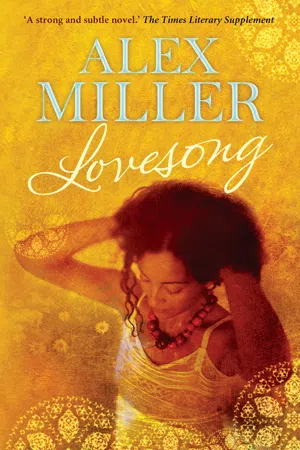
Strangers did not, as a rule, find their way to Chez Dom, a small, rundown Tunisian café on Paris's distant fringes run by the widow Houria and her young niece, Sabiha. But when one day a lost Australian tourist, John Patterner, seeks shelter in the cafe from a sudden Parisian rainstorm, a love story starts to unfold. John and Sabiha's becomes a contented but unlikely marriage-a marriage of two cultures lived in a third-and yet because they are essentially foreigners to each other, their love story sets in train an irrevocable course of tragic events.
Years later, living a small, quiet life in suburban Melbourne, what happened to them in Paris seems like a distant, troubling dream to John. He confides the story behind their seemingly ordinary lives to Ken, an ageing, melancholic writer who sees in his neighbours the possibility of one last simple love story.
Told with Miller's distinctive clarity, intelligence and compassion,
Lovesong is a pitch-perfect novel, a tender and enthralling story about the intimate lives of ordinary people. Like the truly great novelist he is, Miller locates the heart of his story in the moral frailties and secret passions of his all-too-human characters.
eBook - ePub
Lovesong
About this book
Information
It’s happened. Clare’s met someone. He’s not what I’ve been dreaming of for her. I got home from my swim on Saturday and he was sitting in the kitchen on my chair with his head on his arms, spread over the table listening to the football, an open tinny from my stock of Carlton Draught beside him. There was no sign of Clare or Stubby. I came into the kitchen and he stayed down on the table, looking up at me with his head on the side, his right eye looking out past the peak of his baseball cap.
‘I’m Clare’s dad,’ I said, wary.
‘Hi,’ he said.
‘Who’s winning?’
‘We are. Shush!’
Clare told me later, ‘He’s a mad Hawthorn supporter, Dad. You just have to accept it. He wasn’t being rude.’
I’ve never been to a football game. None of my books have football heroes. Everyone I know in Melbourne has been telling me for years I’m missing one of the greatest emotional experiences of life. But I don’t go.
I asked Clare, ‘What does Robin do?’
‘He’s a stand-up comic.’
I was deeply shocked.
‘Don’t start on him.’
He’s younger than Clare. It worries me. How is it going to work in twenty years’ time when she’s nearly sixty and needs a loyal companion and he’s still a flighty fifty-five-year-old making the girls laugh at the stand-up place where he works? Wherever that is. I’ve never seen a stand-up comic either. Local stand-up comedy is as arcane to me as the footy. It’s everywhere these days, except where I am.
I went up to my study and poured a large scotch and read through my latest notes on the saga of John and Sabiha. My refuge! I wrote some stuff that I thought had promise. It felt good to get it out. Moving it on towards an eventual reader. That’s the good old feeling. It didn’t last, but I enjoyed what there was of it. I’m prepared to be thankful these days.
John’s story was keeping my mind off the fact that there was nothing much on my mind. John was my weekly visit to the therapist. He had seemed a bit depressed the other day when he was telling me some of the tough stuff about his wife’s activities with the Italian. I felt sorry for him and asked him if he’d like to bring his wife and daughter around for dinner one Saturday night. He said they were always busy Saturday nights with the pastries. Sunday trading was wearing them out. I said, ‘So what day would suit you?’ He said he’d give it some thought, and would speak to Sabiha. An image of Sabiha sitting at my dining table, her hair up and wearing one of her gowns that she wore for her Saturday night singing at Chez Dom, was deeply interesting to me. I knew in my heart I was never going to see this for real, so I made the most of imagining it.
Asking John to dinner was my attempt to push our friendship to another level. And maybe it wasn’t the right thing to do at that point. I felt him backing off. So I said no more. Anyway, I’d begun having visions of him and Sabiha and their little girl and the baseball cap and Clare and me all sitting around our dining table looking at our food and wondering what the hell to say to each other. The Cap, I guess, would have one ear and one eye to the television replays. He doesn’t take the cap off while he eats.
I told Clare I didn’t think he was funny.
She said, ‘He’s only funny when he’s working.’
‘So he’s a professional? No free stuff for us, eh?’
‘I love him, Dad.’
This really knocked the wind out of me. I got up and drew the cork out of a bottle of Henschke and drank a whole glass before I thought of offering one to Clare. Stubby was lying under the table giving me a warning look. I was on the point of saying something— I forget now what it was—when Clare cut in with, ‘I know what you’re thinking. Don’t say it. This means a lot to me.’
I drank some more wine. Clare was cooking something. It hadn’t struck me till then that she was actually cooking at her mother’s cooktop. It was evident, now that I started taking notice of the kitchen, that she’d been shopping, for food.
I said, ‘Is he coming for dinner tonight?’
‘His name’s Robin, Dad. And yes, he’s coming for dinner after the Geelong game.’
‘I thought he was a Hawthorn supporter.’
‘He’s interested in all the football. He follows it in detail.’
‘Is that the area of his jokes?’
‘He doesn’t tell jokes. That’s your area.’
‘What’s that you’re cooking?’ I stood beside her and looked into the pan. ‘It smells great. You’re making bolognaise sauce! How do you know how to do that?’
‘Everyone in Australia knows how to cook bolognaise sauce.’ She turned to me. ‘Please be nice to Robin, Dad.’
‘I will. I’m always nice to people. I don’t have any enemies, do I?’
‘Promise?’
‘I promise.’
‘Hand on your heart?’
‘Hand on my heart, darling.’
She leaned and kissed my cheek. ‘I love you, Dad.’
‘I love you too, honey pie.’
‘Promise you won’t call me that when Robin’s here.’
‘I can’t promise that,’ I said. I was dismayed. Maybe I would go back to Venice and die there, do a Gustav Aschenbach after John had finished his story. Venice was always an option. I like to have an option.
Clare said in a let’s-change-the-subject voice, ‘So how’s your friend John?’
‘He’s been dealing with some tough stuff. He’s a bit down.’
She stirred oregano into the pot and we were silent for a while, watching the sauce bubbling along nicely. I looked around the bench. ‘Did you get parmesan?’
‘Of course.’
Of course! Suddenly she was the complete hausfrau.
She stirred the sauce thoughtfully for a half-minute, then said in a dreamy voice, ‘I wonder if I’ ll ever have a baby?’
I couldn’t believe what I was hearing. ‘You’ve never said anything before about being interested in having babies.’
She looked at me and smiled, the certainty in her eyes that I would not understand what she was experiencing. It was an infinitely soft smile and made her look at least five years younger than I knew her to be. ‘I’d like to have Robin’s babies, Dad. I’ve never wanted anyone else’s babies.’
‘Does he want babies?’ I imagined a row of half a dozen dwarfish stand-up comedian babies with Clare’s eyes and wearing baseball caps. I don’t know why they were dwarfish.
‘He wants my babies.’
I was lost for something to say.
She laughed and said, ‘Dad! Cheer up. It’s okay. It’s normal. You and Mum did it.’
‘Does he have a house to put this family of his in?’ I asked gloomily.
‘No one has houses these days, Dad. We’ll live here till we can get a flat. We both love the beach. We’ll get somewhere in Elwood. It’s expensive, so it’ll be a while.’
I drank most of a full glass of wine and wiped my mouth with the back of my hand. The health benefits of my swim had all been used up and I was suddenly feeling like a very old man.
She looked at me with little-girl eyes and said, ‘Is that okay with you, Dad? Me and Robin staying here?’
‘Of course it is.’ The idea of having the Cap around the place day and night terrified me.
‘You’re sure?’
‘Positive. It’s what your mother would have wanted.’
‘Is it what you want?’
‘Yes, darling.’
I could see she wasn’t convinced.
‘Are you glad for me, Dad? Really?’
I pulled her against me and gave her a big fatherly hug. My throat was tight with emotion for some reason. ‘I’m just a little bit puzzled, darling.’ I sounded as if I was being strangled.
She broke away impatiently and stirred vigorously at the bolognaise sauce, splashing it on the back of the cooktop.
‘It’s just very sudden,’ I said. ‘Where did you meet him?’
‘It’s not sudden. Anyway, love is sudden. In a pub. He was doing stand-up. I thought he was hilarious. I was laughing louder than anyone else and he started playing his jokes to me. We fell in love.’ She stamped her foot. ‘We did! Don’t say anything, you bastard!’
The image appalled me. My beautiful little Clare falling for this weirdo in a pub, half-pissed and laughing her head off at nothing, desperate to move her life along, ten years older than the rest of the audience. My poor little Clare! What would Marie have said? Babies! If I lived, I could yet become a grandfather. My baby time of life was long past. I thought of my room in the little hotel on the Lido where I’d been staying before I came home. I could pick up the phone tonight and give Signora Croce a call and be back there in a day and a half.
I climbed the stairs slowly, Stubby at my heels looking serious, and I went into my study and closed the door. I sat at my desk and looked at my notes. I needed to be in someone else’s story for a while.
Sabiha’s fourteenth day fell on a Friday again; the rhythm of her body figuring her life in Fridays. She walked out into the chill morning air, leaving the café by the back door. The smell of the garbage bins strong and cold in the dark laneway. She had left John in bed warming his hands around a bowl of coffee and reading his book, savouring his precious solitary hour of the week. When he was alone reading like that, did he imagine himself to be a man endowed with the liberalities of a finer life than this one? she wondered. Did he imagine himself to be Benvenuto Cellini, the hero in his book?
As she walked along the early-morning streets towards the métro at Porte de Vanves she was hanging back in her mind with the innocence of her husband and his book. She told her stories in her songs, as her grandmother and her father had told them, by the fire in the evenings when she was a girl. She did not read stories. Books were too solitary for her. With her grandmother she believed that stories needed the company of listeners; the story finding its life as a gift, passed from teller to listener. For Sabiha the spirit of story was in the community of its telling. Unlike John, she saw no advance in writing over telling. She would sing her stories to her child; and her child, its warm sleepy body against her breasts, would come to know the stories in the intimate interior tones of its mother’s voice. John’s books seemed mean-spirited things to Sabiha; too private, too secretive, too solitary. Books, the silent interior lives within their closed covers, made her feel lonely.
She came up out of the métro and turned into the street of the market. Here the city had been awake for hours. She could never approach the brightly lit entrance to the market without seeing a kind of Aladdin’s cave, a flicker of her original excitement at the sight of it even this morning. Such an incredible abundance of food! There had been nothing like it in her childhood. She could never take the market for granted. It would always be for her a place of enchantment.
Her purpose this morning did not have the grand simplicity of her first visit to him. It distressed her this time to visit the smelly toilet and prepare herself. The sheer cold-bloodedness of it. The calculation. The possibility of failing again. The grimness of her surroundings. She felt like an animal crouching over the open pan. But she went through with it. She was not going to give up. She would not face her life as a barren wife.
She came out of the toilet and walked along the main aisle, her underpants in the right-hand pocket of her overcoat, a pad in the left. Bruno’s stall was at the back of the market, several aisles across to the left, in the far corner. As she walked along the aisles between the fruit and vegetable stalls, the skin of her thighs was shivery and goose-bumped. She felt as if she had a mild fever of the kind she used to suffer from when she was a little girl, her fear of her schoolteacher inspiring the shivery spasms, her longing that her mother would let her stay home from school. She knew nothing would come of it. This was not a symptom of bodily disease.
She saw three women pushing prams, one after the other, as if they had been put in her way on purpose as a sign to her. But she had never envied other women their children. She had never doubted that the motherhood other women experienced was different from the motherhood she would experience herself one day. Other women’s babies did not interest her. The world of mothers and babies did not preoccupy her. It had never occurred to her to ask herself why this should be so. She and her baby were unique. They were inseparable. It was a mystery to her. A sacred mystery. She did not want an explanation for it, she just wanted to fulfil it.
Would Bruno be enraged when he saw her? Would he shout at her to get out of his sight? Would he accuse her of trying to destroy his marriage and his life? Her mind seethed with these anxieties. But she kept going. It was either that or turn around and go back . . .
To the respectable world, when it came to know what she had done, she would seem no better than a whore. Going to see Bruno a second time was not the heroic project of claiming her child it had been the first time. There was desperation in this visit, a sense that she was approaching the end of something, the enterprise sliding into a deep entanglement from which she would never be able to extricate herself; this was the moment when a sweet dream turns into nightmare, casting the intricate net of her illusions into the depths of herself—to snare what monsters?
They saw each other at the same instant.
She stopped. Her hand going to her throat.
He was standing on the far side of the divide between the end of the fruit and vegetables and the bulk stores. He was talking to a man, looking over the man’s shoulder and holding her with his stricken gaze.
The man Bruno was talking to turned now and looked at her. Had Bruno said something to him about her? She felt a rush of shame. Was Bruno telling him, See that woman standing over there looking at us? She comes to see me. You know what I mean? She can’t resist. I’m onto a good thing there, hey? The two of them sharing their joke. Men. She, the woman. But the man turned back to Bruno and they shook hands and he walked away and did not look in her direction again.
Bruno was walking towards her, making his way around the end of the last bays of fruit stalls, his figure lost to her briefly behind a pyramid of golden melons, then reappearing. He was not hurrying. Despite the chill of the morning his red checked shirt was open at the neck, his sleeves rolled above h...
Table of contents
- COVER PAGE
- TITLE PAGE
- COPYRIGHT PAGE
- DEDICATION
- CONTENTS
- ONE
- TWO
- THREE
- FOUR
- FIVE
- SIX
- ACKNOWLEDGMENTS
Trusted by 375,005 students
Access to over 1.5 million titles for a fair monthly price.
Study more efficiently using our study tools.
Frequently asked questions
Yes, you can cancel anytime from the Subscription tab in your account settings on the Perlego website. Your subscription will stay active until the end of your current billing period. Learn how to cancel your subscription
No, books cannot be downloaded as external files, such as PDFs, for use outside of Perlego. However, you can download books within the Perlego app for offline reading on mobile or tablet. Learn how to download books offline
Perlego offers two plans: Essential and Complete
- Essential is ideal for learners and professionals who enjoy exploring a wide range of subjects. Access the Essential Library with 800,000+ trusted titles and best-sellers across business, personal growth, and the humanities. Includes unlimited reading time and Standard Read Aloud voice.
- Complete: Perfect for advanced learners and researchers needing full, unrestricted access. Unlock 1.5M+ books across hundreds of subjects, including academic and specialized titles. The Complete Plan also includes advanced features like Premium Read Aloud and Research Assistant.
We are an online textbook subscription service, where you can get access to an entire online library for less than the price of a single book per month. With over 1.5 million books across 990+ topics, we’ve got you covered! Learn about our mission
Look out for the read-aloud symbol on your next book to see if you can listen to it. The read-aloud tool reads text aloud for you, highlighting the text as it is being read. You can pause it, speed it up and slow it down. Learn more about Read Aloud
Yes! You can use the Perlego app on both iOS and Android devices to read anytime, anywhere — even offline. Perfect for commutes or when you’re on the go.
Please note we cannot support devices running on iOS 13 and Android 7 or earlier. Learn more about using the app
Please note we cannot support devices running on iOS 13 and Android 7 or earlier. Learn more about using the app
Yes, you can access Lovesong by Alex Miller in PDF and/or ePUB format, as well as other popular books in Literature & Literature General. We have over 1.5 million books available in our catalogue for you to explore.