'Fantastic book written by a true LFC legend.' Jurgen Klopp
'George Sephton is part of the brickwork of Liverpool Football Club and was witness to so many iconic moments. He has lived through a huge chunk of our history, from when Liverpool were in the Second Division, when he used to come to Anfield with his father, all the way to being crowned World Club and Premier League champions. It's been a rollercoaster ride, and George has been there for all the ups and downs - but mainly the ups.' Sir Kenny Dalglish
'The voice of George Sephton has been heard at Anfield for so long that you could be forgiven for imagining him poised with a wind-up gramophone and a 78-rpm record of Gerry with his ukulele and a single Pacemaker, on a comb and tissue paper, piping Alan A'Court and Alf Arrowsmith onto the field.' Elvis Costello
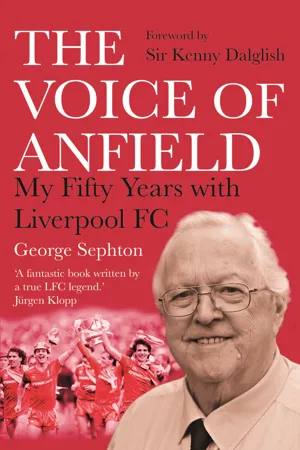
George Sephton's relationship with Liverpool Football Club began in 1971 when he wrote to the club secretary applying to be the stadium announcer. His first match also marked the debut of Kevin Keegan. For the past fifty years, Sephton has been at Anfield for all but a handful of home fixtures, as well as travelling with the team to major finals.
From the highs of winning numerous league titles and European Cups, to the lows of Heysel and Hillsborough, Sephton has been with Liverpool through it all. From encounters with great managers and legendary players - from Bill Shankly to Kenny Dalglish, John Barnes to Jurgen Klopp, he tells his unique and entertaining story of the greatest club in the world.
- English
- ePUB (mobile friendly)
- Available on iOS & Android
eBook - ePub
About this book
Information
Print ISBN
9781838952709
PART ONE
The Fifties and Sixties
Growing Up on the Kop
My mum and dad (Amy and Ted) were married in a church in Goodison Road, of all places, in 1934, and I was born nine months after the end of the Second World War. I was their only child. I never knew my grandparents.
My dad was a lifelong Liverpool supporter. He was a big strapping centre-forward who had a trial for the Reds in 1923 when he was fourteen years old. He stood on the Kop, week in week out, for years until he was crippled with arthritis and had to give up in the late fifties. In 1950, his beloved Reds got to the FA Cup final. He was desperate to go but had to enter the ballot for tickets, which you did by sending a postcard to Anfield with your name and address on the back. He and my poor mum wrote fifty postcards, but he didn’t strike lucky. His only remaining option was to buy a ticket from a tout. He was a plumber, and my mum was an usherette, and they just didn’t have the money that the touts were asking, so he couldn’t go! That episode instilled in me a lifelong hatred of ticket touts.
The Empire Theatre is a historic part of Liverpool’s cultural history, and it holds a special place in my heart. My mum worked there for a while, and her sister Dorothy did too, in the box office. Dorothy was allowed two free tickets on Monday night for every show that ran for a week or more. My parents did well out of that arrangement and so did I when I was a youngster. My parents used the tickets once in a while, then I sometimes went with my mum before being let loose with schoolmates.
Those were the days of the package tours when promoters like Larry Parnes would put on a bill of British and American stars. One particular gig I went to with my mum on 11 November 1956 turned out to be more significant than any of us could have realized. Top of the bill was Lonnie Donegan, the singer, songwriter and musician referred to as the ‘King of Skiffle’. He had thirty-one UK Top 30 hits, including three number ones, and he was the first British male singer with two US Top 10 hits. The importance of that gig was that a young lad called James Paul McCartney was in the audience with his dad. The story goes that it was Donegan’s concert that influenced young Paul to take up the guitar. The following year he met up with another lad by the name of John Lennon at a church fete in south Liverpool and the face of popular music changed for ever. Paul was still a pupil at the Liverpool Institute High School for Boys when I arrived there in 1957. He’s four years older and his brother Mike two years older than me. Mike also went to the Institute, as did a lad by the name of George Harrison, who overlapped me by three years. George used to call me ‘Bugs’ because of my Bugs Bunny teeth! This was the era of rock ’n’ roll, and the ‘Inny’ was full of baby boomers who took to the new music. My form master (Mister Edwards, aka ‘Jake’) was the poor devil who returned early to his form room after lunch one time and, finding a lad with a guitar, uttered the immortal words, ‘McCartney! Put that thing away! It’ll never get you anywhere!’
I was one of those teenagers who spent a lot of time in my bedroom with my record player, radio and homework, listening to hours of music on Radio Luxembourg and, later, Radio Caroline. I wasn’t a very sociable guy and was never a ‘mixer’. My father remarried a couple of years after my mum passed away, and my new stepmother, who had her own ideas about family life, marched me to the youth club in Aintree, a couple of miles from home in Walton. It was run by the Methodist Church there, and we were never allowed to hold dances unless we called them ‘socials’. Coming up to Christmas 1961, we decided to hold one such event and blow our kitty on a band – except they were called groups then! We had £8 to spend. We got The Undertakers, one of the burgeoning number of groups in Liverpool, to play. They were fantastic and were soon making hit records. But my abiding memory of the event was a casual remark from a fellow committee member. ‘Eight quid! That’s a pity! If we’d had ten quid, we could have got The Beatles!’ If we’d known what was on the horizon, we would have found the extra £2!
A couple of years after the Donegan gig, Cliff Richard was booked to appear at the Empire with his band The Shadows, who had just changed their name from The Drifters to avoid clashing with an American group of the same name. I really fancied seeing Cliff (he was cutting-edge rock ’n’ roll in those days!), so I went into Liverpool and wandered round to the Empire. There was a queue that started just inside the big double doors leading to the box office before weaving its way into Lord Nelson Street at the side of the theatre and up the hill, disappearing into the far distance.
I had a quick look through the doors at the head of the queue and spotted a familiar face at the second window. My Aunt Dorothy! She was at the window that said ‘Billy Cotton Band Show’, which, strangely enough, no one was queueing for. She worked out very quickly what I was after and discreetly moved sideways to the next window. She came back with two precious Cliff Richard tickets, and I was on my way. The poor devils at the front of the line realized what was going on and were giving me some murderous looks as I made my escape. Luckily for me, none of them dared to break ranks and lose their position in the queue.
I saw Roy Orbison on the same bill as The Beatles and Gerry and the Pacemakers in London in 1963. That was the famous tour when Roy started off as top of the bill and finished up as the support act to The Beatles. The birth of Beatlemania. I was doubly happy, as it was the only time I got to see the wonderful Louise Cordet (my teenage idol), who was also on the bill, in the flesh. And I saw the show on the day Gerry’s last single before ‘You’ll Never Walk Alone’ was released! Forty years later, I got to know Gerry and Louise. If only I’d known then what was in store for me.
On 6 July 1964, I was in the crowd on the far side of Water Street in the centre of Liverpool looking up at the town hall balcony watching The Beatles, alongside Lord Mayor Louis Caplan, waving to the thousands of people who had come to see the lads return home for the premiere of their first feature film A Hard Day’s Night. That summer I was a clerk at the Trustee Savings Bank city branch in Fenwick Street. Friday was the day when we had evening opening. Normally, it was a pain for an eighteen-year-old who wanted to be out and about, but that night it worked in my favour. As soon as we’d cashed up, I went through the back alleys between Fenwick Street and Water Street and grabbed an ideal spot in the corner between two buildings directly opposite the town hall, just in time for The Beatles to emerge. Four decades later, I sneaked out of a function at the town hall and stood on that same balcony looking down from where The Beatles had waved to their fans.
They say that the song that’s number one on your fourteenth birthday defines your musical tastes for life. I’m not sure that’s always entirely accurate, but in my case it’s not too far from the truth. On 22 February 1960, I turned fourteen, and a catchy little tune called ‘Why’ by Anthony Newley was number one. Newley was a TV actor turned singer who appeared in several movies and married Joan Collins. More important to me was that number four in the same chart was ‘Way Down Yonder in New Orleans’ by Freddy Cannon – not the greatest piece of music ever written but part of the tidal wave of rock ’n’ roll which was engulfing the world. The music was being imported in large quantities by the merchant sailors who criss-crossed the Atlantic and brought cases full of the newfangled 45-rpm records which would soon contribute to the birth of the Merseybeat sound. It may be that I was a late developer. The songs at number one on my fifteenth and sixteenth birthdays were both by Elvis Presley.
Meanwhile, the sleeping giant that was Liverpool Football Club had been, for a few short weeks, in the care of an ambitious Scotsman by the name of Bill Shankly. A decade of underachievement would soon be over, and we would regain the status of champions and reach the holy grail of FA Cup triumph, a trophy that had thus far eluded us.
My first visit to Anfield was in January 1960. Liverpool had been drawn at home in the FA Cup against the mighty ‘Busby Babes’ of Manchester United. After queueing for several hours around Stanley Park, and having been kicked by a passing police horse, I had the precious piece of paper in my hand and went to my first match. We lost 3–1, but I was hooked. Between then and the time I started working at the club, I spent many hours standing on the old Kop. It could be hard work. If you got in too late to find a spot in front of a crush barrier, you could go home with some serious damage. I had my ribs cracked twice in those heady days.
In 1965, Shankly’s Liverpool got to the cup final at Wembley for the first time in fifteen years. By now my poor dad was crippled with arthritis and could barely get out of his chair, so we watched the game on a black-and-white TV in our front room. We went through all sorts of emotional somersaults until Ian St John scored a wonderful flying header to win the game. At the final whistle my dad turned painfully to face me and said, ‘This is the greatest day of my life!’
I’m of an age that I’ve seen almost every one of the top players since the Second World War. I never saw Tom Finney play, but I did see Stanley Matthews when he was in his forties playing for Stoke City. And I was at the World Cup games in Liverpool in 1966 and saw Pelé, Lev Yashin, Eusébio, Bobby Charlton, Garrincha and Ferenc Puskás, to name but a few, in the flesh. Later on, I saw Johan Cruyff playing for Ajax at Anfield. Luckily, I was at the famous 1966 World Cup quarter-final when the Eusébio-inspired Portugal came back from 3–0 down to beat North Korea 5–3.
I was also standing in the Park End at Goodison when Brazil’s Garrincha scored the most amazing free-kick I can remember. My mate Bob Hands and I were behind the goal. A wall was formed by the Portuguese defenders, and we could just glimpse the top of Garrincha’s head as he lined up to take the kick. He was facing the dead centre of the wall. The only reason we knew when he was striking the ball was because of the roar of expectation from the Brazil fans in the Main Stand. Suddenly, the ball appeared like a guided missile round the far end of the wall. It circled back round and hit the back of the net, having flown through 180 degrees. Although I was to witness quite a few more over the years, it remains one of the finest goals I’ve ever seen.
PART TWO
The Seventies
1970–71
Music plays a huge part in my life, and 1970 was a watershed year. The sixties had come and gone, and in April a bomb dropped: The Beatles had split up. I was choked. The phrase ‘end of an era’ is overused, but not in this case. My mood was lifted when I got tickets to see Simon and Garfunkel play at the Royal Albert Hall in London. They were probably at their peak, and their masterpiece ‘Bridge over Troubled Water’ was number one in the UK charts. I just missed out on their first concert but got the best seats for the ‘by popular demand’ second gig. In 1970, you bought tickets by sending a cheque and a stamped envelope. Happy days!
My soon-to-be-wife Liz and I were sitting amongst the likes of two Bee Gees, a couple of the Dave Clark Five and one or two TV stars. There was a tall, long-haired guy next to me whom I didn’t recognize, but when Simon and Garfunkel were about to sing ‘Bridge over Troubled Water’, he suddenly stood up and made his way to the stage. He was Larry Knechtel, the pianist on the actual record.
Liz had to work Saturdays but came with me to midweek games whenever she could. So it was that in spring of 1971 she came with me to see Liverpool play Newcastle. Before kick-off, the guy on the Tannoy made a blooper when reading out the teams. I made a sarcastic remark, and Liz remarked, ‘Could you do any better?’
I don’t know what possessed me, but as soon as we got home I wrote to Peter Robinson. His title was club secretary, but he was effectively in charge of running the club. I wish I still had a copy of that letter. Although it filled an A4 page, it boiled down to, ‘I can do better. Why not give me a go?’
Before long, I got a letter from Peter asking me to come in and see him. We met in his temporary office in the midst of the chaos that was the building work being carried out on the Main Stand. I was nervous, as you can imagine, but I must have said the right thing because I was asked to put some ideas down on paper and, soon afterwards, was given a ‘trial’ and then offered the job. Unbeknownst to me, a young man by the name of Alan Harrison was telling his relative on the Anfield board of directors that he too could make a good fist of the stadium announcer’s job. However, he was soon told that someone else had been appointed but was promised that when I moved on the job would be his. Half a century later, he’s still waiting. Alan is the voice of AFC Liverpool, the semi-professional club set up by supporters of Liverpool FC in 2008, and I’m pleased to call him a friend. The new club was set up as a not-for-profit organization and is run on a one-member, one-vote basis. I’m honoured to be one of their first patrons, alongside Karen Gill, David Price, Joey Jones and John Aldridge. I look forward to the day when they get their own stadium and attain their rightful place in the upper echelons of non-league football. Chairman Chris Stirrup and all of the others who run the club work tirelessly for the place and deserve every success that comes their way.
Before my big day starting work at my beloved Anfield, I had a couple of traumatic moments to get through. My friend Mike Hulm was a devoted Evertonian. In the autumn of 1970, he phoned me to say he was getting married the following spring. The date? Saturday, 8 May!
‘You do realize that’s cup final day, don’t you?’ The line went quiet! For some reason, the significance of the date hadn’t hit him. Just to complicate things, the semi-final draw had brought us together: Everton v. Liverpool at Old Trafford. We went to see the game together in Manchester.
FA Cup Semi-final – Liverpool v. Everton, Old Trafford, 7 March 1971
Mike was in a no-win situation. If Liverpool won, he would be devastated to lose such a big game to his team’s arch-rivals, but if Everton won, he would be unable to make the trip down to Wembley.
The game was a tight affair. Alan Ball put Everton ahead just after the ten-minute mark. It stayed that way till half-time, but midway through the second half Alun Evans equalized for Liverpool before ‘Little Bamber’, aka Brian Hall, won it for the Reds. It’s fair to say that Mike drove home with mixed feelings!
By the time Mike’s wedding came around, several guests had remarked about the ‘fixture clash’, so the event was brought forward from an afternoon to a morning start. A portable TV was found, and the speeches were shorter than usual, with the result that proceedings ended about five minutes before the Wembley kick-off. There was a mini stampede in the direction of the back room where the TV was ready and waiting.
Arsenal won 2–1 after extra time, with all three goals coming in the added half hour. Steve Heighway scored for Liverpool first, before Arsenal equalized with a scrambled goal from substitute Eddie Kelly – the first time a substitute had ever scored in an FA Cup final. Charlie George scored the winner in the second half of extra time. If I close my eyes, I can still see Charlie lying on his back – arms outstretched – inviting the adulation of his teammates. And I can still feel the sick feeling in the pit of my stomach.
The bride and groom, incidentally, had gone on their merry way during half-time.
1971–72
Blackburn Rovers v. Liverpool, Ewood Park, 3 August 1971
With my debut at Anfield fast approaching, my best man Dave Callaghan and I decided...
Table of contents
- Cover
- Title
- Copyright
- Contents
- Foreword
- ‘Sleeve Notes’
- Prologue
- Part One: The Fifties and Sixties
- Part Two: The Seventies
- Part Three: The Eighties
- Part Four: The Nineties
- Part Five: The 2000s
- Part Six: The 2010s
- Epilogue
- Acknowledgements
- Plate Section Photography Credits
- Index
Trusted by 375,005 students
Access to over 1.5 million titles for a fair monthly price.
Study more efficiently using our study tools.