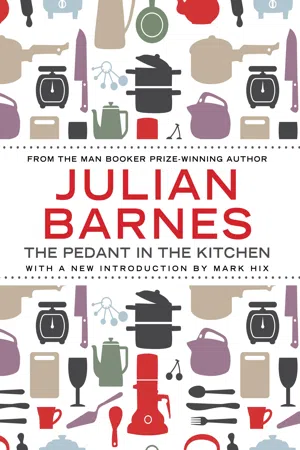
The Pedant's ambition is simple. He wants to cook tasty, nutritious food; he wants not to poison his friends; and he wants to expand, slowly and with pleasure, his culinary repertoire. A stern critic of himself and others, he knows he is never going to invent his own recipes (although he might, in a burst of enthusiasm, increase the quantity of a favourite ingredient). Rather, he is a recipe-bound follower of the instructions of others.
It is in his interrogations of these recipes, and of those who create them, that the Pedant's true pedantry emerges. How big, exactly, is a 'lump'? Is a 'slug' larger than a 'gout'? When does a 'drizzle' become a downpour? And what is the difference between slicing and chopping?This book is a witty and practical account of Julian Barnes' search for gastronomic precision. It is a quest that leaves him seduced by Jane Grigson, infuriated by Nigel Slater, and reassured by Mrs Beeton's Victorian virtues.
The Pedant in the Kitchen is perfect comfort for anyone who has ever been defeated by a cookbook and is something that none of Julian Barnes' legion of admirers will want to miss.
- English
- ePUB (mobile friendly)
- Available on iOS & Android
eBook - ePub
The Pedant In The Kitchen
About this book
Information
Topic
ArtSubtopic
Journalist BiographiesCONTENTS
Introduction by Mark Hix
A Late-Onset Cook
Warning: Pedant at Work
Take Two Medium Onions
By the Book
The Ten-Minute Maestro
No, I Won’t Do That
The Cactus and the Slipper
The Tooth Fairy
Good Things
Service with a Scowl
Once is Enough
Now They Tell Me!
Keep It Simple
In the Purple
Not a Dinner Party
Bottom Drawer
The Moral of It All
INTRODUCTION
In recent years, cookbooks have become immensely popular as Christmas and birthday presents; the gastronome’s collection amasses quickly. Sometimes, a couple of books become trusted favourites, containing recipes that we return to again and again. By and large, however, these books remain unopened on their shelves, their colourful spines and toothsome covers providing nothing more than another decorative element to the kitchen. Over the years, I’ve become rather obsessed with collecting cookbooks, old and new. It gives me comfort to have a wall full of them but, though I now have a couple thousand of the things, I consult only a tiny fraction of them very occasionally. They are an invaluable resource for research and inspiration when I’m writing.
The Pedant in the Kitchen spells out what many chefs think about recipe writing, but rarely get the chance to voice. It’s not difficult to knock out a recipe, but being sympathetic to the reader is all too often overlooked. I remember years ago sitting on a panel with one of my favourite cookery writers. She said something to the audience, to which I try to adhere when writing. Every time I write, I can hear her saying these words: ‘Whenever a reader sees an instruction to cook something gently in butter for more than four minutes they either give up or end up burning it. Two to three minutes is perfectly adequate in all recipes.’ This has stayed with me to this day and, as Julian Barnes quite rightly points out, recipes are seldom written with the under-confident cook in mind. Even the chefs in my restaurants don’t read recipes these days and it drives me bonkers that as well as training them to cook, I have to teach them to follow each step of a recipe meticulously, chopping the vegetables in the right manner, and always using the correct measurements. The recent vogue in recipe writing for ‘a glug’ of this and ‘a dollop’ of that has a lot to answer for.
As well as writing recipes, there is also a certain art to reading and executing them. As Julian has discovered, it’s well worth reading the recipe a couple of times – before you shop and prior to cooking – in order to fully understand what you’re up against. I never like to pre-plan my dinner party menus before I go shopping as I am frequently disappointed when the ingredients aren’t available. This is where gastronomic conservatism loosens its grip and ‘carefree marketing’, as Julian puts it, kicks in. But I say go for it: let loose, buy what looks and smells good. Try to shop a day or two beforehand so you have time to revisit the menu and shop again if needs be. Buy the ingredients for your main course first, then it’s easier to plan starter and pudding.
I think schools are largely to blame for a national lack of confidence in the kitchen. Doing away with the widespread availability of domestic science, or ‘food technology’ as it’s now sometimes laughably called, has created a nation of gastronomically illiterate adults. What is still (just about) taught nowadays in schools is clinical and boring, but cooking is about passion, common sense and doesn’t need to be that technical at all. ‘Food Technology’ sounds like some sort of science lesson that prepares you for a career in a laboratory rather than a part of the school curriculum that prepares you for life (we all have to eat, after all): knocking up simple meals at home and entertaining your friends.
Last year I was invited back to my alma mater, Sir John Colfox School in Bridport, to open the sixth-form catering department kitchen and restaurant. It was truly music to my ears to learn that the school where I had been given the option to do domestic science instead of metalwork was actually making a concerted effort to teach both boys and girls the simple art of cookery. When I was at school, there were only three of us who signed up, never thinking for one minute it would be the beginning of a career in restaurants – I didn’t even really want to learn how to cook! (The truth is, I hated filing away at a piece of metal for weeks on end with only a useless key holder to show for my efforts. Cooking was my only way out – my escape route from the metal workshops was through the kitchen.) But ever since, I’ve found it difficult to understand why it wasn’t compulsory to be taught a little bit about basic cooking and ingredients at school.
It also seems that we’re not teaching our children to cook these days. Julian’s parents never taught him to cook and why would they? In fact, I know very few parents who are teaching their kids to cook, but they should. Food is a massive part of our lives – three meals a day, four if you’re lucky. Many of us spend as much time eating as sleeping.
Julian’s responses to both reading and cooking recipes from various cookery writers will resonate with both the amateur and professional cook. Recipes aren’t always clear, and occasionally suffer from bad editing. Over the years I’ve been guilty, as have many cookery writers, of missing out a vital ingredient or a crucial point in the method. Many’s the time I’ve had to call a reader and grovel and chuckle. Once, a letter arrived on my editor’s desk, concerned about my Scottish black bun recipe and the depth of tin I had used to make it. But I had done my research, even trying a few shop-bought buns and thoroughly enjoying them, so I decided to give the disgruntled reader a call. There was a silence on the line when I introduced myself, but we chatted and laughed a little, and by the end of it we agreed to disagree about the contentious issue of the Scottish black bun.
In amongst my collection of cookbooks is a pristine second edition of Elizabeth David’s French Provincial Cooking. Inside I was amused to find a letter from David herself, apologizing for a couple of errors which had made it into the first edition. It makes me smile every time I look at it, because it just goes to show, even the greats make mistakes.
The Pedant in the Kitchen touches many of the concerns I’ve mentioned here. We don’t get taught enough in school – cooking should be back on the curriculum – but the earlier we learn the basics, the more at ease we’ll be when experimenting. Most of all, it contains the all-important exhortation to anyone experimenting in the kitchen: follow the recipe, and never be afraid. I implore you to read this book and enjoy it as much as I have. It captures perfectly the frustrations, the pleasures and the joy of getting your hands dirty in your kitchen.
THE PEDANT IN THE KITCHEN
A LATE-ONSET COOK
I am a late-onset cook. In my childhood, the usual genteel protectionism surrounded activities in the voting booth, the marital bed, and the pew. I failed to notice a fourth secret place – secret, at least, from boys – in the English middle-class home: the kitchen. Meals and my mother emerged from it – meals often based on my father’s garden produce – but neither he, my brother, nor I enquired, or were encouraged to enquire, about the transformational process. No one went so far as to say that cooking was sissy, it was just something that domestic males weren’t suited to. On school mornings my father would prepare breakfast – re-heated porridge with golden syrup, bacon, toast – while his sons applied themselves to shoe-cleaning and kitchen-stove duty: rake out the ashes, refill with coke.
But male culinary competence was clearly limited to such matutinal dabbling. This was made plain one time when my mother was called away. My father prepared my packed lunch and, not understanding the theory of the sandwich, lovingly inserted extra items that he knew I especially liked. A few hours later, on a Southern Region train to an out-of-town sports field, I opened my lunch bag in front of fellow rugby players. My sandwiches were sodden, falling to bits, and bright red from the paternally cut beetroot; they blushed for me as I blushed for their contriver.
And as with sex, politics, and religion, so with cooking; by the time I began finding out about it for myself, it was too late to ask my parents. They had failed to instruct me, and I would punish them by not asking now. I was in my mid-twenties and reading for the bar; some of the food I concocted at that time was criminal. Top of my range was bacon chop, peas, and potatoes. The peas were frozen, of course; the potatoes were tinned, pre-peeled, and came in a sweetish brine I liked to drink; the bacon chop was unlike anything subsequently encountered under that name. Boneless, pre-shaped, and of a luminous pink, it was distinguished by its ability to keep a fluorescent hue however long you cooked it. This gave much latitude to the chef: it wasn’t undercooked unless positively cold, or overcooked unless coal-black and alight. Then butter was lavished on the peas, the potatoes, and, usually, the chop as well.
The key factors governing my ‘cooking’ at this time were poverty, lack of skill, and gastronomic conservatism. Others might have lived on offal; tinned tongue was as near as I would go to that, though corned beef doubtless contained body parts that would have been unwelcome in their original form. One staple was breast of lamb: easy to roast, fairly easy to see when it was done, large enough to yield three successive dinners for about a shilling. Then I graduated to shoulder of lamb. With this I would serve an enormous leek, carrot and potato pie made from a recipe in the London Evening Standard. The pie’s cheese sauce always tasted strongly of flour, though this gradually diminished with daily re-heating. Only later did I work out why.
My repertoire broadened. Meat and vegetables were the main things to be, if not mastered, at least somewhat tamed. Then came puddings and the odd soup; later – much later – gratins, pasta, risotto, soufflés. Fish was always a problem, and is still only half-solved.
On home visits, it emerged that I cooked. My father observed this development with the mild, liberal suspicion previously deployed when I was spotted reading The Communist Manifesto or when I forced him to listen to Bartók string quartets. If this is as bad as it gets, his attitude seemed to imply, then I can probably handle it. My mother was happier; daughterless, she at least had one child who retrospectively appreciated her years in the galley. Not that we sat around swapping recipes; but she noted the covetous eye I now laid on her ancient copy of Mrs Beeton. My brother, shielded by collegiate life and marriage, didn’t cook anything beyond a fried egg until his fifties.
The result of all this – and I doggedly blame the ‘all this’ rather than myself – is that while I now cook with enthusiasm and pleasure, I do so with little sense of freedom or imagination. I need an exact shopping list and an avuncular cookbook. The ideal of carefree marketing – waltzing off with wicker basket over the arm, relaxedly buying what the day has best to offer, and then contriving it into something which might or might not have been made before – will always be beyond me.
In the kitchen I am an anxious pedant. I adhere to gas marks and cooking times. I trust instruments rather than myself. I doubt I shall ever test whether a chunk of meat is done by prodding it with my forefinger. The only liberty I take with a recipe is to increase the quantity of an ingredient of which I particularly approve. That this is not an infallible precept was confirmed by an epically filthy dish I once made involving mackerel, Martini and breadcrumbs: the guests were more drunk than sated.

I am also a reluctant taster, with excuses always at the ready. For instance: it can’t possibly taste the same now, in the afternoon, with remnants of sweet tea in the mouth, as it will and should this evening, after a morale-boosting gin and tonic. What this means is: I’m scared to discover how unlike actual food it tastes at this stage. The other reliable get-out is to tell yourself there is no point in tasting because you’re following the recipe to the letter, and since (a) the recipe doesn’t insist upon your tasting at this point, and (b) it’s by a respected authority, how could things possibly end up other than they should?
This is, I realize, somewhat less than mature. So too are my infantile bouts of cheffish volatility. If you were in my kitchen, idly stuck your finger into something and said that it tasted good, I would get the hump because I’d been looking forward to surprising you with it on the plate. And if, on the other hand, you were mildly, generously, and civilly to suggest a touch more nutmeg might help, or the sauce could just possibly do with further reduction, I would regard this as the grossest interference.
My wrath is also frequently turned against the cookbooks on which I rely so heavily. Still, this is one area where pedantry is both understandable and important: and the self-taught, anxious, page-scowling domestic cook is about as pedantic as you can get. But then, why should a cookbook be less precise than a manual of surgery? (Always assuming, as one nervously does, that manuals of surgery are indeed precise. Perhaps some of them sound just like cookbooks: ‘Sling a gout of anaesthetic down the tube, hack a chunk off the patient, watch the blood drizzle, have a beer with your mates, sew up the cavity. . .’) Why should a word in a recipe be less important than a word in a novel? One can lead to physical indigestion, the other to mental.
I sometimes wish it were all different; most late-onset cooks do. If only my mother had taught me to boil and bake all those years ago . . .Apart from anything else, I wouldn’t be so pathetically needy of praise nowadays. As the front door closes on the last departing guest, I feel a habitual whine rising to my lips: ‘I overdid the lamb/beef/whatever.’ By which I mean: ‘I didn’t, did I, and if I did it doesn’t matter, does it?’ Mostly I get the contradiction I crave; occasionally a reminder of the house rule that after the age of twenty-five you aren’t allowed to blame your parents for anything. Indeed, you’re even allowed to forgive them. So, OK, Dad, those beetroot sandwiches: you know, they were fine, quite tasty, and – well – really original. I couldn’t have made them better myself.
WARNING: PEDANT AT WORK
In my early thirties, when the kitchen was slowly mutating from a place of resented necessity to one of tense pleasure, I had my first attempt at Vichy carrots. Naturally, I looked up a recipe in a book – one written, as it happened, by a friend of She For Whom the Pedant Cooks. Carrots, water, salt, sugar, butter, pepper, parsley: nothing too challenging about these ingredients. I approached their assembly with something close ...
Table of contents
- Cover
- Author biography
- Title page
- Copyright page
- Dedication page
- Contents
Trusted by 375,005 students
Access to over 1.5 million titles for a fair monthly price.
Study more efficiently using our study tools.
Frequently asked questions
Yes, you can cancel anytime from the Subscription tab in your account settings on the Perlego website. Your subscription will stay active until the end of your current billing period. Learn how to cancel your subscription
No, books cannot be downloaded as external files, such as PDFs, for use outside of Perlego. However, you can download books within the Perlego app for offline reading on mobile or tablet. Learn how to download books offline
Perlego offers two plans: Essential and Complete
- Essential is ideal for learners and professionals who enjoy exploring a wide range of subjects. Access the Essential Library with 800,000+ trusted titles and best-sellers across business, personal growth, and the humanities. Includes unlimited reading time and Standard Read Aloud voice.
- Complete: Perfect for advanced learners and researchers needing full, unrestricted access. Unlock 1.5M+ books across hundreds of subjects, including academic and specialized titles. The Complete Plan also includes advanced features like Premium Read Aloud and Research Assistant.
We are an online textbook subscription service, where you can get access to an entire online library for less than the price of a single book per month. With over 1.5 million books across 990+ topics, we’ve got you covered! Learn about our mission
Look out for the read-aloud symbol on your next book to see if you can listen to it. The read-aloud tool reads text aloud for you, highlighting the text as it is being read. You can pause it, speed it up and slow it down. Learn more about Read Aloud
Yes! You can use the Perlego app on both iOS and Android devices to read anytime, anywhere — even offline. Perfect for commutes or when you’re on the go.
Please note we cannot support devices running on iOS 13 and Android 7 or earlier. Learn more about using the app
Please note we cannot support devices running on iOS 13 and Android 7 or earlier. Learn more about using the app
Yes, you can access The Pedant In The Kitchen by Julian Barnes in PDF and/or ePUB format, as well as other popular books in Art & Journalist Biographies. We have over 1.5 million books available in our catalogue for you to explore.