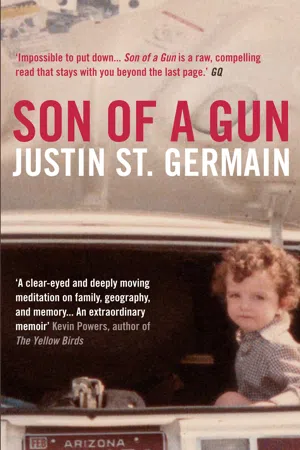
In Tombstone, Arizona, September 2001, Debbie St. Germain is found dead in her trailer, apparently murdered by her fifth husband. For her twenty-year-old son, Justin, the tragedy marks the line that separates his world into before and after.
Long after his mother's death is solved, Justin still sleeps with a loaded rifle under his bed. Ultimately, he sets out into the desert landscape of his childhood in an attempt to make sense of the unfathomable. Justin's journey takes him back to the ghost town of Wyatt Earp and the Gunfight at the O.K. Corral, to the trailers he and Debbie shared, to the string of stepfathers who were a constant presence in his life. He confronts people from his past and delves into the police records in an attempt to make sense of his mother's life and death. All the while he tries to be the type of man she would have wanted him to be.
Brutally honest and beautifully written,
Son of a Gun is a brave, unexpected and unforgettable memoir.
eBook - ePub
Son of a Gun
About this book
Information
Print ISBN
9781782390664
Subtopic
Social Science BiographiesCONTENTS
Introduction
I
The Beast
Her Savior
The Crime Scene
Scrabble at Gabaldon
A Reprieve
Questioning
Final Goodbyes
A Beautiful Time in My Life
The Family Plot
II
Neighbors
Welcome to Arizona
I'm not Here
The Magician
The Canadian
The Detective
Uncle Tom's House
Chance
Gun
Scrapbooking
Tombstone
Consequences
High Lonesome
Author's Note
Acknowledgments
About The Author
I was riding my bike home from class when a plane roared overhead, a green A-10 flying so low I could read its markings. I took my eyes off the road to watch it cross the sky. I'd been living in Tucson for a year, and hardly noticed the planes anymore as they flew over the city, to and from the air force base. But it had been nine days since the towers fell and we were all newly conscious of planes. I was twenty years old, and thought often of the future; I knew the world had changed, but I didn't know how much.
I rode my bike recklessly, helmetless and against traffic, hopping curbs and cutting across yards on my way to the rented house I shared with my brother, sweating through my shirt in the liquid heat. The streets shimmered like rivers. It was almost the end of summer, the last days of a long siege.
When I remember that bike ride, it's always beautiful: a bright expansive sky, tires whizzing on the road, my heart still whole and beating fast. About a mile, that ride, from the university mall gone brown and patchy after months of punishing sun, by the bricks and banners of Greek Row, down the sidewalks of strip malls along Speedway, past the squat stucco houses of my neighborhood, to the dirt yard of our bungalow, where, inside, the phone is ringing. A mile, a few minutes of my life, a few hundred beats of a young heart, but in my memory it lasts forever, and I remain that young man riding his bike, never reaching that front porch. That moment is golden, it's gone, it's a myth, but I remember it.
When I reached our driveway, I got off my bike to check the mailbox. The screen door flew open and my brother emerged, red faced and weeping, phone in hand, struggling to speak through the tears and mucus, his shrinking throat—but that struggle wasn't necessary, because I had never seen him anything like that before, so I knew what he was going to say. He let the screen door slam behind him. I dropped my bike in the yard. He bent at the waist and pinched the bridge of his nose with one hand, still holding the phone in the other. I hoped he'd never find his voice.
“She's dead.”
“Who?” I had the sense of being watched, as if I would be expected to ask.
“Mom,” he said. “Mom's dead.” He turned and walked inside.
I crossed the yard, climbed the porch steps, and stood on the threshold. Josh walked around our living room, circling the couch. He told the person on the phone that he had to go and hung up.
“Who was that?”
“Connie.” She and her husband, Bob, were our mother's best friends. “She was supposed to meet them for lunch and didn't. Bob went to the property and found her.”
“What do you mean, found her?” The heat pressed against my back. I couldn't go inside until I made sense of this feeling: not shock, not grief—those would come later—but recognition, as if I had always known this moment would come.
“She got shot.”
I

“What did you want?”
“Just to live a normal life.”
“There is no normal life, Wyatt.
There's just life. Get on with it.”
“Don't know how.”
—DOC HOLLIDAY AND WYATT EARP,
Tombstone
THE BEAST
Soon after we learned that our mother was dead, my brother and I went to a bar. We'd already worked the phones. Josh had called our grandparents, who'd been divorced for forty years but both still lived in Philadelphia. Grandpop said he'd book the first flight he could, but air travel was snarled from the attacks nine days earlier. Grandma was afraid of flying, so she stayed in her rented room in suburban Philly, wrecked and helpless. I called my dad's house in New Hampshire, but he wasn't home. Eventually he called back. I told him she was dead and a long pause ensued, one in a litany of silences between my father and me, stretching across the years since he'd left and the distance between us, thousands of miles, most of America. Finally he said she was a good person, that he'd always cared for her. He asked if I wanted him to fly to Arizona. I said he didn't have to and hung up.
I emailed my professors and told them what had happened, that I wouldn't be back in class for a while. I called the office of the college newspaper where I worked and told my boss. Josh called in sick to his bartending job. Then we sat on the couch with our roommate, Joe, an old friend from Tombstone we'd known since grade school. It was a Thursday, and we had nothing to do. Somebody suggested the French Quarter, a Cajun joint nearby that had spicy gumbo and potent hurricanes. It seemed like a good idea: I'd heard stories of grief in which the stricken couldn't eat, but I was hungry, and I needed a drink. So that's where we spent our first night without her.
When we walked in, President Bush was on TV, about to give a speech. The jukebox was turned off, as it had been since the attacks, because now everybody wanted to hear the news. Joe went to the bar to talk to some of the regulars. Josh and I took a booth in the corner. Orion, the bartender and a friend of ours, came over and told us he was sorry, and to have whatever we wanted on the house. I wondered if Joe had just told him or if he'd already heard. I didn't know yet how quickly or how far the news would travel, that within a few hours we wouldn't need to tell anyone about our mother, because everyone would already know.
I flipped through the menu but couldn't understand it. We'd both put our cell phones on the tabletop, and mine rang, chirping as it skittered across the glass. I ignored it.
“What now?” I asked.
Josh kept his eyes on the menu and shook his head. “There's not much we can do.”
“Should we go out there?” I didn't know what to call the place where she'd died; it wasn't home, because we'd never lived there, and it didn't have a name. It was just a piece of land in the desert outside of Tombstone.
“We can't. The property is a crime scene.”
I asked him if we should talk to the cops and he said he already had, that we were meeting with them on Monday. I asked about a funeral home and he said the coroner had to do an autopsy first, the cops said it was standard procedure. There was a long pause. My mother and her parents always said Josh was more like my father, difficult to read, and he looked like Dad, too, sharp nosed and handsome. I got more from my mother, they said, the dark and heavy brows, the temper, the heart on my sleeve. But if I was like my mother, why was I so numb?
Food arrived. Through the windows I watched the sky outside go purple and the traffic on Grant die down. A hot breeze blew through the open door. On television, President Bush identified the enemy, a vast network of terror that wanted to kill all of us, and finally he said the name of a murderer.
“Do you think Ray did it?” I asked. The police couldn't find our stepfather or the pickup truck he and my mother owned. He was the only suspect, but I didn't want to believe it.
Josh waited awhile to respond, chewing, letting his eyes wander the walls decorated with beads and Mardi Gras masks and a neon sign above the bar that said “Geaux Tigers.”
“We'll know for sure when they find him.”
A pool cue cracked and a ball fell into a pocket with a hollow knock. My phone rang again. I didn't answer. My voice mail was already full, and the calls kept coming, from distant family, my friends, her friends, acquaintances from Tombstone, people I hardly knew. At first I'd answered, but the conversations went exactly the same: they'd say they were sorry and I'd thank them for calling; they'd ask for news and I'd say there wasn't any; they'd ask if there was anything they could do and I'd say no. It was easier to let them leave a message.
On the TV, the president talked about a long campaign to come, unlike anything we'd ever seen. He said to live our lives and hug our children. He said to be calm and resolute in the face of a continuing threat.
“You think he'd come here?” I asked. Ray knew where we lived. He'd been to the house a few times, with our mother, staying on the pullout couch in the living room.
“The detective mentioned that. He said he doubted it, but to keep an eye out.”
I wondered what good that would do but didn't ask. Josh said we'd know more on Monday, after we met with the cops.
“What do we do until then?”
I could tell Josh was wondering the same thing: what the hell were we going to do? “Wait, I guess.”
Behind me the pool table rumbled as the players began another game. I looked down at my plate, realized that my food was gone, and scanned the old newspaper articles from New Orleans pasted beneath the glass tabletop. My mother was dead. I leaned back against the vinyl seat and finished my beer, watching the president try to soothe a wounded nation. He said that life would return to normal, that grief recedes with time and grace, but that we would always remember, that we'd carry memories of a face and a voice gone forever.
Late that night, I said a prayer for the first time in months. When I was a kid, Mom had always made me say prayers before bed, and it became a habit, something I felt guilty about if I didn't do. I'd stopped praying regularly after I left home, but that night I prayed for my mother's soul, because I knew she'd want me to, and I figured it couldn't hurt.
I didn't pray for my own safety; I knew better than to rely on God for that. Instead, I got up off my knees, pulled a long gray case out of my closet, laid it on the bed, and flipped the catches. Inside, on a bed of dimpled foam, lay a rifle, a gift from my father on my thirteenth birthday, an old Lee-Enfield bolt-action. I lifted it out of the case, loaded it, chambered a round, and rested it against the wall by my bed. Then I tried to sleep, but every time a car passed, I sat up to peek out the window, expecting to see Ray in our front yard.
After a few sleepless hours I got up and went to my desk. I turned on my computer, opened a Word document, and stared at the blank screen. I kept a journal, in which I wrote to the future self I imagined, chronicling important moments in my life, because I thought he might want to remember, and because it made me feel less alone. I would write about how much I missed Tombstone, how dislocated I felt after moving from a town of fifteen hundred people to a city thirty times that size, how I felt like an impostor at school, was failing half my classes, would never graduate. I wrote about girls. I wrote about money, how little I had, my mounting debt, my fear that I wouldn't be able to cover tuition and rent. And I wrote about Mom, how she'd gone crazy after I moved out, how she and Ray had sold our trailer outside of Tombstone and gone touring the country with their horses, camping in national parks, how one day I'd get a card in the mail postmarked from Utah, and the next she'd send an email from Nebraska—all of them signed xoxo, Mom and Ray—and how she'd leave rambling messages on our answering machine at five o'clock in the morning, saying how much she loved and missed us.
I thought I should write something about that day, so the future me never forgot how it had felt to be twenty and motherless, my life possibly in danger, numb from shock and hating my own inability to feel. But I didn't know what to say. I was afraid I wouldn't be able to do the feeling justice, that I'd choose the wrong words. I was in my first literature class at the time, an American lit survey, and I'd just written a paper on Henry James's “The Beast in the Jungle.” So I did what any English major would: I quoted someone else.
My mother is dead. The Beast has sprung.
It worked. I sat down to write at the end of every day for the next few weeks, and each time the words came easily. Sometimes I return to those entries, when I'm afraid I've begun to forget. But I can't read them for long without wanting to write back to my old self, to warn him of what's to come, to tell him that the Beast will always be with us.
I woke up the first day after learning of her death and turned off my alarm, then went back to sleep until the room got too bright. When I woke again, I looked out the window at the yard full of weeds. I stood, stretched, brushed my teeth. Walking down the hall into the living room, wondering what I'd do with the day ahead—it was Friday, so I had a softball game that night, and afterward somebody would be having a party—I glanced through the screen door at the front porch and remembered.
My grandfather arrived from Philly that afternoon, pale and harried, lighting new cigarettes with the still-burning stubs of the last. We went straight from the airport to a Denny's by the highway and sat drinking iced tea and watching cars pass by outside, planes taking off and landing, families piling out of minivans in the parking lot, other people going places. The world hadn't stopped, despite how it seemed to us.
When our food came, we picked at it and discussed our plans. My dad had decided to come and would be flying in the next day. On Monday we had meetings scheduled with the detectives and the funeral director and my mother's bank and lawyer, a gauntlet none of us wanted to think or talk about. My mother's closest friend, Connie, was taking care of the horses and Chance, Ray's dog, who'd been left behind. She said that my mother's property was still cordoned off, that the cops were there in a helicopter, looking for Ray or for his body. We'd go to Tombstone in the morning. For now, there was nothing we could do but try to get some rest.
Grandpop went to his hotel. Josh and I went home and sat on the couch watching pirated cable for the rest of the afternoon. As the room began to dim, I checked the time and remembered that I had a softball game in half an hour. I went to my room and changed. When I walked out carrying my bat bag, Josh asked where I was going.
“We've got a doubleheader.”
“Seriously?”
I put on my hat and grabbed my keys off the coffee table. “There's nothing better to do.”
“OK,” he said, shrugging.
I realized it would be the first time we'd spent apart since we heard the news, and an unfamiliar feeling came over me: I was worried about him. “What are you going to do?”
“I might go to the Bay Horse.”
The Bay Horse was a bar two blocks away where our roommate worked. I was glad to know Josh wouldn't be alone while I was gone, and the thought of joining them later at the Bay Horse gave me comfort. We spent a few nights a week in that smoky dive, playing darts and feeding the jukebox, writing graffiti in the bathroom, drinking ourselves into stupors.
I walked through the door and across the porch and out into the yard, where I stopped and looked back. The blinds were open, revealing my brother's face in the blue glow of the television. The house loomed gray below a purple sky; the stucco had cracked along the edge of the roof and one of the address numbers had been missing since I moved in. It was the only home I had left.

The dugout went quiet when I walked...
Table of contents
- Cover
- Title page
- Copyright page
- Dedication page
- Contents
Trusted by 375,005 students
Access to over 1.5 million titles for a fair monthly price.
Study more efficiently using our study tools.
Frequently asked questions
Yes, you can cancel anytime from the Subscription tab in your account settings on the Perlego website. Your subscription will stay active until the end of your current billing period. Learn how to cancel your subscription
No, books cannot be downloaded as external files, such as PDFs, for use outside of Perlego. However, you can download books within the Perlego app for offline reading on mobile or tablet. Learn how to download books offline
Perlego offers two plans: Essential and Complete
- Essential is ideal for learners and professionals who enjoy exploring a wide range of subjects. Access the Essential Library with 800,000+ trusted titles and best-sellers across business, personal growth, and the humanities. Includes unlimited reading time and Standard Read Aloud voice.
- Complete: Perfect for advanced learners and researchers needing full, unrestricted access. Unlock 1.5M+ books across hundreds of subjects, including academic and specialized titles. The Complete Plan also includes advanced features like Premium Read Aloud and Research Assistant.
We are an online textbook subscription service, where you can get access to an entire online library for less than the price of a single book per month. With over 1.5 million books across 990+ topics, we’ve got you covered! Learn about our mission
Look out for the read-aloud symbol on your next book to see if you can listen to it. The read-aloud tool reads text aloud for you, highlighting the text as it is being read. You can pause it, speed it up and slow it down. Learn more about Read Aloud
Yes! You can use the Perlego app on both iOS and Android devices to read anytime, anywhere — even offline. Perfect for commutes or when you’re on the go.
Please note we cannot support devices running on iOS 13 and Android 7 or earlier. Learn more about using the app
Please note we cannot support devices running on iOS 13 and Android 7 or earlier. Learn more about using the app
Yes, you can access Son of a Gun by Justin St Germain in PDF and/or ePUB format. We have over 1.5 million books available in our catalogue for you to explore.