From the author of the lost masterpiece,
Tony and Susan, comes a kind of intellectual who dunnit, a novel with the thrill of the chase combined with a meditation on who we are, and who we might like to be.
Peter Gregory, a 35-year-old high school English teacher with an ex-wife and kids, tries to drown himself in the Ohio River. Failing to manage even that, he decides to hitch a ride east, fleeing the state and escaping accusations of rape and murder. As he assumes and discards aliases along the way, he believes that he can begin again, a fresh start - but the past has a habit of catching up with all of us, no matter how fast we run...
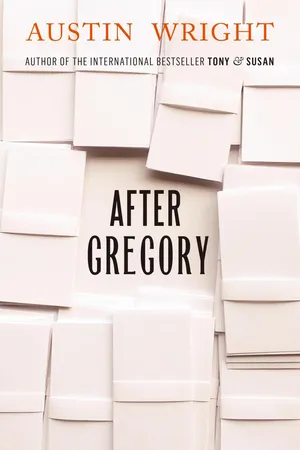
- 319 pages
- English
- ePUB (mobile friendly)
- Available on iOS & Android
eBook - ePub
After Gregory
About this book
Information
Print ISBN
9781786492111
Subtopic
Literature GeneralPART ONE
The River
ONE
So here you are, writing at last. After two days in strangers’ cars, listening to conversations drop into memory and out, thinking all the while what to write when you had the chance. Here’s the chance. Tell where you are at this important moment: Georgia, a motel, November. Describe it, a machine noise, muffled sound of a television set, an audience laughing. Go into detail: a slamming door, a Coke can dropping into the slot, chuckle of ice, feet. Silence wraps these noises like a doughnut. You have now written a paragraph.
The story spreads out, delicious and full of woe, hungry to be written. You have told it often, but only in speech, where it disappears into other people’s vanishing memories. Oral. You told parts of it to the hitchhikers and more to Jack Rome and Bonnie Brown and others, a lot of people. Your tellings narrowed it into a track which served your purposes in one situation and another, but writing is different. The story waits for you, you look forward to the words that will settle it: what it was like to swim out of the river, to hitchhike across the country without a name, to receive the fortune Jack Rome gave you and live in the mansion that fortune bought, all those surprising adventures.
Decisions to make. Where to begin—which depends on whose story you try to tell. If it’s Peter Gregory’s, you could start anywhere, with the Sebastian case, or Linda his wife, or Florry Gates, or his birth. Your birth was different. Think about you. You came into being in the crisis of drowning, alive in the body of a dying man. Discovered like a prophet in the water where he tried to submerge you, without name, only the irreducible sentient you, and you came into life by asserting your refusal to be drowned. You swam and crawled out on the other side of the river like the first amphibian up from the sea. If the story is about you who did that, that’s the place to begin.
Writing can record and then ignore the skepticism of someone like Bonnie Brown. When you told Bonnie about drowning in the Ohio River, she thought you made it up. When you described your Long Island Sound mansion and the fortune which came to you so miraculously, she laughed. Wow, she would say, what happened to it? We could sure use a little of that around here. Why, Bonnie would ask, would Jack Rome endow a nobody like you? A nobody, she called you, a con man inventing picaresque adventures to bolster a weak ego. Her words: con man, picaresque, weak ego. There, you’ve written that, and now it’s part of the story too.
To you reading this, whoever you are—whether you are the one you were meant to be, who has answered and followed up the personal ad with your name in the newspaper and thus returned to the world, or if you are just some stranger: apologies for the confusion of second persons. It’s just one of those ambiguous linguistic things one falls into, unless you prefer it to mean that there really is not much difference between you, you, and you—the you who reads, the you who writes, the you written about. Your second person sets all of you apart from some invisible and undecipherable me, and it’s through you that I exist. Looking at you, thinking through you, writing to you.
TWO
In the beginning, water. Closing over you whistling, cold and black, tasting of mud. You broke through and found air. The city lights were going by in the waves. In heavy clothes, you found yourself swimming. The current was carrying you toward the bridge. Moving downstream in the middle of the river, the stadium parking lights gliding by, the suspension bridge almost overhead. You and he. He had never been a strong swimmer, but the question was whether you in coat, pants, shoes, could make it across. Not urgent, just curious. Under the bridge, trucks rumbled in the waves. Red and green marker lights high up. The steady rhythm less tired than before. Each stroke brought you a few inches toward shore, while the current carried you parallel. The concrete pier of another bridge aimed at your head, swept by, you were surprised how fast. Now you were tired, the way he used to feel, heart swollen under a column of water. Maybe the drowning had only been postponed. You grabbed a rotten log sticking up. It had holes, a light coating of slime, remains of some old dock. From here to shore only twenty feet. Wait, catch your breath, take a look. A chain link fence enclosed a pile of coal, two floodlights on stilts, two parked trucks. Stay out of the light. Just downstream a barge with coal tied up without lights. Then trees growing out of the water’s edge. You made for them. Your hands in the mud, you scrambled up. Found dry ground in the bushes, flung yourself down, rolled over, closed your eyes. Now we can drown in peace, you said, without all that racket and all that water.
You, imagine that night. An unmarked time, neither before nor after, when you became aware of place. Darkness and water flowing, lights on bridges, tiers of lights in a parking garage upriver, back there. Nearby, near the quiet slopping shore, cold and wet in heavy soaked clothing, someone was alive surviving someone who had drowned. If you were going to drown you would have done so before, not resting in a wet body on a hard shore.
That time faded into others with no before or after. A loud near automobile fart without muffler, outside of time. A parallel time when a diesel noise moved a blind spot across the opposite configuration of lights, a gliding clot, an embolism with square orange windows, then the original lights restored.
Again time changed, though still the clothing was wet, necktie, trousers, a mess of wet rags clutching your parts, with a need to pee. Light of the early morning, chilly, ambiguous, a pale white glare full of dark lead, pigiron, and coal. The river visible now, close to his feet, silver and black, a smooth current flattening left. Conveyor belts on the other side, black giraffes arching next to the highway loops into the bridge. The white sky was undifferentiated, dull, dark, tired and bored. Jesus Christ, the man said, what am I doing here?
Scramble to your feet. Shifting soppy clothes, ugh. A house with tacked-on green siding directly above, two screened windows looking down. Everything was closer than last night, the barge, the bridge almost overhead. The bushes were thin scraggly things. The people in the house could hear your pee exploding on the dirt.
A rusty play set, a swing, a slide behind the house, fifteen feet from where you had slept. You sat on a knob of earth. Across the river to the left, beyond the giraffes, houses patching a gray hill asked questions. Why don’t you go home? The pale bored morning has returned, curing you. You sat plunking sticks, arguing with somebody. Go back to the car, he said. The public landing, use the bridge. But a man was coming along the barge, walking with a purpose. Better get out of here. You went back, past the bushes where you had slept and the house, up a dirt path to the road above, where you paused.
Small houses on both sides of the road, mailboxes at the edge, no sidewalks, overhanging trees. Further down it widened with signs and shops. You went that way. Though you couldn’t remember why you couldn’t go home, you knew there was a reason.
A post office, schoolyard, quicklunch, everything closed except the quicklunch. The sign said EAT. You saw light inside, people in back. You entered in your dark soppy business suit, muddy necktie. A long narrow room, brightly lit with an old man in white in the kitchen and waitress in yellow at the counter. Men in work clothes in the booths. A faint steamy smell in your clothing. Once you were in there was no way out.
The waitress was solid and stout, with a nice face. What would you like, honey? You still had the wallet in your pants. The money would not be hurt by wetting, and you ordered bacon, eggs, juice, coffee.
She was talking to everybody. Some people are born mean, she said. She came back with your juice and asked you, Ain’t that right? She leaned her elbow against the coat rack. You can’t change your basic kid. The man in the next booth spoke up, a single word. Permissiveness, he said. Naw, honey, the waitress said, you don’t mean that.
You ate your meal and paid for it. Now what? Back to the street, busy now with school children holding hands to cross and cars trying to park. You saw a path going down between two houses. There was a little park on an embankment with a row of green benches. You sat down there to look at the river or think about this strange new life you found yourself in.
THREE
The day had cleared. The park bench was green, the sky blue, the grass around the bench green. The water close to shore brown, the middle blue, the warehouses dark red and brown. The city skyscrapers beyond the bridges were brown and tan and beige, and the hill to the left green with slabs of white houses.
You sat on the bench, clothes almost dry, a slight crusty stiffness. Up river beyond the bridges, on a slope descending into the water, was a sparkling screen of bright points, the whole slope jumping with fragments of sun: windshields. The public landing, all parked up in the morning. If Peter Gregory’s car has not been discovered yet, it could go unnoticed all day.
The situation includes an imaginary or real policeman on the public landing, preparing to write a ticket for overnight parking. Tomorrow he will come back and find the same car with the same ticket still on the windshield. Then he will see what he missed before: the keys, the envelope. Policeman says, Uh-oh.
The news spreads quickly, giving little shocks as it goes. Did you say Peter Gregory? Students, colleagues, neighbors examine their memories. Did you see it coming? Mrs. Gregory will say she’s not surprised. But you on the green bench, looking at the color of the river, you are surprised. You always thought suicides were different. Suicides I have known: Dr. Holman, May Glesser, Harold Hastings. Trying to understand them always too late, the split between you and the severed friend, deceiving you all your life. Now it’s the same question about Gregory: did you, his intimate for thirty-five years, see it coming? Peter Gregory added to the list, defined by a word.
You looked for something to explain his suicide: Disgust, shame, intolerable frustration. Long low depression. The unbearable process of living—irritation of the senses, light on the eyes, skin, mind. Whatever was wiped out by the drowning: you couldn’t remember.
Maybe you weren’t trying to remember. Maybe you didn’t realize there was a gap. The sun was bright. It shone warmly. You watched a motor launch—a family boat—moving up the river with children aboard. Across the river the conveyor belts moved. A string of coal cars passed slowly along the railroad track, its flanges screeching across the river. You remember that but not what you were remembering then. Maybe it’s not possible to remember an act of remembering. Maybe you merely substitute what you remember now. You do remember this: the sudden fright of wondering if he had forgotten to leave the note.
To my colleagues, children and ex-wife.
By the time you read this
By the time you read this
Such a fright on the bright green park bench would make you try to remember, recapitulate the night before. Recapitulate: downtown in the car, twice around blocks, past hotel lobbies where late night people waited for taxis or the airport limousines, past the square (fountain turned off for the night), naked mannequins in department store windows, waiting for traffic lights.
The public landing was a broad concrete slope descending into the river along a front of several hundred feet. In the day-time cars parked in rows, but at night it was empty and dark. Peter Gregory drove out to the middle point in the slope, turned off the engine, fastened the parking brake. Breathing more heavily with a thumping heart, waiting.
No memory, though, of how long he waited and what finally brought him to act. Such knowledge went to the bottom with him. You remember Peter Gregory blushing in the dark, a fiery burn, fiery enough to put the car into neutral, fasten his seat belt, release the brake, let it roll.
Well, the reason he didn’t do that was that the letter would have been lost too. Which proves the letter was on his mind. So it must have been there, on the seat of the car as planned. Remember coming to that conclusion on the sunny morning park bench, and feeling relieved. Though he should have left the letter in the motel. You can’t remember what was in it. Powerful reasons, no doubt, to explain to Linda and the world what had happened to Peter Gregory.
Well, what did happen to Peter Gregory? He walked down to the river and when he got there kept going until he slipped, fell, and drowned. He was tired when he drowned, and glad to go.
A towboat with barges was coming upstream, daytime equivalent to the blind gap in the night. You watched this one, crisp and enamel white, man standing on the deck, looking at the shore—looking at you. Since you couldn’t see his face, he couldn’t see yours. Engine humming, water churning at the stem. Peter Gregory would have considered it a machine, all energy and power, impersonal as rivets, but to you it was as much a blossom of life as a bird’s nest in a tree.
You looked at your hands, felt your high forehead, scratched the thin curly hair on top and in back, the body that had escaped from the river. Peter Gregory’s body now belonged to you. There was a danger, a risk of being mistaken for him. It made you nervous. Time to go. Why? Because you can’t just sit here. Why not? Move, man, move. Where? Two possibilities, back to the river or the road. The road then, but then what? To avoid Gregory, you needed to get away from here, the city, the region. You had forty dollars which Peter Gregory had left in your wallet along with credit cards. The credit cards, unusable, had his name on them. But the money was free, it would sustain you for a few days, while you figured how to get more.
The quickest way out would be to cross back over the bridge and take Gregory’s car. But then you would have to mail the suicide note. They would wonder what happened to the car, and then you would no longer be a suicide but a missing person. You were on the narrow road above the river, concealed from the river by trees, headed out from town. Cars passed occasionally, going slow on this road. You could hitch rides, like the kids. You turned to face the traffic, raised your arm, put out your thumb. You acquired an identity and a name: Hitchhiker.
With inherited politeness, Hitchhiker tried to look civilized, pleasant, human, like one of you. A big car stopped, man in a business suit and bright tie. Where you going? Hitchhiker hadn’t thought about that. Try East. New York, Pennsylvania.
Mister, you better get over on the other side of the road. You’re headed in the wrong direction.
Hitchhiker wondered why he had said East. It was not that he wanted to go there. But he crossed over anyway and thumbed the other way. A pickup ...
Table of contents
- Cover
- Title Page
- Dedication
- Contents
- Part One The River
- Part Two Rome
- Part Three Delaware
- Part Four Brown and Beyond
- About the Author
- Copyright
Trusted by 375,005 students
Access to over 1.5 million titles for a fair monthly price.
Study more efficiently using our study tools.
Frequently asked questions
Yes, you can cancel anytime from the Subscription tab in your account settings on the Perlego website. Your subscription will stay active until the end of your current billing period. Learn how to cancel your subscription
No, books cannot be downloaded as external files, such as PDFs, for use outside of Perlego. However, you can download books within the Perlego app for offline reading on mobile or tablet. Learn how to download books offline
Perlego offers two plans: Essential and Complete
- Essential is ideal for learners and professionals who enjoy exploring a wide range of subjects. Access the Essential Library with 800,000+ trusted titles and best-sellers across business, personal growth, and the humanities. Includes unlimited reading time and Standard Read Aloud voice.
- Complete: Perfect for advanced learners and researchers needing full, unrestricted access. Unlock 1.5M+ books across hundreds of subjects, including academic and specialized titles. The Complete Plan also includes advanced features like Premium Read Aloud and Research Assistant.
We are an online textbook subscription service, where you can get access to an entire online library for less than the price of a single book per month. With over 1.5 million books across 990+ topics, we’ve got you covered! Learn about our mission
Look out for the read-aloud symbol on your next book to see if you can listen to it. The read-aloud tool reads text aloud for you, highlighting the text as it is being read. You can pause it, speed it up and slow it down. Learn more about Read Aloud
Yes! You can use the Perlego app on both iOS and Android devices to read anytime, anywhere — even offline. Perfect for commutes or when you’re on the go.
Please note we cannot support devices running on iOS 13 and Android 7 or earlier. Learn more about using the app
Please note we cannot support devices running on iOS 13 and Android 7 or earlier. Learn more about using the app
Yes, you can access After Gregory by Austin Wright in PDF and/or ePUB format. We have over 1.5 million books available in our catalogue for you to explore.