The thrilling and previously untold true story of Suzanne Spaak, who abandoned her life of opulence to save the Jewish children of Occupied Paris during the Second World War.
Suzanne Spaak was born into an affluent Belgian Catholic family and married into the country's leading political dynasty. Her brother-in-law was the prime minister while her husband Claude was a playwright and patron of the painter René Magritte. In occupied Paris she was part of the cultural elite and a neighbour of Colette and Jean Cocteau. But Suzanne was living a double life.
Her friendship with a Polish Jewish refugee led her to her life's purpose. When France fell and the Nazis occupied Paris, she joined the Resistance. She used her fortune and social status to enlist allies among wealthy Parisians and church groups. Under the eyes of the Gestapo, Suzanne and women from the Jewish and Christian resistance groups 'kidnapped' hundreds of Jewish children to save them from the gas chambers.
Codename Suzette is a masterpiece of research and narrative, bringing to life a truly remarkable woman and painting a vivid and unforgettable picture of wartime Paris.
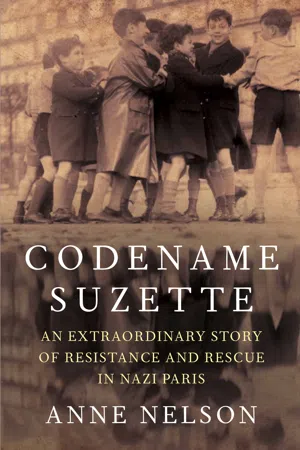
eBook - ePub
Codename Suzette
An extraordinary story of resistance and rescue in Nazi Paris
- English
- ePUB (mobile friendly)
- Available on iOS & Android
eBook - ePub
About this book
Information
Subtopic
Social Science BiographiesIndex
History1
strangers
|1937 – 1940|
Suzanne and Claude Spaak moved to Paris in 1937, bringing their two children, a surrealist art collection, and a large wicker trunk. They were a golden couple, attractive, affluent, cultured; the move was designed to mend the fault lines. Claude was frustrated in his writing career, and their marriage had faltered. Maybe Paris would help.
Claude had outgrown Brussels, though the city had offered him every advantage. He owed many of them to his wife. “Suzette” was the oldest child of Louis Lorge, one of Belgium’s leading financiers. A self-made man, he spent his life pursuing wealth and social status. He had married into a prominent family and employed German and English governesses for his daughters. He provided his family with a mansion in Brussels, a house in the country, and holidays on the French Riviera.
Louis doted on his firstborn, a petite blonde with long ringlets and a Cupid’s bow mouth. He decided that she should marry into the aristocracy and sent her to finishing school to study embroidery, piano, and household management. But she chafed at her father’s mercenary values and leaned toward literature and social reform.
The summer she was fourteen, Suzanne fell in love with Claude Spaak, her fifteen-year-old neighbor at their country estate. A dreamy-eyed poet and a member of Belgium’s leading political dynasty, he courted her on romantic boat rides, reciting French verse. The two became secretly engaged. Suzanne was also enamored of Claude’s mother, Marie Spaak, a tiny dynamo who fought for women’s suffrage, labor reforms, and immigrant rights. When Marie’s father died in 1921, she was invited to take his place in the Belgian senate. According to family lore, “She refused the position and told her family. Her sons burst out laughing, and she was so insulted she changed her mind and accepted”—becoming the first female senator in the world.1
Louis Lorge strongly opposed Suzanne’s choice of husband, but she stood firm. A last-minute complication arose. The couple’s mothers discovered that there was a third party to the romance, a Canadian classmate of Suzanne’s named Ruth Peters. The two girls shared everything, including an infatuation with Claude. The mothers sent Ruth home to Toronto, and Louis took measures to protect his daughter’s fortune. Rather than disbursing her dowry in a lump sum, he would pay it in monthly installments to guarantee her a good living.
Claude Spaak was the youngest of three brothers, all of them tall and combative. Paul-Henri, the oldest, ran away as a teenager to enlist in the Belgian army in the First World War and ended up in a German prison camp. He returned to join the family’s political enterprise, and it was said that he addressed the Belgian parliament as “Monsieur le Président, Sénateurs, et Maman.” The second son, Charles, was on the way to becoming a celebrated screenwriter in Paris. Claude struggled to emerge from his brothers’ shadows. Little was heard of their sister, Madeleine, known as “Pichenette.”
When the brothers joined the family at weekly lunches, they never made it to dessert; one was certain to have stormed out. They taunted Claude’s young fiancée. When there was a lull, she stared at her plate until one demanded, “Suzette, do you hear the clock ticking?” and she would run to her room. As her father’s favorite, Suzanne expected to be treated with respect, but Claude chose to see her take his place at the bottom of the stack.
The couple married in 1925. Within a year Suzanne was pregnant and miscarried, but the next year she gave birth to a healthy girl, Lucie. Claude sent the news to Ruth in Canada in an envelope bearing three horses, indicating her place in their relationship. The family nicknamed the child “Pilette” after a famous Belgian race car driver, whose garage sign caught her attention on her daily stroll.
Claude was appointed the first artistic director of Brussels’ new Palais des Beaux-Arts, where his job was to organize exhibits and answer complaints. He dealt with the boredom by taking up the avant-garde. He was attracted to a struggling Belgian painter, René Magritte, a rough-hewn man from the coal-mining region west of Brussels, six years his senior. Magritte was eking out a living designing wallpaper and sheet music. He aspired to make a name as a surrealist painter, but he struggled with the complex wordplay of the Parisian intellectuals. Claude helped him along by suggesting ideas for paintings, then acquiring them for himself and the extended family (some of whom hid them in the attic). Curious canvases began to fill the Spaaks’ walls. Other families displayed pictures of dead ancestors or bowls of fruit, but the Spaaks’ Magrittes showed a tuba bursting into flame and leather boots sprouting toes.2
At home, all was far from well. Claude’s temper drove Suzanne to tears, and there were other complications. Claude was smitten with an older woman, whom he followed to the South of France. She humored him for two weeks, then sent him packing back to Brussels, whereupon he began an affair with a coworker.
Divorce was legal but rare in Belgium, and Suzanne would be required to show cause, embarrassing the family. She wrote Ruth in Canada and asked her to come back. If Claude was going to have a mistress, it might as well be someone she liked. Ruth could calm Claude’s tantrums and intuit his wishes—and she could type. So she became his secretary, and Claude alternated between two beds.
In 1931 Suzanne gave birth to Paul-Louis, or “Bazou.” On the way home from the hospital the taxi driver looked at him and exclaimed, “Quel petit gros bazouf!” (“What a big little fatso!”), and the nickname stuck. Claude and Ruth stood over his cradle and promised never to do anything that would hurt the children.
Pilette contracted polio at the age of two. After a long search, Suzanne found a Swedish doctor who helped her with a new procedure. The painful operation kept her in a cast for months, but it saved her leg. Suzanne then turned to social issues. The Depression had driven factory workers into the streets. In 1935 Paul-Henri was appointed to serve as Belgium’s youngest cabinet minister. Though he advocated for the workers, Claude and Suzanne thought he was too cautious. Suzanne turned to the World Committee of Women against War and Fascism, a leftist coalition of feminists and pacifists.3
She took an interest in the plight of the Jewish immigrants she met there, a growing population invisible to most Belgians. Jews counted for less than 1 percent of Belgium’s population of eight million, and only a small fraction were citizens. Most had fled hardship and pogroms in Eastern Europe, and the Nazis were adding thousands to their ranks. When Suzanne read some articles by a young Polish Jewish activist, Julia Pirotte, she encouraged her to take up photojournalism. She commandeered her sister Bunny’s Leica Elmar III. “You never use it,” she told her, and Bunny’s Leica launched Pirotte’s career as a world-class photographer.4
In 1936 Claude commissioned Magritte to paint family portraits. He began with a snapshot of Suzanne, placing her image on a page of a book opening to a patch of blue sky with white clouds. Then he did portraits of Claude and Ruth seated in front of surrealist backgrounds. Claude disliked them and cropped the paintings, leaving only the heads. The next year Magritte painted the children in front of a window open to a road strewn with surrealist icons. His final painting of Claude’s family was L’Ésprit de géométrie, which depicted a mother with Bazou’s childish head, holding an infant with Suzanne’s adult head. It is both the most disturbing and successful of his Spaak portraits.I
By 1937 Claude decided that his career was stalled. Brussels was small, provincial, and dominated by his powerful family; his uncle was the current prime minister, and his brother Paul-Henri, the boy wonder of Belgian politics, was about to assume that position. In France, brother Charles had become one of the country’s leading screenwriters, and his coattails would be useful. Claude submitted some plays to Paris producers. Several expressed interest, and he packed up the family.
It was, of course, Suzanne’s inheritance that made the move possible. Claude rented a comfortable apartment in the suburb of Saint-Cloud, and the couple installed the children, unpacked their trunks, and hung their Magrittes. Claude mingled with theater and film folk, but Suzanne felt out of place. Parisians were defying the Great Depression with madcap pursuits. Le Hot Club de France had just launched its first jazz label. Hemlines were long, waists were narrow, and the collaboration between surrealists and couturiers sizzled. Elsa Schiaparelli and Salvador Dalí designed a hat that looked like a shoe and a “skeleton dress” with a protruding rib cage.
In July 1937 Suzanne’s father died, leaving her a sizable inheritance, and the couple bought a farmhouse in the bucolic village of Choisel, thirty miles south of Paris. They renovated it top to bottom and set aside a room for Ruth. Suzanne thought the country would be good for the children. Bazou was thrilled to be reunited with his German shepherd, Wotan, who had been left behind in Brussels, but Suzanne now found herself stranded in a hamlet of flinty French farmers and weekenders.
Magritte, still struggling, wrote to patrons pleading for a stipend. When they turned him down, Suzanne offered him one thousand francs a month (roughly the salary of a secretary) in exchange for a series of paintings. The Spaaks amassed an extraordinary collection of forty-four works that would one day grace the world’s leading museums.
The Spaaks had moved to France for art’s sake, but there was no escaping politics. Over the mid-1930s Paris was rocked by street violence, and the country was polarized. The Left formed a coalition of Socialists, Communists, and trade unions, which won the 1936 elections. Léon Blum became France’s first Socialist and first Jewish prime minister. The Right responded with rage, echoing the Nazi diatribes against immigrant “Jewish agitators” and the “international Jewish banking conspiracy.”
France was still officially at peace, but war was in the air. Edith Piaf sang “Mon Legionnaire,” and there was a new vogue for war movies. One of them was La Grande Illusion, written by Charles Spaak. The 1937 masterpiece, directed by Jean Renoir, was based in part on Paul-Henri’s experiences as a German prisoner of war. It became an international sensation, but Paul-Henri, Belgium’s foreign minister, banned it in that country for fear it would enflame anti-German sentiment.II
In Spain, Fascist forces battled the democratically elected Republican government, and French newspapers warned there was worse to come. In April 1937 German and Italian planes bombed the town of Guernica, killing hundreds of civilians. Tens of thousands of refugees poured across the border into France. Suzanne helped those she could, including a girl named Carmen, who taught the children to dance the jota. Suzanne sewed Spanish costumes, and she and Claude took them to neighboring towns with the family gramophone. Locals gathered in the town square to watch them perform. Suzanne unfurled a banner—“Open the borders to Spain!”—as Bazou passed the hat. A photo shows Suzanne and her entourage raising their fists in a “No Pasarán!” salute.
The French public tended to regard the conflict as a Spanish problem. They were convinced that a broader war was unlikely and that their army and defenses shielded them. But the November 5, 1938, edition of Le Figaro challenged their complacency:
Monsieur von Rath [sic], third secretary of the German embassy [in Paris], was grievously wounded in his office. The aggressor is a young refugee of Polish origin who is not authorized to reside in France.
Le Figaro concluded that the attack was a tragic consequence of France’s lax immigration policies.
France’s ongoing excessive tolerance creates a battleground for those who are not interested in serving our country’s interests, only in undermining them.
The teenaged Jewish gunman, Herschel Grynszpan, was a magnet for French anti-immigrant sentiment. He had acted in response to an immigration dispute between Poland and Germany that had left his elderly parents stranded in a refugee camp on the border. He walked into the German embassy and randomly chose his victim, who died three days later. On November 9 the Nazis unleashed Kristallnacht in Germany, burning synagogues, murdering dozens, and sending more than thirty thousand Jewish men to concentration camps. Some families ransomed their relatives and sent them abroad, driving another wave of Jewish refugees into France.
On November 11, Le Figaro expressed shock at the German violence:
A kind of madness seized the German population, and the hatred of the Israelite race today reached its paroxysm.
The paper included a response from the Berliner Lokal-Anzeiger calling on the French government to expel the foreign troublemakers who “make their nest in Paris” and urging it “to begin with those who bear arms for Jewish Bolshevism.” France’s “excessive tolerance” toward Jewish refugees was now under internal attack.
Suzanne had sympathized with the Jewish exiles in Brussels, among them Miriam Sokol. One day in 1938 she and her husband, Hersch, appeared on the Spaaks’ doorstep in France. The tiny, raven-haired Mira had met Suzanne through her women’s committee. Born in Vilnius, she had earned a PhD in social science in Brussels, where she met “Harry” Sokol, a young physician from a prosperous Jewish family in Bialystock.
The Sokols, like many of France’s immigrant Jews, came from the tumultuous zone that spanned the Russian-German divide, where it was possible to live in three different countries over thirty years without moving house. They had been born in Czarist Russia, grew up under German occupation, and came of age in the newly reconstituted Poland. Each disruption brought more travails for the Jews. It was not uncommon for Jewish families to send their children as far away as possible, praying they would never come back.
Harry Sokol was a short, slight man with alert brown eyes and a puckish smile. He had studied and worked in England, South Africa, and Switzerland, and spoke English, French, and German. When he met Mira in Brussels he was completing his medical studies, but his immigration status made it impossible for him to practice. They attempted to emigrate to Russia, but t...
Table of contents
- Cover
- Title Page
- Dedication
- Epigraph
- Contents
- List of Illustrations
- Map of Paris
- Dramatis Personae
- | Chapter 1 | Strangers
- | Chapter 2 | The Real War
- | Chapter 3 | Paris by Night
- | Chapter 4 | La Plaque Tournante
- | Chapter 5 | Monsieur Henri
- | Chapter 6 | Spring Wind, Winter Stadium
- | Chapter 7 | The Ragged Network
- | Chapter 8 | Suzanne and Sophie
- | Chapter 9 | The Unimaginable
- | Chapter 10 | La Clairière
- | Chapter 11 | Le Grand Livre
- | Chapter 12 | The Unraveling
- | Chapter 13 | Flight
- | Chapter 14 | All Saints’ Day
- | Chapter 15 | The Last Train
- | Chapter 16 | Liberation
- | Chapter 17 | The Aftermath
- Also by Anne Nelson
- Acknowledgments
- Appendix
- Notes
- Bibliography
- Illustration Credits
- Index
- About the Author
- Picture Section
- Copyright
Trusted by 375,005 students
Access to over 1.5 million titles for a fair monthly price.
Study more efficiently using our study tools.
Frequently asked questions
Yes, you can cancel anytime from the Subscription tab in your account settings on the Perlego website. Your subscription will stay active until the end of your current billing period. Learn how to cancel your subscription
No, books cannot be downloaded as external files, such as PDFs, for use outside of Perlego. However, you can download books within the Perlego app for offline reading on mobile or tablet. Learn how to download books offline
Perlego offers two plans: Essential and Complete
- Essential is ideal for learners and professionals who enjoy exploring a wide range of subjects. Access the Essential Library with 800,000+ trusted titles and best-sellers across business, personal growth, and the humanities. Includes unlimited reading time and Standard Read Aloud voice.
- Complete: Perfect for advanced learners and researchers needing full, unrestricted access. Unlock 1.5M+ books across hundreds of subjects, including academic and specialized titles. The Complete Plan also includes advanced features like Premium Read Aloud and Research Assistant.
We are an online textbook subscription service, where you can get access to an entire online library for less than the price of a single book per month. With over 1.5 million books across 990+ topics, we’ve got you covered! Learn about our mission
Look out for the read-aloud symbol on your next book to see if you can listen to it. The read-aloud tool reads text aloud for you, highlighting the text as it is being read. You can pause it, speed it up and slow it down. Learn more about Read Aloud
Yes! You can use the Perlego app on both iOS and Android devices to read anytime, anywhere — even offline. Perfect for commutes or when you’re on the go.
Please note we cannot support devices running on iOS 13 and Android 7 or earlier. Learn more about using the app
Please note we cannot support devices running on iOS 13 and Android 7 or earlier. Learn more about using the app
Yes, you can access Codename Suzette by Anne Nelson in PDF and/or ePUB format, as well as other popular books in History & Social Science Biographies. We have over 1.5 million books available in our catalogue for you to explore.