July 5 2018, Masindi, Uganda:
218 people are massacred when the Lord's Resistance Army attack an undefended hospital. Amongst the dead are 32 American medical volunteers.
September 12, UN Security Council:
The US announces its plan to eradicate the Lord's Resistance Army once and for all. But it will mean military intervention in China's African sphere of influence. The message from the Chinese is keep out.
October 17, Wall Street:
Stock prices tumble as a wave of uncertainty sweeps the US markets. Memories of the collapse a decade ago are still fresh, and Washington is prepared to do what it takes to prop up America's banks. But the government's concern is that this time the turmoil is orchestrated. That someone is deliberately undermining the US markets.
Three unrelated incidents, or the opening moves in a much larger confrontation between two superpowers?
eBook - ePub
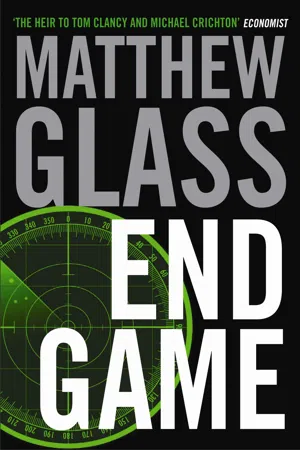
End Game
About this book
Information
1
HE OPENED THE file. It wasn’t the first time he had looked at it. He glanced down the lines of the first page, a summary of the known sequence of
events. The following two pages were intelligence background on the LRA and the regional political situation. The next page was an outline of possible options for response from his national
security advisor. After that were pictures and short biographies of each of the dead Americans, four to a page. There were eight pages of them. Another three had died of their wounds since the file
had been prepared, and a number of others were in critical condition.
He looked through the pictures. Then he turned back to the page that set out the options for response. He had issued an immediate condemnation of the killings. One of the options was to leave it
at that. There were several others. In the wake of the attack, the Ugandan government had called on the US to aid it in eradicating the LRA.
He read over the options, thinking through the implications.
Thomas Paxton Knowles was a tall man of fifty-eight with a jutting, square jaw and a full head of greying hair. President for eighteen months, he had spent twenty years of his life making his
way towards the White House, the last four as governor of Nevada.
Like any president, Tom Knowles had inherited a ready-made complexity of foreign involvements the day he walked into the Oval Office. Seventeen years after invading Afghanistan US forces were
still deployed in and around Kabul, supposedly acting as advisors and trainers to the Afghan army, and American drone aircraft were a constant feature in the skies over the Pakistan border. Five
years on from the Georgia crisis the presence of US troops remained a constant irritant with the Russians, without any obvious exit strategy. Closer to home, what had started as a program of joint
US and Mexican border patrols had turned into a fortified deployment with a virtual war being fought with armed drugs gangs on both sides of the border and frequent US casualties. Colombia,
Liberia, Haiti and the Philippines were all places where there were US missions of varying sizes.
That was a good long list and it posed enough challenges without requiring any additions. The Masindi Massacre was one in a litany of outrages by a longstanding, local insurgency in a distant
country in which a group of Americans had happened to get involved. The charity had been warned by the State Department about sending people to serve in Uganda. It would be perfectly possible for
him to do nothing beyond the condemnation he had already issued.
But thirty-two Americans – rising to thirty-five, and possibly going higher – had been killed in cold blood. And who was to say the LRA hadn’t targeted the hospital compound in
Masindi because they knew Americans would be there?
A good part of the Republican Party was demanding some kind of response, but Knowles didn’t need political pressure to make him feel the need for action. From all he had been told in the
last couple of days, the LRA was a cancer on humanity. It had no apparent program beyond the murder, rape and robbery of the local populations in a terrorized triangle of territory in northern
Uganda, southern Sudan and northeast Congo. Like some kind of hideous reptile, it survived in the dark crevices created by the political tensions between the three affected states. Every time the
group seemed to be dying away, it flared back into life, usually with a spectacular atrocity like the Masindi Massacre. Peace talks had brought the insurgency to the brink of cessation a number of
times, only to collapse when the leaders of the group disappeared into the jungle to restart hostilities. At other times the Ugandan army had mounted a drive to eradicate it but had ground to a
halt in the dense jungle of the area through inadequate manpower and lack of resolve from the other two countries where the LRA found temporary shelter before reinfiltrating its Ugandan base. And
while this was happening, the ranks of the insurgents were constantly replenished by the abduction of children and their forced conversion into soldiers. There were stories of children being taken
back to their villages and compelled to kill their own parents to prove their loyalty to their abductors. After thirty years of fighting this monster the Ugandan authorities felt powerless to
eradicate it.
Knowles could envisage himself agreeing to the Ugandan government’s request. If he gave the go-ahead, US troops could probably be on the ground in weeks. Eradicating the LRA was a clear
objective, defined, contained, with a short time horizon, a willing local government, and an unambiguous case for intervention in the name of humanitarian goals. He hadn’t seen a military
assessment yet, but he didn’t think an outfit like the LRA would pose much of a threat to the US army. His national security advisor, Gary Rose, thought likewise. The situation in Uganda had
nothing in common with the awful embroilments in Afghanistan and Georgia, where military success was prevented by constant political double-dealing and corruption.
But Tom Knowles was a politician, not a crusader. As the standard bearer of the centrist wing of the Republican Party, he had taken the Republican nomination two years previously after a
bruising set of primaries that narrowed down to a straight runoff with Mitch Moynihan, an Idaho senator out of the hardcore Republican right. The election he fought the following November was the
first in which the recession that came out of the credit crunch of ’08 and its long, lingering shock waves were beginning to seem a thing of the past. The pendulum had swung back and the
country right across the political spectrum, left as well as right, responded to a rhetoric of smaller government, tax cuts and reduced federal spending. Knowles carefully kept his program
moderate. He crafted a kind of reverse-Obama coalition of Republicans and centrist Democrats that swept him to power. His first eighteen months in the Oval Office had delivered economic stability
and rising markets. That was the first thing the American electorate demanded of its president and would be until the trauma of the economic crisis was a lot more distant still. Rectitude and
trust, as he said in just about every one of his speeches on the economy. Growth without overheating. That was the focus, a sound and stable domestic economy, and that was what he aimed to deliver.
New foreign adventures weren’t supposed to be on the menu.
Yet presidents aren’t elected so as not to raise their eyes beyond the horizon, even presidents elected to steer a steady course away from the reef of a monumental economic trauma. Like
all his predecessors, Tom Knowles took his place in history extremely seriously. He did have an international agenda, although not one that he had talked about much in the election or in the
eighteen months since he had been sworn in. Together with his national security advisor and defense secretary, he felt that over the last eight years the US had led too little, had been too much
interested in consensus and too little prepared to act. It was as if the country had looked at what it had done during the Bush years, saw the results, and been fearful of doing the same again, so
fearful that it hadn’t trusted itself to do anything on its own. It was a fearfulness that made him angry. Knowles believed that the world needed leadership now more than ever before. As
China and India and Brazil rose to prominence – each with its different perspective and political culture – he felt strongly that the world needed someone to set out certain common,
ineluctable principles and to be prepared to put those principles into action. Rightly or wrongly, Tom Knowles believed that only the United States could play that role.
The truth was, he couldn’t have asked for a better opportunity than the one the Masindi Massacre presented. It came at the perfect time in his first term, with eighteen months of solid
governance behind him to show that he was no trigger happy adventurer and enough time left ahead of him to get the whole thing done before he faced the American people again. None of the current US
foreign interventions was of his making and each was bogged down in one way or another, in his view, because of compromises and poor decisions made by previous administrations. This one would be
his, one that he could launch, prosecute and bring to a close on his watch, one that would allow him to show how a US military intervention should be done.
Beyond the effect of freeing the people of north Uganda from a terrorist menace, an intervention against the LRA would make a strong point. It would make the kind of statement Knowles wanted to
make about American leadership in the world and about American willingness to exert that leadership when the cause was just.
Yet he knew enough history to recognize that his inclination to reach for the gun needed to be questioned. In the first flush of outrage after the massacre, the American people would support
him. But it was easy to start something like this and then find, for reasons you hadn’t foreseen, that it turned into a quagmire from which there was no honorable way out. And the American
people wouldn’t thank him for that. They wouldn’t thank him in two years’ time if he hadn’t got it done and American boys were dying in Uganda when he was up for
re-election.
He leafed through the file. He looked at the pages of faces staring out at him, young American men and women. All good people, all motivated by altruism – all dead. He paused and read a
couple of the biographies beside the pictures.
He just didn’t see how this could turn into a quagmire. It was so clear cut. The local political support was there, the objective was so well defined, the cause so just.
2
MARION ELLMAN LOOKED around the horseshoe-shaped table in the middle of the UN Security Council chamber. Seventeen ambassadors were seated there,
including herself. Set back from the table, the spectator seats within the chamber were largely filled with African diplomats waiting to see which way the vote would go. Ellman herself had no
idea.
It had taken almost two months to get here. Tom Knowles’ idea of starting the operation against the LRA within a few weeks had sounded fine until the military planners got to work. The
government of Uganda didn’t need UN authorization to invite the US army onto its territory, but it soon became clear that the only practical way to project force into the landlocked territory
of Uganda would require access across Kenya. The Kenyan government was prepared to provide air and land access and the use of a military base in the northwest of the country in exchange for a large
chunk of development and military assistance, but not without domestic political cover in the form of a UN resolution calling for armed intervention in the Republic of Uganda. Suddenly the US found
itself needing not only a majority on the Security Council, but the avoidance of opposition from China and Russia, the two veto-wielding members of the Council who were likely to vote down the
resolution. That in turn meant weeks of negotiation and horse-trading in the corridors of the UN headquarters in Manhattan and in foreign ministries across the world.
Through the summer the State Department machine worked at getting a majority of votes behind a resolution and putting the Chinese and Russians into a position where they couldn’t –
or wouldn’t – vote against it. They had reasons to. The Russians were always looking for leverage against the US because of the continuing American presence in Georgia. The Chinese were
deeply involved in Sudan, where they ran the oil industry, and had no reason to want to see US troops across the Ugandan border, for however short a time. But for their own domestic and regional
strategic reasons, neither government wanted to be seen gratuitously blocking an operation with overwhelmingly humanitarian aims. That was where they were vulnerable and Marion Ellman, the US
ambassador to the UN, led the diplomatic offensive. Forty-four, an ex-assistant secretary of state for Latin American affairs and professor of international relations at Berkeley, Ellman was a tall
woman, usually dressed in a pant suit, with an attractive, slightly masculine face and dark shoulder-length hair.
Now she waited for the president of the Council to open the debate.
As proposer of the resolution, Ellman spoke first. Her speech was relatively brief. Minds around the table had been made up, she knew, and nothing she said now was going to change them. The
crimes of the LRA were well known. She gave a succinct overview of the LRA’s murderous record and the failed attempts by the Ugandan government to eradicate it. Without naming them explicity,
she concluded with a last reminder to China and Russia of how they would be seen if they blocked the resolution.
The Russian ambassador, Evgeny Stepsin, didn’t speak in the debate. The Chinese ambassador, Liu Ziyang, made remarks about the gravity of the decision and the risks attached to the
internationalization of any conflict, no matter how localized it seemed. Ellman listened carefully to his words. It was always hard to read the nuances through translation, when not only the
subtlety of meaning might be lost but the words were detached from the expression and body language that accompanied them. She knew Liu wasn’t going to vote in favor. She tried to decipher
whether he was using his apparent objection to ‘internationalization’, as he called it, in order to rationalize an abstention. Or was he trying to justify a veto? The Chinese ambassador
was a small, energetic man with rimless spectacles. By the time he concluded Ellman still didn’t know which way China was going to go.
Speaking in French, the Ivory Coast ambassador, the Council’s president for the month, called for the vote.
First he asked those in favor of the resolution to raise their hands. Ellman did so and looked at the other ambassadors. She counted them off. Argentina, France, India, Ireland, Ivory Coast,
Spain, Thailand, Tunisia and, sitting right beside her, the United Kingdom.
Ten votes, including hers, out of seventeen. She let out her breath. She had a majority. That was the first hurdle.
The translation of the Ivory Coast ambassador’s voice came through her earpiece, calling on those voting against the resolution.
Chad, Bolivia and Serbia immediately voted no. Then Brazil. Then Malaysia.
She looked at Liu Ziyang across the stenographers’ table in the middle of the horseshoe. Further around the table sat the big bulk of Evgeny Stepsin.
Neither Liu nor Stepsin made a move.
‘Abstentions?’ said the voice of the translator in her earphone.
Silently, the two men raised their hands.
THE SESSION BROKE up. The Ugandan ambassador, who had been watching from the spectator seats in the chamber, headed straight for her.
He grabbed her hand in both of his and wouldn’t let it go. He was a large man in a grey double-breasted suit that made him look even larger, and he was genuinely choked up. He tried to
tell her how much this meant to Uganda but all he managed to say was that he couldn’t express how much it meant. Ellman nodded. ‘We’re going to do what we can,’ she said. He
thanked her again. There were tears in his eyes.
‘We depend on you, Madam Ambassador,’ he said, still holding her hand in his big, soft mitts.
‘You can depend on us,’ she said.
The Kenyan ambassador joined them. Marion managed to extricate her hand from the Ugandan ambassador’s grip. They talked for a few minutes about the implications of the vote. Ellman
couldn’t give them a timetable for action. That would be worked out over the coming days.
Out of the corner of her eye she noticed the Sudanese ambassador deep in conversation with Liu.
China had spent a decade building up its position in Africa, and nowhere more dominantly than in Sudan. The strong opinion in the State Department was that if the US was going to do this thing,
it would have to be done in coalition. France and Britain had already told her they were prepared to consider sending limited contingents. Participation from developing countries would be even more
important. No matter how small the contributions, no matter how symbolic, they were needed. China would simply lose too much face if the US went in alone.
The Kenyan and Ugandan ambassadors were still speaking to her. Ellman nodded, only half listening. She looked at Liu again. The Chinese ambassador glanced at her from behind his rimless glasses
and turned away.
3
THE MAN HOLDING the laser pointer was a short, barrel-chested admiral called Pete Pressler, head of the US Africa Command. In front of him in the White House Situation Room sat the president, the most senior members of the administration, the Joint Chiefs of Staff, and a dozen other military officers and presidential aides.
The red dot of the pointer moved across a map and stopped on a town called Lodwar in northern Kenya.
‘That’s the closest we can get to the Uganda border with a runway with the spec we need,’ said Pressler. ‘Gives us coverage of southern Sudan and northwest Congo if we need it as well. We’ll pilot the drones out of Creech air force base in Nevada. Operations will be coordinated from the Abraham Lincoln, which will be my command post.’
‘Offshore?’
‘Exactly, Mr President. Off the Kenyan coast. We’ll have the entire carrier strike group in theater. We’ll refuel Lodwar by air. The storage capacity they have on the ground isn’t worth jack so we’ll put tanks in first thing. Operationally, our primary weapon will be unmanned aircraft. Other than that, we’ll use Apaches or F-35s if we think they’re needed, special forces if we’ve got a high value target and we decide we want to take him alive or can’t get to him any other way. Otherwise, it’ll be air power.’
The president stretched out in his chair and locked his hands behind his head. ‘How does this work with the drones? It’s jungle up there, right?’
Pressler nodded. ‘Infrared, Mr President. Goes right through the tree canopy. We’ll blanket the place with unmanned vehicles. Day, night. Anything moves in there, in the open, under the trees, we’ll pick it up.’
‘What if it’s an animal?’ asked Gary Rose, the national security advisor.
‘It’s the patterns we’ll be looking for. The nu...
Table of contents
- Cover
- Blurb
- Author biography
- Title page
- Copyright page
- Contents
- Prologue
- Chapter 1
- Chapter 2
- Chapter 3
- Chapter 4
- Chapter 5
- Chapter 6
- Chapter 7
- Chapter 8
- Chapter 9
- Chapter 10
- Chapter 11
- Chapter 12
- Chapter 13
- Chapter 14
- Chapter 15
- Chapter 16
- Chapter 17
- Chapter 18
- Chapter 19
- Chapter 20
- Chapter 21
- Chapter 22
- Chapter 23
- Chapter 24
- Chapter 25
- Chapter 26
- Chapter 27
- Chapter 28
- Chapter 29
- Chapter 30
- Chapter 31
- Chapter 32
- Chapter 33
- Chapter 34
- Chapter 35
- Chapter 36
- Chapter 37
- Chapter 38
- Chapter 39
- Chapter 40
- Chapter 41
- Chapter 42
- Chapter 43
- Chapter 44
- Chapter 45
- Chapter 46
- Chapter 47
- Chapter 48
- Chapter 49
- Chapter 50
- Chapter 51
- Chapter 52
- Chapter 53
- Chapter 54
- Chapter 55
- Chapter 56
- Chapter 57
- Chapter 58
- Chapter 59
- Chapter 60
- Chapter 61
- Chapter 62
Trusted by 375,005 students
Access to over 1.5 million titles for a fair monthly price.
Study more efficiently using our study tools.
Frequently asked questions
Yes, you can cancel anytime from the Subscription tab in your account settings on the Perlego website. Your subscription will stay active until the end of your current billing period. Learn how to cancel your subscription
No, books cannot be downloaded as external files, such as PDFs, for use outside of Perlego. However, you can download books within the Perlego app for offline reading on mobile or tablet. Learn how to download books offline
We are an online textbook subscription service, where you can get access to an entire online library for less than the price of a single book per month. With over 1.5 million books across 990+ topics, we’ve got you covered! Learn about our mission
Look out for the read-aloud symbol on your next book to see if you can listen to it. The read-aloud tool reads text aloud for you, highlighting the text as it is being read. You can pause it, speed it up and slow it down. Learn more about Read Aloud
Yes! You can use the Perlego app on both iOS and Android devices to read anytime, anywhere — even offline. Perfect for commutes or when you’re on the go.
Please note we cannot support devices running on iOS 13 and Android 7 or earlier. Learn more about using the app
Please note we cannot support devices running on iOS 13 and Android 7 or earlier. Learn more about using the app
Yes, you can access End Game by Matthew Glass in PDF and/or ePUB format, as well as other popular books in Literature & Literature General. We have over 1.5 million books available in our catalogue for you to explore.