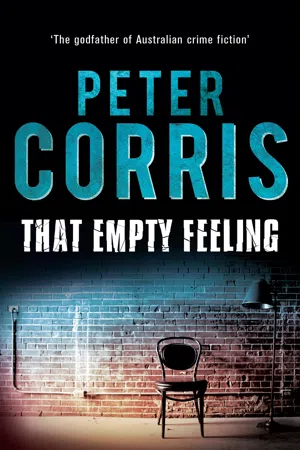
The forty-first book in the Cliff Hardy series
Legendary PI Cliff Hardy has reached an age when the obituaries have become part of his reading, and one triggers his memory of a case in the late 1980s. Back then Sydney was awash with colourful characters, and Cliff is reminded of a case involving 'Ten-Pound Pom' Barry Bartlett and racing identity and investor Sir Keith Mountjoy.
Bartlett, a former rugby league player and boxing manager, then a prosperous property developer, had hired Hardy to check on the bona fides of young Ronny Saunders, newly arrived from England and claiming to be Bartlett's son from an early failed marriage. The job brought Hardy into contact with Richard Keppler, head of the no-rules Botany Security Systems, Bronwen Marr, an undercover AFP operative, and sworn adversary Des O'Malley.
At a time when corporate capitalism was running riot, an embattled Hardy searched for leads - was Ronny Saunders a pawn in a game involving big oil and fraud on an international scale? Two murders raised the stakes and with the sinister figure of Lady Betty Lee Mountjoy pulling the strings, it was odds against a happy outcome.
eBook - ePub
That Empty Feeling
About this book
Information
Subtopic
Literature GeneralIndex
Literature1
I was sitting on the balcony of my daughter Megan’s flat turning over the pages of the Sydney Morning Herald and trying to decide if I liked its new tabloid format. They called it a ‘compact’ but I prefer to call a spade a spade.
I decided I didn’t care one way or the other—the paper was mostly gossip and stories that didn’t matter much now and wouldn’t matter at all tomorrow. I turned to the obituary page and almost dropped the paper.
‘Shit!’
Megan appeared at the sliding door. ‘What now? They’re bringing back the death penalty?’
‘Barry Bartlett’s dead.’
‘Who’s Barry Bartlett?’
I gazed out at Camperdown Park across the street. It was mid-morning in early spring; all the benches were occupied and people were sprawled on the grass, some already unwrapping their lunches. Barry had always enjoyed his lunch.
‘It’s a long story,’ I said.
Megan came out and eased herself into one of the cane chairs. She was eight months pregnant. It hadn’t been planned but she was happy about it. So was her partner Hank and their son Ben, my grandson. Ben was five and looked a lot like me—tall and dark with a hooked nose and a low hairline. He wanted a sister and you’d have to hope that if she came along she’d look like her mother rather than her grandad. Megan, in her late thirties, still turns heads. She looks a bit like Sigourney Weaver with a few more kilos.
‘Cliff,’ she said, ‘Ben’s in school, I’ve done the housework, prepared our lunch and I reckon it’s just about time for a drink. I’ve got nothing to do until 3.30. I wouldn’t mind a story.’
Megan’s partner is an American. She’s picked up expressions like ‘in school’ and they watch gridiron on television. She ran her hands over her swollen belly.
‘Sure it’s not twins?’
They’d decided they didn’t want to be told the sex of the child but they knew they weren’t getting twins.
‘It’s not fucking twins, as you well know. Just a big lump like Ben—and you, probably. What were you when you were born?’
‘Nine pounds something, I believe. Don’t blame me. Hank’s a bit bigger than I am.’
Megan groaned. ‘I can see the stretch marks. I’ll get you a beer and you can tell me all about Barry what’s-his-name. Take my mind off thoughts of the delivery suite.’
She brought the beer and I drank most of the stubby before saying anything. Megan looked enquiringly at me.
‘What?’
‘It’s not something I like to think about.’
‘Not your finest hour?’
‘Not by a long shot. I opened a file on it but in the end I didn’t put anything much in it. I just left it pretty empty. Empty . . . the whole thing had an empty feeling.’
‘Probably do you good to get it off your chest.’
2
Barry Bartlett was what the media called ‘a colourful Sydney identity’, which means that he was a crook who had stayed out of gaol for more than twenty-five years. His English family had migrated to Australia just after the Second World War—Ronald and Irene Bartlett, Barry, his sister Milly and his brother George. Barry was in his early teens then.
‘I was a terror on that ship and no mistake,’ he told me.
This was close to thirty years later, when I first knew him. He’d been a Balmain tearaway who’d left school early, worked for bookies and light-fingered wharfies and done eighteen months in Long Bay for assault with menaces in his late teens. Nothing since. He’d branched out into big-time fencing, illegal gambling and nightclub ownership. He also managed a few boxers. An Aboriginal fighter I knew, Bobby Munday, introduced us.
Bobby went on to have a successful career and have his money honestly managed and invested by Bartlett, which was a very rare thing then and since. I sat with Bartlett at a few of Bobby’s fights. After we watched him just squeak a points decision defending his Commonwealth welterweight title, Bartlett phoned me.
‘That cunt Simmonds wants to buy Bobby’s contract and put him in against Sugar Ray Leonard in Vegas.’
‘Jesus,’ I said.
‘Bobby’s not in that class and never was, plus he’s near the top of the hill if not fucking over it, wouldn’t you say?’
‘Yeah.’
‘I know you’ve got influence with him, Hardy. I won’t sell his contract but those things aren’t really worth a pinch of shit. Simmonds could find a lawyer to get Bobby out of it. There’d be one hell of a big pay night and Simmonds and the lawyer and some fat prick in the US’d get the lion’s share and Bobby’d end up with brain damage or worse. I want you to convince him not to do it.’
‘A lot of money to pass up.’
‘He’s got a lot of fucking money.’
This was well before the days of email. Bartlett had the accountant he’d put in charge of Bobby’s affairs fax me over details of Bobby’s bank accounts, investments and tax status. As things stood, Bobby was set for life, with enough coming in from investments to live on and capital to invest in other enterprises of his own choosing. His life and that of his wife were insured; there were tax-friendly trusts set up for his two kids.
I phoned Bartlett. ‘I should have had you manage me.’
Bartlett laughed. ‘Bobby had some big fights at the right time. That’s how he got the world ranking. I wrung money out of the fucking media every time they wanted him to say two words. That doco brought in a motza. What’s the most you ever made from a case?’
‘Okay, point taken, but you know fighters. They don’t know when it’s over and they don’t like to be told.’
‘I’m asking for your help. Might sound fucking weird, but I’m proud of what I’ve done for that boy. Makes me feel I’ve given something back to this country that’s been so good to me.’
I laughed. ‘Blarney—I thought you were a Pom, not a Mick.’
‘Call it what you like. I’ll pay you . . .’
‘Shut up, you’re not getting the bloody moral drop on me. I’ll do what I can. The last thing I want to see is Bobby on the canvas in Las Vegas and Teddy Simmonds counting the money.’
I rang Bobby and asked if he could spare me some time. Me being a private detective amused him, and he was usually pleased to see me to talk boxing and make jokes about trench coats and .38s. Didn’t matter that I didn’t own a trench coat and my Smith & Wesson hadn’t seen the light of day for quite a while.
I dropped in at Trueman’s gym in Newtown and caught the last of Bobby’s sparring session. He had a massage and a shower and we went out onto King Street.
‘Fancy a beer?’ I said.
‘Are you kidding? I’m strictly off it.’
‘Why’s that, champ?’
Bobby shot me a look. He wasn’t dumb. He knew of my acquaintance with Bartlett. ‘Oh, shit,’ he said. ‘You’re going to tell me Teddy Simmonds is a bigger crook than Barry and not to listen to him.’
‘Not a bit of it. You’re not a child. You can talk to whoever you like. I just want to show you something. Where’s your car?’
Bobby had a Beemer convertible he was proud of and happy to demonstrate. It was parked nearby and we walked there with him nodding graciously to people in the street who knew him.
‘Pretty sharp, eh?’
‘The car? Yeah.’
He laughed. ‘Fuck you, Cliff. The sparring.’
I grunted. ‘Not too shabby. Want you to meet an old mate of mine, Phil Sikes. Lives in Watsons Bay.’
Like all professional athletes, Bobby had trouble filling in the time when not training or performing. He was a family man but his wife, Jenny, handled that part of his life and Bartlett’s accountant dealt with the business side. He read a bit, mostly biographies of the well-known. He liked the movies and TV and did some work with the Aboriginal Youth Program but he didn’t play golf. Time hung heavy and he was happy to go for a drive.
Phil Sikes was an ex-featherweight. A main event fighter in an unpopular division, whose career went nowhere. He won a lottery, retired and kept himself busy and amused by showing boxing films to sporting clubs and charity organisations. He had the best collection of boxing films in Australia and kept up to date via arrangements with US and European television providers and boxing managers and promoters.
Phil shook Bobby’s hand enthusiastically. ‘I’ve got a few of your fights. You had a great left hook.’
Bobby beamed. ‘Still have.’
Phil nodded. ‘Cliff here did pretty good as an amateur but didn’t have the heart for the real game. He wanted me to show you something.’
We went into Phil’s viewing room and he pulled down the blind to block the million-dollar view of the water and the boats. He had a huge TV and video set up and he handled a couple of remote-control devices like a chessmaster setting up the board.
Over the next two hours we watched films of the career of ‘Sugar’ Ray Leonard, then the undisputed welterweight champion of the world. Phil had somehow spliced together a sequence of films that ran from Leonard’s defeat of Cuban KO artist Andrés Aldama to win the gold medal in the welterweight division at the 1976 Olympic Games through his early professional career, where he won a succession of fights, to his contests with Roberto Durán and his defeat of Tommy ‘Hitman’ Hearns.
Interspersed were extracts from documentaries on Leonard—his background, physical characteristics, training, tactics, techniques. No one said a word as we watched Leonard mature from a spindly cutie to a fighting machine. Leonard’s reach was ten centimetres greater than his height and, as with Les Darcy, it let him do damage from a distance without extending himself and left him with abundant power when his opponent, tired of eating leather, was slowed down and easy to hit.
Phil and I had a couple of beers while watching the screen. Bobby refused at first but accepted during the Leonard/ Hearns fight.
‘Moves well,’ I said when the screen went blank.
‘Never stops,’ Phil said. ‘No, he stopped against Durán and lost. Learned his lesson.’
‘What about Hagler?’ I said. ‘Marvelous’ Marvin Hagler was the world middleweight champion, a powerhouse puncher.
‘One day,’ Phil said. ‘Be interesting.’
We thanked him and Bobby was quiet on the return drive, which he made cautiously. I’d left my car at the gym and he dropped me there.
‘I get the point, Cliff. He’d kill me.’
‘Possibly.’
‘You see that left jab?’
I shook my head. ‘Not really.’
‘Exactly. Thanks, Cliff.’
3
Bobby Munday defended his Commonwealth title against an up-and-coming Maori fighter in Auckland and took a pretty heavy beating before rallying and knocking the Maori out in the tenth round. Then he retired.
Barry Bartlett bought me a drink when the retirement was announced and thanked me for helping Bobby see straight. Then I didn’t hear anything from him for a long time. He stayed out of the courts and the papers and, with all my other concerns, I more or less forgot about him. So I was surprised when he phoned and asked to see me.
I was still in Darlinghurst then, although the gentrification wave that would move me out was building. Some of the streets had been blocked off to divert traffic and provide a quieter atmosphere and the building next to mine was being demolished, to be replaced by a block of upmarket flats.
Like Bobby, Barry found it amusing to know a private eye and he’d dropped in a few times in the past to give me a ticket to a fight or just to talk boxing.
He turned up on time. His usual style was to pour scorn on any décor that wasn’t brand spanking new—I had nothing that was—from car to clothes, but he was subdued as he lowered himself into my battered client chair.
He sat silently for a minute and I opened the bidding.
‘How’s Bobby doing? Haven’t seen him for a while.’
He roused himself. ‘Who?’
‘Bobby Munday, the bloke we saved from brain damage.’
‘Bobby, oh yeah. He’s doing fine. Healthy financially and otherwise thanks to you and me.’
‘How’s he occupying himself?’
‘He’s the fitness coach of the fucking Sydney Swans. He reckons his son’s a champion in the making. Poofter game if you ask me, but there it is.’
‘So that’s not why you’re here.’
‘No. Fact is, I’m very fucking confused.’
‘B...
Table of contents
- COVER PAGE
- TITLE PAGE
- COPYRIGHT PAGE
- CONTENTS
- PART ONE
- PART TWO
- PART THREE
Trusted by 375,005 students
Access to over 1.5 million titles for a fair monthly price.
Study more efficiently using our study tools.
Frequently asked questions
Yes, you can cancel anytime from the Subscription tab in your account settings on the Perlego website. Your subscription will stay active until the end of your current billing period. Learn how to cancel your subscription
No, books cannot be downloaded as external files, such as PDFs, for use outside of Perlego. However, you can download books within the Perlego app for offline reading on mobile or tablet. Learn how to download books offline
Perlego offers two plans: Essential and Complete
- Essential is ideal for learners and professionals who enjoy exploring a wide range of subjects. Access the Essential Library with 800,000+ trusted titles and best-sellers across business, personal growth, and the humanities. Includes unlimited reading time and Standard Read Aloud voice.
- Complete: Perfect for advanced learners and researchers needing full, unrestricted access. Unlock 1.5M+ books across hundreds of subjects, including academic and specialized titles. The Complete Plan also includes advanced features like Premium Read Aloud and Research Assistant.
We are an online textbook subscription service, where you can get access to an entire online library for less than the price of a single book per month. With over 1.5 million books across 990+ topics, we’ve got you covered! Learn about our mission
Look out for the read-aloud symbol on your next book to see if you can listen to it. The read-aloud tool reads text aloud for you, highlighting the text as it is being read. You can pause it, speed it up and slow it down. Learn more about Read Aloud
Yes! You can use the Perlego app on both iOS and Android devices to read anytime, anywhere — even offline. Perfect for commutes or when you’re on the go.
Please note we cannot support devices running on iOS 13 and Android 7 or earlier. Learn more about using the app
Please note we cannot support devices running on iOS 13 and Android 7 or earlier. Learn more about using the app
Yes, you can access That Empty Feeling by Peter Corris in PDF and/or ePUB format, as well as other popular books in Literature & Literature General. We have over 1.5 million books available in our catalogue for you to explore.