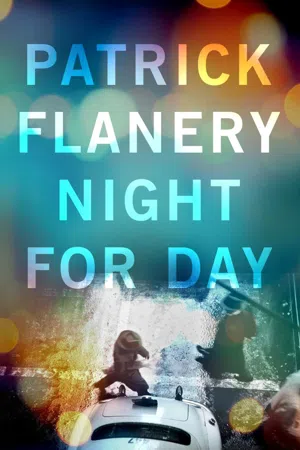
Los Angeles, 1950. Over the course of a single day, two friends grapple with the moral and professional uncertainties of the escalating Communist witch-hunt in Hollywood. Director John Marsh races to convince his actress wife not to turn informant for the House Committee on Un-American Activities, while leftist screenwriter Desmond Frank confronts the possibility of exile to live and work without fear of being blacklisted. As Marsh and Frank struggle to complete shooting on their film
She Turned Away, which updates the myth of Orpheus to the gritty noir underworld of post-war Los Angeles, the chaos of their private lives pushes them towards a climactic confrontation with complicity, jealousy, and fear.
Night for Day conjures a feverish vision of one of the country's most notorious periods of national crisis, illuminating the eternal dilemma of both art and politics: how to make the world anew. At once a definitively American novel, echoing Philip Roth and Raymond Chandler, it also nods to the mythic landscapes of Dante and the iconoclastic playfulness of James Joyce. With as much to say about the early years of the Cold War as about the political and social divisions that continue to divide the country today,
Night for Day is expansive in scope and yet tenderly intimate, exploring the subtleties of belonging and the enormity of exile-not only from one's country but also from one's self.
eBook - ePub
Night for Day
About this book
Information
PART ONE:
Day
1
The last time I saw you was the day my life ended. I say that it ended but you understand this is only a figure of speech. Say instead that my life up to that point came to an end but in the intervening decades my body has kept walking around in the world, although I have now reached an age when such movement occurs at what feels like a nearly geological pace. If I manage a mile in forty-five minutes I have accomplished something significant. That last day we spent together we both still had the energy of our youth, the resilience of our bodies, never imagining how quickly our energy might begin to dissipate or how long and unswerving the decline would prove. To say that I have wished to hear from you without ever expecting you to phone or write suggests I believed the onus was on you to initiate contact, as if I felt no sense of responsibility to do so myself. This was never the case. Shame has kept me silent, distant from you and Helen and all the people I used to call friends, though even to call you friends fails to admit of the strength of our bond, the way we managed for a few brief years to craft the closest thing to family I have known since leaving the home of my parents.
Over the course of the preceding night I began to formulate what I knew I must do. I can no longer recall whether this private planning – plans I did not share with you until far too late – was the spur for the argument we had, or if the argument itself prompted the decision. You would tell me now, I suspect, that even asking the question suggests a denial of guilt. Perhaps you will reply to this letter and tell me what you think, whether and how I should judge myself in the last months of my life. It was not my intention when I decided to write that I would return to grievances, because I know after all these years that you are, if not entirely innocent, at least more so than I. So this is my defense, an explanation of how I came to the decision I made that day so many years ago, and an apology for the consequences that have marked us both.
Let me start much earlier, back when we met, four years before the day we parted, on the set of a film in which you had only one line but a line I nonetheless wrote, and in seeing the boy they had cast – for then you could have been no more than twenty-two – I rewrote the line to suit the face cast to speak it. And you, performing a naïveté as intoxicating as gardenias in twilight, slouched across the soundstage and asked me the meaning of those words I had blown into your mouth. That was the first time we spoke, although we had noticed each other on the lot at various points, since your arrival fresh from military service, unscathed because you never reached a battlefield. You caught my eye, and I flatter myself to think I might have caught yours. We knew what we were before you ever spoke to me – at least I knew what you were even if you might have been unsure of me. It was not how you walked or spoke but the way your gaze lingered when it fell upon my face.
Because following the eye as it traveled could lead us into the arms of a sting if we were reckless or unlucky, it was natural to distrust our instincts, to doubt the pull of our attraction. You were young and beautiful enough that I thought it possible you were no one I should allow myself to follow. I understood that I was attracted to you and hoped you might be attracted to me, but there was no guarantee that you were conscious of any attraction you might feel, and I could not trust you knew yourself well enough to accept what you were. Dark skin and pale hair and eyes the shade of California lilacs. Who could fail to notice? We bumped into each other at the newsstand one December morning when you were buying a copy of Life with Ingrid Bergman dressed as Joan of Arc on the cover and I noticed how embarrassed you were to be seen holding a magazine like that, or perhaps it was because a woman was on the cover, or because that woman was dressed as a man. I remember thinking you needed someone to show you how to comb your hair differently, to move the part from the center and off to the left, and then, when I saw you again a few weeks later, catching your eye in the commissary, you had done just that. In changing your hair, you looked more yourself, self-contained without being smug. You were having lunch with Helen that day, the two of you cast in the same film, and because Helen was already my friend I drummed up the courage to ask her a few days later who you were. A kid from Montana, she said, a farm boy. A ranch boy to be precise, with two brothers. But does he have a girlfriend? I asked Helen. I remember the way she turned to me. We were sitting in my living room after a Christmas party to which only five people came. I had filled the picture window with poinsettias and bought a white-flocked tree hung with red ornaments and matching lights. Helen let her head tilt back and half closed her eyes. No, the farm boy does not have a girlfriend. Why do you ask? And then she must have seen me blush because she whispered, Oh, is that it? Well, I can’t say for sure but you might have a chance.
Before we ever spoke I imagined you in denim and cowboy boots and a plaid shirt with a bandanna around your neck, a Stetson on your head and a lazy way of sitting in the saddle, one hand on the reins of your appaloosa, one gripping a copy of Life. That evening in December 1946 I could not have imagined how only a year later I would be in bed with you in that same house, discovering you were not the innocent you appeared, that I should have had no fear about whether you accepted yourself or not. That was the miracle. So long as the truth remained hidden you were more at ease with who you were than I have ever managed to be. It was only outside of the house that you became your public self, and that man bore as little resemblance to the one I knew as Ingrid Bergman to Joan of Arc.
In my living room that Christmastime, I was conscious of Helen’s hand shaking where it lay on the back of the sofa. What’s wrong, I asked. Her lips drew taut and her chin quivered. Why don’t we get married, she said, it would make things so much easier for you.
I was sensitive enough not to laugh at the suggestion because I could see what it cost her. But you know that wouldn’t work, Helen, I’m not suitable for marriage, not to someone like you. That’s just it, she said, I’m not someone like me. I’m someone like you.
Weak for a man in uniform? I joked, and her eyes began to water. You know what I mean, Desmond. I’m as unmoved by men as you are by women. I wouldn’t put it quite that way, I said, taking her hand in mine and holding it until it stopped shaking. I love you too much to risk making you hate me. Why would I ever hate you? she asked. Anyone who lives with me long enough eventually hates me. I’m sure that’s not true, she said, and besides, who have you lived with apart from your parents? No one, I admitted, except the man who cleans my house and cooks my food and if you ask Max tomorrow he’ll tell you he could do without me.
Helen laughed and we never spoke again of her proposal. I could not have imagined that only six months later, the night after you and Helen were married, I would be in bed with you in my own house, because the two of you did not yet have a house of your own, and we presumed it safe enough to suggest I was a friend of the couple letting them stay before they departed on their honeymoon.
The night before my last day in Los Angeles, not even four years after we first spoke to each other, we argued about the terms of our arrangement. In the months leading up to that night in April 1950 I had allowed myself to believe I was on the margins because you and Helen and Barbara were able to live together while I had to retreat to my own house. I feared this meant you did not really love me. Perhaps I was looking for a way of cracking a rift between us, seeking fodder for an argument that would allow me to escape with a conscience less burdened by guilt. When we fought, which was not very often, it felt as if my chest were wired up with electrodes, the air supercharged with electricity and the anger between us waiting for a spark. Because I had risked being too intimate in public, at the studio, on set, I can no longer remember, you found me at fault. I had been standing too close, perhaps I touched your hand or your shoulder, maybe I spoke words that betrayed an intimacy whose exposure to the scrutiny of strangers you feared, and not without cause. I accused you of being more concerned about your own reputation than mine and you said that wasn’t fair and I said that didn’t make it untrue and you said you were just as concerned for my wellbeing as your own and I said that’s a fucking lie and you took my head in your hands and for an instant I had a vision of you head-butting me hard and knocking me out but instead you kissed me just as violently, cutting your lips into mine with an anger that made me almost afraid of you, but then you held the kiss and softened it and I let you keep gripping my head, your fingertips pressing into my scalp, consuming your rage because that was what I had learned to do since we first fell in love.
So much fury for such an angelic man.
Don’t resent me for saying what you must know is true.
When we were exhausted by fighting, we went to bed, not speaking as we undressed, you snapping your slacks tight and draping them over a hanger that clattered in the closet as you put it away, the door shutting too sharply, and then we were in bed, in your house with its walls of glass, a window cracked open to admit fresh air and the sound of the Pacific. You rolled over to press the length of your body against mine and I sighed with relief.
So my last day in Los Angeles began with me inside you and you inside me in the happiest hour of sadness I have ever known. I sensed the end was coming and you did not. If it were possible to do this for the rest of my life, exploring your body from within as you explored mine, I would, but then the swell started in my gut, a sensation of pleasant seasickness, that weightlessness of the stomach rising as an illusion of being borne away by tides took hold. Then the swell crested and whatever was watery turned to light. I squeezed my eyes shut and in the eclipse of that moment a measure of me rushed into you. After we finished, we lay chest against chest and you angled your head to kiss me.
That was the day my life ended.
I could hear the ocean crashing and, down the hall, Helen and Barbara talking in their own darkness. You nuzzled my neck and whispered, I trust you completely.
I could never forget the words because they broke my heart. You too, kid, I said, and you scowled. Don’t call me that, Desmond. Maybe I smiled, let’s say I did, or perhaps I apologized and kissed you again, gripping you tighter, and told you I had to work. How could I sleep knowing it was the last time I would make love to the man who might have been my husband in another world and time? My ear pressed against your body, I listened as your heart stepped down to a slower dance, felt you relaxing, legs twitching as you began to drop into sleep.
Don’t leave, you mumble...
Table of contents
- Cover
- Title
- Copyright
- Part One: Day
- Part Two: Night
- Acknowledgements
Trusted by 375,005 students
Access to over 1.5 million titles for a fair monthly price.
Study more efficiently using our study tools.
Frequently asked questions
Yes, you can cancel anytime from the Subscription tab in your account settings on the Perlego website. Your subscription will stay active until the end of your current billing period. Learn how to cancel your subscription
No, books cannot be downloaded as external files, such as PDFs, for use outside of Perlego. However, you can download books within the Perlego app for offline reading on mobile or tablet. Learn how to download books offline
Perlego offers two plans: Essential and Complete
- Essential is ideal for learners and professionals who enjoy exploring a wide range of subjects. Access the Essential Library with 800,000+ trusted titles and best-sellers across business, personal growth, and the humanities. Includes unlimited reading time and Standard Read Aloud voice.
- Complete: Perfect for advanced learners and researchers needing full, unrestricted access. Unlock 1.5M+ books across hundreds of subjects, including academic and specialized titles. The Complete Plan also includes advanced features like Premium Read Aloud and Research Assistant.
We are an online textbook subscription service, where you can get access to an entire online library for less than the price of a single book per month. With over 1.5 million books across 990+ topics, we’ve got you covered! Learn about our mission
Look out for the read-aloud symbol on your next book to see if you can listen to it. The read-aloud tool reads text aloud for you, highlighting the text as it is being read. You can pause it, speed it up and slow it down. Learn more about Read Aloud
Yes! You can use the Perlego app on both iOS and Android devices to read anytime, anywhere — even offline. Perfect for commutes or when you’re on the go.
Please note we cannot support devices running on iOS 13 and Android 7 or earlier. Learn more about using the app
Please note we cannot support devices running on iOS 13 and Android 7 or earlier. Learn more about using the app
Yes, you can access Night for Day by Patrick Flanery in PDF and/or ePUB format, as well as other popular books in Literature & Literature General. We have over 1.5 million books available in our catalogue for you to explore.