Based on one of the two engineers working for Gustave Eiffel to design the tower for the World Fair of 1889.
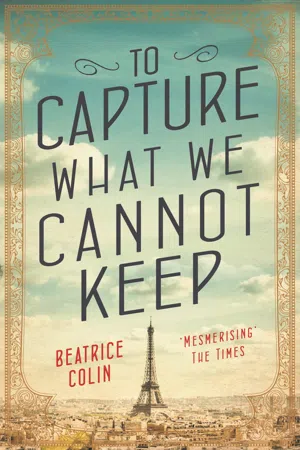
In February 1887, Caitriona Wallace and Émile Nouguier meet in a hot air balloon, floating high above Paris - a moment of pure possibility. But back on firm ground, their vastly different social strata become clear. Cait is a widow who because of her precarious financial situation is forced to chaperone two wealthy Scottish charges. Émile is expected to take on the bourgeois stability of his family's business and choose a suitable wife. As the Eiffel Tower rises, a marvel of steel and air and light, the subject of extreme controversy and a symbol of the future, Cait and Émile must decide what their love is worth.
Seamlessly weaving historical detail and vivid invention, Beatrice Colin evokes the revolutionary time in which Cait and Émile live - one of corsets and secret trysts, duels and Bohemian independence, strict tradition and Impressionist experimentation.
To Capture What We Cannot Keep, stylish, provocative and shimmering, raises probing questions about a woman's place in that world, the overarching reach of class distinctions and the sacrifices love requires of us all.
Winter in 19th-century Paris is wonderfully evoked and Beatrice Colin's prose is suitably mesmerising for this rather beautiful love story. -
The Times
- English
- ePUB (mobile friendly)
- Available on iOS & Android
eBook - ePub
To Capture What We Cannot Keep
About this book
Information
I
____
1
____
February 1886
THE SAND ON THE Champ de Mars was powdered with snow. A huge blue- and-white-striped hot-air balloon swooned on its ropes in front of the École Militaire, the gondola tethered to a small wooden platform strung out with grubby yellow bunting. Three figures, two women and a man, hurried from a hired landau on the avenue de Suffren across the parade ground toward the balloon.
“Attendez,” called out Caitriona Wallace. “Nous arrivons!”
As she paused on the steps to wait for the other two, Cait’s vision spun with tiny points of light in a darkening fog. She had laced tight that morning, pulling until the eyeholes in her corset almost met, and now her chest rose and fell in shallow gasps as she tried to catch her breath—in, out, in and out.
“We made it,” said Jamie Arrol as he reached her. “That was a close thing.”
“Here are the tickets,” she told him. “You get on board. Your sister is just coming.”
In the wicker gondola twenty people waited impatiently, the men in bell-curve beaver hats, and the women—there were only two—in fur-lined traveling coats. But the balloon attraction wasn’t full, not on a cold winter morning with a sky so leaden it looked as if it might descend any moment, not at eleven o’clock in the morning on a Monday.
The ropes strained in the wind that blew up from the Seine, a wind that whipped the sand and the snow into a milky haze. The showground smelled of new rope and hot tar, of smoke blown from the charcoal brazier of the balloon, and underneath it all a note of something alcoholic. A flask, Cait thought, was being passed among the male passengers above. She could do with a little sip of something herself. Once on board, however, all would be well. She would not let herself imagine anything untoward, she would not visualize the gondola rising upward until it burst into flames or hurtling down until it smashed into pieces on the ground or floating away over the rooftops like Gambetta in 1871. No, she wouldn’t let her fear get the better of her. She had read the promotional leaflet thoroughly. They would be tethered to the platform by a long chain. It was quite safe. And when they had made their ascent and reached a height of three hundred meters, she would look out and see the whole world clearly.
“Come on!” she cried out to her charge. “They’re all waiting!”
As Alice Arrol finally approached the steps, her pace became little more than leisurely. A small group of Parisian ladies were standing at the base of the platform, their parasols raised to stop the wind blowing their hats away. After throwing the ladies a glance, Alice’s face stiffened into an expression that suggested nonchalance.
“Actually,” she said as she adjusted her gloves and stared up into the overcast sky, “I think I’ll stay here.”
Not five minutes earlier Alice had been almost ecstatic with excitement. Cait found it hard to hide her dismay.
“Are you sure? Wasn’t the balloon excursion your idea?”
Alice’s eyes widened in warning and her mouth curled into a small smile.
“Don’t be ridiculous.” She laughed. “I wouldn’t dream of setting foot in such an undignified contraption!”
Alice’s cheeks were flushed and her ringlets had turned into a golden frizz around her face. She had kept her hair color, the blond not turning dark. It made her look younger than she really was; her skin, nursery-pink and chalk-white with a touch of blue around the eyes. She was nineteen but often taken for much younger. Cait felt a rush of affection toward her. She still wore her newly acquired adulthood badly, like an oversize coat that she hoped to grow into.
The balloon operators started to untie the ropes. Cait glanced up at the lip of the basket. There was no sign of Jamie. She would have to tell him of the change of plan. She turned back to Alice.
“Will you wait here?”
“Are you going to go without me?” Alice asked.
At that point, the idea hadn’t even occurred to Cait. Of course she should stay behind; she was a companion, paid to accompany and supervise Alice and her brother, Jamie Arrol. Also, at thirty-one, she was far too old to be spontaneous. Worst of all, heights, steep ascents, and theater seats in the upper circle all terrified her. And yet, as she had told herself in the carriage on the drive to the showground, she would get the chance only once in her lifetime and so she must take advantage.
“Maybe I should,” she said. “Would you mind?”
“No, don’t remain on my account.”
“And you’d be safe? You wouldn’t move an inch from this spot.”
“I won’t be seduced, I promise. Just go, Mrs. Wallace.”
“The tickets are already paid for,” Cait called as she climbed toward the outstretched hand of the balloon handler. “It would be a terrible waste if we didn’t use them. Your uncle would be outraged! Mortified! Can you imagine?”
She looked back just as Alice laughed out loud, then quickly covered her mouth with her hand. Ironically, for a girl who spent so long perfecting her expressions in the mirror, she was prettiest like that, when she forgot herself.
When the last few sandbags had been tossed over the side and the ropes coiled, the pilot leaned on a lever, air rushed into the brazier, the fire roared, and the balloon began to rise with the upward momentum of an air bubble through water. Cait shut her eyes and held tight to the wicker edge of the basket as the balloon ascended. Despite everything, it was just glorious.
Eight years earlier Cait had had no idea that she would end up here, rising into the sky above Paris, practically weightless, impossibly high. She had been married, settled, grounded. Her husband, Saul Wallace, was handsome and debonair, their home in Glasgow was large and comfortable; their shared future stretched out in front of them like the red roll of a carpet. There would be children, holidays, anniversaries.
Saul was just thirty-two when his train left one side of the River Tay and failed to reach the other. It was three days after Christmas, December 1879. As Cait sat beside the fire and opened a novel, she had not known—how could she—that at that moment their life together was ending, that the Tay Bridge had collapsed and Saul Angus Wallace was drowning in black-water currents beneath several tons of hissing iron.
The hot-air balloon had reached the end of its chain and came to a sudden, jolting halt. She opened her eyes. The brazier roared, the balloon still floated in the air, the world was as she had left it; Paris below and the sky above. For a moment she focused on breathing. She wouldn’t let herself think about the empty space beneath the gondola. She wouldn’t imagine the altitude they had reached. The other passengers rushed from one side to the other, clearly unconcerned that they were suspended by nothing more than hot air. No one else was fearful, no one else stood, as she did, several feet from the basket’s rim in the grip of a private terror.
“What a view!” Jamie Arrol was peering over the edge, almost hysterical with happiness. “Come and look.”
“I will,” she said. “In a minute.”
He turned and noticed that she was alone.
“Miss Arrol changed her mind,” Cait explained.
“She missed out.” He shrugged. “There’s the Panthéon . . . the Arc de Triomphe . . . and over there . . . I think that must be Notre-Dame! Look!”
Cait steeled her resolve, then cautiously, tentatively, hesitantly peered over the edge. And there, far below, were Baron Haussmann’s wide boulevards that followed the line of the old walls of the city, the green blot of the Bois de Boulogne, the pump of black smoke from the factories in the south, the star spokes radiating from the Place de l’Étoile, and, closer, the Place du Trocadéro. And there were lines of carriages as tiny as black beetles, people as minute as ants, the city as small and regular as a set of children’s stone building blocks placed on a painted sheet.
“Well?” said Jamie.
The image blurred, her head began to pound; it was too much. She stepped back.
“You’re shaking!” Jamie laughed. “Wait until I tell my sister.”
“I’m fine,” she told him. “At least, I’ll be fine in a minute. Go, go and make the most of it.”
Despite the heat from the brazier, the air was far colder up here than on the showground. Her hands were indeed trembling, but it wasn’t just the chill. What scared her most was not the thought that she might fall out of the gondola, but the sense that she might be seized at any moment by an overwhelming compulsion to jump. Since her husband’s death she had often felt this panic, as if she existed in a liminal space, half in and half out of the world.
In the quiver of the heat coming from the fire, she tried to focus on something, anything. She heard a small click and turned. A man was standing behind a small wooden box on the other side of the basket, his face absorbed in thought. He wore a softly knotted bow tie and, unlike the rest of the passengers, wasn’t wearing a hat. As if he felt her gaze, he blinked and looked around. For no more than a fraction of a second, their eyes met. Cait’s heart accelerated, a rapid knocking against a solid wall of whalebone and wool. She swallowed and glanced away. What on earth did she think she was doing? What kind of a lady returned a man’s gaze? She turned and sought other, safer distractions. Next to her a party of Americans were discussing restaurants.
“Five francs for an apple on a plate,” one of the men was saying. “It was daylight robbery.”
“But the wine was very reasonable,” his companion pointed out.
“That may well be, but they saw me coming. I aim to avoid dining at our hotel for the remainder of my trip. The French have a nose for gullibility, so I hear.”
She was suddenly aware that the man without the hat had come to her side of the balloon and was looking out across the river toward the north of the city. She concentrated wholeheartedly on listening to the Americans’ accounts of terrible food and horrendous hotel experiences. But she was conscious of him, of his proximity, of the wooden box he was carrying, of his hair swept back from his forehead falling in loose, dark curls over his collar, of the rise of his frozen breath mingling with her own.
“Fleas!” one voice rang out. “Fleas everywhere!”
“I had bedbugs,” another agreed. “They even got into my toothbrush.”
The man took another, smaller wooden box out of the first box and carefully attached it to three metal legs. It looked like some sort of photographic device. Photography was the new craze in Paris, and she had seen dozens of men carrying those mahogany and brass boxes, strolling up and down the Quais or setting up in the Luxembourg Gardens.
She could see now that he was slightly older than he had first appeared, maybe around forty. His dark hair was flecked with gray, his coat was finely cut and his shoes polished; he looked cared for. And yet there was something in the way he moved, in the slant of his shoulders and the way he took up space in the world that she recognized. He was a man who was, or had been, lonely.
As she watched, he opened the box and extended a small concertina shape from the front. And then he stepped to the side of the gondola and leaned over. Cait felt a surge, the momentum of falling, headlong, into nothingness. Of its own accord, her hand reached out and grabbed his arm. He turned.
“Madame?” he said.
“Excuse me,” she blurted out in French. “But you looked as if you were about to—”
Cait opened her mouth but couldn’t say the word.
“Throw myself over the edge?” he asked in French.
She blinked at him.
“I was going to say ‘fall.’ ”
“Not today, but thank you for your concern,” he said.
He glanced down to where her hand still gripped his sleeve. It was her left hand, bare now of the wedding band she used to wear.
“I’m so sorry,” she said as she let him go.
“Not at all. Are you all right?”
“I have a fear of heights,” she explained.
How ridiculous that must sound, she thought suddenly, how lame, how patently untrue, in a hot-air balloon of all places. His eyes, however, were on her face, his gaze unwavering. He wasn’t laughing.
“I spend a lot of time in the air,” he said.
“Really? What are you, an aerialist?”
He laughed and his face lifted. It was not, she decided, an unpleasant face.
“Close,” he said. “Are you enjoying it?”
“It certainly is an experience,” she replied. “I’ve never been in a hot-air balloon before. I’m not sure I would again.”
“I rather like it. The sensation that one is attached to the Earth only by a chain. And now, if you will excuse me for one moment, I must take another picture.”
He moved his camera toward the edge, looked through a tiny hole in the back, and adjusted the concertina in front. Once he was satisfied, he turned a dial, reached into his case, found a flat b...
Table of contents
- COVER PAGE
- PRAISE
- ALSO BY BEATRICE COLIN
- TITLE PAGE
- COPYRIGHT PAGE
- DEDICATION
- CONTENTS
- PART I
- PART II
- EPILOGUE: EDINBURGH, 1890
- ACKNOWLEDGMENTS
- READING GROUP GUIDE
Trusted by 375,005 students
Access to over 1.5 million titles for a fair monthly price.
Study more efficiently using our study tools.
Frequently asked questions
Yes, you can cancel anytime from the Subscription tab in your account settings on the Perlego website. Your subscription will stay active until the end of your current billing period. Learn how to cancel your subscription
No, books cannot be downloaded as external files, such as PDFs, for use outside of Perlego. However, you can download books within the Perlego app for offline reading on mobile or tablet. Learn how to download books offline
Perlego offers two plans: Essential and Complete
- Essential is ideal for learners and professionals who enjoy exploring a wide range of subjects. Access the Essential Library with 800,000+ trusted titles and best-sellers across business, personal growth, and the humanities. Includes unlimited reading time and Standard Read Aloud voice.
- Complete: Perfect for advanced learners and researchers needing full, unrestricted access. Unlock 1.5M+ books across hundreds of subjects, including academic and specialized titles. The Complete Plan also includes advanced features like Premium Read Aloud and Research Assistant.
We are an online textbook subscription service, where you can get access to an entire online library for less than the price of a single book per month. With over 1.5 million books across 990+ topics, we’ve got you covered! Learn about our mission
Look out for the read-aloud symbol on your next book to see if you can listen to it. The read-aloud tool reads text aloud for you, highlighting the text as it is being read. You can pause it, speed it up and slow it down. Learn more about Read Aloud
Yes! You can use the Perlego app on both iOS and Android devices to read anytime, anywhere — even offline. Perfect for commutes or when you’re on the go.
Please note we cannot support devices running on iOS 13 and Android 7 or earlier. Learn more about using the app
Please note we cannot support devices running on iOS 13 and Android 7 or earlier. Learn more about using the app
Yes, you can access To Capture What We Cannot Keep by Beatrice Colin in PDF and/or ePUB format, as well as other popular books in Literature & Historical Fiction. We have over 1.5 million books available in our catalogue for you to explore.