For the past six years, Whitney Dafoe has been confined to a bedroom in the back of his parents' home, unable to walk, eat or speak. His diagnosis? The mysterious disease myalgic encephalomyelitis or chronic fatigue syndrome (ME/CFS) which affects 20 million people around the world who largely suffer in silence because the condition is little known and much misunderstood.
Waiting for Superman follows Whitney's father, groundbreaking geneticist Ron Davis, as he uncovers new possibilities for treatments and potentially a cure. At its heart, this book is about more than just cutting-edge research or a race to find an answer - it's about the lengths to which a parent will go to save their child's life.
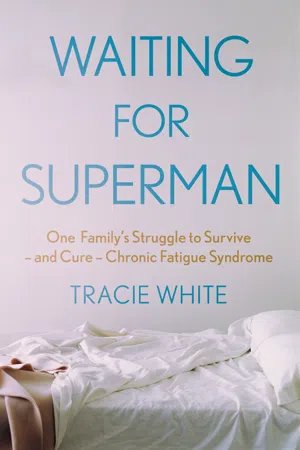
eBook - ePub
Waiting For Superman
One Family's Struggle to Survive – and Cure – Chronic Fatigue Syndrome
- English
- ePUB (mobile friendly)
- Available on iOS & Android
eBook - ePub
Waiting For Superman
One Family's Struggle to Survive – and Cure – Chronic Fatigue Syndrome
About this book
Information
Topic
MedicineSubtopic
Diseases & AllergiesChapter 1

The House

IN DECEMBER 2016, SOMETIME in the middle of the night, Whitney Dafoe slowly used Scrabble tiles to spell out this:
“Can’t take care of myself. Don’t know what to do.”
This was followed with five more tiles: D . . . Y . . . I . . . N . . . G.
Then he pushed a button next to his bed that rang a bell throughout the house to summon his parents, who were caring for him around the clock, to his room.
Later, when I asked his father, Ron Davis, a legendary scientist, how he responded when he saw what his son had spelled out in tiles, he simply said, “I did not answer him—he cannot tolerate anyone speaking to him.”
That week, Whitney was taken in an ambulance to the hospital to get a feeding tube inserted into his abdomen. He needed it to stay alive.
Two months later, I drove up to Ron Davis’s home in Palo Alto, California, for the first time on a chilly winter’s evening. A gentle breeze touched my cheek as I climbed out of my old, green Honda Civic, but my heart felt heavy. I had come to interview Ron and his wife, Janet Dafoe, to hear Whitney’s story. (Whitney’s parents, I would also learn, chose to share their last names between their two children. Whitney has his mother’s last name, and their daughter, Ashley, was given her dad’s.) Over several decades as a journalist, I had gained a reputation as the go-to writer for tragic stories, so it was natural my editor at Stanford Medicine magazine had assigned me this story about a father trying to save his severely ill son.
I’d written articles for the magazine before about amputees who survived the 2010 Haitian earthquake, Cambodian refugees with PTSD, the deplorable lack of health care on Native American reservations, and myriad other science stories about horrific medical conditions and the search for cures. I was proud to be able to give a voice to these often neglected stories, but I also had a personal motivation. I’d been devastated myself decades before by a late-term miscarriage. The grief eventually lifted, but it left me with a chronic case of insomnia that I struggle with still. Along with that came a growing obsession with writing stories about people living with chronic conditions. I wrote about cancer and Alzheimer’s disease, clinical depression and foster children living with PTSD. I’d look into people’s eyes when I interviewed them, searching for answers. How did they do it? How did they carry on?
Still, for some reason, when confronted with this story of the daily pain and suffering of a young man imprisoned in his own body with his grief-stricken family standing at his side, it unnerved me. Perhaps it was the years of his total and complete isolation that scared me most or the fact that his photos looked too much like my own grown son. Whitney couldn’t eat or speak. He was completely voiceless. Now thirty-one years old, he lived twenty-four hours a day, every day, in the back bedroom of his parents’ home. I’d talked briefly over the phone with both Ron and Janet when arranging the interview. They told me Whitney had been diagnosed with chronic fatigue syndrome more than five years before, but that for the past two years, his condition had deteriorated into a coma-like state. When I asked if I could interview him, they’d said no. His mother was the first to say it. Whitney was far too sick for anything like that.
“I understand,” I told her. Though at the time I didn’t fully.
At the time, I was working for Stanford medical school in an office building that happened to be across the street from Ron’s science lab, the Stanford Genome Technology Center, in Silicon Valley. As a science writer who often wrote about faculty research, I was aware of his reputation. I’d never met him before, but when my colleagues talked about him, it was with awe and respect. Some rumored he could be in line for a Nobel Prize one day. So it was big news that Ron Davis, PhD, had suddenly changed the course of his genomics research to study this little known disease and find a cure for his son.
I had read through the smattering of media stories about Whitney and Ron online. In a 2015 Washington Post article titled “With His Son Terribly Ill, a Top Scientist Takes On Chronic Fatigue Syndrome,” Ron Davis, the story said, developed techniques for gene mapping that were later used in the Human Genome Project. In 2013, the Atlantic ranked him on a shortlist of the world’s greatest living inventors alongside SpaceX founder Elon Musk and Amazon founder Jeff Bezos.
His son, on the other hand, had been an artist. Whitney used to be an award-winning photographer who traveled around the world. He had helped to build a nunnery in the Himalayan mountains, ridden a motorcycle across India, and visited all fifty American states. Now he was fed intravenously and could barely tolerate sounds. His parents, and the medical personnel who saw him, wore plain clothing when they entered his room because bright colors or any patterns could make him feel worse. I lingered over the before and after photos of Whitney that ran with the story. One showed a smiling Whitney in a red plaid jacket, tall and handsome, with bushy brown eyebrows and kind eyes, posing in front of the blue waters of the San Francisco Bay. In the next, an emaciated body lay on its side in bed. Ron knelt there, at Whitney’s side, shaving his son’s head because he had grown too weak to wash his own hair.
Standing in this family’s driveway, as a parent of two children myself and having many years ago lost a third, I just wanted to turn my head and drive away. The suffering of a child is so hard to bear. Instead, I chastised myself for being cowardly, took a deep breath, and turned to walk down the tree-lined driveway, pausing occasionally to stare up at the stately old house with columns on the front porch and wisteria climbing its walls. Somewhat hopefully, the house was decorated with twinkling white lights strung across a wide, green lawn and colorful Tibetan prayer flags hanging from a circular front porch. I would learn that back when it was first built in 1889 in the upscale neighborhood now known as Professorville, this house had a palm-lined circular driveway that curved past tennis courts, a coachman’s quarters, and an outside kitchen, a sign of old Palo Alto wealth. When Ron and Janet moved into the house in 1983, their son just an infant, the tennis courts had long ago disappeared, and the aura of old wealth had changed to a quaint nostalgia.
I walked across the front porch and paused to read a handwritten note stuck to the front door: “Please do not knock or ring a bell before 3 p.m. Call or text. Very sick person.”
Stupidly, I checked my watch, even though it was obviously well past 3 in the afternoon. I knocked softly. Janet opened the door and invited me inside.
Like many people, I knew little about chronic fatigue syndrome when I arrived at the house that evening. Reading through the Post story had jogged my memory about an old article I had written on CFS years earlier, back when I was working as a reporter for my hometown paper, the Santa Cruz Sentinel. It was a mysterious disease with no known cause or cure, often lumped together with other so-called contested diseases—like chronic Lyme disease, fibromyalgia, and Gulf War Syndrome. I’d heard it was a “woman’s” disease, which often meant, insultingly, psychological in origin. Therefore forgotten and tossed aside. I had no idea patients with CFS could get as sick as Whitney. Many people, including physicians, didn’t even believe it was a real disease. Some said these chronically fatigued “sick” people were just suffering from depression or were “malingerers” who wanted to collect monthly disability checks. I knew there was an active CFS patient community that protested such propaganda and cited science to back them up. I would hear more about it from Whitney’s parents that night.
I followed Janet into a large foyer, and she took me on a quick tour of their home. It was a house overflowing with a lifetime’s worth of science books, paintings, and Whitney’s photographs. The detritus from years of raising children filled every nook and cranny with baby photos, Whitney in Little League, and Ashley in ballet. I slowly began to relax. It reminded me of my grandmother’s home in Salt Lake City, with crystal doorknobs and those old-fashioned light fixtures that you had to push hard into the wall to turn on. I felt comfortable in Whitney’s home. Janet opened a door to the basement revealing a creaky-looking staircase just like my grandma’s, where my cousins and I used to play. Basements are a rarity in California. I wondered if Janet canned peaches like Grandma Deedee had.
Janet had short gray hair like my Grandma DeeDee. She was a child psychologist with a PhD from Stanford. And, at least that day, she had her guard up. She doesn’t trust me yet, I thought. We walked back through the foyer, then settled in the library, on comfy couches with shelves full of old books, a television, and their pet tortoise, Rex. This was obviously where the couple escaped to when they had a chance to relax.
“Ron feels a huge amount of responsibility and stress,” Janet said, as she sat down on the couch. I pulled out my reporter’s notepad. Ron joined us in the room and quietly sat by her side. I introduced myself, and we shook hands. He was wearing old jeans with a cowboy belt buckle and sneakers, his brown cowboy hat on the coffee table in front of him. Not a whiff of arrogance came off this man. He had a gray beard, glasses, and a kindly demeanor that lent him more of a grandfatherly air than any kind of snooty professor with long lists of big science awards. Mostly, he just looked tired. At seventy-one, Ron had undergone an aortic heart valve replacement two months earlier but returned to his CFS research as quickly as he could, Janet said.
“He also has to keep all his other grants up,” she told me. “He spends all the waking hours he can thinking about CFS research.”
Ron smiled sadly, then added, “It is enormous pressure. We have to figure this out very quickly because millions of people are suffering and my son is dying.”
I didn’t know how to respond. I tried not to think of how it might feel to have your grown child so sick, nearing death. Looking around the living room, I could see how well they’d seen to it that he and Ashley had a safe and grounded childhood. The thought of losing him to an illness with no cure and one that they did not have any control over—I felt a great sympathy for Ron especially. To feel the responsibility of finding a cure not only for his son but for so many other people’s loved ones who depended on him must’ve been a huge burden for this gray-haired man. My heart hurt for them as Janet began to tell me more about Whitney’s story. As she spoke, I had the feeling she had told this story many times and would tell it many more. It was as if it was her job as a mother was to make the world both understand and believe in her son’s story.
Maybe it first started with a case of mononucleosis in high school, Janet told me. They didn’t know for sure. Or it could have been at the age of twenty-one, after a trip to Jamaica during college when Whitney experienced dizziness, a severe headache, and nausea—symptoms that never seemed to completely abate. More signs of illness came two years later, when he traveled to India for the better part of a year.
Whenever he could, Ron veered the conversation back to the science. Talking about his son’s sickness was obviously painful for him, but he understood science. It made much more sense to him. He explained how the disease affected multiple systems of the body including the immune, nervous, and metabolic systems. He told me he had been part of the Institute of Medicine (now the National Academy of Medicine) committee that the year before had published a report on CFS. It listed symptoms that range from chronic pain to cognitive problems, brain fog, gastrointestinal issues, sleep disturbances, and extreme fatigue. The flagstone of the disease is a symptom known as post-exertional malaise, PEM, which means symptoms worsen after any kind of physical, mental, or emotional exertion—sometimes, in severe cases, it can be something as simple as brushing your teeth. Also, sleep doesn’t help the fatigue, and sleep cycles go haywire.
“So many people will ask us, ‘Has your son tried caffeine?’ ” Ron continued, shaking his head. “They think CFS just means you’re really tired. Caffeine does not help with this disease.”
At the sound of a faint bell, he suddenly stopped talking and stood up.
“That’s Whitney,” Janet told me. “He’s ready for his dad.” Whitney usually woke up in the late afternoon or early evening, Janet explained. Ron’s daily routine was to care for Whitney then, giving Janet, who stays up most nights with Whitney, a break. He’d clean up the room, pick up tissues, fill containers with water. It was his job to prepare the IV line that delivered the life-sustaining TPN, liquid nutrients, along with medications and supplements. The feeding tube inserted into Whitney’s abdomen a few months earlier was beginning to help add more nutrition, but each additional supplement still had to be tested carefully.
“When I walk in the room, he’s still as death,” Ron told me before he left. “If his feet are left uncovered, it means he wants me to change his socks.” Janet explained how it took awhile for Whitney to prepare mentally for someone to enter his room to prevent him from “crashing.” I didn’t know what this meant, but it sounded bad. She said they would sit in the hallway outside his door and peer through the keyhole to watch for Whitney’s signal that it was OK to enter. This was hard to imagine, so I asked if I could see how it worked. I followed Ron to the hallway that led to Whitney’s room; then he signaled for me to watch from there.
Ron didn’t enter Whitney’s bedroom right away. Instead he sat on a chair outside the door and peeked through a keyhole waiting for his son to find the strength to sit up and pull a blanket over his shoulders, signaling it was OK to come inside. I could see it was one of those old-fashioned keyholes big enough to see through.
“He can hear me sitting outside,” Ron explained to me later. “It can take him a long time to prepare. Sometimes I wait for hours at the door. I once watched him take thirty minutes to move his cap from his lap to his head.”
After some time had passed, I left Ron waiting there and returned to the library to join Janet on the couch. It was getting late, and I had a long drive back home to Santa Cruz that night. As I stood to go, Janet pointed to a book on one of the shelves titled Osler’s Web, which had been written decades ago by Hillary Johnson, an investigative reporter who had CFS herself. “The folks in the patient community think of it as their Bible,” she said. “It tells the story of how the medical establishment failed this disease.”
She told me that we should take another look at the back of the house before I left. When I entered the kitchen, I realized that it had basically been transformed into a hospital ward for Whitney. The large, wide-open space was filled with boxes of syringes and medicine bottles. Just off the kitchen, a closed door led down a short hallway to Whitney’s room. Janet put her finger to her lips telling me to shush and softly opened the door.
I fol...
Table of contents
- Cover
- Title
- Copyright
- Contents
- Introduction
- Chapter 1: The House
- Chapter 2: The Invisible Patient
- Chapter 3: The Adventure
- Chapter 4: A Mysterious Diagnosis
- Chapter 5: Rocket Boy
- Chapter 6: Blood Trails
- Chapter 7: Raggedy Ann Syndrome
- Chapter 8: In Search of Lost Time
- Chapter 9: The Map
- Chapter 10: The Heartbreaker
- Chapter 11: Vindication
- Chapter 12: The Superman
- Epilogue
- Acknowledgments
- Bibliography
Trusted by 375,005 students
Access to over 1.5 million titles for a fair monthly price.
Study more efficiently using our study tools.
Frequently asked questions
Yes, you can cancel anytime from the Subscription tab in your account settings on the Perlego website. Your subscription will stay active until the end of your current billing period. Learn how to cancel your subscription
No, books cannot be downloaded as external files, such as PDFs, for use outside of Perlego. However, you can download books within the Perlego app for offline reading on mobile or tablet. Learn how to download books offline
Perlego offers two plans: Essential and Complete
- Essential is ideal for learners and professionals who enjoy exploring a wide range of subjects. Access the Essential Library with 800,000+ trusted titles and best-sellers across business, personal growth, and the humanities. Includes unlimited reading time and Standard Read Aloud voice.
- Complete: Perfect for advanced learners and researchers needing full, unrestricted access. Unlock 1.5M+ books across hundreds of subjects, including academic and specialized titles. The Complete Plan also includes advanced features like Premium Read Aloud and Research Assistant.
We are an online textbook subscription service, where you can get access to an entire online library for less than the price of a single book per month. With over 1.5 million books across 990+ topics, we’ve got you covered! Learn about our mission
Look out for the read-aloud symbol on your next book to see if you can listen to it. The read-aloud tool reads text aloud for you, highlighting the text as it is being read. You can pause it, speed it up and slow it down. Learn more about Read Aloud
Yes! You can use the Perlego app on both iOS and Android devices to read anytime, anywhere — even offline. Perfect for commutes or when you’re on the go.
Please note we cannot support devices running on iOS 13 and Android 7 or earlier. Learn more about using the app
Please note we cannot support devices running on iOS 13 and Android 7 or earlier. Learn more about using the app
Yes, you can access Waiting For Superman by Tracie White in PDF and/or ePUB format, as well as other popular books in Medicine & Diseases & Allergies. We have over 1.5 million books available in our catalogue for you to explore.