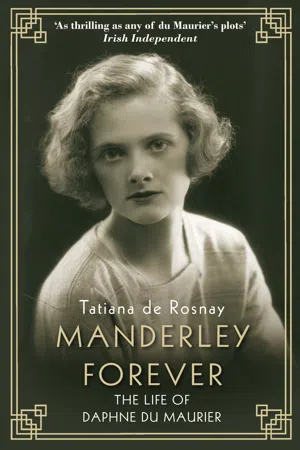
Bestselling novelist Tatiana de Rosnay pays homage to Daphne du Maurier, the writer who influenced her deeply, in this startling and immersive new biography. A portrait of one writer by another,
Manderley Forever meticulously recounts a life as mysterious and dramatic as the work it produced, and highlights du Maurier's consuming passion for Cornwall.
De Rosnay seamlessly recreates Daphne's childhood, rebellious teens and early years as a writer before exploring the complexities of her marriage and, finally, her cantankerous old age. With a rhythm and intimacy to its prose characteristic of all de Rosnay's works,
Manderley Forever is a vividly compelling portrait and celebration of an intriguing, hugely popular and (in her time) critically underrated writer.
- English
- ePUB (mobile friendly)
- Available on iOS & Android
eBook - ePub
About this book
Information
Subtopic
Literary BiographiesPART ONE
LONDON, 1907–25

The child destined to be a writer is vulnerable to every wind that blows.

Mayfair, City of Westminster, London
November 2013
There are usually crowds of people in Regent’s Park. Visitors come here to walk around and admire the flower beds, see Queen Mary’s rose garden, take boat trips on the lake. But on this very British grey and drizzly November morning, the park is deserted.
The Queen was born here; Oscar Wilde lived here, as did Handel, Somerset Maugham, and Nancy Mitford. In place of the previous century’s patrician families, the elegant Georgian buildings are now home to luxury stores and fashionable restaurants, embassies, and five-star hotels. Impossible not to notice that the people who live here or frequent these places have money. There are fur coats on display everywhere, while only the priciest, flashiest cars are parked by the side of the road. In Monopoly, Mayfair has been the most desired space on the board for more than eighty years.
To the east of the park are the Terraces, quiet residential streets where rows of identical terraced houses stretch out towards the horizon, perfectly symmetrical. Chester Terrace is the longest, Clarence Terrace the shortest; Park Crescent is formed in a graceful semi-circle. The one I have come to see this morning is the most imposing of all: Cumberland Terrace. I read that it dates from 1826 and comprises about thirty houses. It is located between the Outer Circle, the street that borders the park, and Albany Street.
It’s not especially easy to find. Despite my map, I get lost several times before spotting its neoclassical façade from a distance. I walk through the rain towards it, impressed by its immense size and its famous Wedgwood blue pediment. I daren’t move any closer; I feel as if I am being watched. What could I say to one of the building’s inhabitants if they came out to ask me why I was taking photographs?
I could say, quite simply, that I am here for her, that I am following the footsteps of her life, and this is where my journey begins. Because it was here, at number 24, under these huge ivory columns, behind that white door, that Daphne du Maurier was born on May 13, 1907.
Leaving the park after going for a walk, the little girl has to pass under that gigantic-seeming arch, then climb the steps that lead to the house, on the right. The white front door matches the cumbersome pram, which Nanny cannot lift up on her own. They have to ring the doorbell so someone will come to help them. The little girl bickers with her sister Angela over who gets to press the copper-coloured button first, and she has to stand on tiptoes in her Start Rite shoes in order to reach it.
Their childminder wears the same uniform, day after day. The little girl likes to look at it: the grey coat, the black hat, the veil covering her face. It is one of the maids who comes out to help Nanny with the baby carriage. She is wearing an apron and a white bonnet. They struggle to lift the pushchair with the baby inside it. From inside the carriage, Jeanne smiles, and the little girl notices the way everyone melts at her pink-cheeked sister’s smile.
Inside the long entrance hall, the little girl sees coats, stoles, and capes hung on pegs; she hears the hubbub of a conversation, peals of laughter coming from the living room, to her left; she sniffs out the whiff of an unfamiliar perfume. Her heart contracts. That means there are ladies invited to lunch, that she’ll have to go downstairs, later, after the meal in the nursery, to say hello. This does not bother Angela; in fact, she’s excited, already asking who is there with their mother. The little girl rushes upstairs, taking the steps two at a time, escaping while she can, and taking refuge in the large nursery on the top floor of the house, in that comforting warmth, near the doll’s house, of the toy cupboard with two shelves (one for Angela, one for her), of the treasure chest lined with cotton cloth, of the old armchair that transforms so easily into a shipwreck run aground on a beach. She moves towards the fireplace, where flames crackle behind the fire screen. The table is set for three—Nanny, Angela, and her—because the baby still sits in her high chair to eat. She looks out on Albany Street, towards the army barracks. Nanny’s voice is raised and it pursues her, repeating her name several times over. It is telling her to wash her hands before lunch. Daphne doesn’t want to wash her hands, she doesn’t want to eat lunch. She wants to continue looking out of the window, watching the troop of Life Guards officers as they return from their morning patrol. Her father has explained that this is the oldest regiment in the British Army, its mission to protect the king and the royal buildings. There is no way she is going to miss seeing the glint of their shining armour, the plume of feathers on their helmets, the red lightning flash of uniforms. Since she stopped sleeping with Jeanne and joined her older sister on the other side of the nursery, she is woken at dawn every day by the bugle call, but this doesn’t bother her at all.
During the meal, Nanny lectures Daphne about the need to finish her vegetables, and at dessert she orders her to eat every last morsel of her rice pudding. Daphne does not like rice pudding. Why must she always do what Nanny tells her? Because she’s only a four-year-old girl? And yet she likes Nanny; she sees her more often than she sees her own mother.
After lunch, the dreaded moment arrives. Nanny rubs Daphne’s face clean, brushes her hair. Angela admires herself in the mirror. The sisters wear identical embroidered mauve velvet dresses and pale pink pelisses; even the baby is dressed to match. They must walk downstairs, open the door of the dining room, and they must smile, in front of that sea of strange faces. Why doesn’t Angela suffer during this ordeal? Murmurs of approval. The ladies are elegant, they wear large hats. Mummy too. Daphne finds this odd: How can anyone eat lunch while wearing such a big hat? Nanny hands the baby to their mother; the baby gurgles, and everyone coos over her. Daphne wants to run away, back to the nursery; she hides behind Angela, who is prancing around in her velvet dress in front of the ladies. Their mother gives the baby lumps of sugar. When the ladies all stand up to move through into the living room, Daphne finds them too tall, too fat; they laugh too loud, cackling like hens, and not only that, but they all want to kiss her. It’s horrible. She hates it. Angela puts up with the kissing gracefully (how can she?), but not her, no way, no kissing. She scowls, bites her fingernails. The ladies laugh—they think she’s shy and sweet—but they notice the nail chewing, the naughty little thing. Her mother shoots her a reproachful look. We’ve tried everything with Daphne’s fingernails. . . . Thankfully, no one is paying any attention to her now; she is free to go back upstairs at last. It’s over. Until the next time.
She loves this view over the roofs of the city. Look, down there, that house painted red: Why is it red? Who lives there? How can she find out? It looks like that house is not friends with the house next to it; it’s different, separate. Daphne imagines living there, all alone. In that red house, no one would force her to finish her vegetables or her rice pudding, no one would order her to put on embroidered velvet dresses, no one would make her go downstairs to say hello to the guests. She would have a sword, like Peter Pan, whom she admires so much. She would love to be able to fly like him, over the chimneys.
It’s already time for lessons with Mrs. Torrance, the governess. Angela, who is three years older than Daphne, is far ahead of her. Daphne struggles with her capital letters. Why isn’t she able to master her Ss? She tries as hard as she can, leaning over the table, tongue between her teeth. You’re making lots of progress, Daphne; that’s very good. Have you written before? Daphne sits up proudly and gives the governess a haughty look. Yes, she has already written a book. Angela bursts out laughing, and says that Daphne can hardly write at all, she’s talking nonsense, she’s only four. Mrs. Torrance asks her, in a serious voice, what the title of her book is. Daphne replies, “John in the Wood of the World.” Deep down inside, Daphne knows that she is not telling the truth, that she has not written a book, that she just made up that strange-sounding title. The governess understands; kindly, good-naturedly, she smiles at the little girl. Daphne starts work on her capital letters again. Silence falls in the nursery. There is no sound but the crackling of flames in the hearth. Time passes slowly. She looks up at the window and starts to daydream.
Peter Pan is there, hidden behind the shutter. He’s come to fetch her, to take her to Neverland. Her, and no one else.
One day, Nanny leaves. The little girl asks her mother why. It’s because Jeanne is no longer a little baby, Angela is nearly nine, and Daphne will be six. They’re big girls now; they don’t need Nanny anymore. Daphne looks at Nanny, who is going away forever. Why are her eyes red? What is she doing with her handkerchief? She looks like she’s crying. Daphne is surprised: she didn’t know grown-ups cried, too. After Nanny, there is a succession of nurses that Daphne doesn’t like: a fat one who spends all her time eating snacks, another who hums annoying tunes, and yet another who scolds them constantly from morning till night. The walks in Regent’s Park last longer nowadays: they are no longer simple strolls along Broad Walk to the zoo, where little Jeanne gets excited at seeing the wild animals. Sometimes, they go around the lake. Daphne’s father tells her that a long time ago, before he was born, a tragic accident occurred here during one exceptionally severe winter. Back then, he explains, Londoners adored ice-skating. Despite being warned, hundreds of skaters went out onto the frozen lake. But the ice was too thin, and it cracked. Horrified, Daphne sees the tragic scene unfold as she listens to her father. She seems to hear the fatal creak and snap of the ice, the screams of fear. The skaters were wearing heavy Victorian clothes (wide, frilly skirts and thick, elegant fur coats, her father specifies) and it was difficult to fish the victims’ corpses out. About forty people drowned. Daphne can’t help thinking about this every time they walk around the lake, one hand resting on Jeanne’s pushchair.
One of the nurses prefers a large, private garden surrounded by a fence. They have to use a key to get in. The nurse meets up with her friends there, and they sit under cover with a Thermos of hot chocolate and some cakes and talk in low voices. The children are urged to play elsewhere, except for Jeanne, who stays close to them in her pushchair. Daphne thinks this unfair. She wants to stay under the roof and eat cakes, too. The nurse orders her to go farther off and enjoy herself. Daphne sulks, walking slowly down a path. There’s no one here to play with, and Angela’s having a lesson with Mrs. Torrance. Where have the other children gone? Suddenly Daphne sees that boy. Older than her, at least seven, maybe eight, blond hair cut very short, light-coloured eyes, looking like a bit of a thug. She doesn’t like him at all; she’s seen him before at the park. He goes up to her and kicks her. She doesn’t say a word. She’s not going to cry in front of him. You’re the little Frenchy, aren’t you? Little French idiot. She doesn’t flinch. Go on; tell me your name. What’s your name, Frenchy? Another kick. She mumbles her first name. Your surname, you stupid girl! She stands up straight, looks him in the eye, and pronounces her full name. What did I tell you? That’s French, that is, du Maurier. Stupid Frenchy! Another boy appears, smaller, but looking just as mean. You’re going to listen to us now, Frenchy. We’re going to leave and you’re going to stay here. If you move, you’ll regret it. They walk away, sniggering. Daphne stands motionless, like a statue. How can she escape? Who could help her? The nurses are far off, at the other end of the garden. She doesn’t dare move a muscle, staying exactly where she is, numb, freezing, trembling with fear. After an eternity, the boys return. You moved, Frenchy. We were watching. We saw you. She denies this, but they start laughing, nastily, and the kicks rain down on her again. This time she doesn’t just take it; she kicks back at them. Her bonnet is askew, she’s out of breath, her cheeks are red, she’s hot. How stupid it is to wear a dress, to be a girl, not to be able to lift her leg up like a boy in trousers.
Back at Cumberland Terrace, she is still trembling. That night, at bedtime, the nurse gasps when she sees Daphne’s bruises. Daphne says nothing. She doesn’t want to talk about those boys. The blond-haired one is her enemy, her worst enemy. She has to watch out for him, always be on her guard. But there is one thing she doesn’t understand. Why did he call her Frenchy? Is du Maurier really a French name? She decides to talk to Daddy about it. She asks him the question later, in the living room, when she’s sitting on his lap in front of the fireplace. Her father always smells nice; he is elegant, his blue eyes sparkle. He tells her that du Maurier is indeed a French name. His father, Daphne’s grandfather, was born in Paris. He was a great artist and a great writer, but he died before she could get to know him, alas. Daddy will show her his father’s drawings and his books. The look in Daddy’s eyes turns thoughtful. Paris is one of the most beautiful cities in the world, she’ll see. Daphne must never forget that she is one-fourth French and she should be proud of it. She feels reassured. She trusts Daddy; he’s always right. She doesn’t care about her enemy. He doesn’t have a famous grandfather.
Her father teaches her to pronounce their name correctly: she must say du Maurier, not dou Maurier. A sharp u, very French. As he strokes her hair, her father whispers that one day Daphne will learn to speak French fluently like her grandfather. He himself speaks it with an awful English accent. But he is certain, he knows for sure, that Daphne will speak it perfectly; she will be the most French of all his daughters. Sitting on her father’s lap, Daphne starts daydreaming about this grandfather she never knew, a writer, an artist, born in the most beautiful city in the world.
One winter morning, in the nursery, the black letters on the white page soar up and come to life. Amazed, Daphne starts deciphering word after word: she can read on her own, in her head. She devours the books of Beatrix Potter, fascinated by the adventures of Peter Rabbit. What a bore to have to go and eat dinner when she is dying to find out what the terrifying Mr. McGregor will do! How can she leave Tom Kitten and Mrs. Tiggy-Winkle? Daphne has to explain to the nurse that what happens next in the story of Jeremy Fisher is far more important than taking her bath.
One story frightens her, even more than her blond enemy from the park. The Snow Queen. She is paralyzed with fear by the evil monarch who takes little Kay in her sleigh of ice, and by that shattered mirror, whose tiny splinters get stuck in the little boy’s heart and eyes. Thankfully, brave Gerda goes off to save him. Daphne is so frightened by this tale that one night, when she sees her mother climbing the staircase, she seems to have the beautiful and terrifying face of the evil queen. And yet Mummy is gentle and kind. Why is it only with her father that Daphne feels such a strong attachment? Why does she want to be with him all the time? He often watches her, proudly. He watches his two other daughters as well, but there is a special relationship between Daddy and her, a connection she could never describe, a strong and almost secret connection, and she knows that Mummy has noticed it.
In the mornings, Daphne and her sisters have to be careful not to make noise in the nursery, as their parents’ bedroom is just below. Daddy gets back late from the theatre, never before midnight. And then he has to eat supper, so he doesn’t go to bed until two in the morning at the earliest. Daddy can’t bear noise, especially not the racket made by children laughing and jumping about. He doesn’t like the sound of a dog’s bark either, or a car engine backfiring, or a bird singing too loudly in the park. While she waits, Daphne reads. When she gets up, she walks on tiptoes, and so does Angela. They have to wait for the maid to take Daddy’s breakfast to him in bed. Her footstep on the stairs, her cheerful Good morning, sir: these are the signals that the girls can go and say hello to their father. He wears a green bathrobe over his silk pyjamas, and Daphne loves the pleasant scent that floats around him. Daddy is never in a bad mood. She once got her bottom spanked, when she stuck her tongue out at Nanny, but that was a long time ago.
Daphne’s father is an actor. Every evening, he plays at being s...
Table of contents
- Cover
- Title Page
- Dedication
- Contents
- List of Illustrations
- Preface
- Part I: London, 1907–25
- Part II: France, 1925
- Part III: Cornwall, 1926
- Part IV: Cornwall, 1943
- Part V: Cornwall, 1969
- Quotes upon the Death of Daphne du Maurier
- Acknowledgments
- Glossary
- Notes
- Sources
- Works by Daphne du Maurier
- French Family Tree
- Map
- Also by Tatiana de Rosnay
- Index
- Picture Section
- Copyright
Trusted by 375,005 students
Access to over 1.5 million titles for a fair monthly price.
Study more efficiently using our study tools.
Frequently asked questions
Yes, you can cancel anytime from the Subscription tab in your account settings on the Perlego website. Your subscription will stay active until the end of your current billing period. Learn how to cancel your subscription
No, books cannot be downloaded as external files, such as PDFs, for use outside of Perlego. However, you can download books within the Perlego app for offline reading on mobile or tablet. Learn how to download books offline
Perlego offers two plans: Essential and Complete
- Essential is ideal for learners and professionals who enjoy exploring a wide range of subjects. Access the Essential Library with 800,000+ trusted titles and best-sellers across business, personal growth, and the humanities. Includes unlimited reading time and Standard Read Aloud voice.
- Complete: Perfect for advanced learners and researchers needing full, unrestricted access. Unlock 1.5M+ books across hundreds of subjects, including academic and specialized titles. The Complete Plan also includes advanced features like Premium Read Aloud and Research Assistant.
We are an online textbook subscription service, where you can get access to an entire online library for less than the price of a single book per month. With over 1.5 million books across 990+ topics, we’ve got you covered! Learn about our mission
Look out for the read-aloud symbol on your next book to see if you can listen to it. The read-aloud tool reads text aloud for you, highlighting the text as it is being read. You can pause it, speed it up and slow it down. Learn more about Read Aloud
Yes! You can use the Perlego app on both iOS and Android devices to read anytime, anywhere — even offline. Perfect for commutes or when you’re on the go.
Please note we cannot support devices running on iOS 13 and Android 7 or earlier. Learn more about using the app
Please note we cannot support devices running on iOS 13 and Android 7 or earlier. Learn more about using the app
Yes, you can access Manderley Forever by Tatiana de Rosnay in PDF and/or ePUB format. We have over 1.5 million books available in our catalogue for you to explore.