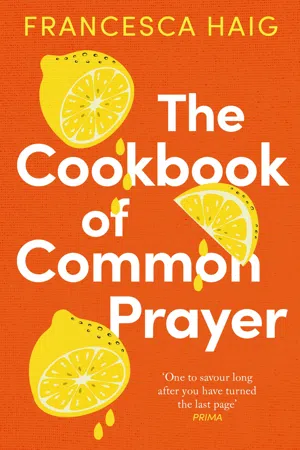
When Gill and Gabe's elder son drowns overseas, they decide they must hide the truth from their desperately unwell teenaged daughter. But as Gill begins to send letters from her dead son to his sister, the increasingly elaborate lie threatens to prove more dangerous than the truth.
A novel about family, food, grief, and hope, this gripping, lyrical story moves between Tasmania and London, exploring the many ways that a family can break down - and the unexpected ways that it can be put back together.
- English
- ePUB (mobile friendly)
- Available on iOS & Android
eBook - ePub
The Cookbook of Common Prayer
About this book
Information
PART ONE
Omelette for the day the police come to
your house to tell you that your son is dead
your house to tell you that your son is dead
Take six eggs (large; ideally free range).
Crack them, one by one, carefully separating
the yolks and whites into two large bowls.
Crack them, one by one, carefully separating
the yolks and whites into two large bowls.
Throw them away.
Gill
This is how it happens:
There’s a knock on the front door. It’s Sunday, mid-morning. Teddy’s gone to soccer practice with Papabee and I’m back in bed with the papers, SausageDog asleep across my legs. Gabe, still in his dressing gown, is in the bathroom.
I get up, the dog protesting. I see them as soon as I reach the corridor. One man, one woman, their blue and white uniforms unmistakable even through the dappled glass panels of the door. I’m surprised it’s the police – in the past, whenever Sylvie’s gone downhill, the hospital has always called us. That’s how I know it must be really bad.
For a second I want to hide. If I never let them in – if I freeze, or drop very slowly to the ground so they can’t see my silhouette, and crawl back into the bedroom and never answer the door – then they’ll never be able to tell me the news.
They knock again, and call out, ‘Mr and Mrs Jordan?’
I can’t move. I’m frozen in a crouch, staring at the pattern on the hallway rug and trying to ignore the hammering on the door. From the bathroom I hear Gabe, voice thick with toothpaste. ‘Gill? Can’t you get that?’
I’m still stuck there, half-crouched on the rug, when he comes out from the bathroom, holding his toothbrush. He sees me, sees the police at the door.
‘Shit,’ he says, and goes straight to the door, and opens it.
Will I ever be able to forgive him for opening that door? If he’d just left them outside, and stayed here with me, the police would never be able to come inside and say the words, Your daughter has died.
But it isn’t our daughter. It’s our son.

When Dougie first went away for his gap year, I didn’t really grasp that he’d moved out until the pasta fell on me. The corner shop used to do a special pasta deal: five packets for five dollars. When Dougie was in high school, I’d pick up a pasta deal at least once a week. From the instant he hit puberty, he was always eating. He ate WeetBix in a pasta bowl because it was bigger than a cereal bowl; ten WeetBix at breakfast, and sometimes the same after school. Our fridge was crammed with cartons of milk, and still we couldn’t keep up. His friends were always coming over after school, and they’d cook pasta before heading off to hockey or basketball practice. Jars of cheap tomato pasta sauce; mounds of grated cheese. I was forever buying cheese – huge bricks of cheddar. Gabe and I used to laugh about it. ‘Jesus,’ he said, when we were out of cheese and milk again. ‘It’d literally be cheaper to buy a cow.’
Then Dougie left for his year away. After he’d been in England for five weeks, I still hadn’t consciously changed my regular shopping routine. One afternoon I opened the pantry and twenty-five packets of pasta came tumbling down on me from the top shelf. I sat on the cold tiles of the kitchen floor and cried. I wasn’t hurt – not even bruised. But it was the first time I really understood that Dougie had left home.
Now there are two strangers in my house telling me that he’s dead, and I think: I need a moment like the falling pasta to make it real. He’s already been away for more than four months. We’ve become used to not having him here, and it will take something as tangible as twelve and a half kilos of pasta falling on my head to prove to me that this is different. Then I could hold the fact of his death, as solid as all those crinkling packets of spaghetti and penne that I had to pick up from the floor. Instead, all I have are these police officers in their neatly ironed uniforms, and their words that I can’t make sense of: accident; caving; flash flood; coroner.
They use phrases that I’ve heard on TV shows – Perhaps you should sit down; We’re terribly sorry to have to tell you; Every effort was made – but the officers seem sincere. The man even has tears in his eyes while he explains what happened. He’s very young, probably only early twenties, with a few spots still lingering on his forehead. He sits opposite us, leaning forward as he talks, his shirt coming untucked at the back. I remember Dougie’s school uniform shirt, always untucked. I find myself comforting the policeman, saying, ‘It’s OK, don’t cry. Don’t cry.’
The dog, excited to have visitors, is trying to lick the policewoman’s ankle. His tail’s wagging, not just from side to side but round and round like the crank on my coffee grinder.
‘Do you have someone who can be with you?’ the policewoman asks, trying to push SausageDog away without being rude.
‘Sue,’ I say, at the same time as Gabe says, ‘We’ll be fine.’ I want Sue here – my best friend. I want somebody to translate the police officers’ words into something that I can understand. There’s a ringing in my ears. Several times I ask Gabe, ‘Can you hear that?’ and he keeps shaking his head.
I give the policeman my phone and he calls Sue. I hear his voice from the corridor. ‘If you can come straight away, I think that would help.’
‘We have to be there,’ Gabe says. ‘In London. I’ll book flights.’ He wipes the back of his hand across his eyes. ‘We’ll ask Sue if she’ll keep an eye on Teddy and Papabee. And Sylvie, too.’
‘Oh God,’ I say. ‘Sylvie. This’ll kill her.’
Gabe
The policeman gives us the number of the Buckinghamshire police. I get put through to a woman and I put the phone on speaker so Gill can hear too. The lady is nice – terribly, convincingly nice, as if what happened to Dougie is an unprecedented shock, even though it’s presumably her job to deal with death on a regular basis.
‘I’m afraid I can confirm that they found Douglas’s body last night.’
‘It can’t be him,’ Gill says immediately. Her eyes are jammed tight shut, her fists too. ‘It can’t be,’ she repeats. ‘It must be somebody else.’
‘There’s been a preliminary identification, and—’
Gill interrupts her. ‘Who?’
‘We’re confident that it’s Douglas, Mrs Jordan.’
‘That’s not what I meant,’ says Gill. ‘Who identified him?’
There’s a shuffling of paper. ‘A Rosa Campbell,’ the woman says.
‘Dougie’s mentioned her,’ I say. ‘She’s his girlfriend. She teaches there, at the school where he works.’ Should I say worked? Through which hole in language has my son slipped from the present to the past tense?
‘She could be wrong,’ Gill says. ‘How can she be sure it’s him?’
‘They know him.’ I look down at my hands. ‘Rosa’s his girlfriend, for God’s sake. If they’re sure, they’re sure.’ And it’s not as though the caves under the Home Counties are crammed with the bodies of young men, I want to add, but it seems too flippant, too harsh.
‘You can view Douglas’s body at the hospital,’ the woman says.
‘The hospital?’ I echoed, stupidly. I was expecting it to be a morgue, or a funeral home or something. Why is he at the hospital? He’s dead. He’s already been dead for – I counted hurriedly in my head – at least twenty hours. There’s nothing they can do for him at a hospital.
‘The deceased are kept at the hospital,’ she explained. ‘Until they can be released to the care of a funeral home.’
She gives me the number for the hospital, and the address of her own office. Gill’s crying more noisily now, so I end the call quickly, with apologies that the woman politely brushes away.
I’m angry at Gill for forcing me to be the sensible one. For taking all the hysteria for herself, and for leaving me to handle things: talking to the police; booking the flights. Meanwhile, Gill sobs, and rocks herself forwards and backwards, and the policeman says something about making us sweet tea, for the shock.
I walk to Gill and lean close to her, my forehead against hers.
‘How are we going to tell Sylvie?’ I ask.
Gill
‘How are we going to tell Sylvie?’ he asks.
I have no answer for him, so it’s a relief when Sue arrives, a shriek of brakes outside. She lets herself in the back door, all noise and tears. ‘Fuck,’ she says. ‘I can’t believe it. I can’t fucking believe it’s real. Is it real? You poor loves. My loves. How can it be real? Fucking fuck.’
She grips my hand and I grip back and I’m glad that she’s punctured the orderly calm of this scene, and the rehearsed condolences of the police officers. She clutches me to her, then Gabe, and then me again. My lungs are an accordion being squeezed. An atonal gasp bursts from me.
‘I’ll pick up Teddy and Papabee,’ she says.
I nod. I haven’t even been able to think properly about them yet. Teddy, and my dad.
Once, years and years ago, we left Teddy behind at the hockey club’s end-of-season barbecue at the reservoir. My sister, her partner, and their kids were staying, so there were four adults and six children. It was chaotic – Dougie had eaten too many chocolate bars and thrown up, and we were rushing to get home, herding the kids into two cars, everyone assuming Teddy was in the other car. We got halfway down Waterworks Road before I realised. When we rushed back we found Teddy, unaware we’d even left, playing with his friends among the trees by the water’s edge. For weeks afterwards I’d wake at night picturing him in the reservoir, the water closing over his little face.
Standing at the counter, I crack the eggs, one after another. I separate the yolks and whites, cradling each yolk in my palm while the white slips through my fingers to the bowl below.
‘I don’t think I can eat,’ Gabe says. ‘Can you?’
‘No,’ I say, and I keep cracking the eggs. When they’re all done, the yolks make a slurping noise as I tip them into the bin. The police officers must have gone; I didn’t even notice Gabe showing them out.
Footsteps outside the back door – Sue’s brought Teddy and Papabee back. She hasn’t told them anything yet, and my dad’s as oblivious as ever, bu...
Table of contents
- Cover
- Title
- Copyright
- Prologue
- Teddy
- Gabe
- Part One
- Part Two
- Part Three
- Part Four
- Part Five
- Part Six
- Part Seven
- Acknowledgements
Trusted by 375,005 students
Access to over 1.5 million titles for a fair monthly price.
Study more efficiently using our study tools.
Frequently asked questions
Yes, you can cancel anytime from the Subscription tab in your account settings on the Perlego website. Your subscription will stay active until the end of your current billing period. Learn how to cancel your subscription
No, books cannot be downloaded as external files, such as PDFs, for use outside of Perlego. However, you can download books within the Perlego app for offline reading on mobile or tablet. Learn how to download books offline
Perlego offers two plans: Essential and Complete
- Essential is ideal for learners and professionals who enjoy exploring a wide range of subjects. Access the Essential Library with 800,000+ trusted titles and best-sellers across business, personal growth, and the humanities. Includes unlimited reading time and Standard Read Aloud voice.
- Complete: Perfect for advanced learners and researchers needing full, unrestricted access. Unlock 1.5M+ books across hundreds of subjects, including academic and specialized titles. The Complete Plan also includes advanced features like Premium Read Aloud and Research Assistant.
We are an online textbook subscription service, where you can get access to an entire online library for less than the price of a single book per month. With over 1.5 million books across 990+ topics, we’ve got you covered! Learn about our mission
Look out for the read-aloud symbol on your next book to see if you can listen to it. The read-aloud tool reads text aloud for you, highlighting the text as it is being read. You can pause it, speed it up and slow it down. Learn more about Read Aloud
Yes! You can use the Perlego app on both iOS and Android devices to read anytime, anywhere — even offline. Perfect for commutes or when you’re on the go.
Please note we cannot support devices running on iOS 13 and Android 7 or earlier. Learn more about using the app
Please note we cannot support devices running on iOS 13 and Android 7 or earlier. Learn more about using the app
Yes, you can access The Cookbook of Common Prayer by Francesca Haig in PDF and/or ePUB format, as well as other popular books in Literature & Literature General. We have over 1.5 million books available in our catalogue for you to explore.