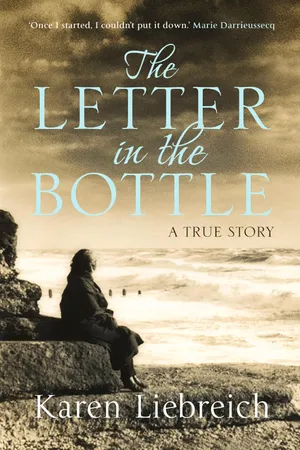
The amazing true story of a heart-breaking message in a bottle and one mother's successful quest to find the person who sent it.
On a winter's day in 2002, a bottle shaped like a tear washed up on the Kent coast. It contained a letter written in French, a lock of hair, and a mystery. Only one thing could be known for certain - that the writer of the letter was a mother, grieving for her lost child, Maurice.
Moved by the woman's heartache Karen Liebreich sets out on an epic journey to piece together the mother's story. Her book is the amazing true story of one woman's search for another, and a poignant reflection on love, loss and motherhood.
In this revised edition Liebreich concludes her epic quest, finally meeting the woman who sent the bottle years before and coming to understand the loss that was at the heart of one mother's impulse to communicate with the unknown.
- English
- ePUB (mobile friendly)
- Available on iOS & Android
eBook - ePub
The Letter in the Bottle
About this book
Information
Print ISBN
9781848875777
Subtopic
Social Science BiographiesContents
Abstract
Epigraph
The Letter in the Bottle
Original Transcript: The Letter
The Search Concludes
Three Years Later
Conclusion
The Mother’s Story
Postscript
Acknowledgements
Sources
On Sunday 31 March 2002 a bottle containing a letter washed up on the beach at Warden Bay, Isle of Sheppey, Kent.
After a seven year search, the author of the letter finally made contact . . .
‘Un livre est une bouteille jetée en pleine mer sur laquelle il faut coller cette etiquette: attrape qui peut.’
‘A book is a bottle cast into the open sea on which the label reads: catch me if you can.’
Alfred de Vigny, Journal d’un poète, 1797–1863
‘Writing a book is like throwing a message in a bottle into the sea. You can’t control who reads your book.’
Philip Pullman, BBC Radio 4, 17 November 2003
1
The bottle lay washed up on the mud at the high-tide mark. Very blue, bright, shaped like a teardrop, it was untouched by the debris and seaweed that surrounded it.
She had taken a break from work to walk the dogs. Suddenly overwhelmed by the backlog facing her, she had turned away from her desk, summoned her dogs, and headed out to the car.
Warden Bay was not the nearest beach. It was a twenty-minute drive, but its bleakness suited her mood. She crossed from the mainland to the Isle of Sheppey, enjoying the flat, open landscape after the claustrophobia of work. In winter at low tide the grey mud of Warden Bay stretched away into the distance. The lack of features and sheer sameness attracted none of the visitors who frequented Beachy Head, with its dramatic shores, helpful car parks, convenient road access and plunging cliffs. No one visited Warden Bay in winter, although tough children who lived on the wind-blown estate behind the muddy hillocks sometimes threw supermarket trolleys down on to the shore below.
She had been on the beach for about twenty minutes, muffled against the cold and damp by an ancient black leather jacket zipped up to the chin and a bobble hat pulled low over her forehead. The dogs bounded around happily, a few hundred metres from her, keeping an eye on the general direction of travel. Their coats, rendered drab brown and black by the grey winter light, blended into the pebbles of the beach and on the rare occasions when they stood still to sniff something particularly interesting, they were almost perfectly camouflaged. Only their movement made them visible.
The blue of the bottle was a sudden splinter of colour which she saw from a distance as she made her way along the beach, shoulders hunched against the oncoming wind. Its glow belonged to a different clime, where the sun shone and the sea was a proper blue. It lay at the tide mark, where the grey mud met the grey pebbles.
She drew close, bent and picked up the bottle, drawn by its irresistible colour and its fragile smoothness. She felt she could no more have left it there ungathered than she could have abandoned her own child on the beach. Maybe she would use it as a vase for single flowers in some far-off spring. A voice told her she already had a shelf-full of dusty scavenged bottles in her kitchen, but this one was different. The shape was unusual; an Evian teardrop of blue, it would have stood out even in a bright supermarket full of garish primary colours. On the monochrome beach the effect was startling. As she crouched over it, lying slick and gleaming in the woolly palm of her glove, she saw that there was a slim scroll of paper within.
Something stirred within her. A message in a bottle. A fragment of excitement on a dreary day, in a dreary month, after what had turned out to be a dreary year. She tried to unscrew the top but her gloved hands slipped on the glass, and a light drizzle had misted the bottle’s surface. Rather than risk ruining the message, she contained her excitement, whistled to her companions and turned for home. The dogs, caught unawares by the change of direction, raced to catch her up.
Back home, as she dried the dogs’ paws, and made herself a cup of tea, her thoughts fixed on the bottle containing the scroll. Was it a love letter? A plea for rescue? Or only kids messing around? She knew it would be special because the tide had not smashed it, the mud had not buried it, and the local children had not found it first and broken it. It was as if it had been sent to her.
She took her mug and the bottle through to the living room and settled down on the sofa. In the corners the dogs were licking the grit and salt from between their paws. A smell of wet dog filled the room. The bottle seemed to glow with promise, and she felt reluctant to break the delicious thrill of anticipation. Finally she put down her mug, picked up the bottle, and tried to twist the cap. It was a strange pointed shape, and offered her little grip. She struggled for some time, then, suddenly, it yielded.
The seal had been secured by a strip of white tape, and the letter was dry. She upended the bottle over the coffee table and the roll slid out, tied by a pale blue ribbon, along with a sprinkle of perfumed wood shavings. Very gently she undid the narrow ribbon, and uncurled the papers. A lock of curled hair fell from the pages. Between her fingers she held two sheets, densely written in blue ink, which were struggling to re-roll themselves. The writing was looped and foreign, and her schoolgirl French was barely sufficient to decipher the first words.
She felt a pang of disappointment. It seemed she would have to wait to find out what the message contained, though it seemed appropriate that the bottle should hold on to its secret for a little longer. As she held the letter to her nose and inhaled the sweet smell from the sandalwood shavings that had cradled the scroll, she thought about whom she could ask to translate the letter. The bottle was so carefully chosen, the ribbon, the lock of hair, the scented shavings so carefully assembled and prepared with such tenderness that the contents would surely not disappoint.
She left the bottle and its contents lying scattered over her table and went over to the telephone.

2
Although I had agreed immediately to look at the letter, I was still annoyed when it arrived a day or two later. I was trying desperately to meet an important deadline, and had no time to spare. I had listened with half an ear to the description of how the letter had been found, and the prompt arrival of a few pages of intricately written French came at a bad moment. My friend had not replaced the letter in the bottle, but had simply posted the pages on to me, roughly flattened, in a recycled envelope without any accompanying note. When I unfolded the sheets and saw the looped handwriting with the r’s and the n’s that could be read as u’s, my spirits sank. I skimmed the first few lines half-heartedly. This would take some effort to decipher, and I put it aside to deal with when I had more time.
A few weeks later I took the letter from my in-tray and started to translate, typing directly as I read, without letting the meaning run ahead of my fingers.
To all ships at sea, to all ports of call, to my family, to all friends and strangers.
This is a message, a prayer. The message is that my sufferings have taught me a great truth.
I already had (a long time ago) what everyone is searching for, and few ever find, the only person in the world whom I was born to love for ever, my first son, Maurice. A child rich in simple treasures, that no wind . . . no storm . . . not even death could ever destroy. The prayer is for all mothers to know such a love and be healed by it. If my prayer is answered, it will erase all errors . . . all regrets . . . and soothe all anger.
Please, God . . .
My life started when he was born, and I thought it was over when he left me one summer’s evening, never to return. He was thirteen years old . . . Without warning, he slipped away from life in an excess of desires, too full of vivid life, at the dawn of summer. For a long time he travelled between two waters, between two lights, trying tirelessly to use up the strength in his outstretched arms. He submitted to the silence, the terrors and the cold, but he discovered the secret ways of the universe, the infinite movement of our origins, and the wanderings of the stars.
He didn’t know that I, his mother, fed him with my thoughts to grant him eternal life in memory, to keep him whole within my flesh.
Forgive me, my son, my love . . . I thought that by clinging to your memory in this way I would keep us both alive for as long as possible. Forgive me, my son, for not having spoken to you for such a long time. I felt I was lost, without my bearings. I kept crashing into things, stumbling everywhere . . . I had never been lost before you left me. You showed me the north, I always found my way, for you were my way.
Forgive me for being so angry at your disappearance. I still think there’s been some mistake, and I keep waiting for God to fix it.
I’m doing better now, my love. The road has been long, very long, but through it all you have supported me.
A few nights ago, you appeared to me in a dream, and your smile rocked me like a child. I understood that it was time for me to let you go.
You stayed close to me for all these years . . . I clung on with all my despair to what was no longer and what would never be again.
My infinity, I thought this suffering bound me to you. It consumed me until it left no room for anything else, but I began to permit it to leave my heart, my soul, my very being. Thanks to you, my love, I succeeded in transforming this suffering into love, into life. All that I remember of this dream is a feeling of peace, for you, for me. When I awoke I still felt it, and I tried to keep the feeling alive for as long as possible.
I am writing to you, Maurice, to tell you that I am embarking on the search for this peace, and to beg your forgiveness for so many things. Forgive me for not having known how to protect you from death. Forgive me for not having been able to find the words at that terrible moment when you slid through my fingers, to express what I felt, and above all for not having held you so tightly that God would not have been able to take you away.
There is no moment in my life, my son, where you are not present. How many paths travelled before I was able to listen and hear the sound of my pain, of our pain.
Your thirteen years of life brought me infinite happiness.
Today, I know that you were just passing through to show me the way, to reveal how I could lead my life, and by leaving me you invited me to dare to change something that I could not envisage until then. You had the power to say, through your presence, however fleeting, and your brutal disappearance, ‘Mum, dare [to live] your life, only you will live it.’ Today I am listening and I hear the message that my son has sent me, my son whose ephemeral life has wounded me for ever because I was deaf to his message for so long.
Today the journey is ending, my son has reached harbour again, on a faraway shore, close to the rising sun. He has once more found the light vessel of his childhood that will lead him gently towards the peace he has attained.
So my dear, my love, I let the balloon rise to the skies, serenely, with all the tenderness of a mother.
May this bottle thrown far from the shore stay forever rocked by the ocean, in the ebb and flow of the rolling waves.
While God gives me life, I promise you to live it to the full, to savour each instant in richness and in serenity.
I know that we will find one another again, when the time comes. God owes it to us.
Farewell my son, farewell my love.
I love you with all my heart, with all my soul, and I am proud to have been your mother. Fly away in peace.
Go, my love, go towards the light, my gentle seagull. May the source of your soul surge and run murmuring towards the sea, and unfold like the innumerable petals of a lotus flower.
It may be that most of us write our own life story, making it up as we go through life, but there are those whose lives seem written in advance, inescapable, and which form a perfect circle. There are others whose course is unforeseeable, sometimes incomprehensible. What I have had the sorrow of losing in my life has taught me what is most precious, just as it has taught me about this love for which I can only be grateful.
This letter, my son, I intend to share with only one person, the only friend I will keep all my life, and beyond. She is called Christine, she is gentleness itself.
I had no preconceptions when I started deciphering and translating the letter. It was long, and I figured it would probably take me an hour just to type out the rough translation. But as I began to read I was almost immediately swept along by the emotional journey of the unknown mother who had lost her son. How does one come to terms with that? How can one continue living? How had he died? As I translated and typed I began to fear that the letter was a suicide note. In the middle, I broke off and turned to the end, dreading a final farewell as the mother jumped off the cliff to join her son. But the last few lines made no sense without the rest of the letter, so I had to go back to where I had stopped. I typed faster, making the translation as literal as possible, rushing to discover what had happened. As I translated, I wept, and my partner, working quietly behind me, looked round curiously. I could not stop to recover my composure until I knew how the letter would end. But as the mother promised her son that she would ‘live [life] to the full’ and ‘savour each instant in richness and in serenity’ my anxiety eased. By the end of the letter I felt emotionally wrung out by the horror of the writer’s experience and the rawness of her grief. Who was she? What had happened to Maurice? Where was she now?
I kept the letter but sent the translation to my friend, and turned back to my own work with relief.
3
I heard nothing for several days. Finally I asked my friend whether she had received the translation and what she thought.
‘It’s awful,’ she said almost in a whisper, and I could hear her voice breaking. She too had been devastated by the letter. A single mother, with a thirteen-year-old son herself, she found the message almost unbearable, and it took her several attempts to read to the end. When she had picked up the bottle on the beach that day, she had thought of romance, mystery, the glamour of a message from a distant shore. But it was far from the casual love letter she had imagined. She later told me that for days after discovering the contents she had been depressed and emotional, mourning Maurice’s death in sympathy with the unknown mother. She grew quietly more protective of her own son. She offered to take him to his football matches; she walked the first few streets with him when he set off for school in the mornings; she dropped him off when he went to meet his friends, so that he wouldn’t have to catch the bus alone.
The death of a child is unimaginable. The mind shies away from it, but when I held this letter in my hand I was forced to confront it. Although my friend had found the bottle, I felt the letter it contained was written to me. And it was addressed to me, the stranger, ‘l’inconnu’. Apart from the unknown friend, Christine, I was the first person to hold the paper the unknown mother had written on, and I had been the first to read and understand her message of desperation.
It was a personal letter. It started off addressing all strangers, but narrowed its focus into a private message to her son. But the final paragraphs seemed to open up a more universal message, a message that ‘life has taught me what is most precious’ which echoed the opening lines, that ‘all mothers [should] know such a love and be heal ed by it’. There was an ambivalence in the letter about keeping her grief secret and sharing it with the world, an ambivalence reflected in the secrecy of writing a private letter and then throwing it out to sea, addressed to all strangers in any port of call anywhere i...
Table of contents
- Cover
- Author biography
- Title page
- Copyright page
- Dedication page
- Contents
Trusted by 375,005 students
Access to over 1.5 million titles for a fair monthly price.
Study more efficiently using our study tools.
Frequently asked questions
Yes, you can cancel anytime from the Subscription tab in your account settings on the Perlego website. Your subscription will stay active until the end of your current billing period. Learn how to cancel your subscription
No, books cannot be downloaded as external files, such as PDFs, for use outside of Perlego. However, you can download books within the Perlego app for offline reading on mobile or tablet. Learn how to download books offline
Perlego offers two plans: Essential and Complete
- Essential is ideal for learners and professionals who enjoy exploring a wide range of subjects. Access the Essential Library with 800,000+ trusted titles and best-sellers across business, personal growth, and the humanities. Includes unlimited reading time and Standard Read Aloud voice.
- Complete: Perfect for advanced learners and researchers needing full, unrestricted access. Unlock 1.5M+ books across hundreds of subjects, including academic and specialized titles. The Complete Plan also includes advanced features like Premium Read Aloud and Research Assistant.
We are an online textbook subscription service, where you can get access to an entire online library for less than the price of a single book per month. With over 1.5 million books across 990+ topics, we’ve got you covered! Learn about our mission
Look out for the read-aloud symbol on your next book to see if you can listen to it. The read-aloud tool reads text aloud for you, highlighting the text as it is being read. You can pause it, speed it up and slow it down. Learn more about Read Aloud
Yes! You can use the Perlego app on both iOS and Android devices to read anytime, anywhere — even offline. Perfect for commutes or when you’re on the go.
Please note we cannot support devices running on iOS 13 and Android 7 or earlier. Learn more about using the app
Please note we cannot support devices running on iOS 13 and Android 7 or earlier. Learn more about using the app
Yes, you can access The Letter in the Bottle by Karen Liebreich in PDF and/or ePUB format. We have over 1.5 million books available in our catalogue for you to explore.