____________
Daily Telegraph's Best Books of the Year
Guardian's Best Books of the Year
Evening Standard's Best Books of the Year
Daily Mail's Best Books of the Year
BBC's Biggest Books
Prospect's Best Books of the Year
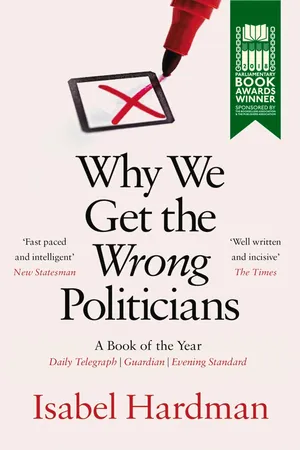
Politicians are consistently voted the least trusted professional group by the UK public. They've recently become embroiled in scandals relating to everything from expenses to sexual harassment to illicit parties. Every year, they introduce new legislation that doesn't do what it sets out to achieve - often with terrible financial and human costs. But, with some notable exceptions, they are decent, hard-working people, doing a hugely difficult and demanding job.
In this searching examination of our political class, award-winning journalist Isabel Hardman tries to square this circle. She lifts the lid on the strange world of Westminster and asks why we end up with representatives with whom we are so unhappy. Filled with forensic analysis and revealing reportage, this landmark and accessible book is a must read for anyone who wants to see a future with better government.
'This book has the power to fundamentally change how we do things in this country.'
Emily Maitlis
'An
entertaining read that addresses hard questions...
invaluable for those who think they know what's wrong with Westminster but have no idea how to put it right.'
John Humphrys
eBook - ePub
Why We Get the Wrong Politicians
Shortlisted for the Waterstones Book of the Year
- English
- ePUB (mobile friendly)
- Available on iOS & Android
eBook - ePub
About this book
Information
Part I
______
HOW WE GET THE WRONG POLITICIANS
CHAPTER 1
______
GETTING IN
Brian Shaw is a three-time winner of the World’s Strongest Man competition. At six feet eight and 415 pounds, Colorado-born Shaw must eat between 8,000 and 10,000 calories a day while training for the contests, which involve carrying fridges and heaving huge concrete balls known as Atlas Stones onto high platforms. He leads a disciplined life.
You’d be hard pressed to find many men like Shaw on the campaign trail. When he’s pounding the streets, it’s with a rope tied around his waist, pulling a truck, rather than clutching a bag of party leaflets and a clipboard. But Shaw and his World’s Strongest Man competitors seem to have become a model for political candidates. The latter may not eat huge joints of meat to feed their muscle (endless takeaways and soggy service station sandwiches are more their fare), and most of them worry more about the cost of the petrol they’re putting into their cars than the weight of the vehicle. But both candidates and truck-pullers are involved in what can be a totally pointless show of strength. Shaw pulls a lorry that runs perfectly well without him. Prospective parliamentary candidates (PPCs) pound pavements for two years and spend more of their own money than a strong man’s daily calorie intake, only for voters to totally ignore their valiant efforts and reject their party because they don’t like its leader and its policies.
Take Rowenna Davis. She was selected to stand for Labour in Southampton Itchen in July 2013. The party was just about hanging onto the seat with a tiny majority of 192 votes and the sitting MP, John Denham, had decided that 2015 was the year to retire from Parliament. Davis was a councillor in Southwark and a well-known political commentator and author. At the time, she was better known for her membership of the political class than her links to Southampton. But she upped sticks and moved to the constituency before the selection, and then flung herself into two frantic years of campaigning.
Davis and her team raised £150,000 through fund-raising events, donations from wealthy supporters and political groups, and recruited more than 200 volunteers to help. She posted half a million leaflets, got up early to follow the bin men around, and supported a successful community campaign to save an NHS walk-in centre from closure. Her friends from Westminster travelled to help her out at weekends. During the week, she worked full-time on her campaign, funded by what she describes as ‘debt and generosity’.
She might have strong Bubble credentials, but there isn’t a soul in the Labour Party who’ll say a bad word about the way Davis ran her campaign, or the effort she poured into it. Campaign staff who were critical of other candidates thought her brilliant. Partly because of the high esteem she was held in by her Labour colleagues, and partly because of that existing network in Westminster, she appeared regularly in lists of ‘rising stars’ of prospective MPs who would make a big impact on the Commons when they arrived in May.
But Davis wasn’t among those excited MPs clattering into Parliament for the first time on 11 May 2015. She never made it. In the final few days of the campaign, people living in homes marked on her party records as solid Labour were telling her they were voting either Conservative or UKIP. She went to bed as the polls closed feeling fearful – and tired after months of slogging her guts out. At 3 a.m., she was woken by her phone ringing. It was her election agent. She had lost.
Two years later, Davis watched another Labour candidate come within 31 votes of taking the seat from the Tories. Across the country, other Labourites who hadn’t appeared to have even a splinter of the chance she’d had in Southampton Itchen were winning their seats. The 2017 snap election hadn’t given anyone the time to embed themselves in a constituency like Davis and her comrades had done in 2015. But that didn’t make any difference to who won.
Candidates in a planned, rather than surprise, election are forced to go through a strongest-man contest event while the judges – the electorate – are watching something else on another channel. In 2017, the Tory candidates who had resigned from their day jobs and leapt on the train to the seats they assumed they’d take easily from Labour found that actually those voters were sufficiently unimpressed with Theresa May to refuse them the chance. In 2015, voters couldn’t even hear what candidates were saying about their two years of hard campaigning because they didn’t trust Ed Miliband. Two very different elections, but the same pointless show of strength.
World’s strongest candidate
That heavy lifting doesn’t just involve a few weeks of knocking on doors wearing a rosette directly before an election. Standing for Parliament is, for many candidates, the most expensive and time-consuming job interview on earth. It’s not just that you have to work hard to persuade voters to back you. It’s that you have to work hard for free, for a number of years. Worse than that: you spend tens of thousands of pounds of your own money for the pleasure of working hard for free for a number of years – and without a guaranteed job at the end of it.
The cost of standing for Parliament is absurd. It is an embarrassment to Westminster, not just because requiring people to shell out a sum of money comparable to a deposit on a house naturally filters out good candidates who cannot afford this, but also because few of those in the Bubble acknowledge just what a problem it is. And as we shall see, being a candidate is costly not only financially, but also personally. Marriages break down, candidates develop addictions and mental health problems, and others end up sobbing on their kitchen floors night after night after reading streams of personal abuse over email and social media.
No one gets paid to stand for Parliament, even though most of those with a chance of winning a seat tend to give up their jobs or at the very least cut their working hours down significantly in order to campaign. And even before someone has the great honour of representing their party, the costs are mounting.
This chapter will show just how difficult it is for anyone outside the Bubble to enter Parliament unless they have a lot of money. If you’re already working in Westminster in some capacity, for instance as a special adviser, then you’ve got a much better chance of having the contacts, time and understanding of the system to be able to stand.
You’re unlikely to get much interest from a political party if you apply to be an MP without ever having attended a party conference, campaigned with your local party or joined a by-election campaign. Like any job application, parties are looking for signs of experience and commitment to the cause, so before you’ve even sent in your CV, you will likely have spent hundreds of pounds on party conferences and fund-raising dinners. The cost of attending the annual conference has soared in the past few years too: when registration fees, accommodation and travel are taken into account, four days listening to speeches in a windowless hall and eating stale vol-au-vents at fringe meetings costs around £700 per party member. You could enjoy a decent holiday in the Mediterranean for less. Swapping a week in Spain for the thrills and spills of conference season isn’t something normal people do.
These are all silly little sums compared to the cost of being a candidate, though. For the Tories and the Lib Dems, it begins with an assessment day, known as parliamentary assessment boards and assessment days respectively. In Labour, anyone can apply direct to a constituency Labour Party (CLP) for selection, until the final months before an election, when the party produces a central shortlist for CLPs to select from before imposing candidates on seats that become free very close to the election.
The selection days generally feature an interview carried out by MPs and senior party figures to check a wannabe politician’s eligibility, as well as tasks to make sure that you can manage your time, deliver speeches and handle local rows. The Tories previously ran theirs over a weekend ‘to see what people were like at the bar’, but they now take up just an afternoon. Candidates do fail this process, which is supposed to weed out the Walter Mittys, though the behaviour of some approved candidates in the 2015 election suggests it isn’t failsafe by any means. One, Afzal Amin, was forced to step aside as a Tory candidate after a newspaper revealed he had spoken to the English Defence League about the far-right group announcing a march in the constituency where he was standing, so that he could take credit when the fake protest was scrapped.1 Amin claimed that he never intended to deceive and said that the plan was an exercise in ‘conflict resolution’.2 A Tory MP contacted me during the row to tell me that this candidate was ‘a well-known nutter’ before this, but clearly even being a well-known nutter isn’t enough to stop a selection day approving you as a potential candidate. Mark Clarke, whom we met in the last chapter as a candidate chucked off the list after his behaviour during the 2010 election, passed his PAB too. For sensible public servants and well-known nutters alike, the assessment process costs £250 for Conservatives and £50 for Liberal Democrats. Depending on where it is held, there may also be a chunky petrol bill or train ticket on top of that.
Once you’re on the list of approved candidates, you need to persuade a constituency association to pick you as its MP. If your local seat has a vacancy and you’ve been trudging the streets with the party for years, this might be reasonably easy, though you’ll still have to campaign for the nomination against others from all over the country. This is where the costs start to mount in a normal election cycle. Candidates can spend around £4,000 on glossy leaflets that they send to local party members persuading them to back them, while envelopes and postage costs can run to hundreds of pounds. If they’re not local, they’ll also spend hundreds of pounds travelling to the seat for meetings. Some people even move to live in a seat that they believe will become available soon. ‘Available soon’ includes an aspiring candidate judging that the incumbent MP may be likely to die before the next election. But of course, if they’re not selected in that seat (or their prognosis is wrong and the MP lives a long and happy life), they’ll do it all over again for another one. And another.
The parties don’t just use their candidates list as a means of quality control. They also mine them as a rich seam of free labour, demanding help in by-elections and so on, regardless of a candidate’s ability to afford to up sticks and trundle across the country to campaign.
Of 554 candidates from all parties surveyed about their selection for the 2015 campaign, 112 – 20 per cent – had applied for selection in other seats before being successful. There were 21 candidates who had applied for five or more seats, and six who had applied for 10 or more. One Tory who went for 10 selections says, ‘It is incredibly bruising, as you have to go to two or three stages for each, with train tickets, hotel rooms each time.’ The cost seems to disproportionately affect women, too: a survey of 3,107 Labour members by the Fabian Society found that 49 per cent of women who have stood for selection for Parliament, Europe or a devolved administration couldn’t afford what they needed for their campaign. Just 27 per cent of men said the same.3 Presumably this is because of the gender pay gap, and because the bulk of childcare responsibilities fall upon women, meaning they have less access to savings.
Polly Billington stood for Labour in Thurrock in 2015. After 18 years with a Labour MP, the seat had fallen to the Tories in 2010, albeit by only 92 votes. Billington was horrified when she first visited the constituency, because she couldn’t believe her party had managed to lose a working-class seat. On first walking around Thurrock, she experienced a rush of emotion so strong that she moved to the constituency from Hackney, where she lived, and ran a campaign to be the candidate that cost her £10,000, including loss of earnings, rent, and leaflets to the local party. Fortunately for her bank balance, the party picked her, and saved her having to work out if she could afford to go through the same process in another seat. However, she then failed to win in the 2015 general election.
The selection process is just much easier to bear if you have financial support. That is especially true if that financial support comes from an organisation with a seemingly bottomless wallet, like a trade union. Trade unions used to be the way working-class people made it into Parliament: you started as a shop steward in your steelworks, and then rose through the union hierarchy before moving into party politics. But with the decline of manual jobs, ‘working class’ now applies to a rather wider range of occupations, including people who have worked for trade unions as lawyers (and can therefore afford to be candidates). Those in traditional working-class jobs are less likely to be unionised, and therefore have lost their route into politics.
Because the unions can spend a lot of money on their preferred candidates, it is in their interests for selection processes to favour the big spenders. And those processes tend to be drawn-out ones, which is why the Labour Party dropped what seemed to be a sensible policy of limiting selection campaigns to four weeks and returned to 13 weeks instead. That’s a long time to be campaigning if you don’t have any support.
If you are desperate to win a selection, there’s a whole satellite industry of experts who, for a fee, will help you charm a local party. The Conservative Party expert Peter Botting helps candidates who can afford his services to write attractive CVs, prepare dazzling speeches, and understand a constituency using crib sheets. His success rate is impressive: over a third of current Tory MPs have bought his services. In 2010, he helped 34 Conservatives win seats, and in 2015, 20 MPs were elected thanks in part to this ‘professional storytelling coach’. A number used his services repeatedly when applying for selection in different seats. He says his fees are a tiny fraction of the overall cost of standing, and he has helped the party select better candidates from outside the Westminster Bubble. But coaching is another way that someone with just a little bit more money can get much further ahead than their rivals.
Some argue that you don’t need any of this professional help if you’re standing in a local seat that you love. But if your home seat isn’t up for grabs because the MP has been there for years, then you need to work out a way of convincing a local party in another seat that you’ll do a good job for their area. And given that the local party will, quite understandably, consist of members who have fierce opinions about the town centre, commuter links and the distinct problems in different wards, you can’t just bowl up and offer some vague platitudes about the lovely surrounding countryside. That’s where the professionals come in handy: they can brief you on those local obsessions so that even if you’ve never driven along the A303, you will know all about the problems involved in its upgrade.
Other candidates adopt more inventive ways of suggesting links to a local area. At a Tory selection for Folkestone and Hythe, a remarkable number of candidates applied who claimed to have been conceived in the constituency. Chris Philp, now Conservative MP for Croydon South, applied to a number of seats before an association picked him. His candidate leaflet for each included a picture of him in a loving embrace ‘with my horse Remy’, and he told the primary for one seat that ‘my horse is stabled locally’, presumably to show his commitment to the area. Remy must have been relieved when the selection process was over – though his owner didn’t win in the constituency where he was stabled.
The power of the panel
Remy the horse isn’t the only one who needs to worry about the demands of candidate selection. The process is little understood by the wider public, yet it wields a great deal of power over the sort of politicians that we end up with in our parliament. Does it really find the right politicians?
Party selections usually involve a very small number of people: popular seats might have 250 members picking the future MP, while poorly resourced ones with demoralised associations might have a motley crew of just 15 hunched in a cold warehouse at the final meeting. And those party members are, as we saw in the previous chapter, increasingly drawn from narrow sections of society.
So a small group of people who are certainly unrepresentative of the country at large and probably even unrepresentative of their own constituen...
Table of contents
- Cover
- Title
- Copyright
- Contents
- Author’s Note
- Preface to the Paperback Edition
- Introduction: A Mistrusted Class
- Part I: How We Get the Wrong Politicians
- Part II: Why We Get the Wrong Policies
- Conclusion: Can We Get the Right Politicians?
- Notes
- Acknowledgements
- Index
Trusted by 375,005 students
Access to over 1.5 million titles for a fair monthly price.
Study more efficiently using our study tools.
Frequently asked questions
Yes, you can cancel anytime from the Subscription tab in your account settings on the Perlego website. Your subscription will stay active until the end of your current billing period. Learn how to cancel your subscription
No, books cannot be downloaded as external files, such as PDFs, for use outside of Perlego. However, you can download books within the Perlego app for offline reading on mobile or tablet. Learn how to download books offline
Perlego offers two plans: Essential and Complete
- Essential is ideal for learners and professionals who enjoy exploring a wide range of subjects. Access the Essential Library with 800,000+ trusted titles and best-sellers across business, personal growth, and the humanities. Includes unlimited reading time and Standard Read Aloud voice.
- Complete: Perfect for advanced learners and researchers needing full, unrestricted access. Unlock 1.5M+ books across hundreds of subjects, including academic and specialized titles. The Complete Plan also includes advanced features like Premium Read Aloud and Research Assistant.
We are an online textbook subscription service, where you can get access to an entire online library for less than the price of a single book per month. With over 1.5 million books across 990+ topics, we’ve got you covered! Learn about our mission
Look out for the read-aloud symbol on your next book to see if you can listen to it. The read-aloud tool reads text aloud for you, highlighting the text as it is being read. You can pause it, speed it up and slow it down. Learn more about Read Aloud
Yes! You can use the Perlego app on both iOS and Android devices to read anytime, anywhere — even offline. Perfect for commutes or when you’re on the go.
Please note we cannot support devices running on iOS 13 and Android 7 or earlier. Learn more about using the app
Please note we cannot support devices running on iOS 13 and Android 7 or earlier. Learn more about using the app
Yes, you can access Why We Get the Wrong Politicians by Isabel Hardman in PDF and/or ePUB format, as well as other popular books in Politics & International Relations & Leadership. We have over 1.5 million books available in our catalogue for you to explore.