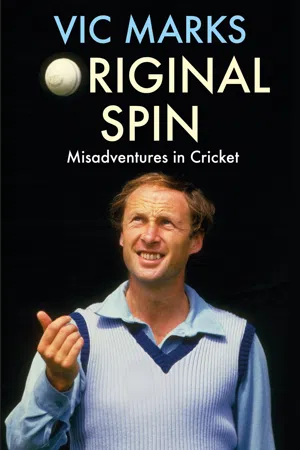
The much-loved former England player,
Guardian cricket correspondent and TMS broadcaster tells the story of his life in cricket for the first time.
In April 1974 new recruits
Viv Richards,
Ian Botham,
Peter Roebuck and
Vic Marks reported for duty at
Somerset County Cricket Club. Apart from Richards, 'all of us were eighteen years old, though Botham seemed to have lived a bit longer - or at least more vigorously - than the rest.'
In this irresistible memoir of a life lived in cricket, Vic Marks returns to the heady days when Richards and Botham were young men yet to unleash their talents on the world stage while he and Roebuck looked on in awe. After the high-octane dramas of Somerset, playing for England was almost an anti-climax for Marks, who became an unlikely all-rounder in the mercurial side of the 1980s.
Moving from the dressing room to the press box, with trenchant observations about the modern game along the way,
Original Spin is a charmingly wry, shrewdly observed account of a golden age in cricket.
- English
- ePUB (mobile friendly)
- Available on iOS & Android
eBook - ePub
About this book
Information
Print ISBN
9781911630203
ONE
__________________
TAUNTON 1974
‘WELL, WE’RE NOT GOING to get into the team ahead of him.’ Peter Roebuck and I stared at one another and simultaneously came to the same conclusion.
It was April 1974 at the County Ground and the Somerset players were having their first middle practice. A gangling pace bowler from Burnham-on-Sea, Bob Clapp, who would one day become a far better teacher, raced in and hurled the ball down as fast as he could. The delivery was not too bad, a fraction short perhaps and a little wide. There was the crack of willow on leather and the ball disappeared to the cover point boundary at staggering speed. A square cut of awesome power and certainty. Clapp looked a little puzzled and crestfallen. Meanwhile the batsman made ready for the second delivery of his practice session, although it took some time for the first one to be retrieved from beyond the greyhound track that encircled the playing area. Isaac Vivian Alexander Richards had arrived in Taunton.
Richards was barely known outside Antigua and Lansdown in Bath, where he had played a season of club cricket in 1973. That state of affairs would not last for long. Those who had played with or against Richards at Lansdown had soon recognized something special. Within a decade it was tricky to argue with the assertion that here was the best batsman of his era. I never bothered to try. He was the best.
Maybe it was Richards’ exploits for Lansdown the previous summer that allowed him to change in the main dressing room of the old pavilion when he first reported as a Somerset cricketer in that spring of 1974. There he found himself alongside three giants of the county game: Brian Close, an exile from Yorkshire having been controversially sacked in 1970, was the captain of the club; Tom Cartwright, once of Warwickshire and an exquisite bowling machine, was now Somerset’s player/coach; and in his last season as a professional there was ‘Gentleman’ Jim Parks, who had spent most of his career caressing the ball up and down the slope at Hove.
There were also some old Somerset stalwarts sitting under their usual pegs in that homely dressing room (well, there were a couple of sofas and an old gas fire in between the cricket bags) in the bucolic figures of Mervyn Kitchen and Graham Burgess, and some young ones, too – namely a pair of athletic blonds from Weston-Super-Mare, Brian Rose and Peter Denning. To augment the locals there was an assortment of cricketers from elsewhere: within the last few years Derek Taylor, the wicketkeeper, had come from Surrey; fast bowler Hallam Moseley from Barbados; left-arm spinner Dennis Breakwell from Northampton; and from Sussex Allan Jones, who would end up bowling fast for a good percentage of the clubs on the county circuit before sending batsmen on their way with his right index finger as an umpire.
At the back of the pavilion was a little alleyway beyond which was a dingy stone-floored room, which in later years would serve far more appropriately as modest toilets for gentlemen spectators. There was one tiny, thin window near the ceiling, a couple of benches and a few pegs on the wall. This was where the new recruits to Somerset were housed since there was not enough room in the main dressing room for the entire staff. That room no longer exists; it was demolished to make way for the suave, state-of-the-art Somerset Pavilion in 2015. There were no preservation orders to overcome in that process.
Back in the winter of 1973 the chairman of cricket, Roy Kerslake, who had captained Somerset in 1968, had successfully advocated a youth policy to the committee. Hence there were five newcomers in addition to Richards: Phil Slocombe, another batsman from Weston-Super-Mare; John Hook, a tall, gentle, prematurely deaf off-spinner, who was also from Weston; Roebuck and Marks, who had both been enlisted as batsmen (I’ll explain later) and a young man from Yeovil named Ian Botham. We were the occupants of the makeshift dressing room. All of us were eighteen years old though Botham seemed to have lived a bit longer – or at least more vigorously – than the rest. He tended to dominate proceedings even then, especially in our claustrophobic dressing room.
In that cubby hole a pattern emerged in those first few weeks. Ian rubbed along happily with Peter Roebuck, who was a very bright, Cambridge University-bound Dylan fan with huge feet, far more prepared to lower the drawbridge as a teenager than in later life. Ian and I were two South Somerset boys – I had grown up on a farm near Yeovil – and we got on perfectly well. Fairly early on in our relationship I learnt the necessity of identifying some form of escape route late in the evening when in Ian’s company. In Somerset I did not have to use it very often since I always had a forty-minute drive back home; hence the nocturnal haunts available in Taunton were never my specialist subject. By and large it always seemed wiser to avoid a serious argument with the young Botham if at all possible, a philosophy I maintained in later life.
Ian did not take so easily to Phil Slocombe; he sensed too many airs and graces, real or imagined. The point to remember, given how Somerset would disintegrate a dozen years later, was that Roebuck and Botham were once in the same camp, both intrigued by their obvious differences and enjoying one another’s company for the best part of a decade. They would argue merrily about most things and they would even write a book together, It Sort of Clicks, a task that, unsurprisingly, fell largely – no, entirely – upon the shoulders of Roebuck.
Slocombe, Roebuck and I had all come to the fore as cricketers by excelling to various degrees at local independent schools. Phil and Pete had played together, not necessarily in perfect harmony, at Millfield while I had been at Blundell’s School in Tiverton just across the border in Devon. Along the way we had all played cricket for the county in the school holidays – sometimes in youth sides run chaotically by the old Somerset cricketer Bill Andrews, who, according to the title of his autobiography, possessed the hand that bowled Bradman (for 202) – and later for the second team. That has been a pattern repeated frequently with the Somerset sides of the twenty-first century (minus the endearing, larger-than-life Andrews). Whatever the merits of the system, James Hildreth, Arul Suppiah, Jos Buttler, Craig Kieswetter, the Overton twins, Tom Abell, Dom Bess, Eddie Byrom, George Bartlett and Tom Banton have all progressed in a similar manner, though, as Jack Leach has demonstrated, other routes are still possible.
Meanwhile Ian had spent two years on the Lord’s groundstaff, a more fertile training ground then than it is now when every county boasts its own academy. That was a hard, boisterous, old-fashioned school, which may have suited him well. Botham had probably become more streetwise and more confident – not that he has ever been lacking in these departments – after spending two teenage summers in London rather than Yeovil.
Richards’ path to Somerset had been more unorthodox. In early 1973 Len Creed, a mischievous Bath bookmaker, was visiting Antigua with a touring side, the Mendip Acorns. In his wallet he had a cutting from The Cricketer magazine in which Colin Cowdrey had noted, ‘There was a chap called Vivian Richards who looked promising.’ Creed met Richards, watched him score a brisk 30 and was impressed. He phoned the club’s chairman, their former captain Colin Atkinson, because he had decided that he wanted to bring Richards back to Somerset. Atkinson was understandably reluctant to agree to this since it would involve the club in a risky outlay of cash on the recommendation of just one man. Then Creed suggested that he would bring Richards over to England himself to play for Lansdown CC, on the understanding that Somerset would cover the expenses incurred if the young batsman proved good enough to be granted a contract having served his qualification year. Atkinson thought this was a much better idea.
So, upon the hunch of a Bath bookmaker, never previously renowned for his cricketing nous, Somerset hit upon a jewel. Creed could dine out on the tale for the rest of his life – no one could ever begrudge him that – and for one season Lansdown CC became one of the most feared clubs in the county. Such a glorious sequence of events would not have been possible in 2019. Now it is necessary for an overseas signing to have played the requisite number of international matches in the previous year for him to be allowed into county cricket. A bookmaker’s hunch would not be enough.
This was an interesting time to join Somerset. Yet my first day as a professional cricketer was a bit of a disappointment. I arrived wide-eyed, eager for the fray and scrupulously punctual after the drive from home in a fifteen-year-old black VW beetle with no fuel gauge and orange indicators that protruded from the side of the car like arrows when they deigned to work. It was raining at Taunton, but there was never any intention among the players to leap straight into the nets to hone the strokes that we had been working on in the indoor net sessions, on Thursday nights throughout the winter, under the omniscient eye of Tom Cartwright.
There were more important matters to discuss as we huddled around the gas fire in the main dressing room. ‘This petrol money is bloody diabolical,’ said Merv Kitchen, ‘and you couldn’t feed a mouse on our meal money.’ Of course such crucial minutiae had not crossed my mind as I contemplated the season ahead but it’d be the duty of our player’s representative, Derek Taylor, to go off to see the secretary, Jimmy James, to haggle for a more reasonable rate. It was not quite the big, happy family I had envisaged. Throughout that period the players had absolute faith in Kerslake, the cricket chairman, but that confidence did not necessarily extend to every member of the committee – and there were plenty of them.
Once the rain stopped we did something rather modern. We played football. In 2019 England do that for about fifteen minutes before every day’s play and I can understand why, despite the risk of the odd embarrassing injury. It cheers everyone up. Just about every cricketer thinks he is a very fine footballer and there were times at Somerset when the despair among those not selected for the football team for those end-of-season benefit games was far more obvious than when they were omitted from a County Championship match at Derby.
When today’s England team play football before the start of a Test match there are understandable restrictions, rigorously applied. It is a two-touch game with a lot of noise but no tackling. At the County Ground in 1974 there was also plenty of noise but no tackling ban. The matches were often extremely competitive and the tackles reflected the influence of Norman Hunter of Leeds United and Ron Harris of Chelsea; arguments raged and decisions were fiercely disputed. Sometimes these games would end abruptly as they overheated. ‘Come on,’ said Kitchen to his faithful dog, Thumper, who often came to pre-season training with him, ‘we’re buggering off now.’ That meant the game was over because it was Merv’s ball.
At some point we would disappear down the road to Wellington Sports Centre for a few days of fitness training. We dutifully donned a motley range of tracksuits (there were no sponsors for them in 1974), ran up and down hills and were detailed to complete devious training circuits. It was not that scientific. Even D. B. Close, who was forty-three, would do some press-ups. To be more precise, he would do two: one for the BBC cameras and one for those of HTV, which was the local ITV station.
Soon the cricket took over. I remember being in the twelve travelling to Warwickshire for a warm-up match and nervously discovering that the room list read ‘Parks and Marks’. I was twelfth man and when Close asked me to sandpaper his bat while the side was out in the field I set to work with a zealous determination to impress my old, new captain. I found the Stuart Surridge bat bearing the initials DB and I cleaned it up meticulously. There was not a blemish to be seen. My pride was soon dented when the team returned to the dressing room and a puzzled Dennis Breakwell picked up his bat to find it mysteriously spotless.
In that first summer I was never entirely sure that Close could tell all of the newcomers apart. For some reason it did not take him long to work out which one was Botham, who would end up playing in sixteen of the twenty Championship matches. After that he might have been guessing whether it was ‘Pete lad’, ‘Phil lad’ or ‘Vic lad’. When carrying out the twelfth man duties we all happily made Close his pots of tea upon which he seemed to survive throughout a day of county cricket. I was not quite so adept at placing bets on his behalf down at the bookies, which may have saved him a bit of money.
Despite an injury to Cartwright, from which he never really recovered, Somerset had a successful season. Viv Richards made his mark in his first game for the club against Glamorgan at Swan-sea in the Benson & Hedges (B&H) Cup on 27 April. He hit 81 not out with thirteen fours and one six to win the match. Close apparently delivered the immortal words, ‘You’ll do for me, lad.’ It was all too much for Len Creed, who was in tears.
Soon it was evident that Richards was touched with genius and destined for a long international career. It was never so obvious with Ian. We watched eagerly when he played in the first team in the knowledge that anything might happen. If he succeeded that cheered us all up because here was a positive sign: if Ian, our peer, could hold his own, then perhaps we could as well at some point in the not too distant future. Ian was captivating, but one of England’s greatest all-rounders, a future knight of the realm? There was more chance of a band comprised of furry creatures of dubious provenance making the top ten in the hit parade (mind you, that happened to the Wombles in 1974).
However, on 12 June at Taunton in front of 6,500 spectators Botham’s performance suggested that, like Richards, he had something special. This was the B&H quarter-final against Hampshire. I watched almost every ball of that match. I had been stationed along with Roebuck inside the old, brown scoreboard almost opposite the pavilion. It was our job to operate it by pulling levers left and right and then leaning out of the window to plonk a few figures on the outside. We had a direct telephone line to the scorer just in case we occasionally lost track of the score, but with two alert young men who would soon be Oxbridge undergraduates, what could possibly go wrong?
When Hampshire batted Botham yielded 33 runs from his eleven overs and took two wickets, Peter Sainsbury and, rather more memorably, Barry Richards, who at the time was arguably the best batsman in county cricket, if not the world. However, the most instructive recollection is the manner of Richards’ dismissal. He was bowled by Botham yet he was very reluctant to leave the crease because he thought that our wicketkeeper, Derek Taylor, whose twin brother, Mike, was playing for Hampshire, had inadvertently knocked off the bails. So here is evidence that in 1974 Botham bowled at little more than medium pace. The wicketkeeper – and Taylor was especially adept at this against seamers – stood up to the stumps to him most of the time. Over the next few years, encouraged by Close and tutored by Cartwright, Botham added pace in abundance. But at the start he propelled gentle away-swingers.
Hampshire scored 182, which looked more than enough when Hallam Moseley joined Botham at the crease with Somerset languishing at 113–8. I now know exactly what would have been happening in the press box. Everyone, recognizing a Hampshire victory as a foregone conclusion, would have been writing up feverishly to meet their paper’s deadline and to get the job done as quickly as possible.
Andy Roberts, Viv’s mate from Antigua and the most fearsome bowler on the circuit, was recalled. Yet with Moseley surpassing all expectations alongside Botham the score reached 150. Roberts now bounced Botham and the ball hit him in the face, loosening some teeth and spilling some blood. Another bouncer and the Somerset faithful were jeering Roberts angrily. Then Botham clipped a delivery from Mike Taylor for six, just clearing Roberts on the boundary. Now the crowd sensed an impossible victory while those in the press box began to anticipate an inconvenient rewrite. Botham hit another six and when Moseley was lbw to Roberts only seven more runs were required.
By now there was chaos inside the scoreboard as Roebuck and I lost control, whether it was thro...
Table of contents
- Cover
- Title
- Copyright
- Contents
- 1 Taunton 1974
- 2 On the farm
- 3 Oxford
- 4 Full-time pro
- 5 Great losses
- 6 Great wins
- 7 Caps no. 55 and 499
- 8 One-day cricketer
- 9 On tour
- 10 Perth
- 11 Trouble over Bridgwater
- 12 Retired hurt
- 13 The Observer
- 14 Test Match Special (then)
- 15 Test Match Special (now)
- 16 Loose ends
- Acknowledgements
- Index
Trusted by 375,005 students
Access to over 1.5 million titles for a fair monthly price.
Study more efficiently using our study tools.