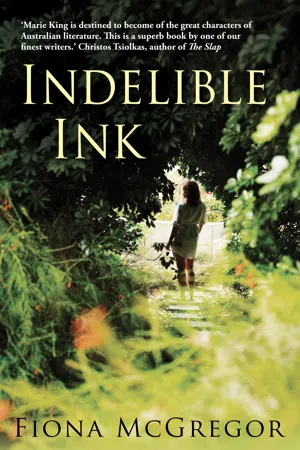
Marie King is fifty-nine, recently divorced, and has lived a rather privileged suburban existence. And though her three adult children have moved out, they are telling her what to wear, making her buy smarter furniture, and urging her to sell the family home and with it her beloved garden. Marie feels trapped.
On a drunken whim, Marie gets a tattoo - the beginning of an unexpected friendship with her tattoo artist, Rhys. Her children are mortified by their mother's transformation, but have their own self-absorbed challenges to deal with: workplace politics, love affairs and the real-estate market. Before long, Rhys has introduced Marie to a side of her city that she never encountered before and she begins to realise that the affluent world she has left behind has kept her in its clutches for far too long.
eBook - ePub
Indelible Ink
About this book
Information
Contents
INK
BLOOD
WATER
Acknowledgements
INK
FOR THE FIRST TIME IN YEARS, the children were all at Sirius Cove for their mother’s birthday. A westerly had been blowing since morning, depositing grit on the deck as the family brought out food and fired up the barbecue. Leon, who hadn’t been in Sydney for over a year, was struck by the effects of the drought on the city and the emptiness of the house since his parents’ divorce. Ross had taken his most valuable furniture and artworks with him, and Marie as lone inhabitant seemed to have shrunk and the house to have grown. Passing the cabbage tree palm that grew close to the deck, Leon leant out to touch the bark, thick and hard as an elephant’s hide. An old habit that comforted him.
Clark moved the seedling that Leon had given their mother away from the heat of the barbecue. It was sinuous and elegant with narrow delicate leaves. ‘What’s this?’
‘Agonis flexuosa.’ Leon broke a leaf off and crushed it near Clark’s face, releasing a sharp peppery smell. ‘It needs to be planted soon.’
‘We can look after it for you, Mum,’ said Blanche.
Clark placed chicken on the griddle. ‘Yes, please,’ he said to Hugh, who was pouring wine.
Marie was walking back to the kitchen. ‘I might have a spot for it down near the banksia,’ she said over her shoulder.
Blanche sent Leon a look, which he ignored. She was wearing a hat with a wide floppy brim so her mouth, full and always painted red, was the only thing visible. It was smiling wryly.
The children sat down to eat.
‘Where’s the wine?’ Their mother’s vexed voice travelled out. ‘Where’s my glass?’
‘Here, Mum.’
‘I’ve poured you a glass, Mrs King,’ Hugh said.
‘But I had one in here.’ The wine she’d had in the kitchen was in a bigger glass, and the last of the Queen Adelaide Riesling, which Marie was convinced didn’t sit on her breath as heavily as the Taylors Chardonnay that Blanche and Hugh had brought.
‘Mum. Will you come and sit down, before it gets cold?’
There it was, stashed behind the toaster. Marie returned to the deck, flushed and happy, with her Riesling. ‘This is the first outdoor meal of the season,’ she announced. ‘I think we should drink a toast.’
‘The weather’s beautiful,’ said Hugh.
‘I think it’s sinister,’ said Clark. ‘It’s the last day of August and it feels like summer.’
Dense blue harbour pushed against the canopy of trees below. The flapping of sails from yachts going about was close enough to have come from next door. They had moved the table against the glass doors for maximum shelter, and pinned the napkins down with cutlery.
‘It feels so weird without Pat Hammet,’ Leon said ruefully.
‘She stayed in that house on her own for nearly ten years after Judge Hammet died, you know,’ said Marie.
‘Yeah, and left the place totally run-down,’ said Blanche.
‘I liked it run-down,’ said Clark. ‘I liked Pat. That house was amazing.’
The new neighbours, the Hendersons, had pulled down the Hammets’ one-hundred-year-old Gothic pile shortly before the Kings’ divorce. They had rebuilt so close to the fence that Marie’s winter light was almost gone, and in place of the front garden was a four-car garage for Rupert Henderson’s fleet of vintage Jaguars. There were surveillance cameras on the front wall, and the back garden, facing the harbour, would soon be a swimming pool.
‘Pat’s still around,’ said Marie. ‘I see her up at the Junction sometimes. Salt of the earth.’ She pushed out her chair.
‘Where are you going, Mum?’
‘To get more wine.’
‘You’re not supposed to be moving,’ said Hugh. ‘I’ll go.’
‘No, no, I know where it is.’
‘It’s like this entire city has obsessive-compulsive disorder,’ Clark went on. ‘Nothing’s allowed to be more than ten years old. There’s no patina. It’s so philistine.’
‘Remember the Hammets’ before Pat moved out?’ said Blanche. ‘The flagging down the bottom was caving in. I went over there to give her some Christmas cake, and there was this giant bush rat dead in the middle of the path —’
‘Apparently that house could have been heritage listed. It could have been saved.’
‘— it was so foul.’
‘It’s about history, our need to destroy our history.’
‘A lot of the interior timber was cheap and poor quality,’ Hugh said to him.
‘It couldn’t have been.’ Clark spoke with his shoulders hunched, bracing for a sneeze. Bloody cat must have been sleeping on the chairs again. He looked around the room but couldn’t see Mopoke anywhere. He glared at Hugh instead. ‘It wouldn’t have lasted.’
‘I’m afraid it was,’ Hugh said with an insider’s authority. ‘I think we’re often so desperate to look historical that we make these decisions on sentiment, and it’s nonsense.’
‘I was meaning in a bigger sense.’
‘It’s bricks and mortar. It needs to last. Architects in the past weren’t necessarily better. If someone built Gothic in Mosman now, there’d be an outcry.’
Leon lowered his voice and inclined his head to his siblings, subtly avoiding Hugh. ‘I was thinking how much Mum is the house. You know, Dad was all the stuff, and now that’s gone you don’t feel his presence much. It’s really just her.’
‘She should replace the furniture before the house goes on the market,’ said Blanche. With the chaise longue and armchairs gone, the bookshelf had become the prominent marker on this side of the room, and most of the books looked tatty.
‘Why buy new things when you’re about to move to a smaller place?’ said Clark.
‘Because it looks like shit?’
‘Why don’t you wait until she says she wants to sell,’ said Leon.
Marie returned with another bottle of wine. She handed it to Hugh, then held out her glass.
‘Might help to get a bit more furniture in here,’ Hugh said.
‘I mean, I actually like it with less furniture,’ said Blanche. ‘I like the sense of space. Like what Leon was saying ... I mean replace.’
‘So do I,’ Marie agreed. ‘Do you want more chicken, Hugh?’
‘Thanks. That’d be great.’
Marie spooned extra sauce on. Poor Hugh. After all these years the boys still hated him. Even Blanche was embarrassed by him. Marie also thought Hugh was an oaf, but as her children thought she was a drunken fool, she often found herself siding with him, out of guilt as well. She thought that family get-togethers would be better without Ross, but his legacy of carping remained. Even little Nell, if here, would probably be making snide remarks. The physical elements of heredity were inexorable, but the gestures and tones seeding generation after generation seemed more like psychological afflictions that she, as mother, should have thwarted. Then again, as at least half the afflictions had come from her, there wasn’t much she could do apart from sit back and watch them replicate. Yes, actually, Hugh, as oafish as he was, being free of the King afflictions was a relief. Marie never expected Blanche would marry this man with his thinning, colourless hair, his thick rugby neck, yet she liked Hugh for the same reason that she disliked him — his dreary predictability — and assumed her daughter felt similarly. It was also a relief finding things to agree on with Blanche.
Clark offered the wine around.
Blanche shook her head. ‘I’m driving.’
‘Why don’t you come east, Mum? I think you’d like it. It’s less Henderson, more Hammet.’
‘I’ve never lived on that side of the bridge, Clark.’
‘You could actually get more value for money in Kirribilli,’ said Blanche.
Marie sighed. ‘I don’t want to talk about this today, thanks.’
‘We’ll put you on to the people who renovated our kitchen and bathroom,’ said Hugh eagerly. ‘They did an excellent job.’
‘You could get them done for as little as seventy K, Mum.’
‘That’s such a con,’ said Clark. ‘When I was house hunting you’d see these ads saying Just renovated and it’d be a slap of paint or a bit of Ikea and they’d double the price. Even a mug like me could see through it.’
‘We’re not talking about Ikea, Clark.’
Marie thought of putting ice in the wine, the crack it would make like her arthritic big toe escaping its shoe at the end of the day. The chill emanating from the cubes through the surrounding alcohol to frost the glass, and persuade her she wasn’t drinking as much as she really was. But she was aware of how often she had already left the table, so for distraction she unwrapped her remaining presents. Clark had given her a book. Marie read every book she was given. She liked Graham Greene, Inga Clendinnen and Angela Carter. She didn’t like Bryce Courtenay or Paul Auster. Clark gave her crime and local history; she drank the latter down oblivious to style, interested only in content. But her favourite books were her gardening ones, the most significant shelf taken up by eight volumes of The Encyclopedia of Australian Plants. Today’s birthday present was about first contact. She thanked Clark. Blanche and Hugh had given her a bottle of Issey Miyake. ‘Oh,’ she said, ‘perfect. I’ve just run out.’
‘If you don’t like it, I’ll get you something else. And I’ll have that. Honestly.’
‘Thank you!’ Marie tilted her head and angled the perfume at her clavicle. Most of it sprayed over her shoulder, in Hugh’s direction. Hugh’s neck was flushed and dimpled like the skin of a blood orange. He laughed then refilled their glasses.
Blanche dipped her head and Leon guessed she was grimacing. He got up to help her clear.
Clark walked down to the bottom of the garden, a magical place of mysterious plants whose names he mostly didn’t know. Pale green spiky heads weighing on thick stems. Low, fleshy things, one of which sprouted a pink flower like a studded club. Magnolia, hibiscus, red grevillea. Tree ferns, palms, their nuts like pebbles strewn across the path, which grew more indistinct the further down he went. He roared out a sneeze, nearly slipping on the dry leaf cover. Some of the compost slopped out of the bucket he was carrying. Righting himself, he saw Leon arrive and sit beneath the orange tree. He emptied the compost, wiped his hands on the grass, then trudged back up the path to sit next to his brother.
‘Blanche told me you got the sack,’ Leon said.
‘More or less. Restructuring. That’s what they call it these days.’
‘Collateral damage.’ Leon used an American accent. ‘What are you going to do?’
‘I don’t know.’ Clark shredded a twig to a point, then began picking his teeth with it. His teeth veered at odd angles, as though trying to avoid whatever he was taking in.
‘Have you applied for any jobs?’
‘There’s no work out there if you haven’t done postgrad. They advertised lots of other positions too. Even for the guides they got about a hundred applications, four of them PhDs.’
Leon felt sorry for his brother, bowed over his shoe, but he wasn’t sure how to talk to him. He was wary of Clark lashing out. Nearly forty, divorced, now the sack. Not that anyone was sorry to see the back of uptight Janice. The fact that his own business was failing didn’t strike Leon as a point of solidarity, let alone something to talk about, probably because it was his own fault. ‘That’s terrible. I thought you were one of their best guides.’
‘I wasn’t a guide.’ Leon had never come to the museum. ‘I worked in publications and archives.’
‘Well, I hope it works out, mate.’
They sat in silence beneath the tree. Tricked by the heat, the jacaranda had begun flowering. The bark on the angophora was growing coarse. Leon recorded the browning of the rhapis and Blanche’s totem magnolia. The sickness, the thirst. He reflected how different it would be working in Sydney in this weather. He would be drought-proofing one garden after another, or creating false economies for clients in Mosman and Woollahra. He would be learning about a whole new biosphere. They didn’t anticipate this in college fifteen years ago. The whole horticulture industry was scrambling. Meanwhile, the so-called dabblers like his mother were getting by on common sense. The xanthorrhea she planted as his totem when Leon was born looked robust as a bush native. He could have described its circumference with his arms outstretched. It was a lot to give up, a garden like this. The thought of somebody coming in and destroying it was unbearable.
‘So you think Mum should sell as well,’ Leon said.
‘Yeah. I think the upkeep on a place like this is too much and she needs a fresh start.’
‘Sure. But it’s such a big deal. She created this. You reckon Hugh wants to take on the sale?’
‘Of course. A house like this’d pay a massive commission.’
‘Maybe he’s not so bad, as far as real-estate agents go.’
Blanche was calling from the top of the path. ‘We’re about to have the cake, guys.’
‘Didn’t Blanche just get a promotion?’
‘Yep. Creative Director. Way into six figures.’
Leon whistled. ‘Hugh always seems so genial, kinda harmless, you know? We can at least keep the bastard honest. Can’t we?’
‘Don’t count on me to oversee financial anything.’
‘Are you coming?’ Blanche crunched down the path towards them.
Leon s...
Table of contents
- Cover
- About the Author
- Title page
- Copyright page
- Dedication page
- Epigraph page
- Contents
Trusted by 375,005 students
Access to over 1.5 million titles for a fair monthly price.
Study more efficiently using our study tools.
Frequently asked questions
Yes, you can cancel anytime from the Subscription tab in your account settings on the Perlego website. Your subscription will stay active until the end of your current billing period. Learn how to cancel your subscription
No, books cannot be downloaded as external files, such as PDFs, for use outside of Perlego. However, you can download books within the Perlego app for offline reading on mobile or tablet. Learn how to download books offline
Perlego offers two plans: Essential and Complete
- Essential is ideal for learners and professionals who enjoy exploring a wide range of subjects. Access the Essential Library with 800,000+ trusted titles and best-sellers across business, personal growth, and the humanities. Includes unlimited reading time and Standard Read Aloud voice.
- Complete: Perfect for advanced learners and researchers needing full, unrestricted access. Unlock 1.5M+ books across hundreds of subjects, including academic and specialized titles. The Complete Plan also includes advanced features like Premium Read Aloud and Research Assistant.
We are an online textbook subscription service, where you can get access to an entire online library for less than the price of a single book per month. With over 1.5 million books across 990+ topics, we’ve got you covered! Learn about our mission
Look out for the read-aloud symbol on your next book to see if you can listen to it. The read-aloud tool reads text aloud for you, highlighting the text as it is being read. You can pause it, speed it up and slow it down. Learn more about Read Aloud
Yes! You can use the Perlego app on both iOS and Android devices to read anytime, anywhere — even offline. Perfect for commutes or when you’re on the go.
Please note we cannot support devices running on iOS 13 and Android 7 or earlier. Learn more about using the app
Please note we cannot support devices running on iOS 13 and Android 7 or earlier. Learn more about using the app
Yes, you can access Indelible Ink by Fiona McGregor in PDF and/or ePUB format, as well as other popular books in Literature & Literature General. We have over 1.5 million books available in our catalogue for you to explore.