Dan Lyons was Technology Editor at
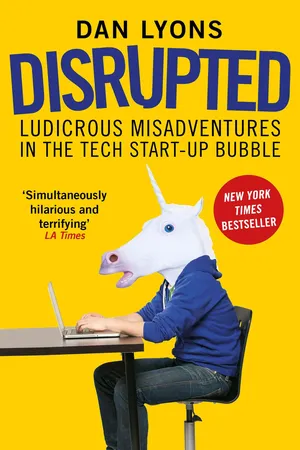
Newsweek Magazine for years, a magazine writer at the top of his profession. One Friday morning he received a phone call: his job no longer existed. Fifty years old and with a wife and two young kids, Dan was unemployed and facing financial oblivion. Then an idea hit. Dan had long reported on Silicon Valley and the tech explosion. Why not join it? HubSpot, a Boston start-up, was flush with $100 million in venture capital. They offered Dan a pile of stock options for the nebulous role of "marketing fellow." What could possibly go wrong?
What follows is a hilarious and excoriating account of Dan's time at the start-up and a revealing window onto the dysfunctional culture that prevails in a world flush with cash and devoid of experience. Filled with stories of meaningless jargon, teddy bears at meetings, push-up competitions and all-night parties, this uproarious tale is also a trenchant analysis of the dysfunctional start-up world, a de facto conspiracy between those who start companies and those who fund them. It is a world where bad ideas are rewarded with hefty investments, where companies blow money lavishing perks on their post-collegiate workforces, and where everybody is trying to hang on just long enough to cash out with a fortune.
- English
- ePUB (mobile friendly)
- Available on iOS & Android
eBook - ePub
About this book
Information
One
Beached White Male
Nine months earlier, it’s the summer of 2012, and life is good. I’m fifty-one years old, happily settled into married life in a suburb of Boston, with two young kids and a job I love. At Newsweek, I get paid to meet amazing people and write about subjects that fascinate me: fusion energy, education reform, supercomputing, artificial intelligence, robotics, the rising competitiveness of China, the global threat of state-sponsored hacking. To me, Newsweek is more than a company—it’s an institution. And being a magazine writer seems like the very best job in the world.
Then one day, without warning, it all just ends. It’s a Friday morning in June. The kids are at school. I’m sitting with my wife, Sasha, at the kitchen table, drinking coffee and going over the plans for our upcoming vacation, a three-week trip to Austria. It’s a bit of a splurge for us, but by using frequent flyer miles and staying in modest hotels we can just about afford it. Our kids—twins, a boy and a girl—are turning seven in a few weeks, and they’re finally old enough to handle an adventure. Sasha has just left her teaching job, because she’s been suffering from chronic migraines and spending too much time in emergency rooms. She needs time off to take care of herself. A few weeks in the Alps seems like a good way to start. We’ll miss her paycheck, and her insurance, which is first-rate, but I can get decent insurance from Newsweek, and in addition to my salary I’ve been making some money on the side by giving speeches.
So we’re good. Sasha can quit her job and we can still afford the vacation. It’s all going to be great. That’s what we’re telling each other as we pull up the website for one place where we’ll be staying, a cluster of chalets perched on a hillside in a remote village surrounded by mountains. A local guide takes tourists on day hikes and offers a rock-climbing class for kids. A nearby stable offers trail rides on sturdy little Haflinger horses with shaggy blond manes. We leave in three weeks.
My phone beeps. It’s an email from my editor, Abby. She wants to know if I can get on the phone. I go upstairs to my office and call her at the office in New York. I figure Abby wants to give me an update on the tech blog we’re launching. But unfortunately that’s not it at all.
“I have some bad news,” she says. “They’re making some cuts. Your job is being eliminated.”
I’m not quite sure what to say. On the one hand this should not come as a surprise. Newsweek has been losing money for years. Two years ago the magazine was sold to a new owner, who promised to turn things around. Instead we are losing more money today than we were two years ago. Subscribers and advertisers are drifting away. I suppose some part of me has been expecting this call. Still, I wasn’t expecting to get it today.
Abby says it wasn’t her decision to fire me. I ask her whose it was. She says she doesn’t know. But someone, somewhere, has made a decision. Abby is simply the messenger. There’s nothing she can do, and no one to whom I can appeal. This is obvious bullshit. Abby knows who made the decision. I’m betting it was Abby herself.
Abby is an old-time Newsweek person. She left the magazine before I joined, but three months ago she was recruited to come back as the executive editor. I was overjoyed when I found out I would be reporting to her. We’re old friends. We’ve known each other for twenty years. As soon as she arrived we started talking about launching a tech blog, which I would run. I figured I would have a year, maybe more, to get the blog off the ground. That’s why I thought my job was secure and why I am now sitting here, staring out my window, feeling as if I have been clubbed over the head.
“I think they just want to hire younger people,” Abby says. “They can take your salary and hire five kids right out of college.”
“Sure.” I’m not angry. I’m just dumbfounded. “I get it.”
From outside comes the roar of a lawnmower. I glance out the window and see that the guys who mow our lawn have arrived in their truck. I make a mental note that this is one small luxury that we now will have to live without, because surely an unemployed man cannot pay someone else to mow his lawn. I’m not even finished getting fired yet and I’m already thinking about ways to save money. Should we get rid of cable TV? Will we stop going out to dinner? Can we still go to Austria?
Abby says she really likes me, and this was a really hard phone call for her to make, and she hates to do this because we’ve known each other for so long, and nobody ever wants to call up their friend and tell them this. In a way I actually start to feel bad for her, even though I’m the one getting fired.
I tell her I understand. I’m a business reporter, after all. This is the stuff I write about—legacy companies getting disrupted by new technologies, slowly going under, laying off workers. If I were running a magazine that was losing money, I would be looking to cut costs, too. I’d get rid of the expensive old guys and hire a bunch of hungry young kids. It makes sense.
I went into this job knowing that it probably wouldn’t last forever. Back in 2008, when I joined, Newsweek veterans were being offered buyouts and early retirement packages. And it wasn’t just Newsweek. Newspapers and magazines were dying out all over the place, disrupted by the Internet. Despite all that, Newsweek was still an amazing place, and even if the magazine only had a few years left in it, I still wanted to work there.
Now, on this sunny Friday morning, it’s over.
My last day will be in two weeks, Abby says. I will get no severance package, just two weeks of pay and whatever vacation time I’m owed. At the end of two weeks I’ll also lose my health insurance, but the HR people will help me figure out how to set up COBRA to continue my benefits.
Some of my colleagues who left when the magazine was sold in 2010 received packages equal to a year’s salary. I’d expected that if or when I got cut, I’d be given enough severance to provide a cushion. Two weeks seems inordinately harsh. I try to bargain. I ask Abby if they will keep me on for six months while I look for a new job. That will let me save face and make it easier for me to find my next job. Sorry, she tells me, but no. I offer to take a pay cut. That won’t fly either, she says. How about I take a different job, I say. It doesn’t have to be much, but it will keep me on staff, with benefits, while I look for something else.
Abby is not having any of it.
“Abby, I have kids.” There’s a quaver in my voice. I take a breath. I don’t want to sound panicked. “I’ve got twins. They’re six years old.”
She says she’s sorry, she understands, but there’s nothing she can do.
I tell her that my wife has just left her teaching job. I’ve just finished sending in the paperwork to move us from Sasha’s insurance to the insurance plan offered by Newsweek. The HR department at Newsweek must be aware of this. That was the “qualifying life event” that enabled us to join the Newsweek health plan outside of the annual open enrollment period.
“Look,” I say, “if you can just push back my end date and keep me on for a few months, I’ll at least be able to keep my health insurance, and I promise I’ll get another job and get out of here.”
But Abby, my old friend, a woman I’ve known since we were both in our twenties and starting out in the journalism business, says no, she can’t do it. In two weeks I’m done, and that’s that.
I hang up the phone, go downstairs, and tell Sasha what just happened. She’s stunned. Wasn’t I just telling her that it was safe for her to quit her job, because my Newsweek job was secure?
“I thought Abby was your friend,” Sasha says.
“I thought so, too.”
Sasha still has the vacation folder with the brochures and plane tickets and hotel and car rental confirmations out on the table.
“Maybe we should cancel the trip,” she says.
There’s no sense in that, I tell her. Some of the money has already been spent, in deposits that we can’t get back. “We should go,” I say. “We’ll go, and we’ll use the time to think about what we’re going to do next. We can do anything, right? We can start over. We can move someplace new. It’s a fresh start.”
I talk about Vermont. We’re always saying how cool it would be to live there. Our friends did that—one day they sold everything and moved to Vermont. They love it! Or there’s Boulder. Or Bozeman. We could live in the Rocky Mountains! We should make a list of the best places to live, rent a Winnebago, visit each one, and then decide. We could spend the whole summer traveling around the country! We could see the Grand Canyon, and Zion, and Yellowstone, and Yosemite. In a way this whole thing is a gift. Because now we have all this free time! When are we ever going to have a chance like this again?
Sasha knows that I’m full of shit, and she also knows I’m panicking, because this is what I do when I’m panicking—I talk and talk and talk. But even as I’m reeling through my list of fantasy mountain towns where I can wear plaid shirts and drive a pickup truck and grow a beard, Sasha has arrived at the truth of our situation, which she feels the need to explain to me, as if by speaking the words out loud she might feel more in control of the situation.
“Let’s just talk about where we are right now,” she says. She’s working hard to remain calm. “The reality is that I just quit my job, and I can’t get that job back. They’ve already hired someone else. And now you’ve been fired.”
“Laid off,” I say, because that sounds better.
“Point is, we’re both unemployed, and we have six-year-old twins, and no health insurance, and no income. And we’re about to go on a really expensive vacation.”
“Well,” I say, “when you put it like that.”
“How else would you put it?”
I launch back into my spiel about moving to the mountains, but she cuts me off. None of that is going to happen, and we both know it. We’re not going to spend the summer cruising around the United States in a Winnebago like the Griswolds on some zany adventure.
“Look,” I say, “I’ll get another job. I’m going to start hitting the phone today. Right now. I’m going to email everyone I know. I’ve got a bunch of speeches booked, which should keep us going into the fall. And I can pick up some freelance work.”
I’m trying to sound confident. But the truth is that I’m fifty-one years old and I have never gone looking for a job before. I’ve always had a job and then moved to a better one. I’ve never had to call my friends and ask them to keep me in mind if they hear of anything. I’ve always been the guy on the other end of that call, and I’ve always felt bad for those friends who were calling me. Sure, I told them, I’ll pass the word around. I’ll keep an eye open. I’m sure you’ll find something.
But we all know the reality of our situation. Every year there are fewer jobs in journalism. It’s a game of musical chairs, with a bunch of laid-off old hacks running around and fighting over the few remaining seats.
Things are even worse if you’re over fifty. In what now seems like a cruel irony, I learned about this by reading my own magazine. In 2011, Newsweek published a cover story with the attention-grabbing headline THE BEACHED WHITE MALE. The cover depicted a middle-aged white guy in a suit, soaking wet, facedown on a beach at the water’s edge—maybe not dead, but definitely washed up.
The article described a whole generation of once-successful men who, having been laid off during the recession, or “Mancession,” as the magazine dubbed it, were now shuffling around in their bathrobes, stunned, emasculated, psychologically destroyed, humiliated in front of their wives and children, drifting through life like castrated zombies. In the new economy, age fifty was the new sixty-five. Hit fifty, and your company would find an excuse to fire you, and good luck trying to find another job. As for filing an age discrimination suit: Forget about it. You wouldn’t stand a chance. Even if you won your lawsuit, you’d never work again.
I’d read the article when it came out, but it hadn’t bothered me too much. I figured that somehow I was immune to this. Newsweek wasn’t doing well, but as long as the magazine remained in business, surely they would need a technology reporter?
Apparently not. Because suddenly, on this lovely sunny day in June, as I sit in my kitchen waiting for my kids to come home from school, wondering if I should tell them what happened and, if so, how best to present the news—right now I am no longer the technology editor of Newsweek. Instead, I am that guy on the cover of Newsweek: facedown on a beach, soaking wet, possibly dead. I am a Beached White Male.
I started working in newspapers in 1983, while I was still in college. After graduation I didn’t know what else to do, so I just kept working at newspapers. I thought about law school and business school, but didn’t have the heart for either. Originally I had been headed toward medicine, but I had fallen off the track and it seemed too late to start over. Newspapering didn’t seem like much of a career. It seemed like something to do until you discovered a career, or, as one of my reporter friends, a Brit with a background on Fleet Street, once told me: “It beats working for a living.” At some point I realized that I been working as a reporter long enough that journalism had become my career. It felt almost accidental.
In 1987, a friend of mine talked me into joining him at a newspaper aimed at the computer industry called PC Week, which was based in Boston. In those days Boston still had a lot of high-tech companies. I didn’t know anything about computers, but nobody else did, either. The personal computer was still a relatively new thing. We were getting in on the ground floor of what would become a huge new market.
In the 1980s Silicon Valley technology companies were boring places where engineers worked in drab office parks writing software or designing semiconductors and circuit boards and network routers. There weren’t any celebrities, other than Steve Jobs at Apple, and even he wasn’t such a big deal back then. In the early 1990s the Internet era began, and Silicon Valley changed. The new companies were flimsy, based on hype and grandiose rhetoric and the promise of making a fortune overnight. The dotcom boom of the late 1990s was followed by the dotcom bust, and then came a period when Silicon Valley felt like a ghost town. Slowly, a new generation of Internet-related companies arose, and while this second boom wasn’t a direct copy of the first one, there were some worrisome similarities, chief among them the fact that none of these companies seemed to be generating a profit. They were all losing money, and some were losing shocking amounts—billions of dollars, in some cases—and nobody seemed to mind.
I covered the first dotcom bubble and crash as a reporter at Forbes. Those years have turned out in retrospect to have been a kind of golden age not just for Forbes but for magazines in general. Magazine writers didn’t get rich, but we made ...
Table of contents
- Cover
- Title Page
- Author’s Note
- Contents
- Prologue: Welcome to the Content Factory
- Chapter 1: Beached White Male
- Chapter 2: When the Ducks Quack
- Chapter 3: What’s a HubSpot?
- Chapter 4: The Happy!! Awesome!! Start-Up Cult
- Chapter 5: HubSpeak
- Chapter 6: Our Cult Leader Has a Really Awesome Teddy Bear
- Chapter 7: We Need to Make the Blog a Lot More Dumberer
- Chapter 8: The Bozo Explosion
- Chapter 9: In Which I Make a Very Big Mistake
- Chapter 10: Life in the Boiler Room
- Chapter 11: OMG the Halloween Party!!!
- Chapter 12: The New Work: Employees as Widgets
- Chapter 13: The Ron Burgundy of Tech
- Chapter 14: Meet the New Boss
- Chapter 15: Grandpa Buzz
- Chapter 16: Ritual Humiliation as Rehabilitation
- Chapter 17: A Disturbance in the Farce
- Chapter 18: A House of Cards?
- Chapter 19: Go West, Old Man
- Chapter 20: Glassholes
- Chapter 21: Excuse Me, but Would You Please Get the Fuck Out of Our Company?
- Chapter 22: Inbound and Down
- Chapter 23: Escape Velocity
- Chapter 24: If I Only Had a HEART
- Chapter 25: Graduation Day
- Epilogue
- Acknowledgments
- Copyright
Trusted by 375,005 students
Access to over 1.5 million titles for a fair monthly price.
Study more efficiently using our study tools.
Frequently asked questions
Yes, you can cancel anytime from the Subscription tab in your account settings on the Perlego website. Your subscription will stay active until the end of your current billing period. Learn how to cancel your subscription
No, books cannot be downloaded as external files, such as PDFs, for use outside of Perlego. However, you can download books within the Perlego app for offline reading on mobile or tablet. Learn how to download books offline
Perlego offers two plans: Essential and Complete
- Essential is ideal for learners and professionals who enjoy exploring a wide range of subjects. Access the Essential Library with 800,000+ trusted titles and best-sellers across business, personal growth, and the humanities. Includes unlimited reading time and Standard Read Aloud voice.
- Complete: Perfect for advanced learners and researchers needing full, unrestricted access. Unlock 1.5M+ books across hundreds of subjects, including academic and specialized titles. The Complete Plan also includes advanced features like Premium Read Aloud and Research Assistant.
We are an online textbook subscription service, where you can get access to an entire online library for less than the price of a single book per month. With over 1.5 million books across 990+ topics, we’ve got you covered! Learn about our mission
Look out for the read-aloud symbol on your next book to see if you can listen to it. The read-aloud tool reads text aloud for you, highlighting the text as it is being read. You can pause it, speed it up and slow it down. Learn more about Read Aloud
Yes! You can use the Perlego app on both iOS and Android devices to read anytime, anywhere — even offline. Perfect for commutes or when you’re on the go.
Please note we cannot support devices running on iOS 13 and Android 7 or earlier. Learn more about using the app
Please note we cannot support devices running on iOS 13 and Android 7 or earlier. Learn more about using the app
Yes, you can access Disrupted by Dan Lyons in PDF and/or ePUB format, as well as other popular books in Computer Science & Business Biographies. We have over 1.5 million books available in our catalogue for you to explore.