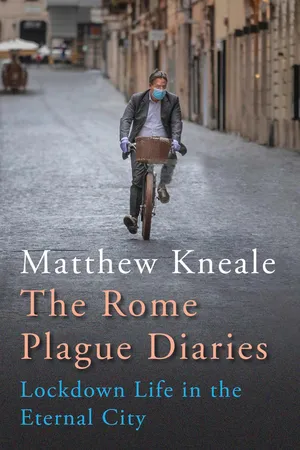
On the first morning of Rome's Covid-19 lockdown Matthew Kneale felt an urge to connect with friends and acquaintances and began writing an email, describing where he was, what was happening and what it felt like, and sent it to everyone he could think of. He was soon composing daily reports as he tried to comprehend a period of time, when everyone's lives suddenly changed and Italy struggled against an epidemic, that was so strange, so troubling and so fascinating that he found it impossible to think about anything else.
Having lived in Rome for eighteen years, Matthew has grown to know the capital and its citizens well and this collection of brilliant diary pieces connects what he has learned about the city with this extraordinary, anxious moment, revealing the Romans through the intense prism of the coronavirus crisis.
- English
- ePUB (mobile friendly)
- Available on iOS & Android
eBook - ePub
About this book
Information
Topic
Personal DevelopmentSubtopic
Social Science BiographiesFriday the 10th of April
Breaking out and seeing Fascism
Last night we had another Zoom meeting with our friends and we were all badly in need of seeing different faces and hearing everybody’s news. One of our friends was so cabin-fevered that he proposed that we should all get together for a secret drink in somebody’s house. Nobody else was at all keen. The rules we’re living by are in place for a good reason, and though we all assume we’re clear of the virus, who’s to know if one of us might have picked it up in some shop or supermarket, and would then spread it to the others, who would then spread it further? The penalties for infractions are tough now. A few days ago, a man from Testaccio was stopped in his car near the Circo Massimo – barely a kilometre from his home – and fined €3,000.
Still, I have to admit that, after a month locked down and two and a half weeks bubbled down, the thought of a change of view is tempting. Looking for insects in our green area, admiring the villas on the Via Dandolo, peering through the gates of the Syrian temple – it feels a very small world. Perhaps it’s time to throw caution to the winds and burst out? Are you up for it? It’s another beautiful day, with tree blossom just beginning to show itself, white and pink. Don’t be alarmed. Try as they may, nobody can fine you on these pages. I know it’s Good Friday, which is the busiest, maddest time in all the year to see Rome, but to hell with it. Let’s walk and walk, for four thousand words, five thousand, six thousand, till our feet ache and we can hardly take another step. Let’s see the whole city. Not postcard Rome. I’ll show you some places that few visitors think of going to. What’s that? With the lockdown everything will be closed? Don’t worry, I give you my guarantee that it will all be open. The Italian government has decreed that we must stay within our bubbles. I now decree that, just for you, today will be a normal Good Friday.
Good Friday is a working day in Italy, of course, and a busy one. Let’s give a wave to Roberto and Anna, struggling to serve the crowd of customers waiting to buy traditional Easter salami (with big chunks of fat). And as we pass the market let’s give a ‘Buongiorno’ to Matteo, Sara and her father, Bruno, hurrying to sell potatoes, artichokes and other vegetables to go with everybody’s Easter meal of lamb. Tomorrow will be busier still. On we go, across the frontier of our bubble. Even before the lockdown, this short street, Via di San Cosimato, was a frontier. Behind us is Piazza San Cosimato, with its bars and restaurants, our market and a children’s playground – where I spent many an hour standing beneath the climbing frame in case Alexander or Tatiana fell off – which is the locals’ Trastevere. Ahead, Piazza di Santa Maria is tourist Trastevere, where visitors are happy to pay extra for a coffee where they can sit and look at the view. Then again, it is quite a view. Santa Maria in Trastevere is one of the most beautiful churches in Rome. But here’s something few people know. It was built from spite. In the early twelfth century the church here was associated with the antipope, Anacletus II, and when he died and his rival and enemy, Pope Innocent II, gained control of Rome, Innocent had Anacletus’ church demolished and wholly rebuilt. A prettier consequence of vindictiveness I’ve yet to see, and it’s never looked better than now. The paintings on the facade, which had become very faded, were restored recently and you can now make out long-vanished details.
Our next stop is one of nostalgia. Let’s make our way across the piazza, past the street buskers and the man launching huge detergent bubbles into the air, past the Ci-Lin Chinese restaurant, and down the quiet lane of Vicolo del Piede. See the door over there? It doesn’t look like much now but it was once the entrance to a great Trastevere institution: the Pasquino English-language cinema. It’s not easy to see films in their original language in Italy, as a law that dates back to the Mussolini era requires everything to be dubbed. The Pasquino was the city’s only full-time Englishlanguage cinema, and it was unusual in another way, too. I was once in the audience here on a hot summer’s night in the late 1980s when, as the film was rather dull, I happened to glance upwards and, to my surprise, I saw stars shining down. When the film ended, I looked up again and all I saw was ceiling, making me wonder if I’d imagined the whole thing. I had to go several more times before I looked up at the right moment and saw the roof silently swinging open. Sadly, the Pasquino is no more.
Here’s more nostalgia. It’s quite a maze round here, I know, and if you’ve ever wondered what classical Rome was like, look no further; these winding streets, faced by apartment blocks three or four or five floors high, are much as residential streets would have been in the ancient city – albeit cleaner. And here we are: Vicolo della Frusta. It was once a street of carriage-makers – hence the name, which translates, rather suggestively, as Whip Lane. Do you see the low building on the left, with a metal door opening onto the street? This was where Shannon and I first lived in Rome. It’s not large inside, just one bedroom, and Alexander, who was here from babyhood to toddlerhood, had to sleep in a walk-in wardrobe, but we liked it. We lasted until the day came when we fixed a pink rosette to the front door: the Italian way of announcing the birth of a baby daughter. After that we definitely didn’t fit.
Next I’d like to show you a scene of Roman glory. In truth there isn’t as much of this as you might expect in Rome’s long history. In the early days, as Rome rose from an obscure Italian town to a Mediterranean superpower, there was determination, a will to dominate and a good deal of cruelty, yet personally there’s not much that I find likeable about the Romans’ heroics. Up here, though, they did something that I truly can admire. It’s a bit of a climb, I know, steps and then more steps, so let’s pause for a moment by this grand fountain. If it looks familiar it’s probably because you saw it in the opening scene of the film La Grande Bellezza, when a Japanese tourist suddenly dies of a heart attack. It’s a vast fountain, with an immense outpouring of water, because this is actually an entire river; it’s the arrival point in the city of one of classical Rome’s aqueducts, the Acqua Paola. In Rome’s efficient, classical days the city had no fewer than eleven functioning aqueducts, of which three still work. They each have a grand arrival place – the other two are the Fountain of Moses, by Via Venti Settembre, and the Trevi Fountain. It’s quite a view from up here and you can see the whole of Rome. Over to the right are the Alban Hills – Rome’s local dormant volcanoes – and straight ahead are the Apennines. Those distant peaks covered in snow, where Romans go skiing, are just an hour’s drive from here.
I’m tempted to make a short detour. A little south of here is a small, beautiful park, the Villa Sciarra, that nestles inside a corner of the old papal walls. You can see part of it from our flat. Walk through it early in the morning and you may come across one of Rome’s more curious sights. First, you’ll hear beautiful violin music emanating from behind trees up by the wall. As you come closer and the music grows louder you’ll see a dog crouched on the slope beneath the walls, looking up with an air of great expectation. After a moment the music stops and a ball flies out of the greenery, bounces away and the dog dashes off in pursuit. The violinist, who’s very talented, comes here with the twin purpose of practising away from his neighbours and walking his dog.
But we have no time for detours. Out through the papal wall we go, and down this short, noisy stretch of Via di San Pancrazio. And here it is – the scene of glory. It doesn’t look much now, I know: a small, gravelly car park that opens up before us, V-shaped, and then extends ever wider into the greenery of another park beyond, which is one of Rome’s largest, the Villa Pamphili, that stretches on for several miles. It feels so peaceful here, walking up the gentle slope between avenues of trees, towards a triumphal arch, and you’d never think this was once a scene of slaughter. If there’s one single place where Italy was born as a united, independent country, free of foreign rulers, it’s right here.
On an early June day in 1849, scores of Romans and other Italians died on this spot. It was a time of revolution. The pope, Pius IX, had fled into exile and France’s new ruler, Louis Napoleon, had sent a powerful army to crush Rome’s pro-unification government and put Pius back on his throne. During the night the French, using trickery, had seized a strategically key point. It was a country villa on high ground, of which nothing remains, where the triumphal arch now stands. The Roman commander, Giuseppe Garibaldi, knew that unless the villa was recaptured the city would be impossible to defend. Wave after wave of Italians came through a small gate at the beginning of what is now the car park and then ran up the slope, across open country where there was no cover to protect them from blistering French fire from the villa. Several times the Italians captured the villa only to lose it again, as it was impossible to defend from the other side. By evening the struggle was over and, after a few weeks of valiant defence, Rome fell and – the much hated – Pope Pius returned to power.
Yet, if the battle was lost, the slaughter in this pretty wooded area brought about success in the end. Until this time, Italian patriots had been viewed from abroad as divided and lacking commitment. The terrible battle that was fought here helped persuade influential foreigners, including British prime-minister-to-be William Gladstone, of the passion and justice of the Italian cause. To see how matters concluded, we need only retrace our steps and then turn left, passing busts of numerous heroes of Italian unification, till we reach the Piazza Giuseppe Garibaldi. The view here is even better than it was by the fountain. We’re lucky it’s still early in the morning, as on this spot you can get quite a shock. Every day at noon, soldiers of the Italian army wheel out an artillery piece from just below and fire off a blank round to signal the hour. It’s extremely loud and, if you’re not expecting it, it can really make you jump. And there’s Garibaldi, looking splendid on his great horse. But here’s another curiosity. Do you see how he’s not facing ahead towards the city but disdainfully to the left, towards the Vatican? It’s as if he’s staring down the popes and telling them, ‘Look who won.’
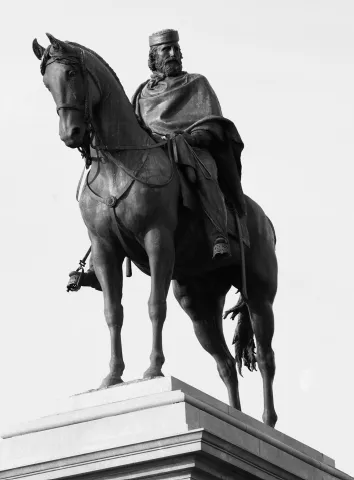
Giuseppe Garibaldi glowering in the direction of the Vatican.
This was certainly how the papacy saw matters. When, after six decades of icy non-relations between the popes and the Italian state, Mussolini negotiated a pact with the Church, one of the Vatican’s first demands was that the statue of Garibaldi should be removed. It’s not often that I agree with Mussolini, but on this occasion I do. Unwilling to show himself to be in the Church’s thrall, he not only kept Garibaldi where he was, but he put up a new statue just down the road of Garibaldi’s Brazilian wife, Anita, who was hardly less of a warrior than her husband. There she is, in a suitably heroic pose, on a rearing horse, a pistol in one hand and a baby in the other.
I think that’s enough glory. Our next stop is the site of altogether more self-interested events – but then part of the charm of Rome’s immense history is that it’s so filled with instances of human weakness. Along the ridge of the Gianicolo Hill we go, down the steps and past the remains of Tasso’s Oak, beneath which the sixteenth-century poet Torquato Tasso, who suffered greatly from depression, would sit in his last, troubled days. Long propped up and kept alive, the tree is now nothing more than a hollow, dead trunk and a few blackened, dead branches.
On down the hill to the river and there it is: an immense, circular chunk of stonework with battlements on the top. The Castel Sant’Angelo, originally the tomb of the Roman Emperor Hadrian, was so high and strongly built that it became Rome’s citadel – the city’s Bastille or Tower of London. You see that wall-like structure leading out from it to the left? That is a fine example of papal foresight. It’s the Passetto di Borgo – a raised passageway, that leads all the way to Saint Peter’s Basilica, almost a kilometre from here. It proved very useful on the morning of 6 May 1527, when Charles V’s half-starved army rushed into the Vatican like a great scythe, killing everything in its path. As Pope Clement VII, who had been praying in St Peter’s for longer than was wise, hurried along this escape route, he was spotted by Spanish troops, who took shots at him from below.
At this same moment there was an immense crush of desperate Romans fleeing in through the gate to the Castello – just over there. Pope Clement was consulted and, on being told that many of these citizens were of no military use, he had them thrown out, including women and children. What became of them is hard to know. But there was always room for those of the right kind. Cardinal Pucci was hauled up by a rope through a window and Cardinal Armellino was pulled over the battlements in a basket. As Romans across the city were murdered, raped, castrated, tortured and ransomed, life in the Castel Sant’Angelo wasn’t too bad. There had just been time to bring in provisions before the enemy arrived, and the besieged had forty bullocks for meat, plenty of grain and rice, ham and cheese and some excellent Greek wine. But before we snigger and judge, perhaps we should ask ourselves, what would we have done? Would we have cast self-interest aside and walked out to share our fate with our fellow Romans? Or would we have stayed safe, guiltily sipping Greek wine?
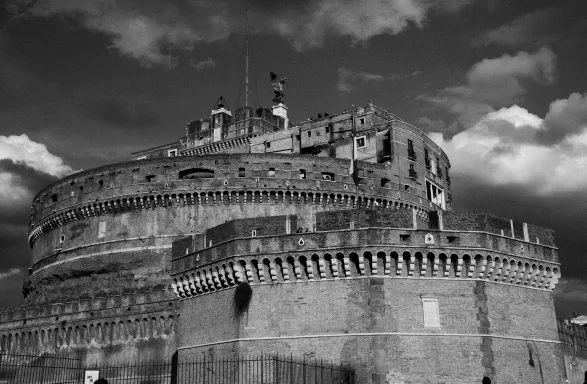
Castel Sant’Angelo
You’d like to go to the Vatican? It’s Good Friday, remember? D’you see the queue to go through security to Saint Peter’s, that winds halfway round the square? As for the Vatican Museum, it’s a long time since I’ve encouraged any visitor to go there, except during the very lowest of the low season. These days it’s like a scrum, where you can hardly see the museum’s wonders for the crowds brandishing selfie sticks and tour guides’ batons. Some blame Dan Brown but I’d point the finger at Ryanair, EasyJet and Airbnb. The Vatican should really put a cap on numbers, for both the sake of its visitors and to protect its treasures – I can’t believe all that damp breath is good for the frescoes in the Sistine Chapel and the Raphael rooms – but I see no sign of that happening. They’re loathe to lose a euro of ticket income.
If it’s all right with you, I’d rather go somewhere else, where I can guarantee there’ll be hardly a tourist in sight, and which, in its way, is no less interesting. It also says a great deal about the darker side of Rome’s recent history. First, we need to cross over the Ponte Cavour and walk alongside the river. But it’s hard not to get sidetracked in Rome. Let’s stop here, just for a moment and look through this window. This building, which was designed by the US architect Richard Meier – and has many detractors for its un-Roman, white exterior – houses one of the finest examples of Roman art: Emperor Augustus’ Temple to Peace, the Ara Pacis. As well as mythological scenes, it depicts the imperial family processing to take part in a sacrifice. For anyone who’s read Robert Graves’ I Claudius, half the cast of characters is here: a big Italian family dynasty that had hit the jackpot as rulers of the empire, captured in stone before they turned murderously on one another.
Along with the statue of Anita Garibaldi, this is a rare instance where I’m willing to give a little praise to Mussolini (his draining of the Pontine Marshes, which helped overcome Italy’s malaria problems is a third). The Ara Pacis had long before been broken into fragments, some of which were found during nearby excavations. Other sections had made their way into foreign museums and Mussolini made it a diplomatic priority to get them back. He wasn’t always successful, and some segments of the temple we see today are copies of the originals, but it’s wonderful to see the building standing.
Yet the restoration of the Ara Pacis came at a cost. The parts of the temple that were found here were discovered during the destruction of this neighbourhood of the city, which was demolished to excavate Emperor Augustus’ tomb – whose rather disappointing remnants are just over there – and to make space for the hideous Fascist buildings all around us. This was one of many Roman neighbourhoods whose old houses, churches and piazzas were torn down, displacing over 100,000 Romans. Mussolini wanted to make Rome into a new Paris or Berlin, with wide, military-parade-sized boulevards, though Rome’s charm was that it was the very opposite: a city of narrow streets and intimate spaces. We just crossed a prime example of Mussolini’s vandalism: the Via della Conciliazione that leads to Saint Peter’s. To build it, Mussolini destroyed a medieval area of long, narrow, winding streets. He also destroyed the drama of walking through these and suddenly emerging to find oneself in Saint Peter’s Square, with Saint Peter’s Basilica rising up behind.
So much for what Mussolini destroyed, what did he build? That’s what we’re going to see. We have to pass through Piazza del Popolo, which is where, for centuries, most pilgrims first entered the city. Do you see those two churches behind us, that look identical? They’re actually an ingenious optical illusion, and one is larger than the other. Out through the city walls we go, and here’s our tram, number 2, as it’s too far to walk. A short ride, a walk across the Ponte Duca d’Aosta, and here we are.
This is the Foro Olimpico, originally known as the Foro Mussolini, a broad expanse of Fascist display that, rather surprisingly, has survived intact. See the paving with M for Mussolini, and Duce a Noi. Over here, around the Marble Stadium, these statues were each made in a different Italian city. Though I have to say that rather ...
Table of contents
- Cover
- Title
- Copyright
- Contents
- Introduction
- Tuesday the 10th of March: All locked down
- Wednesday the 11th of March: Discovering our new and smaller world: postal district 00153 Roma – and doing the virus dance
- Thursday the 12th of March: A stroll across the river
- Friday the 13th of March: Eccentrics, and being an honorary Roman
- Saturday the 14th of March: Chatting with friends (at a safe social distance)
- Monday the 16th of March: A street warmed by opera
- Tuesday the 17th of March: Insanity in the UK
- Wednesday the 18th of March: On the need to connect – and a recipe for pork and slow-cooked onion pasta
- Thursday the 19th of March: Our vanished market
- Friday the 20th of March: Growing to love the green area and sometime rubbish dump below our apartment
- Saturday the 21st of March: All about my mother
- Sunday the 22nd of March: Rome’s plagues past
- Monday the 23rd of March: Making my own DIY surgical face mask
- Tuesday the 24th of March: Scammers – and a recipe for Pasta cacio e pepe
- Wednesday the 25th of March: About our building
- Thursday the 26th of March: How to buy a used car in Rome
- Friday the 27th of March: Roman love of regularity, homeless Romans and Romani Romans
- Saturday the 28th of March: Rome: the city that globalization forgot
- Sunday the 29th of March: A bad day at the supermarket, and getting to know our new bubble
- Monday the 30th of March: Writing on walls
- Tuesday the 31st of March: My family, tiny nation
- Wednesday the 1st of April: What brought us to Rome: a film that was never made
- Thursday the 2nd of April: In pizza we trust
- Friday the 3rd of April: The strange story of the Tomato King
- Sunday the 5th of April: Our local Syrian temple
- Tuesday the 7th of April: An atheist and the Catholic Church
- Friday the 10th of April: Breaking out and seeing Fascism
- Saturday the 11th of April: Spring is here – and a recipe for Pasta alla vignarola
- Sunday the 12th of April: Mysteries, conspiracies and the shooting of Sister Piera
- Monday the 13th of April: Daring to look to the future: Rome in four seasons
- Wednesday the 15th of April: A down day – and a recipe for comfort pasta
- Friday the 17th of April: Is it a lie that Romans are friendly?
- Saturday the 18th of April: Politics, populism and wickedness from the distant past
- Tuesday the 21st of April: Rome’s worst plague of all
- Wednesday the 22nd of April: Interior decorating and paganism
- Thursday the 23rd of April: Are Romans really such bad drivers?
- Friday the 24th of April: How to survive Roman red tape, and what it taught me about Brexit
- Saturday the 25th of April: Liberation Day and Roman criminality
- Monday the 27th of April: Is Roman cuisine really any good?
- Wednesday the 29th of April: Rome: ideological showcase – and a recipe for Pasta all’Amatriciana
- Thursday the 30th of April: Is there a film that truly captures Rome?
- Saturday the 2nd of May: What do Romans think of their city’s past?
- Sunday the 3rd of May: Was there a golden age of Rome?
- Monday the 4th of May: Unlocked – and a recipe for Pasta fredda
- Acknowledgements
- A Note About the Author
- Plates
Trusted by 375,005 students
Access to over 1.5 million titles for a fair monthly price.
Study more efficiently using our study tools.
Frequently asked questions
Yes, you can cancel anytime from the Subscription tab in your account settings on the Perlego website. Your subscription will stay active until the end of your current billing period. Learn how to cancel your subscription
No, books cannot be downloaded as external files, such as PDFs, for use outside of Perlego. However, you can download books within the Perlego app for offline reading on mobile or tablet. Learn how to download books offline
Perlego offers two plans: Essential and Complete
- Essential is ideal for learners and professionals who enjoy exploring a wide range of subjects. Access the Essential Library with 800,000+ trusted titles and best-sellers across business, personal growth, and the humanities. Includes unlimited reading time and Standard Read Aloud voice.
- Complete: Perfect for advanced learners and researchers needing full, unrestricted access. Unlock 1.5M+ books across hundreds of subjects, including academic and specialized titles. The Complete Plan also includes advanced features like Premium Read Aloud and Research Assistant.
We are an online textbook subscription service, where you can get access to an entire online library for less than the price of a single book per month. With over 1.5 million books across 990+ topics, we’ve got you covered! Learn about our mission
Look out for the read-aloud symbol on your next book to see if you can listen to it. The read-aloud tool reads text aloud for you, highlighting the text as it is being read. You can pause it, speed it up and slow it down. Learn more about Read Aloud
Yes! You can use the Perlego app on both iOS and Android devices to read anytime, anywhere — even offline. Perfect for commutes or when you’re on the go.
Please note we cannot support devices running on iOS 13 and Android 7 or earlier. Learn more about using the app
Please note we cannot support devices running on iOS 13 and Android 7 or earlier. Learn more about using the app
Yes, you can access The Rome Plague Diaries by Matthew Kneale in PDF and/or ePUB format, as well as other popular books in Personal Development & Social Science Biographies. We have over 1.5 million books available in our catalogue for you to explore.