Shortlisted for the Dublin Literary Award 2016
Jeremy O'Keefe, a middle-aged Professor, returns to his native New York after a decade teaching at Oxford, and quickly settles into a lonely rhythm of unfulfilling lectures and long, silent evenings.
His quiet world is suddenly shaken by a series of encounters with a strange young man who presumes an acquaintance, and the arrival of three mysterious packages. And when a haunting figure starts to linger outside his apartment at night, his chilling conviction that he is being watched is seemingly confirmed. As Jeremy's grip on reality shifts and turns, he fears that he will never know whether he can believe his experiences, or whether his mind is in the grip of an irrational obsession.
I Am No One explores the world of surveillance and self-censorship in our post-Snowden lives, where privacy no longer exists and our freedoms are inexorably eroded.
eBook - ePub
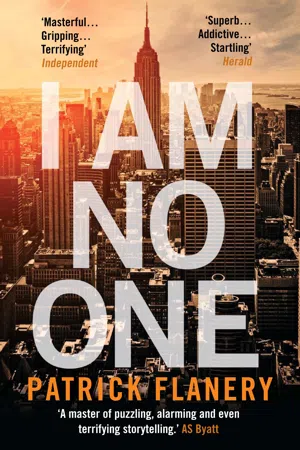
I Am No One
About this book
Information
Title page
I Am No One
Patrick Flanery

ATLANTIC BOOKS
LONDON
Dedication
For AEV & GLF
I
AM
NO
ONE
NOVEL BEGINS
At the time of my return to New York earlier this year I had been living in Oxford for more than a decade. Having failed to get tenure at Columbia I believed Britain might offer a way to restart my career, though I always planned to move back to America, imagining I would stay abroad for a few years at most. In the interim, however, America has changed so radically—by coincidence I left just after the attacks on New York—that I find myself feeling no less alienated now than I did during those long years in Britain.
Although I acquired British citizenship and owned a house in East Oxford on the rather optimistically named Divinity Road, which becomes gradually more affluent as it rises to the crest of a hill, Britain has no narrative of immigrant assimilation, so for my British colleagues and friends and students, it mattered little that I was legally one of them. First and last, I was and would always be an American. Perhaps if one comes at a younger age total acculturation is possible, but as a man in his forties my habits were too firmly in place to undergo whatever changes might have allowed me to become British in anything other than law.
When I was fresh out of my doctorate at Princeton, New York University was not one of the places I would have chosen to work, but I was thrilled when NYU’s History Department approached me to apply for a professorship and even happier when I was offered the position, assured at last that my years away from home were finished. It is surprising how much displacement can alter the mind, and while I went to Britain entirely of my own accord, I became restive after the first few years and increasingly resentful that I was being denied—it seemed to me then—access to a fully American life. I blamed my former colleagues at Columbia and whatever machinations had led to my not being awarded tenure and having thus to begin afresh as a rather lowly sounding Fellow and University Lecturer at one of Oxford’s older Colleges, which, though founded in the fifteenth century, does not attract the brightest students or have the largest endowment.
Nonetheless, I came to see it as a comfortable place to be, despite the workload being substantially greater than at a comparable American institution since Oxford has continued to teach students individually or in small groups, and there is an ever-expandable duty of pastoral care unlike anything in American academia. I became accustomed to the College chef sending me lunch in my rooms if he was not too busy, often including some tidbit (or as the British say, titbit) from the previous night’s High Table dinner. There were excellent wines in the College cellars and life ticked on as it had for centuries, with few changes other than the admission of women, which some dons in my time still regarded as an ill-thought-out modernization that had, they insisted, altered the character of Oxford irremediably.
I was lucky with the property market and before returning to New York this past July sold the house on Divinity Road for a staggering million dollars’ profit, which I invested in a house and some land overlooking the Hudson River a couple hours north of the city, while taking up NYU’s generously subsidized housing in the Silver Towers on Houston Street. Beautiful this apartment is not, but it is a five-minute walk to Bobst Library and I have relished being back in a city that feels global in a way Oxford certainly did not despite the great number of international students and scholars hustling around its quadrangles.
Coming home, of course, meant knowing that I would see my daughter more than once or twice a year, as was our custom during my time in Britain. My loss of tenure coincided with the breakdown of my marriage, though the two were unrelated and no one was really at fault. Nonetheless, it had felt at the time as if there were doubly good reason to seek new opportunities, not only because my career in American academia was finished, so far as I could tell, but because my marriage was also over.
A few weeks ago, just months into my first semester back in New York, I had a meeting scheduled with a doctoral student to whose committee I had been assigned. Life in Oxford has produced a kind of informality in my relations with students, graduate students in particular, and so I proposed meeting Rachel at a café on the Saturday afternoon before Thanksgiving. It was one of a series of Italian-themed places on MacDougal Street that claimed a lineage longer than seemed likely, but I enjoyed its cheap coffees and the variety of authentic pastries for sale in the glass display case. It helped soften some of the culture shock I have been feeling on my return to America, allowing me to believe for a moment that those markers of European life towards which I have grown fond remain accessible even on this side of the Atlantic. Accordingly I made Caffè Paradiso a regular stop in my weekly life, as it provided the kind of quiet and spacious venue where friends and students could be met and conversation lingered over without the sense that a waiter or waitress was going to rush us out the door. It has more atmosphere and élan than any of the chain coffee shops and less hectic bustle than the faux-artisanal places so packed that one has to compete for a table and then feel the pressure of other guests helicoptering with eyes peeled for the first movements building to a departure. Caffè Paradiso is not chic or hip but it has understated style and that, I suspect, is what has kept it in business for so many years—either that or it’s a front for money laundering, which is always a possibility in this town.
Rachel was usually prompt in our communications and we had met once before, in September, for what in Oxford I would have called a supervision but which now was perhaps better called a meeting or, if that felt too businesslike, then simply coffee. In the intervening two months I had heard little from Rachel until she sent me a completed draft of a chapter. This work, on the organizational history of the Ministry for State Security in the German Democratic Republic, was very assured. I had only a few suggestions for how she might fine-tune her methodological framework but wrote to say I thought it would be productive to meet again before the holidays.
Since I am always early wherever I go I had brought a book with me, though I did not expect Rachel to keep me waiting. She gave the impression in our first meeting and in all our subsequent communications of being a young woman of exceptional meticulousness and punctuality, even punctiliousness. Several days prior to our previous meeting she had written to confirm the time and place before I had done so and when I arrived for that appointment, in the coffee shop near the southeastern corner of Washington Square, she was already waiting for me.
On this second meeting, just a few weeks ago, I ordered an Americano, took a table near the window, and opened my book. I cannot now remember what the book was, it might have been Paul Virilio’s Open Sky, or something of that sort, but I soon found that I had read ten pages and when I looked at my watch it was nearly a quarter past four, fifteen minutes after the appointed time of the meeting. I took out my phone, an antiquated black plastic wedge unable to send or receive emails, but at least, I thought, I could send Rachel a text message, as I sometimes did to my daughter if I was arranging to meet her and got stuck in traffic. When I scrolled through my list of contacts I was surprised to discover that Rachel’s name was not among them, although I was certain I had entered her details when we met in September.
Another ten minutes passed and I took out my phone again, checked to be sure I had not overlooked her number, perhaps it was filed under last name instead of first, but there was nothing. It was possible that at some point I had accidentally deleted the entry, my fingers are not as dexterous as they once were and the tiny keys on my phone are difficult for me to punch accurately, or maybe, I reasoned, the memory of putting Rachel’s name and number into the list of contacts was nothing more than willful invention or a false memory of an intention left unfulfilled.
I had been nursing the coffee and now decided there was no point in waiting longer so I raised the cup to my mouth and in so doing caught the gaze of a young man, perhaps in his late twenties or early thirties, sitting at a table across from me. I cannot say how long he had been sitting there, whether he had already been present when I walked in or if he had arrived after me, but he nodded or perhaps did not nod but made some acknowledgment or greeting and then began speaking in a way so casually familiar that I was taken off guard. This is not something that tends to happen in Britain, where suspicion of strangers is so deeply ingrained in the national psyche, perhaps from the years of the IRA threat, or even more distantly, from the suspicion of German spies during the Second World War, that strangers often do not even make eye contact let alone speak with one another, unless they are from elsewhere, and then, by happy chance, it becomes possible to bond with someone in a public place, both shaking your heads over the confounding maze of London’s transportation network or the cost of living or the difficulty inherent in walking down the street because whatever laws of left-side walking that might once have been in force have been confused by London’s transformation into an international microstate, and though distant enough from the capital, Oxford is a satellite of this phenomenon, its Englishness gradually giving way to a cosmopolitanism that moves with brutal transformative force. Perhaps the day will soon come when strangers in Britain talk to each other in ways that will feel normal rather than extraordinary.
But here, in New York, on a cold day in November, there was a stranger engaging me in conversation, and because of my habituation to an English attitude of reticence it seemed so astonishing that at first I did not believe he could possibly be speaking to me.
‘Stood up?’
I did a double take, looking round the room. ‘You talkin...
Table of contents
- Title page
- Acknowledgments
Trusted by 375,005 students
Access to over 1.5 million titles for a fair monthly price.
Study more efficiently using our study tools.
Frequently asked questions
Yes, you can cancel anytime from the Subscription tab in your account settings on the Perlego website. Your subscription will stay active until the end of your current billing period. Learn how to cancel your subscription
No, books cannot be downloaded as external files, such as PDFs, for use outside of Perlego. However, you can download books within the Perlego app for offline reading on mobile or tablet. Learn how to download books offline
Perlego offers two plans: Essential and Complete
- Essential is ideal for learners and professionals who enjoy exploring a wide range of subjects. Access the Essential Library with 800,000+ trusted titles and best-sellers across business, personal growth, and the humanities. Includes unlimited reading time and Standard Read Aloud voice.
- Complete: Perfect for advanced learners and researchers needing full, unrestricted access. Unlock 1.5M+ books across hundreds of subjects, including academic and specialized titles. The Complete Plan also includes advanced features like Premium Read Aloud and Research Assistant.
We are an online textbook subscription service, where you can get access to an entire online library for less than the price of a single book per month. With over 1.5 million books across 990+ topics, we’ve got you covered! Learn about our mission
Look out for the read-aloud symbol on your next book to see if you can listen to it. The read-aloud tool reads text aloud for you, highlighting the text as it is being read. You can pause it, speed it up and slow it down. Learn more about Read Aloud
Yes! You can use the Perlego app on both iOS and Android devices to read anytime, anywhere — even offline. Perfect for commutes or when you’re on the go.
Please note we cannot support devices running on iOS 13 and Android 7 or earlier. Learn more about using the app
Please note we cannot support devices running on iOS 13 and Android 7 or earlier. Learn more about using the app
Yes, you can access I Am No One by Patrick Flanery in PDF and/or ePUB format, as well as other popular books in Literature & Literature General. We have over 1.5 million books available in our catalogue for you to explore.