- 612 pages
- English
- ePUB (mobile friendly)
- Available on iOS & Android
eBook - ePub
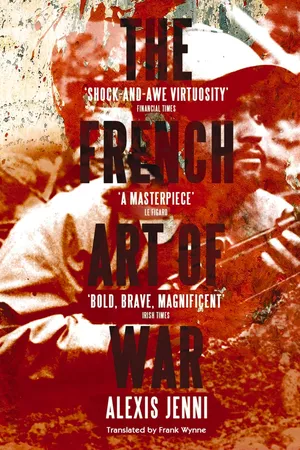
The French Art of War
About this book
It was the beginning of the Gulf War. I watched it on TV and did little else. I was doing badly, you see. Everything was going wrong. I just awaited the end. But then I met Victorien Salagnon, a veteran of the great colonial wars of Indochina, Vietnam and Algeria, a commander who had led his soldiers across the globe, a man with the blood of others up to his elbows. He said he would teach me to paint; he must have been the only painter in the French Forces, but out there no one cares about such things. I cared, though. In return, he wanted me to write his life story. And so he talked, and I wrote, and through him I witnessed the rivers of blood that cut channels through France, I saw the deaths that were as numberless as they were senseless and I began finally to understand the French art of war.
Information
Print ISBN
9780857897541
Subtopic
Literature GeneralNovel V
The war in this bloody garden
THERE IS NO CITY in the world that Salagnon despised more than Saigon. The horrendous everyday heat and the noise. To breathe is to suffocate; the air is hot and waterlogged. Open the window you think will protect you and you cannot hear yourself speak or think or breathe: the deafening roar of the street drowns out everything, even inside your head; close it again and you cannot breathe; you feel a clammy sheet wrap around your head and tighten. In his first days in Saigon he opened and closed the window of his hotel room many times, then gave up; and he lay in his boxer shorts on the damp bed; he was trying not to die. Heat is the sickness of this country; you have to acclimatize or you die from it. Better to acclimatize and gradually it subsides. You no longer think about it, so it takes you by surprise when you are called upon to do up the buttons of your jacket, make a vigorous gesture, carry even the slightest weight, lift a kitbag, climb a flight of stairs; in such moments the heat returns like a crashing wave that soaks your back, your arms, your forehead, as dark stains spread over the pale uniform. He learned to wear light clothes, to leave everything unbuttoned, to save his energy, to make sweeping gestures so that skin never touched skin.
He did not like the teeming streets, the constant noise, the swarming anthill that was Saigon; because to him, Saigon was like an anthill in which an infinite number of indistinguishable people scurried here and there, for reasons he could not fathom: soldiers, unobtrusive women, gaudy women, men in identical clothing whose expressions he could not interpret, more soldiers; people everywhere you looked pulled rickshaws, human-powered vehicles; and a bewildering array of businesses on the pavements: food stalls, hawkers, barbers, toe-nail clippers, sandal repair, and nothing: dozens of crouching men in threadbare clothes, some smoking, others not, half watching the commotion, although it was impossible to know what they were thinking. Soldiers in striking white uniforms passed, sprawled in the back of rickshaws; others sat on the terrace of the grand cafés, sometimes with other soldiers, sometimes with women with long black hair; a few sporting golden uniforms moved through the crowds in automobiles, opening up a path with honking horns, threats and a rumble of engines, and as soon as they had passed, the crowds merged again into a teeming throng. He loathed Saigon from the very first day, because of the noise, the heat, all the horrid invasions it endured; but once outside the city, having ventured a few kilometres into the countryside with a good-natured officer keen to show him the calmer, more serene, outlying villages, some of which had swimming pools and pleasant restaurants, when he found himself in the boundless paddy fields beneath motionless clouds, he experienced such utter silence, such emptiness, that he thought he was dead; he suggested they cut short the excursion and go back to Saigon.
He preferred Hanoi, because on his first morning there he was woken by the sound of bells. It was raining; the light was grey and the chill air made him think he was elsewhere, back home, perhaps in France, although not in Lyon, because he did not want to think of anyone waiting for him in Lyon; he thought he was in another part of France, somewhere he felt at ease, a green-grey place, an imaginary place drawn from his readings. He shook himself awake and found he did not sweat while getting dressed. He was to meet someone in the hotel bar, ‘after Mass’ he had been told, the Mass at the cathedral; the bar in the Tonkin Grand Hôtel, a curious mixture of provincial French and far-flung colonial. In Saigon you had to squint into the light, an overexposed yellow, dotted with patches of colour; in Hanoi the light was simply grey, sometimes ominous, sometimes a beautiful melancholy grey, and the city teemed with people who wore only black. It was just as difficult to move through the streets congested with goods, carts, convoys, but Hanoi worked with a seriousness that was quietly mocked elsewhere; Hanoi worked and was never distracted from its gold; here, even war was waged seriously. The soldiers were thinner, wiry and as tense as live cables, their eyes burned in faces haggard with exhaustion; they did not dawdle; harried, economical in their movements, there was nothing extraneous in their gestures. Dressed in ragged uniforms of indeterminate colour, there was nothing Oriental or decorative about them; they moved unaffectedly, like Boy Scouts, explorers, mountaineers. One might have encountered them in the Alps, in the middle of the Sahara, in the Arctic, crossing vast wastes of stone or ice with the same unvarying tension in their gaze, the same eager leanness, the same economy of movement, because meticulousness makes it possible to survive, mistakes do not. But these things he discovered later, by then he was already a different man; his first contact with Indochine was the revolting hot wet rag that enveloped Saigon and smothered him.
The heat, the gaping wound of the Far East, had begun in Egypt at the point when the Pasteur, which sailed the route to Indochine, sailed into the Suez Canal. The crowded ship slowly followed the watercourse, wending its way through the desert. The inshore wind had dropped; they were no longer at sea, and it was so hot on deck that touching metal fittings was dangerous. Below decks, filled with young men who had never seen Africa, it was impossible to breathe; soldiers melted in the heat, several of them fainted. The colonial doctor brutally brought them round, bawling at them to make them understand: ‘From now on you keep your bush hat and you take your salt tablets, unless you want to pass out like an idiot. How stupid would it be to set off for war and die of sunstroke? Imagine the telegram being sent to your families. If you’re going to die over there, at least die in a decent fashion.’ After Suez, a veil of melancholy settled over the soldiers crowded into every space aboard the ship; only now did it dawn on them that some men would not be coming back.
At night they heard loud splashes against the hull. There were rumours of legionnaires deserting. They dived in, swam, climbed the sides of the canal and, soaking wet, set off on foot into the dark desert to a different fate, and no one would hear from them again. NCOs kept watch on deck to stop men from jumping. On the Red Sea a steady breeze returned, ensuring they would not all die overwhelmed by the sweltering sun that beats down on Egypt. But heat of a different kind was waiting for them in Saigon: a sauna, a steam bath, a pressure cooker whose lid would remain firmly screwed on for the duration of their stay.
At the Cap Saint-Jacques they disembarked from the Pasteur and headed up the Mekong. The noun was enchanting, as was the verb; putting verb and noun together, ‘heading up the Mekong’, they felt the thrill of being somewhere alien, of setting out on an adventure, a feeling that quickly faded. There was not a ripple on the glassy river; it gleamed like sheet metal covered with dark oil, while the barges carrying them left a dirty trail in their wake. The flat horizon was very low, the sky came down very low, blanching at the edges of crisp white clouds that hung motionless in the air. What Salagnon saw was so flat that he wondered how they would be able to get enough footing to stand up. In the back of the barge the young soldiers, exhausted by the crossing and the heat, were dozing on their knapsacks in the sickly sweet smell of mud rising from the river. Guys in shorts with bare, tanned chests sat in the stern, scanning the banks, with tripod-mounted machine guns. Their faces expressionless, they did not even trouble to look at these brand-new tin soldiers, this herd of pale, neat men whose transhumance they were charged with, half of whom would soon be dead. Salagnon could not know that within a few months he would have the same face. The engine of the barge boomed over the water, the armour plate clattered beneath the men and the deafening roar rolled away and died on the vast Mekong, since it met no obstacle, nothing that might reverberate. Huddled with the others, silent like the others, heart in his mouth like the others, throughout the journey to Saigon he had a feeling of hellish solitude.
He was summoned by some old fogey from Cochinchine who had fixed ideas about how war should be conducted. Colonel Ducroc held meetings in his office. Lounging on a Chinese sofa, he served champagne that remained chilled until the ice cubes melted. His magnificent white uniform, elaborately embellished with gold, was a little tight, while the ceiling fan dispersed his sweat and filled the room with a scent of cooked fat and eau de Cologne; as, outside, the tropical day advanced – a series of dazzling slashes in the venetian blinds – the stench of him grew stronger. Between pudgy fingers he held out a tiny object that all but disappeared.
‘You know how they say “hello” here? They say “Have you eaten rice yet?” That’s how we’re going to win, by focusing all of our forces on this.’
He squeezed his fingers, wrinkling them, but Salagnon realized that he was holding out a grain of rice.
‘In this country, young man, controlling the supply of rice is vital!’ he said enthusiastically. ‘Because in a famine-stricken country everything is calculated in rice: numbers of men, tracts of land, the value of inheritances and the length of journeys. This yardstick by which everything is measured grows in the mud of the Mekong; so if we control the rice getting out of the delta, we can crush the rebellion, just as we might starve a fire of oxygen. It’s physics, it’s mathematics, it’s logic. Look at it whatever way you want: by controlling the rice, we win.’
The fat folds in his face obliterated his features, unwittingly giving him an impassive, faintly pleased air; when he squinted for any reason, his eyes were transformed into two Annamese slits, making it look as though he knew whereof he spoke. The country might be vast, the population at best indifferent, his forces meagre and his equipment falling apart, but he had very fixed ideas about how to win a war in Asia. He had been living here for so long that he believed he had melded with it. ‘I’m not completely French any more,’ he would say with a little laugh, ‘but French enough to use the statistics of the Intelligence Service. Subtlety in Asia, precision in Europe: by combining the wisdom of both worlds, we can achieve great things.’ With the point of his pencil he tapped the report lying next to the champagne bucket, and the confidence of his gesture was as good as proof. The figures explained everything about rice production: production in the delta area, capacity of junks and sampans, daily consumption by combatants, maximum weight transportable by the coolies, walking speed. If you integrate these data, you realize you only need to confiscate a certain percentage of the production from the delta to tighten the noose and strangle the Viet Minh. ‘And when they are dying of hunger they’ll come down from the mountains. They’ll come down into the plains and then we’ll crush them, because we have the numbers.’
This glorious old codger gesticulated as he explained his plan; the ceiling fan turned overhead, dispersing his muggy scent, the smell of a local river, warm and perfumed and slightly sickly; behind him on the wall, the large map of Cochinchine was criss-crossed with red lines that indicated victory as certainly as an arrow indicates its own extremity. He concluded his explanation with a complicit smile that had the ghastly effect of causing his many chins to pucker and discharge an excess of sweat. But this man had the power to distribute military equipment. With a stroke of his pen, he granted Lieutenant Salagnon four men and a junk to win the rice war.
* * *
Outside, Victorien Salagnon plunged into the molten tar of the street, into the boiling air that clung to everything, filled with potent, penetrating scents. Some were scents he had never smelled before. He did not even know that a smell existed that was so pervasive, so intense that it was also taste, texture, object, the flow of fickle, mellifluous matter within him. It mingled plant and animal; it might have been the scent of some giant flower with petals of flesh, the smell of meat that oozed sap and nectar; you long to bite into it, you feel you might pass out or throw up, you do not know how to react. The streets were pervaded by the scent of pungent herbs, the scent of honeyed meats, the scent of sour fruits, the musky scent of fish that triggered a craving not unlike hunger; the smell of Saigon awakened an instinctive desire mingled with a little instinctive repulsion and a longing to know. They had to be cooking smells, because all along the street, at makeshift stalls wreathed in steam, the Annamese were eating, sitting at stained, rickety tables, worn out through too much use and too little repair; the wisps of steam all around made his mouth water, triggered the physical symptoms of hunger, although he had never smelled any of these scents before; it had to be their local food. They ate quickly from little bowls, noisily slurping soup, spearing threads and morsels using chopsticks they wielded like paintbrushes; they brought the food quickly to their mouths, drinking, sucking, moving the food around with a porcelain spoon; they ate their fill, their eyes lowered, focused on their gestures, without speaking, without pausing, without exchanging a single word with the two people sitting shoulder to shoulder on either side; but Salagnon knew that they were aware of his presence, that even with their heads lowered they were watching him; with those eyes that seem closed they were tracking his every movement through the fragrant steam, every one knew where he was, the only European on this street where he had vaguely lost his way, having taken several arbitrary turns after leaving naval headquarters, where he had just been assigned four men and the command of a wooden junk.
He did not know how to communicate with the Annamese people sitting at tables, did not know how to interpret their expressions. They were tightly packed, their eyes fixed on their bowls; their attention confined to the short trajectory of the spoon moving between the bowls they cradled and open mouths, sucking with the gurgling sound of a pump. He could not see how he might say a word to anyone, how he might notice anyone, isolate him, talk to him and him alone in this cacophonous throng of men focused on eating and nothing else.
A stiff blond head rose above the heads of dark hair bent over their bowls. He walked towards it. A tall European was eating, keeping his back straight, a legionnaire wearing a short-sleeved shirt and no hat; on either side were two Annamese, but there was no one sitting opposite, or on the empty seat where he had placed his white kepi. He ate slowly, emptying his bowls in turn and pausing momentarily after each one to sip from a small, glazed, earthenware jar. Salagnon gave a vague salute and sat down opposite him.
‘I think I need help. I’d like to eat, everything smells amazing, but I don’t know what to order or how to go about it.’
The other man continued to chew, keeping his back straight; he drank from the neck of his small, earthenware jar; Salagnon politely insisted, although he did not beg, he was simply curious; he wanted to be guided and once again asked the legionnaire how to go about things; around him the Annamese went on eating without raising their heads, their backs bowed, deliberating making that slurping sound; these people were so reserved, so discreet in everything, with the exception of this noise they made when they ate. Customs are unfathomable. When one of them finished, he got to his feet without looking up and another man took his place. The legionnaire nodded to his kepi on the chair.
‘Already two lunches,’ he said in a thick accent.
He drained the earthenware jar. Salagnon carefully moved the kepi.
‘Well then, now three lunches.’
‘You have money.’
‘Like a solider off the boat with his pay packet.’
The other gave a terrible roar. The Annamese, busy with their soup, did not flinch, but an elderly man appeared, dressed in black like the others. The dirty dishrag tied around his waist was clearly his cook’s apron. The legionnaire reeled off a list in his booming voice, his thick accent noticeable even in Vietnamese. A few minutes later the bowls arrived, coloured morsels that the sauce made glossy as though lacquered. Unfamiliar aromas floated around them like clouds of colour.
‘That’s fast…’
‘They cook fast… Viet cook fast.’ He eructated with a huge laugh, starting on another jar. Salagnon also had one. He drank. It was strong, unpleasant, slightly foul-smelling. ‘Choum! Rice wine! Like potato alcohol, but with rice.’ They ate, they drank, they got dead drunk and by the time the elderly, slightly grubby cook doused the fire beneath the large black pan that was his only utensil, Salagnon could not even stand; he was bathed in a mixture of sauces, salty, spicy, sour, sweet, that had engulfed his nostrils and glistened on his sweat-drenched skin.
When the legionnaire got up, he stood almost two metres tall and had a pot belly that could have accommodated a normal man if he curled up into a ball. He was German. He had seen a...
Table of contents
- Cover
- Title Page
- Contents
- Commentaries I: The departure for the Gulf of the Spahis of Valence
- Novel I: The life of rats
- Commentaries II: I have known better days and left them behind
- Novel II: Going up to the maquis in April
- Commentaries III: A prescription for painkillers from the all-night pharmacy
- Novel III: The Zouave regiments arrive in the nick of time
- Commentaries IV: Here and there
- Novel IV: The first times, and what came after
- Commentaries V: The fragile nature of snow
- Novel V: The war in this bloody garden
- Commentaries VI: I saw her around all the time, but I’d never have dared speak to her
- Novel VI: Trifid, hexagonal, dodecahedral war; self-consuming monster
- Commentaries VII: We watched, uncomprehending, the paseo of the dead
- Copyright
Trusted by 375,005 students
Access to over 1.5 million titles for a fair monthly price.
Study more efficiently using our study tools.
Frequently asked questions
Yes, you can cancel anytime from the Subscription tab in your account settings on the Perlego website. Your subscription will stay active until the end of your current billing period. Learn how to cancel your subscription
No, books cannot be downloaded as external files, such as PDFs, for use outside of Perlego. However, you can download books within the Perlego app for offline reading on mobile or tablet. Learn how to download books offline
Perlego offers two plans: Essential and Complete
- Essential is ideal for learners and professionals who enjoy exploring a wide range of subjects. Access the Essential Library with 800,000+ trusted titles and best-sellers across business, personal growth, and the humanities. Includes unlimited reading time and Standard Read Aloud voice.
- Complete: Perfect for advanced learners and researchers needing full, unrestricted access. Unlock 1.5M+ books across hundreds of subjects, including academic and specialized titles. The Complete Plan also includes advanced features like Premium Read Aloud and Research Assistant.
We are an online textbook subscription service, where you can get access to an entire online library for less than the price of a single book per month. With over 1.5 million books across 990+ topics, we’ve got you covered! Learn about our mission
Look out for the read-aloud symbol on your next book to see if you can listen to it. The read-aloud tool reads text aloud for you, highlighting the text as it is being read. You can pause it, speed it up and slow it down. Learn more about Read Aloud
Yes! You can use the Perlego app on both iOS and Android devices to read anytime, anywhere — even offline. Perfect for commutes or when you’re on the go.
Please note we cannot support devices running on iOS 13 and Android 7 or earlier. Learn more about using the app
Please note we cannot support devices running on iOS 13 and Android 7 or earlier. Learn more about using the app
Yes, you can access The French Art of War by Alexis Jenni, Frank Wynne in PDF and/or ePUB format. We have over 1.5 million books available in our catalogue for you to explore.