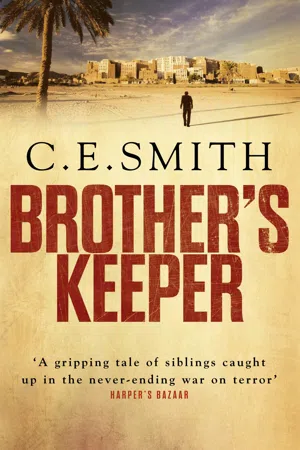
Struck off and hooked on prescription pills, disgraced American surgeon Ryan Burkett flies to the war-torn Middle East to identify his murdered twin's body. Staring down at the lifeless form in the mortuary, it is as though Burkett is gazing at his own failings. His brother was first and best - the better athlete, better doctor, better son.
With little reason to go home, Burkett agrees to take over his brother's charitable surgical clinic. Within weeks, however, he is taken hostage by Islamic fundamentalists. Forced into withdrawal - from both drugs and his own self-loathing - Burkett becomes convinced that his captors are his brother's murderers, and that revenge may be the only path to redemption.
eBook - ePub
Brother's Keeper
About this book
Information
1
The squawking radio, some kind of prayer, is torture to Burkett’s headache. The driver speaks no English, or so it seems when Burkett asks him to lower the volume. He’d lower it himself, sacrilege or no, but a wire partition confines him to the back of the cab.
They’re next in line at a military checkpoint, where a one-armed man with the dark skin of a native Khandari endures a painstaking search despite his advanced age. The old man watches impassively as the soldiers, in flagrant disregard for the standstill traffic, mount his wooden flatbed and jostle the sisal bales and overcrowded birdcages. It could be the missing arm that aroused their suspicion: he could have blown it off making bombs.
Whatever the case, their scrutiny doesn’t bode well for Burkett, even if he just cleared customs without a problem, and even if most of the drugs he’s carrying are perfectly legal. Of the hundred or so packages of antibiotics, he’ll simply repeat what he said less than an hour ago at the airport: these medicines have been donated to the people of Khandaros, to a clinic that treats the poor free of charge.
But his personal stash of Xanax and Valium, a week’s worth, could earn him up to ten years in prison. A week for ten years: it seems on the surface like the risk of a madman, but only a pharmacist or a certain type of addict would notice the discrepancies of pills and labels. At least that’s what he’s been telling himself in the days since his summons to this impoverished island.
The drug laws here are rather harsh for a new democracy boasting social reform: life in prison for a kilogram of marijuana, death for five grams of heroin. In some ways, nothing has changed since the draconian years of Quadri the Behemoth. It is well and good to disband the secret police, to hold fair trials and rock concerts, but to Burkett’s way of thinking, the concept of westernization isn’t complete without some degree of permissiveness in the area of pharmacology.
But he isn’t worried. The customs inspector at the airport hardly bothered with his shaving kit, much less any pills inside. Why should he expect any different from troops at a checkpoint? They have more important things to consider, like their fledgling government’s war with Islamic militants. They wouldn’t waste their time on minimally addictive drugs when a suicide bomber could be sitting in the very next car.
The driver shuts off the radio as he pulls up to the checkpoint. Burkett welcomes the silence, though in a way it grants the soldiers a measure of respect he isn’t sure they deserve. There are signs of poor discipline: an unsnapped holster, a missed belt loop, even food stains on the taller one’s shirt. Burkett doubts he’d concern himself with such superficial details if the two men weren’t armed with assault rifles.
‘Salam,’ the taller one says, studying Burkett. ‘Passport, please.’
Burkett hands his passport through the window. He waits while the soldier confers with someone in a parked SUV. He hears the word ‘American’ and the SUV’s door opens. This one is older, more professional in his bearing. A member of the old guard, Burkett guesses, maybe a player in the coup nearly twenty years ago that brought an end to the ancient line of kings and paved the way for Quadri.
The older officer flicks through Burkett’s passport. He reads the name aloud – Ryan as ‘Ron’, Burkett as ‘Buckett’ – and lifts his sunglasses for a closer look at the picture, which shows Burkett in the goatee he wore during medical school.
‘What is your profession, sir?’
‘I’m a surgeon,’ Burkett says, which draws a look of confusion. ‘A doctor,’ he says. ‘But I’m here for personal reasons.’
In the heat Burkett wants to follow the driver’s lead and get out of the cab, but the soldier blocks the door while trying to compare the passport photograph to the real thing. He takes much longer than necessary, perhaps because of the goatee, and eventually shakes his head as though resigned to the impossibility of verification.
‘Why empty?’ he asks, thumbing through the pages.
Perhaps he thinks the new passport is fake. The single stamp represents his first international trip in years.
‘I haven’t had much time for travel,’ Burkett says. How could he explain more than a decade of surgical training at less than minimum wage?
The soldier slides the passport into his shirt pocket. He yawns and mutters something to the cab driver, who reaches through the window and pops the trunk.
Burkett gets out to watch while his luggage is searched for the second time today. The soldier lifts the shaving kit by its strap, the pills inside faintly rattling, but sets it aside in favor of a stethoscope. Holding it up he grins and says, ‘Doctor surgeon’, as if only now comprehending Burkett’s profession.
He opens the duffel of antibiotics and begins shuffling through the boxes as if looking for a particular label. If he had such difficulty with the word ‘doctor’, what could he possibly learn from a pharmaceutical box? He opens a package and draws out a plastic card with rows of tablets in transparent domes. He squints at the words on the peel-away back.
‘Ciprofloxacin,’ Burkett says.
Apparently satisfied that Burkett isn’t smuggling narcotics, the soldier moves on to the other duffel, which produces a froth of mosquito netting as he pulls back the zipper.
‘What is this?’ the man asks.
Mosquito netting works just as well, if not better, than the expensive mesh surgeons typically use for repairing hernias. Burkett makes cutting gestures and points to his groin, but the soldier has lost interest. He’s found something else buried in the duffel. His hands emerge from the white folds with a bottle of bourbon.
‘This for surgery too?’ the officer asks. Is he making a joke?
‘Duty free,’ Burkett says. ‘Do you understand duty free?’
The officer rotates the bottle, appraising the label.
‘Do you understand the prison?’ he asks.
Burkett remains silent. He’d gathered online that the ban on alcohol applied only in name, and almost never to foreigners or non-Muslims. The customs agent at the airport was so preoccupied with the antibiotics and their expiration dates that he hardly seemed to notice the bourbon. Or rather he noticed but chose to avoid the paperwork of reporting it.
‘Pardon me,’ the officer says, and carries the duffel to the SUV. When he returns with the bag, Burkett can tell from the lighter weight that his duty free bourbon has been confiscated.
‘Can I have my passport?’ Burkett asks.
‘There is a fine for liquor,’ he replies, fanning himself with Burkett’s passport. ‘The fine is one hundred dollars American.’
The cab deposits him at a crowded intersection supposedly in the vicinity of the medical complex. He unfolds a map but without knowing the street names he can’t even be sure of his own location. In the niche of a doorway, he sets down his luggage and sorts through his backpack. Both of his flasks are empty and yet he finds himself unscrewing the caps and hoping a drop might fall on his parched tongue. From his shaving kit he takes two pills, swallowing them dry.
A boy sits in the shade with a pair of wooden crutches that look like Victorian relics except for the armpit cushions of duct tape and foam. At the sight of Burkett the boy, whose left leg is encased in plaster, extends his open hand. Burkett offers a five-dollar bill, which the boy receives in silence.
In the cab he had only limited success with his Arabic–English dictionary, but again he opens it and speaks the words for ‘hospital’ and ‘morgue’. The boy says something and points in the direction of a cylindrical tower that stands o...
Table of contents
- About the Author
- Brother’s Keeper
- Contents
- 1
- 2
- 3
- 4
- 5
- 6
- 7
- 8
- 9
- 10
- 11
- 12
- 13
- 14
- 15
- 16
- 17
- 18
- 19
- 20
- 21
- 22
- 23
- 24
- 25
- 26
- 27
- 28
- 29
- Acknowledgements
Trusted by 375,005 students
Access to over 1.5 million titles for a fair monthly price.
Study more efficiently using our study tools.
Frequently asked questions
Yes, you can cancel anytime from the Subscription tab in your account settings on the Perlego website. Your subscription will stay active until the end of your current billing period. Learn how to cancel your subscription
No, books cannot be downloaded as external files, such as PDFs, for use outside of Perlego. However, you can download books within the Perlego app for offline reading on mobile or tablet. Learn how to download books offline
We are an online textbook subscription service, where you can get access to an entire online library for less than the price of a single book per month. With over 1.5 million books across 990+ topics, we’ve got you covered! Learn about our mission
Look out for the read-aloud symbol on your next book to see if you can listen to it. The read-aloud tool reads text aloud for you, highlighting the text as it is being read. You can pause it, speed it up and slow it down. Learn more about Read Aloud
Yes! You can use the Perlego app on both iOS and Android devices to read anytime, anywhere — even offline. Perfect for commutes or when you’re on the go.
Please note we cannot support devices running on iOS 13 and Android 7 or earlier. Learn more about using the app
Please note we cannot support devices running on iOS 13 and Android 7 or earlier. Learn more about using the app
Yes, you can access Brother's Keeper by C. E. Smith in PDF and/or ePUB format, as well as other popular books in Literature & Literature General. We have over 1.5 million books available in our catalogue for you to explore.