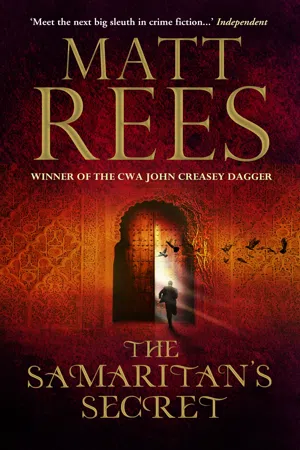
When Omar Yussef travels to Nablus, the West Bank's most violent town, to attend a wedding, he little expects the trouble that awaits him. An ancient Torah scroll belonging to the Samaritans, descendants of the biblical Joseph, has been stolen. But when the dead body of a young Samaritan is discovered, a seemingly straightforward theft inquiry takes an unexpected turn.
As Omar sets out to find the perpetrators of this murder, he is driven down into the murky alleys and tunnels of the old casbah in Nablus. Here, as he uncovers the secret deals of one of the region's richest businessmen, and the shadowy world of the tiny Samaritan community, he begins to wonder whether he will be able to attend the wedding after all...
eBook - ePub
The Samaritan's Secret
About this book
Information
Contents
Chapter 1
Chapter 2
Chapter 3
Chapter 4
Chapter 5
Chapter 6
Chapter 7
Chapter 8
Chapter 9
Chapter 10
Chapter 11
Chapter 12
Chapter 13
Chapter 14
Chapter 15
Chapter 16
Chapter 17
Chapter 18
Chapter 19
Chapter 20
Chapter 21
Chapter 22
Chapter 23
Chapter 24
Chapter 25
Chapter 26
Chapter 27
Chapter 28
Chapter 29
Chapter 30
Chapter 31
Chapter 32
Chapter 1
Lime green paint on the domes of the neighborhood mosques punctuated the khaki limestone in the Nablus casbah. Like tarnished copper tacks, they seemed to pin the Ottoman souk and the Mamluk caravanserai to the floor of the valley. Otherwise even the stones might get up and run away from this dirty town, Omar Yussef thought.
The distant siren of an ambulance rumbled in the stomach of the city and Omar Yussef felt the last crispness of dawn burn away in the sun. With his habitually shaky hand, he stroked the meager white hairs covering his baldness and clicked his tongue. These few strands wouldn’t save his scalp from sunburn, and he could see that the day would be hot. Sweat itched behind his tidy gray mustache. He scratched his upper lip petulantly.
He turned from the valley and contemplated the sparse spring grass stippling the rocky flank of Mount Jerizim. Let’s see who gets burned worse—you or me, he thought. The mountain arced, sullen and taut, to the row of mansions on its ridge, as though tensing its shoulders to endure the heat of the day.
A turquoise police car pulled up. The driver’s window lowered and a smoldering cigarette butt spun onto the sidewalk. “Greetings, ustaz,” Sami Jaffari said. “Get in.”
Omar Yussef left the paltry shade of the lacquered pinewood canopy outside his hotel, opened the door of the patrol car and stretched a stiff leg into the passenger’s side.
“Grandpa, morning of joy.”
Bracing himself against the car door, Omar Yussef looked up. From the balcony of a second floor room, his granddaughter waved. In her other hand, she clutched a book. He wiggled his fingers to her in greeting. “Morning of light, Nadia, my darling,” he said.
“Don’t forget, you’re taking me to eat qanafi today.”
Omar Yussef’s mustache curled downward. Sweet things were not to his taste. But Nablus was famous for this dessert of goat cheese and syrupy shredded wheat, and this was Nadia’s first time in the town. He anticipated that the inquisitive, methodical thirteen-year-old would want to compare the qanafi from a range of bakeries and he would have to gulp it all down and grin indulgently. Even his considerable prejudice in culinary matters couldn’t outweigh his love for this girl. He waved to her again. “If Allah wills it, we’ll eat qanafi soon,” he said.
“Sami, make sure you bring my grandpa back in time for a midmorning snack in the casbah,” Nadia called.
“He’s on official police business now,” Sami shouted. “We have to investigate the theft of a valuable historical relic.”
“I’m warning you. I’ll tell Meisoun to call off the wedding, if you don’t bring him back in time. She won’t marry you if I tell her you’re not nice to little girls.”
Sami stuck out his tongue and put a thumb to his nose. Nadia giggled as the car pulled away from the curb. “You’re going to get fat in Nablus, Abu Ramiz,” Sami said, slapping Omar Yussef on the knee.
“It’s you who’ll start to gain weight, because by the end of this week you’ll have a wife to cook for you.”
Sami swerved to avoid a long, yellow taxi that drifted languidly out of a side street. He rummaged for a pack of Dunhills in the glove compartment. “Police work in Palestine keeps me thin,” he said, shaking a cigarette loose and lighting it. “It’s four parts nervous tension and one part genuine danger. I burn more calories thinking about my day than most people would by running a marathon.”
Sami had become leaner since Omar Yussef last saw him in Gaza almost a year earlier. In the police car, Omar’s initial impression was of a healthy, contented young man, but as he looked harder he sensed this was a mask for something apprehensive and angry. It was as though the police officer had been forced to swallow the criminal outrages of Nablus and had found that they ate away his muscle and left his flesh tight on his bones.
Sami picked his teeth, discolored almost to the shade of his tan by the thick coffee he drank to stay awake on long shifts. “I’m looking forward to seeing my old childhood friends at my wedding,” he said. “I’m very lucky that you and your sons were able to get permits to pass through the checkpoints. It’s been years since I spent time with Ramiz and even longer since I saw Zuheir.”
Omar Yussef forced a smile.
Sami lifted his palm, questioningly. “What’s wrong?”
“Zuheir is much changed.” Omar Yussef looked at his feet. “He’s become very religious.”
“Then he’ll be at home in Nablus. This place is one big mosque.”
“He’s very different from the boy who went off to study in Britain a few years ago.” He thought of the square-cut beard and the loose white cotton his son had taken to wearing, the regular prayers and the stern disapproving face. He didn’t know how far his son had ventured into the unbending world of indignant imams, but the question disturbed him.
“It’s lucky you gave up alcohol, or Zuheir would be trying to force some major lifestyle changes on you,” Sami said with a smile.
“If I hadn’t given up alcohol, it would’ve killed me and I might not have lived long enough to see my son become an adherent of a crazy, hard-line version of our religion.”
“May Allah forbid it.” Sami slapped Omar Yussef’s thigh. “Enough of such thoughts. This is a day of pleasures. I have to go down to the casbah later to finalize arrangements for the wedding with the sheikh. Then we’ll have a reunion with your sons at the hotel.”
“After we’ve checked on the theft at the Samaritan synagogue and talked to their priest.”
Sami shrugged. “Crime is also one of the pleasures of Nablus.”
“I’m a connoisseur. Thank you for bringing me.”
“I knew you’d be intrigued, as a history teacher who’s knowledgeable about all elements of Palestinian culture.” Sami sucked in some smoke. “They are part of Palestinian culture, aren’t they?”
“The Samaritans? They’ve been here longer than we have, Sami. They claim to be descended from some biblical Israelites who remained in this area when their brethren were exiled to Babylon. In a way, they’re Palestinians and Jews and neither, all at the same time.”
Sami pulled over and peered out of the window. “I think it’s in here,” he said.
Omar Yussef raised himself out of the passenger seat with a grunt. His back ached after the long ride from Bethlehem the previous day, squashed into a taxi with his wife, his granddaughter and two of his sons. To bypass the security checks around Jerusalem, they had taken the desert backroads. He was fifty-seven and unfit, so the bumpy ride and the heat had exhausted him.
On the sidewalk, Omar Yussef straightened his spine. He pushed his remaining hair into place with his palm and nudged his gold-framed glasses to the bridge of his nose with the tip of his index finger.
He looked up a walkway of cracked steps between two apartment buildings, bright green weeds cutting through the polished stone paving, creeping over the railings at each side of the path. The door of the Samaritan synagogue, set forty yards back from the road, was a tasteless metal panel painted brown to look like wood. Seven bulbous lights on long, upright stems surmounted the stone canopy at the entrance. The building was a low square faced in the same limestone as the apartment blocks around it. Its basement level was painted pink.
“I thought it would be older than this,” Sami said. He stamped out his cigarette and set off up the steps.
“They had a much older synagogue down in the casbah,” Omar Yussef said, “but they left the old town fifty years ago, because their Muslim neighbors wouldn’t sell them land to expand their homes as their community grew. So they moved up here.”
Sami waited at the top of the first flight of steps. “But they don’t even live here anymore.” He pointed above the roof of the synagogue to a cluster of buildings on the ridge of Mount Jerizim. “They went up there, out of the way of everyone.”
“Out of the way of the first intifada, Sami. Those were violent times in Nablus. You can’t blame people for trying to get away.”
They reached the final set of steps. To their left, grilles of curling black metal guarded the six arched windows of the synagogue.
“The bars on that first window are new,” Omar Yussef said. “They’re the only ones that aren’t rusty.”
Sami leaned over the railing at the side of the entrance and examined the bars. “You’re right, Abu Ramiz. The window has been scorched by something, too.”
Omar Yussef glanced at the ledge. Jagged black smudges slashed the polished stone. In the yard below, a square frame of rusty metal leaned against the pink wall, its bottom edge ripped away. “The original bars.” He turned to Sami and smiled with one side of his mouth. “As the representative of the police, I think perhaps you might draw some conclusions from this.”
Sami tapped the new black grille. “The thieves got in through this window.”
Omar Yussef rubbed his chin. “Thieves who had enough explosives to blow away those bars.”
“Nablus isn’t short of explosives experts.”
“But it is short of Samaritans, and even shorter of their priceless historical documents.”
Sami lit another cigarette and took in some smoke with a sharp breath. “Let’s go and see this priest.”
Chapter 2
Along each jaundice-yellow wall inside the synagogue, ragged prayer books were wedged tight or stacked haphazardly on their sides behind the glass of their bookcases. A curtain of blue velvet embroidered with Hebrew characters in gold thread hung behind a dais at the head of the hall. The thick walls preserved the chill of night in the air. Omar Yussef shivered and pulled his French collar higher, pressing it to the slack skin of his jaw.
“It’s as cold as a cellar in here,” Sami said.
“Or a grave.” Omar Yussef caught Sami’s frown. “Don’t worry. I may not be certain that this truly is a day of pleasures, as you put it, but by the time of your wedding, I’ll be cheeriness personified.”
Sami walked down the aisle toward the blue curtain. Between the Hebrew characters, the outline of two stone tablets had been stitched into the material. “Can you read this, Abu Ramiz?” Sami asked.
“No, but the tablets are a representation of the commandments given to the Prophet Moussa, I think. The ones that contained the Jewish law.”
“The Samaritan law.”
A man of about seventy years approached from a stairwell at the back of the room. He was tall and slender, like an evening shadow. He wore a white ankle-length cotton robe, a long vest of coarse gray wool, unfastened at the front, and a fez wrapped with a red cloth so that it resembled a turban.
“The Jewish law is very similar to ours, gentlemen,” the old man said, “but their holy texts include seven thousand mistakes. The books of the Samaritans are without error.”
“Then you are without excuses for your mistakes.” Omar Yussef smiled. “That’s a terrible fate.”
“No one is ever short of justification for their sins in this part of the world.” The man’s mild eyes appeared unfocused and bemused, like café habitués Omar Yussef had met in Morocco who smoked too much kif. He shook hands with Omar Yussef. “I’m Jibril Ben-Tabia, a priest of the Samaritan people. Welcome to our synagogue.”
Sami stepped forward. “Lieutenant Sami Jaffari of the National Police. This is my colleague Abu Ramiz.”
“From Bethlehem,” Omar Yussef said. He glanced at Sami. His granddaughter had been trying to make a detective of him since he had been forced to investigate accusations of murder against a favorite former pupil over a year ago. Despite his insistence that he was happy as a history teacher in the Dehaisha refugee camp, Sami seemed now to have made his change of career official.
The priest tilted his head as though wondering why an investigating officer should have been brought from Bethlehem. He kept Omar Yussef’s hand in his.
“The lieutenant asked me to join him because I have a special interest in Palestinian history,” Omar Yussef said. He raised an eyebrow at the young officer. “I understand the crime relates to one of your historical documents.”
“It did.” Ben-Tabia let go of Omar Yussef’s hand and raised his arms in a shrug. “But I must apologize, honored gentlemen, particularly to you, Abu Ramiz, for bringing you all the way from Bethlehem for nothing. The crime is solved.”
Sami dropped his cigarette and ground it out with his heel. “Solved?”
The priest glanced sharply at the cigarette butt on the floor and rolled his lower lip over the edge of his mustache. “Yes, there was a theft, but the stolen object has been returned. So, you see, your intervention is unnecessary.”
“Has the criminal been apprehended?”
“Everything has been sorted out to...
Table of contents
- Cover
- Author biography
- Title page
- Copyright page
- Dedication page
- Epigraph page
- Contents
Trusted by 375,005 students
Access to over 1.5 million titles for a fair monthly price.
Study more efficiently using our study tools.
Frequently asked questions
Yes, you can cancel anytime from the Subscription tab in your account settings on the Perlego website. Your subscription will stay active until the end of your current billing period. Learn how to cancel your subscription
No, books cannot be downloaded as external files, such as PDFs, for use outside of Perlego. However, you can download books within the Perlego app for offline reading on mobile or tablet. Learn how to download books offline
Perlego offers two plans: Essential and Complete
- Essential is ideal for learners and professionals who enjoy exploring a wide range of subjects. Access the Essential Library with 800,000+ trusted titles and best-sellers across business, personal growth, and the humanities. Includes unlimited reading time and Standard Read Aloud voice.
- Complete: Perfect for advanced learners and researchers needing full, unrestricted access. Unlock 1.5M+ books across hundreds of subjects, including academic and specialized titles. The Complete Plan also includes advanced features like Premium Read Aloud and Research Assistant.
We are an online textbook subscription service, where you can get access to an entire online library for less than the price of a single book per month. With over 1.5 million books across 990+ topics, we’ve got you covered! Learn about our mission
Look out for the read-aloud symbol on your next book to see if you can listen to it. The read-aloud tool reads text aloud for you, highlighting the text as it is being read. You can pause it, speed it up and slow it down. Learn more about Read Aloud
Yes! You can use the Perlego app on both iOS and Android devices to read anytime, anywhere — even offline. Perfect for commutes or when you’re on the go.
Please note we cannot support devices running on iOS 13 and Android 7 or earlier. Learn more about using the app
Please note we cannot support devices running on iOS 13 and Android 7 or earlier. Learn more about using the app
Yes, you can access The Samaritan's Secret by Matt Rees in PDF and/or ePUB format, as well as other popular books in Literature & Literature General. We have over 1.5 million books available in our catalogue for you to explore.