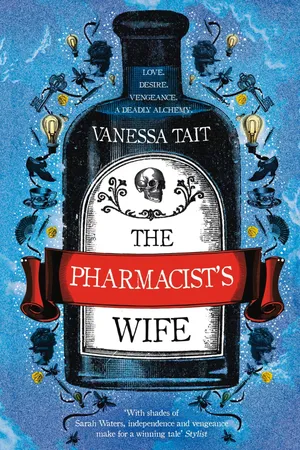
A dark and thrilling tale of Victorian addiction, vengeance and self-discovery, perfect for fans of Sarah Waters, Jessie Burton's
The Miniaturist and Sarah Perry's
The Essex Serpent.
Love. Desire. Vengeance. A deadly alchemy.
When Rebecca Palmer's new husband opens a pharmacy in Victorian Edinburgh, she expects to live the life of a well-heeled gentlewoman. But her ideal turns to ashes when she discovers her husband is not what he seems. As Rebecca struggles to maintain her dignity in the face of his infidelity and strange sexual desires, Alexander tries to pacify her so-called hysteria with a magical new chemical creation. A wonder-drug he calls heroin.
Rebecca's journey into addiction takes her further into her past, and her first, lost love, while Alexander looks on, curiously observing his wife's descent. Meanwhile, Alexander's desire to profit from his invention leads him down a dangerous path that blurs science, passion, and death. He soon discovers that even the most promising experiments can have unforeseen and deadly consequences...
Reminiscent of the works of Sarah Waters, this is a brilliantly observed piece of Victoriana which deals with the disempowerment of women, addiction, desire, sexual obsession and vengeance.
- 387 pages
- English
- ePUB (mobile friendly)
- Available on iOS & Android
eBook - ePub
The Pharmacist's Wife
About this book
Information
CHAPTER 1
Edinburgh, 1869
Perhaps it was her shoes that were making a dent in the afternoon. Because, look there, a little monkey on a gold chain, pulling up its knees in time to the brass band that Alexander had hired; and there, the cymbals crashing away and the trombone glinting in the uneven sunlight. And see, a little further off, stalls selling saloop and whelks and whatnot, and people gathered round them, drawn from either end of Edinburgh; it was all very gay. And the pharmacy itself was looking swish, its broad window polished to a glint and – and this was the proudest part – the name above it, written very bold, in gilt lettering on the wooden board, Palmer, which was Rebecca’s name, too, these last six months, though she still could not get used to it.
The pharmacy, everyone said, would be the making of North Bridge – the road that ran between the Old Town and the New, connecting the rich part of Edinburgh with the poor. It would draw its customers from the slums and from the toffs, and take advantage of both. As Mr Badcock said, they ought not to care who’d owned the shillings before, just so long as they all flowed in their direction.
But still, and Rebecca was sad to notice it, the pump-a-rum of the trombone beat almost the same rhythm as the pulse in her big toe. She flexed her feet upwards to take the pressure off them that way, but if she leaned back a little on her heels t’would be even better … but that was too far! She had almost tipped over, she must clutch at her husband’s arm to right herself.
‘What on earth are you doing?’ said Alexander, pulling his arm away.
Rebecca snatched back her hand and clasped her fingers together. ‘Just …’
But Alexander was looking at her feet and frowning. ‘You have got your shoes stained, after all the trouble.’
‘Stained?’ Rebecca had only walked the short distance from their brougham to their place here at the front of the crowd. But she had got the heel hooked on the step – had she marked it then? She could not see without craning down to look, which would not look elegant, standing up here, as she was, as they were, she and her husband, on show. Or the shoe had got marked by the water that gathered in the indents of the pavement, hard to avoid, impossible to see. Their leather was so soft and pale and would stain as easy as a blush.
‘’Tis a pity, after all the trouble that was gone to in the measuring of your feet. All you have had to do was stand, after all,’ said Alexander, rubbing at his chin.
‘I can clean them for you, madam,’ said Jenny. ‘If you like.’
‘I don’t know how, when she is wearing them,’ her husband said.
‘Thank you, Jenny. P’raps it can wait until we get home.’ The shoes were stained, Rebecca saw it now: an uneven mark thrown carelessly over the knuckle of her smallest toe. She blinked. She was not made to wear such shoes, she had known it even as she pulled off her old black boots to make way for them, back at the house. Such pale and slender shoes should not go on her great feet, and now she had proven it, for she could not even get out of a carriage without ruining them.
‘I have brought a handkerchief,’ said Jenny, turning her face so that Alexander would not hear.
Rebecca swallowed. She did not know if her maid meant for her shoes or for her eyes. She must not cry – she was not crying! Not today. She shook her head at Jenny, tried to smile and spread out her gaze.
They stood in front of a crowd of about sixty, and now that she looked she saw that Mr Badcock had been right. A group of women from the New Town, their parasols trimmed with lace, were at the front, nodding in time to the band, but to the side of them an old lady whose skirt was held up by string – from the Old Town, of course – was staring hungrily at the food stalls. As well as those there were a number of actors, swells, tramps and other types of a more middling sort, and a dog who could have been from anywhere. It must have been attracted by the smell of burning sugar, for the first batch of lozenges Lionel had made had been ruined and thrown away behind the shop.
Try again, Rebe, ’tis a proud day, you said it yourself! Rebecca turned to her husband. ‘It is going very well, isn’t it, Alexander, just as you planned?’
‘Mr Badcock is not here yet,’ he said, picking a hair from his trousers between finger and thumb and pursing his lips.
‘But, still, it’s a proud day, Al, that’s for sure!’ Rebecca smiled hard.
Where other men sprouted beards and moustaches Alexander had nothing but skin. Even the place where his whiskers should have been was bare. Beards trapped disease inside them, he said, and made men ill. (Mr Badcock maintained that on the contrary, beards trapped bacteria on the outside and prevented them getting in.) Rebecca did not hold either opinion, she only knew that when Alexander was angry all that bareness made his face terrible.
‘I beg your pardon?’ he said now, his lips tighter than ever.
Rebecca had made another mistake even as she’d tried to rectify the last. She knew what it was, and how stupid she had been to risk his displeasure! She palpated her toes against the soles of her shoes, as if she could drain away the heat from her face. Other wives had affectionate names for their husbands! She knew of a woman who called her husband Flossie, though he was not light and airy but short and fat. Rebecca had planned to try out a more familiar name for her husband today, but she saw now what she ought to have seen all along: it did not suit him, did not suit him at all.
After waiting so long … Rebecca shut her eyes and shook her head to banish the word waiting, but it was no good: it was there already, plump and falsely bright, with its ting on the end. She set her teeth and stared over at the whelk stall and forced the word to dissipate … After waiting for more than two years she had been saved from spinsterhood and all the humiliations that went with it by Alexander Palmer, proprietor of a fine pharmacy on North Bridge.
Yes, that was right. That was the story that she would tell and she would feel better for it. And now her father had died she could wait no longer, for her house was sold and everything in it was gone. But she had Mr Palmer, a husband many women would envy, and how lucky she had been to be chosen by him, just by chance, on the street!
But in the anxiety of preparing for today, she had forgot to eat. Eating, that may be counted upon as the opposite of thinking. And now a good smell was coming across from the food stalls; some of the people of Old Town had no kitchens, and this was as good a place as any to set up trade, catering for the stomach as the pharmacy would cater for the rest of their needs.
‘I only meant, Alexander, you must be very proud. It is exactly what you hoped for – all this – is it not? And I wondered … I thought, perhaps I may get a cone of whelks. I forgot to breakfast, in the rush of the morning.’
‘Whelks?’
‘It is unconventional, I know, but I have a fondness for them.’
‘It would not look right to eat. Not street food, not here.’
‘Well, I would not—’
But Alexander twitched impatiently. ‘There he is at last,’ he said. And in front of them Mr Badcock was indeed stepping out of his brougham on his tiny feet and shouldering his way between the backs of the crowd with surprising agility.
‘Ah, John, you are late.’
‘Mrs Palmer.’ Mr Badcock caught up her hand and brought it up towards his great beard, pushing his lips down on the back of her glove. ‘A great day, a great day. I am late, I was in a desperate hurry, I was almost afraid I had missed it all!’
Alexander consulted his pocket watch. ‘No, you have not missed it. I would not start without you, as it is your money that has gone into it.’ He nodded in the direction of the large glass doors of the pharmacy with their polished brass handles, still shut.
Mr Badcock raised his eyes to heaven. ‘The good Lord would not let me miss such a day; He would not allow that to happen. And may it be the start of many great days.’ He brought the tips of his fingers to his chin and moved his lips silently. Then he wrinkled his nose and his eyes snapped open. ‘I suppose they,’ he motioned towards the food stalls, ‘are a good thing, to draw people in. But I wonder if the smell is healthy?’
‘Mrs Palmer is asking for whelks,’ said Alexander.
‘Oh no,’ said Mr Badcock, ‘you cannot eat whelks! Not at all, not you, Mrs Palmer, I am afraid. They operate on women in unfortunate ways. They contain certain minerals – zinc, say – which have properties of an aphrodisiacal nature. Spermatozoa, of course, contain zinc. So if a man eats whelks, he becomes more of a man. But a woman ingesting such a compound, hmmm, may also become more of a man! It would not be the natural order of things. An army of marauding women … Ah – and who is this?’ Mr Badcock asked, turning to the maid.
‘This is Jenny, my new maid.’
Jenny made a curtsy. Mr Badcock took up her hand, as if it were a great extravagance. ‘Charming,’ he said, though he stopped short of kissing it.
Jenny blushed and tried to smile. Rebecca pressed her hand to her stomach. Other women were eating at the stalls: those two there, slurping down their saloop from tin cups; that old lady in the faded hat at the eel stall, spooning jelly into her mouth from a filthy bowl. And at the whelk stall, a woman in a green dress. Her coat and hat were trimmed with matching brown feathers from a rarely seen bird, an owl perhaps. She was as thin as the most excoriating fashion demanded and yet her chin worked up and down as she spooned the rubbery whelks into her...
Table of contents
- Cover
- Title
- Copyright
- Chapter 1
- Chapter 2
- Chapter 3
- Chapter 4
- Chapter 5
- Chapter 6
- Chapter 7
- Chapter 8
- Chapter 9
- Chapter 10
- Chapter 11
- Chapter 12
- Chapter 13
- Chapter 14
- Chapter 15
- Chapter 16
- Chapter 17
- Chapter 18
- Chapter 19
- Chapter 20
- Chapter 21
- Chapter 22
- Chapter 23
- Chapter 24
- Chapter 25
- Chapter 26
- Chapter 27
- Chapter 28
- Chapter 29
- Chapter 30
- Chapter 31
- Chapter 32
- Chapter 33
- Author’s Note
Trusted by 375,005 students
Access to over 1.5 million titles for a fair monthly price.
Study more efficiently using our study tools.
Frequently asked questions
Yes, you can cancel anytime from the Subscription tab in your account settings on the Perlego website. Your subscription will stay active until the end of your current billing period. Learn how to cancel your subscription
No, books cannot be downloaded as external files, such as PDFs, for use outside of Perlego. However, you can download books within the Perlego app for offline reading on mobile or tablet. Learn how to download books offline
Perlego offers two plans: Essential and Complete
- Essential is ideal for learners and professionals who enjoy exploring a wide range of subjects. Access the Essential Library with 800,000+ trusted titles and best-sellers across business, personal growth, and the humanities. Includes unlimited reading time and Standard Read Aloud voice.
- Complete: Perfect for advanced learners and researchers needing full, unrestricted access. Unlock 1.5M+ books across hundreds of subjects, including academic and specialized titles. The Complete Plan also includes advanced features like Premium Read Aloud and Research Assistant.
We are an online textbook subscription service, where you can get access to an entire online library for less than the price of a single book per month. With over 1.5 million books across 990+ topics, we’ve got you covered! Learn about our mission
Look out for the read-aloud symbol on your next book to see if you can listen to it. The read-aloud tool reads text aloud for you, highlighting the text as it is being read. You can pause it, speed it up and slow it down. Learn more about Read Aloud
Yes! You can use the Perlego app on both iOS and Android devices to read anytime, anywhere — even offline. Perfect for commutes or when you’re on the go.
Please note we cannot support devices running on iOS 13 and Android 7 or earlier. Learn more about using the app
Please note we cannot support devices running on iOS 13 and Android 7 or earlier. Learn more about using the app
Yes, you can access The Pharmacist's Wife by Vanessa Tait in PDF and/or ePUB format, as well as other popular books in Literature & Historical Fiction. We have over 1.5 million books available in our catalogue for you to explore.