A
New York Times bestseller,
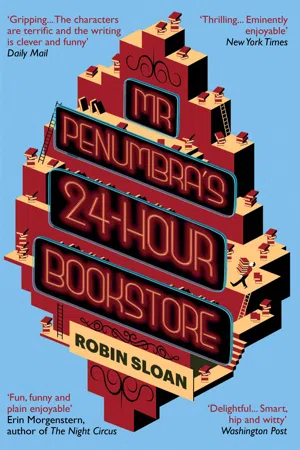
Mr Penumbra's 24-hour Bookstore is an entirely charming and lovable first novel of mysterious books and dusty bookshops; it is a witty and delightful love-letter to both the old book world and the new.
Recession has shuffled Clay Jannon out of his life as a San Francisco Web-design drone - and serendipity, coupled with sheer curiosity, has landed him a new job working the night shift at Mr. Penumbra's 24-Hour Bookstore. But after just a few days, Clay begins to realize that this store is even more curious than the name suggests. There are only a few customers, but they come in repeatedly and never seem to actually buy anything, instead they simply borrow impossibly obscure volumes from strange corners of the store, all according to some elaborate, long-standing arrangement with the gnomic Mr. Penumbra. The store must be a front for something larger, Clay concludes, and soon he's embarked on a complex analysis of the customers' behaviour and roped his friends into helping to figure out just what's going on. But once they bring their findings to Mr. Penumbra, it turns out the secrets extend far outside the walls of the bookstore...
'The pages swell with Mr Sloan's nerdy affection and youthful enthusiasm for both tangible books and new media... [but] the ties that bind the story are friendship and vitality for life. This is a clever and whimsical tale with a big heart'
The Economist
Shortlisted for the LA Times Book Award for First Fiction.
- English
- ePUB (mobile friendly)
- Available on iOS & Android
eBook - ePub
Mr Penumbra's 24-hour Bookstore
About this book
Information
Subtopic
Literature GeneralIndex
LiteratureCONTENTS
THE BOOKSTORE
THE LIBRARY
THE TOWER
EPILOGUE
An extract from Ajax Penumbra, the prequel to Mr Penumbra’s 24 Hour Bookstore
The Society of the Unbroken Spine

THE BOOKSTORE

HELP WANTED
LOST IN THE SHADOWS of the shelves, I almost fall off the ladder. I am exactly halfway up. The floor of the bookstore is far below me, the surface of a planet I’ve left behind. The tops of the shelves loom high above, and it’s dark up there—the books are packed in close, and they don’t let any light through. The air might be thinner, too. I think I see a bat.
I am holding on for dear life, one hand on the ladder, the other on the lip of a shelf, fingers pressed white. My eyes trace a line above my knuckles, searching the spines—and there, I spot it. The book I’m looking for.
But let me back up.
My name is Clay Jannon and those were the days when I rarely touched paper.
I’d sit at my kitchen table and start scanning help-wanted ads on my laptop, but then a browser tab would blink and I’d get distracted and follow a link to a long magazine article about genetically modified wine grapes. Too long, actually, so I’d add it to my reading list. Then I’d follow another link to a book review. I’d add the review to my reading list, too, then download the first chapter of the book—third in a series about vampire police. Then, help-wanted ads forgotten, I’d retreat to the living room, put my laptop on my belly, and read all day. I had a lot of free time.
I was unemployed, a result of the great food-chain contraction that swept through America in the early twenty-first century, leaving bankrupt burger chains and shuttered sushi empires in its wake.
The job I lost was at the corporate headquarters of NewBagel, which was based not in New York or anywhere else with a tradition of bagel-making but instead here in San Francisco. The company was very small and very new. It was founded by a pair of ex-Googlers who wrote software to design and bake the platonic bagel: smooth crunchy skin, soft doughy interior, all in a perfect circle. It was my first job out of art school, and I started as a designer, making marketing materials to explain and promote this tasty toroid: menus, coupons, diagrams, posters for store windows, and, once, an entire booth experience for a baked-goods trade show.
There was lots to do. First, one of the ex-Googlers asked me to take a crack at redesigning the company’s logo. It had been big bouncy rainbow letters inside a pale brown circle; it looked pretty MS Paint. I redesigned it using a newish typeface with sharp black serifs that I thought sort of evoked the boxes and daggers of Hebrew letters. It gave NewBagel some gravitas and it won me an award from San Francisco’s AIGA chapter. Then, when I mentioned to the other ex-Googler that I knew how to code (sort of), she put me in charge of the website. So I redesigned that, too, and then managed a small marketing budget keyed to search terms like “bagel” and “breakfast” and “topology.” I was also the voice of @NewBagel on Twitter and attracted a few hundred followers with a mix of breakfast trivia and digital coupons.
None of this represented the glorious next stage of human evolution, but I was learning things. I was moving up. But then the economy took a dip, and it turns out that in a recession, people want good old-fashioned bubbly oblong bagels, not smooth alien-spaceship bagels, not even if they’re sprinkled with precision-milled rock salt.
The ex-Googlers were accustomed to success and they would not go quietly. They quickly rebranded to become the Old Jerusalem Bagel Company and abandoned the algorithm entirely so the bagels started coming out blackened and irregular. They instructed me to make the website look old-timey, a task that burdened my soul and earned me zero AIGA awards. The marketing budget dwindled, then disappeared. There was less and less to do. I wasn’t learning anything and I wasn’t moving anywhere.
Finally, the ex-Googlers threw in the towel and moved to Costa Rica. The ovens went cold and the website went dark. There was no money for severance, but I got to keep my company-issued Mac-Book and the Twitter account.
So then, after less than a year of employment, I was jobless. It turned out it was more than just the food chains that had contracted. People were living in motels and tent cities. The whole economy suddenly felt like a game of musical chairs, and I was convinced I needed to grab a seat, any seat, as fast as I could.
That was a depressing scenario when I considered the competition. I had friends who were designers like me, but they had already designed world-famous websites or advanced touch-screen interfaces, not just the logo for an upstart bagel shop. I had friends who worked at Apple. My best friend, Neel, ran his own company. Another year at NewBagel and I would have been in good shape, but I hadn’t lasted long enough to build my portfolio, or even get particularly good at anything. I had an art-school thesis on Swiss typography (1957–1983) and I had a three-page website.
But I kept at it with the help-wanted ads. My standards were sliding swiftly. At first I had insisted I would only work at a company with a mission I believed in. Then I thought maybe it would be fine as long as I was learning something new. After that I decided it just couldn’t be evil. Now I was carefully delineating my personal definition of evil.
It was paper that saved me. It turned out that I could stay focused on job hunting if I got myself away from the internet, so I would print out a ream of help-wanted ads, drop my phone in a drawer, and go for a walk. I’d crumple up the ads that required too much experience and deposit them in dented green trash cans along the way, and so by the time I’d exhausted myself and hopped on a bus back home, I’d have two or three promising prospectuses folded in my back pocket, ready for follow-up.
This routine did lead me to a job, though not in the way I’d expected.
San Francisco is a good place for walks if your legs are strong. The city is a tiny square punctuated by steep hills and bounded on three sides by water, and as a result, there are surprise vistas everywhere. You’ll be walking along, minding your own business with a fistful of printouts, and suddenly the ground will fall away and you’ll see straight down to the bay, with the buildings lit up orange and pink along the way. San Francisco’s architectural style didn’t really make inroads anywhere else in the country, and even when you live here and you’re used to it, it lends the vistas a strangeness: all the tall narrow houses, the windows like eyes and teeth, the wedding-cake filigree. And looming behind it all, if you’re facing the right direction, you’ll see the rusty ghost of the Golden Gate Bridge.
I had followed one strange vista down a line of steep stair-stepped sidewalks, then walked along the water, taking the very long way home. I had followed the line of old piers—carefully skirting the raucous chowder of Fisherman’s Wharf—and watched seafood restaurants fade into nautical engineering firms and then social media startups. Finally, when my stomach rumbled, signaling its readiness for lunch, I had turned back in toward the city.
Whenever I walked the streets of San Francisco, I’d watch for HELP WANTED signs in windows—which is not something you really do, right? I should probably be more suspicious of those. Legitimate employers use Craigslist.
Sure enough, the 24-hour bookstore did not have the look of a legitimate employer:
HELP WANTED
Late Shift
Specific Requirements
Good Benefits
Late Shift
Specific Requirements
Good Benefits
Now: I was pretty sure “24-hour bookstore” was a euphemism for something. It was on Broadway, in a euphemistic part of town. My help-wanted hike had taken me far from home; the place next door was called Booty’s and it had a sign with neon legs that crossed and uncrossed.
I pushed the bookstore’s glass door. It made a bell tinkle brightly up above, and I stepped slowly through. I did not realize at the time what an important threshold I had just crossed.
Inside: imagine the shape and volume of a normal bookstore turned up on its side. This place was absurdly narrow and dizzyingly tall, and the shelves went all the way up—three stories of books, maybe more. I craned my neck back (why do bookstores always make you do uncomfortable things with your neck?) and the shelves faded smoothly into the shadows in a way that suggested they might just go on forever.
The shelves were packed close together, and it felt like I was standing at the border of a forest—not a friendly California forest, either, but an old Transylvanian forest, a forest full of wolves and witches and dagger-wielding bandits all waiting just beyond moonlight’s reach. There were ladders that clung to the shelves and rolled side to side. Usually those seem charming, but here, stretching up into the gloom, they were ominous. They whispered rumors of accidents in the dark.
So I stuck to the front half of the store, where bright midday light pressed in and presumably kept the wolves at bay. The wall around and above the door was glass, thick square panes set into a grid of black iron, and arched across them, in tall golden letters, it said (in reverse):
MR. PENUMBRA’S 24-HOUR BOOKSTORE
Below that, set in the hollow of the arch, there was a symbol—two hands, perfectly flat, rising out of an open book.
So who was Mr. Penumbra?
“Hello, there,” a quiet voice called from the stacks. A figure emerged—a man, tall and skinny like one of the ladders, draped in a light gray button-down and a blue cardigan. He tottered as he walked, running a long hand along the shelves for support. When he came out of the shadows, I saw that his sweater matched his eyes, which were also blue, riding low in nests of wrinkles. He was very old.
He nodded at me and gave a weak wave. “What do you seek in these shelves?”
That was a good line, and for some reason, it made me feel comfortable. I asked, “Am I speaking to Mr. Penumbra?”
“I am Penumbra”—he nodded—“and I am the custodian of this place.”
I didn’t quite realize I was going to say it until I did: “I’m looking for a job.”
Penumbra blinked once, then nodded and tottered over to the desk set beside the front door. It was a massive block of dark-whorled wood, a solid fortress on the forest’s edge. You could probably defend it for days in the event of a siege from the shelves.
“Employment.” Penumbra nodded again. He slid up onto the chair behind the desk and regarded me across its bulk. “Have you ever worked at a bookstore before?”
“Well,” I said, “when I was in school I waited tables at a seafood restaurant, and the owner sold his own cookbook.” It was called The Secret Cod and it detailed thirty-one different ways to— You get it. “That probably doesn’t count.”
“No, it does not, but no matter,” Penumbra said. “Prior experience in the book trade is of little use to you here.”
Wait—maybe this place really was all erotica. I glanced down and around, but glimpsed no bodices, ripped or otherwise. In fact, just next to me there was a stack of dusty Dashiell Hammetts on a low table. That was a good sign.
“Tell me,”...
Table of contents
- Cover
- Title Page
- Copyright Page
- Dedication Page
- Contents
Trusted by 375,005 students
Access to over 1.5 million titles for a fair monthly price.
Study more efficiently using our study tools.
Frequently asked questions
Yes, you can cancel anytime from the Subscription tab in your account settings on the Perlego website. Your subscription will stay active until the end of your current billing period. Learn how to cancel your subscription
No, books cannot be downloaded as external files, such as PDFs, for use outside of Perlego. However, you can download books within the Perlego app for offline reading on mobile or tablet. Learn how to download books offline
Perlego offers two plans: Essential and Complete
- Essential is ideal for learners and professionals who enjoy exploring a wide range of subjects. Access the Essential Library with 800,000+ trusted titles and best-sellers across business, personal growth, and the humanities. Includes unlimited reading time and Standard Read Aloud voice.
- Complete: Perfect for advanced learners and researchers needing full, unrestricted access. Unlock 1.5M+ books across hundreds of subjects, including academic and specialized titles. The Complete Plan also includes advanced features like Premium Read Aloud and Research Assistant.
We are an online textbook subscription service, where you can get access to an entire online library for less than the price of a single book per month. With over 1.5 million books across 990+ topics, we’ve got you covered! Learn about our mission
Look out for the read-aloud symbol on your next book to see if you can listen to it. The read-aloud tool reads text aloud for you, highlighting the text as it is being read. You can pause it, speed it up and slow it down. Learn more about Read Aloud
Yes! You can use the Perlego app on both iOS and Android devices to read anytime, anywhere — even offline. Perfect for commutes or when you’re on the go.
Please note we cannot support devices running on iOS 13 and Android 7 or earlier. Learn more about using the app
Please note we cannot support devices running on iOS 13 and Android 7 or earlier. Learn more about using the app
Yes, you can access Mr Penumbra's 24-hour Bookstore by Robin Sloan in PDF and/or ePUB format, as well as other popular books in Literature & Literature General. We have over 1.5 million books available in our catalogue for you to explore.