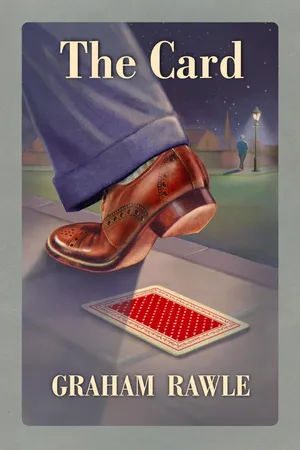
Since childhood, Riley has been a keen collector of bubble gum cards. Now, thirty years later, the one card missing from his collection is the legendary card 19 from the 1967
Mission Impossible television series, of which only one exists.
One day a mysterious grey-haired man drops a playing card in a deserted alley. Riley picks it up. Is it a secret sign? Before long, he is finding all kinds of bubble gum and cigarette cards on the street, each one apparently containing a further hidden clue to a coded message. Will Riley rise to the challenge and discover the secret of the cards? And will he ever find illusive card 19?
Exquisitely written, extremely funny, and visually stunning,
The Card is the utterly unforgettable story of a man who views the world - and everything in it - just a little bit differently from the rest of us.
eBook - ePub
The Card
About this book
Information
CONTENTS
I
ONE
TWO
THREE
II
FOUR
FIVE
SIX
SEVEN
EIGHT
NINE
TEN
ELEVEN
TWELVE
THIRTEEN
FOURTEEN
FIFTEEN
III
SIXTEEN
SEVENTEEN
EIGHTEEN
NINETEEN
TWENTY
TWENTY-ONE
TWENTY-TWO
TWENTY-THREE
I
ONE
THIS IS THE way I see things.
1967. A young man, cigarette in mouth, works a sheet-fed offset printing press. Two older men are busy in the background. Machines and noise. The young man wipes his hands on a dirty rag as he watches a pretty secretary in a mini-skirt pass through the print shop. He’s a family man, but she seems nice. Given that this is the swinging sixties you might expect him to be sporting a mod Carnaby Street hairdo and ‘If You’re Going to San Francisco’ moustache, but he actually has more of an Elvis look about him. Some might put him closer to Engelbert Humperdinck, but his co-workers opt for the more obvious reference. His hair is longish, in the modern trend, but it retains the toppling teddy-boy quiff of his teenage years, along with the wide, flaring sideburns, like miniature trouser legs straddling his face. He’s dark and handsome—but where Elvis glows with flawless Max Factor gold, the printer’s complexion is lardy and pitted with inky blackheads.
Sheets of card stock fall one atop the other as they clatter through the machine. The noise is relentless. A Vitalis-slick swag of hair falls like a curtain across the Elvis brow as he leans over to check the job. The machine rhythmically pumps the sheets out one by one. The job in progress is for Chad Ltd, a bubble-gum card series of photo stills from the popular TV show, Mission: Impossible. The colourful, playing-card-sized pictures sit in neat rows, six images by eight: the entire series of forty-eight printed on one sheet, ready to be guillotined, mixed and packed, five cards at a time, along with a thin rectangle of pink bubble-gum in a deliciously slippery wax-pack wrapper. The constant blurring movement as each subsequent sheet slides into place frustrates any attempt to focus on a particular image.
The boss enters and strains to make himself heard. Elvis turns. The boss points at the press and then strokes his index finger across his throat. Understanding the mime, Elvis touches the greasy button and kills the machine. Less noise now, but other machines continue to shake, rattle and roll.
“What’s up, Mr Greenwood?”
“How many have you done?”
“Just these.” Elvis indicates the thick wad of printed sheets.
“They’re withdrawing one of the cards.”
“Why?”
“God knows, but we’ve got to start again with a new plate. They’re sending replacement artwork. There must be some legal issue because Chad wants all prints from this run to be destroyed. Get Sid to cut them through on the guillotine before you bin them.”
“Which card is it?”
“They didn’t say. Anyway, get rid of this lot and start on that Burton’s job.”
The boss starts to leave. Elvis calls him back. “Is it all right if I take a sheet home for my lad? He loves Mission: Impossible.”
“No, it bloody isn’t.”
“I’ll make sure it doesn’t leave the house, Mr Greenwood.”
“Absolutely not. If that cancelled card surfaces somewhere, I don’t want Chad blaming us.”
The boss leaves. Elvis stacks the printed sheets on a trolley and wheels them over to the guillotine. Sid, one of the older workers, is busily stacking postcards, whistling loudly. There’s a tune playing on the tinny transistor radio, but it’s not the same one. Elvis realizes that his co-worker hasn’t seen him. Seizing the opportunity, he checks to make sure that no one else is watching before sliding a sheet from the top of the pile and tucking it surreptitiously behind one of the machines. Sid turns and Elvis hands him the pile, leaning in to his ear to pass on Mr Greenwood’s instructions.
Late afternoon. Elvis bids goodnight to various co-workers as he leaves for home. He moves a little self-consciously as he passes the boss’s office. The secretary glances at him discreetly, but nobody notices that protruding from one of Elvis’s raincoat sleeves is a stiff white cuff of rolled cardboard.
Later the same evening. The Mission: Impossible sheet lying flat on a bedroom carpet. Elvis crouches beside a ten-year-old boy who kneels prayer-like before it, poring with wonder over the colourful pictures.
“Can I cut it up into cards?”
“Wouldn’t you rather keep it as a poster? Put it on the wall? It would look great over your bed.”
“No, I want them as cards so I can take them to school.”
“Oh no, son, you can’t do that. You’d get me fired. This series isn’t even out yet. You must keep it here in your bedroom. Promise?” Elvis points a warning finger to show that he is serious. The boy reluctantly agrees. They shake. It’s a pact.
Next day. A huddle in the school playground. The boy’s hands dealing through a set of Mission: Impossible cards with inexpertly cut edges. Other boys gather round the coveted collection. Blazers jostle, grubby fingers prod and paw; things are getting out of control. Cor, where d’you get them? Give us a look. Do you want to swap? The boy shakes his head and tries to return the cards to his pocket, hoping to put an end to it, but as he does, someone makes a grab for them, knocking the cards from his grasp. They scatter to the ground and the ravenous pack pounce, scrabbling to pick them up. The anguished boy struggles to assert ownership.
Well, that’s no good. I’ve just done a word count: 880 so far, and I’ve only told the very beginning of the lost-card story. The Lost Card. That’s quite good. I might use that as the title for my piece. Or maybe just The Card. The editor told me 2,000 words maximum and there’s a long way to go.
The article is for Card Collector Monthly, a specialist magazine for collectors of cigarette cards, trade and bubble-gum cards. I’ve written to the editor, Michael Mallinsay, on numerous occasions before, usually to point out factual errors or to suggest features on specific bubble-gum series, but most recently to propose my contributing a thesis on the origin and mysterious disappearance, thirty years ago, of the now legendary card number 19 from the 1967 Mission: Impossible series. He wrote back saying he’d be delighted to consider such a piece for publication for their Readers Writes section, which I took to mean that there would be no fee involved. The first part of my story, covering the genesis of the card—how it became the sole surviving example, and the circumstances that launched it into general circulation—is probably too long, but I want to give the readers something of the flavour and atmosphere of the period before I get on to the factual stuff.
I’d been so engrossed in writing my article that I’d missed a call from Hector Goodall, who had left a message on my answering machine. An item he thought might interest me had come in. It’s probably nothing special, but you never know.
There’s usually a bloke with a wagon outside the Queen’s Head on Rookery Road, selling cockles and whelks, but he wasn’t there today. In his place, a ruddy-faced man in a grey tracksuit stood behind a wallpaper-pasting table selling little polythene red white and blue Union Jacks, perhaps anticipating that a bout of lunchtime drinking might induce flag-waving patriotism in the pub’s customers. Five for a pound, your flags. He shouted the price to nobody in particular as he stabbed their plastic poles into an offcut of white polystyrene. I noticed he was selling disposable cigarette lighters as a sideline—also five for a pound.
A poster in the window of Books Etc announced that one of the so-called stars of Coronation Street has written a book, Life on the Street, a candid account of her twenty years as Britain’s best-loved soap queen, and that the store will be hosting a book-signing event next Thursday at 2.00 p.m. Suddenly everyone on television is an author; the real writers no longer get a look-in. To get on the bestseller list today, Dostoevsky would need to have his own daytime TV show, or become a regular on Ready, Steady, Cook.
I shan’t be going. I’m no stranger to celebrity, so I tend to be less easily impressed than most. I’ve met dozens of famous stars, like Bob Monkhouse, merry master of mirth, and the lovely Katie Boyle. You’ll remember her, of course, as the iconic presenter of the Eurovision Song Contest in the sixties and seventies, as well as for her television adverts for Pink Camay beauty soap with the creamy rich lather. Later on, she had breast reduction surgery; I read about it in one of the magazines. Not sure why. They didn’t seem especially big to me.
Members of the public will be familiar with Bob Monkhouse as the veteran comedian and popular TV game show host, but might not be aware of his interest in calligraphy. It was a surprise to me too, but when he signed my autograph book, he used a proper fountain pen and he had beautiful handwriting. Celebrities generally use whatever pen you give them, but Bob produced his own from the inside pocket of his sleek suit jacket. It had evidently perspired a little under the hot stage lights of the Futurist Theatre, Scarborough, because when he came to sign, he accidentally made an ink smudge on the facing page. Bob suggested I save that one for his comedy rival, Jimmy Tarbuck. Bob’s a real joker. Fay Foyne or Toyne or something, a tennis player—can’t read her writing. I met these people when I was just a kid, and long before Barry Manilow burst into the charts with his 1975 hit, ‘Mandy’. Can you imagine the look on Bob Monkhouse’s face today if I told him that Barry Manilow, the greatest singer-songwriter in the world, is actually my cousin? If he knew that, Bob might whip out his fountain pen and ask me for my autograph instead!
I don’t collect autographs any more. Living in London, you see people off the telly all the time.—David Soul from Starsky and Hutch; I almost didn’t recognize him. Moustache, fat cigar and big bulging sunglasses that made him look like a blowfly. He had a sweater tied round his neck and one arm draped over the thin shoulders of a young woman wearing Nancy Sinatra go-go boots. He must have spotted me trying to locate his eyes behind the reflective lenses because he nodded and said, “All right, pal.” His accent sounded more Yorkshire than American, but I’m pretty sure it was him.
Then there was Lulu, waiting to get served in the circle bar at the Albery Theatre during the interval of Blood Brothers. We stood next to each other for ages because the bar was busy and under-staffed. I could smell her perfume. I made a point not to look directly at her because of her celebrity status, like not staring directly into the sun during an eclipse, but there was a mirror behind the bar so I could watch her without fear of permanent eye damage. Later, when she went to stand with her friends, I noticed that her petite, girlish torso was supported by surprisingly short legs and that she had a larger-than-average-sized head, lending her the bodily proportions of a ventriloquist’s dummy. I could have gone over, sat her on my knee and congratulated her on being (joint) winner of the Eurovision Song Contest back in ’69 with ‘Boom Bang-a-Bang’, but decided not to bother her. Famous people don’t always want to chat with the public and I’m familiar enough with the world of showbiz to know when to hold back, even though there was the obvious connection with me having met Katie Boyle who had hosted the event. Celebrities need their personal space. Barry’s the same; he yearns for privacy. It’s up to the fans to respect that, but how many of them do? I’m not sure if Barry knows Lulu. Even though they share superstar status in the music industry, and Barry has sung duets with just about everyone going, I couldn’t say for sure whether their celebrity career paths have ever crossed.
The general consensus among dealers, Hector Goodall included, is that card 19 from the 1967 Mission: Impossible series is a myth, that it doesn’t exist and it never did, but a number of us avid collectors are convinced that it’s still out there somewhere.
Why a replacement for No. 19 was never issued remains a mystery. At the time, the manufacturers, Chad, were accused of deliberately withholding the card to encourage collectors to buy more. But...
Table of contents
- Cover
- Copyright page
- Dedication page
- Contents
- ACKNOWLEDGEMENTS
Trusted by 375,005 students
Access to over 1.5 million titles for a fair monthly price.
Study more efficiently using our study tools.
Frequently asked questions
Yes, you can cancel anytime from the Subscription tab in your account settings on the Perlego website. Your subscription will stay active until the end of your current billing period. Learn how to cancel your subscription
No, books cannot be downloaded as external files, such as PDFs, for use outside of Perlego. However, you can download books within the Perlego app for offline reading on mobile or tablet. Learn how to download books offline
Perlego offers two plans: Essential and Complete
- Essential is ideal for learners and professionals who enjoy exploring a wide range of subjects. Access the Essential Library with 800,000+ trusted titles and best-sellers across business, personal growth, and the humanities. Includes unlimited reading time and Standard Read Aloud voice.
- Complete: Perfect for advanced learners and researchers needing full, unrestricted access. Unlock 1.5M+ books across hundreds of subjects, including academic and specialized titles. The Complete Plan also includes advanced features like Premium Read Aloud and Research Assistant.
We are an online textbook subscription service, where you can get access to an entire online library for less than the price of a single book per month. With over 1.5 million books across 990+ topics, we’ve got you covered! Learn about our mission
Look out for the read-aloud symbol on your next book to see if you can listen to it. The read-aloud tool reads text aloud for you, highlighting the text as it is being read. You can pause it, speed it up and slow it down. Learn more about Read Aloud
Yes! You can use the Perlego app on both iOS and Android devices to read anytime, anywhere — even offline. Perfect for commutes or when you’re on the go.
Please note we cannot support devices running on iOS 13 and Android 7 or earlier. Learn more about using the app
Please note we cannot support devices running on iOS 13 and Android 7 or earlier. Learn more about using the app
Yes, you can access The Card by Graham Rawle in PDF and/or ePUB format, as well as other popular books in Literature & Literature General. We have over 1.5 million books available in our catalogue for you to explore.