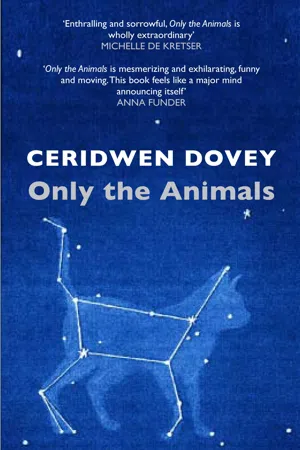
Perhaps only the animals can tell us what it is to be human.
The souls of ten animals caught up in human conflicts over the last century tell their astonishing stories of life and death. In a trench on the Western Front a cat recalls her owner Colette's theatrical antics in Paris. In Nazi Germany a dog seeks enlightenment. A Russian tortoise once owned by the Tolstoys drifts in space during the Cold War. In the siege of Sarajevo a bear starving to death tells a fairytale. And a dolphin sent to Iraq by the US Navy writes a letter to Sylvia Plath.
Exquisitely written, playful and poignant,
Only the Animals is a remarkable literary achievement by this bright young writer. An animal's-eye view of humans at our brutal, violent worst and our creative, imaginative best, it asks us to find our way back to empathy not only for animals, but for other people, and to believe again in the redemptive power of reading and writing fiction.
eBook - ePub
Only the Animals
About this book
Information
CONTENTS
The Bones
Soul of Camel
Died 1892, Australia
Pigeons, a Pony, the Tomcat and I
Soul of Cat
Died 1915, France
Red Peter’s Little Lady
Soul of Chimpanzee
Died 1917, Germany
Hundstage
Soul of Dog
Died 1941, Poland
Somewhere Along the Line the Pearl Would be Handed to Me
Soul of Mussel
Died 1941, United States of America
Plautus: A Memoir of My Years on Earth and Last Days in Space
Soul of Tortoise
Died 1968, Space
I, the Elephant, Wrote This
Soul of Elephant
Died 1987, Mozambique
Telling Fairytales
Soul of Bear
Died 1992, Bosnia and Herzegovina
A Letter to Sylvia Plath
Soul of Dolphin
Died 2003, Iraq
Psittacophile
Soul of Parrot
Died 2006, Lebanon
Acknowledgements
THE BONES
Soul of Camel
Died 1892, Australia

The three of us were nodding off around the campfire, the queen’s yellow bones in a sack beside my owner, when I saw the goanna watching us again, the same one that had stalked us through the bush for days.
Mister Mitchell was already asleep on his swag, wrapped in an expensive blanket he had brought with him from Sydney for the expedition. But the poet drifter we’d picked up in Hungerford, Henry Lawson, was still awake. He lifted the square of calico he’d put over his eyes to block out the light of the moon and listened. The goanna was moving through the dry leaves, making them scrape against one another like cartilage.
It was summer in the back country, the night of Christmas. The men had eaten too much dinner – doughboys fried over the fire, boggabri to pass as greens, salted mutton that Henry Lawson had cadged from one of the sheep stations we’d passed along the track. And we had all had too much rum.
‘I told Mitchell to put the bones back,’ Henry Lawson said. ‘I warned him. Since we were boys together, he’s been stubborn. He was born on the Grenfell goldfields, like me, you know. Hadn’t seen him in years ’til he walked into the pub in Hungerford. His father got lucky, got rich. Mine didn’t. They moved out, disappeared to Sydney.’
I waited. In the short time we had spent together, I’d learned that when Henry Lawson was dehydrated or drunk – and he was usually one or the other – he talked to himself out loud.
‘He’ll go to hell for it, he will,’ Henry Lawson said. ‘The goanna’s come to take him there. The ghost of Christmas past.’ He gave a laugh, but his eyes, almost as big and liquid as my own, were watchful. The goanna had spooked him. It certainly spooked me. It was huge, more like a crocodile than a lizard, with frightening claws.
‘My mother used to read me Dickens as a boy, if you can believe it,’ he said. ‘We lived in a tent with a bark room out front, lined with newspapers, a door made of glass left behind in the last goldrush, a whitewashed floor. But still she read me Dickens, and Poe. I can hardly believe it myself.’
Was he in fact talking to me? It was unclear. Not since my handler, Zeriph, passed away years before in Bourke had a human spoken to me casually, for the sake of conversation. Mostly all I got was ‘Hoosh!’ and ‘Itna!’ Down. Up. Up. Down. I lowed quietly in response, as encouragement, and settled more comfortably onto my thick kneepads on the sand. The rum had made me thirsty, but I knew the waterbags Mister Mitchell had filled with tank water in Hungerford were almost empty and it was no use begging for more.
Hungerford. Of all the strange, half-formed places I’d seen since I was brought here, it was one of the strangest, straddling the border between Queensland and New South Wales, a rabbit-proof fence down the main street, a couple of houses on one side, five on the other. After sampling a few glasses of sour yeast at one of the two pubs (both on the Queensland side), Henry Lawson joked the town should instead have been called Hungerthirst. Then he pointed out with a twinkle in his eye that there were rabbits on either side of the fence.
‘That was back in Pipeclay, where our fathers were fossicking on the goldfields,’ Henry Lawson said, laying the calico square over his eyes again. ‘Most of the other diggers had left by then. Their holes had collapsed, their huts were haunted. The first ghost I ever saw came at me from one of those huts, the ghost of a Chinese digger murdered for bottoming on too much payable gold. He used to sit up in the forked trunk of the blue gum above our tent, making the branches sway even on nights when there was no wind.’
I too have ghosts in my past, I wanted to tell Henry Lawson. The ghosts of the other camels who were shipped with me from our birthplace on the island of Tenerife, sold along with our handlers – who had come from somewhere else far away – to an Englishman on his way to Australia. I was the only one of my caravan to survive that dreadful sea journey. The women died around me in the hold, one by one.
And the ghost of the bachelor camel I killed near Alice Springs, who challenged me by grinding his teeth together. I suffocated him, squashed his head between my leg and body, though there were no females around to compete over and we should instead have become friends. Zeriph never let me forget my stupidity, killing that bull. He felt sorry for the other handler, who grieved over his dead camel as if for a child.
‘Our schoolhouse – the one Mitchell and I went to as boys – was haunted,’ Henry Lawson said, sitting up to suck the last drops from his black bottle of rum. ‘By the bushranger Ben Hall’s ghost. The troopers had murdered him in his sleep out on the Lachlan Plain. We thought he was a hero of the people. Mother said he was a common thief. Funny thing was, my little brother couldn’t decide if he wanted to be a bushranger or a trooper when he grew up. That was the choice for us boys from the bush – outlaw or agent of the law! Ha!’
He lay back down on his swag, leaving his face uncovered. Slowly he raised one arm and pointed a long accusatory finger at the moon. ‘At Sunday School we were told it was wicked to point at the moon.’ The rum had stopped his shakes. ‘And we were told our blacks are the lowest race on earth. There was a painting of some Aborigines hung on the schoolroom wall, but they looked more like you, like camels, peculiar creatures that shouldn’t exist, than like the black men we knew.’
But I do exist, I thought. I may have oval red blood cells, three stomach compartments, and urine as thick as syrup, but I exist. I watched him, still pointing at the moon. I felt sick, not just from the rum. Homesick.
‘A black man’s ghost turned up at one of my mother’s séances,’ he went on. ‘She had joined the local Spiritualist Society – it was the thing to do in the bush for a while – and she let me come along to one of the meetings. A lot of teamsters had joined, and the first hour of the séance was taken up by them asking the medium to check whether any of the spirits might know the location of their missing bullocks.’
He chuckled, and shook his head hard as if to clear it. ‘Mitchell’s father was at that meeting. His wife didn’t know he was there. He had come to ask the spirits for help finding gold, but the medium couldn’t answer those questions. Then a different spirit came knocking. It wanted to speak to Mitchell’s father through the medium. “Who are you?” she kept asking, but it wouldn’t say. “Have you met in spirit land many you knew on earth?” the medium asked. “Yes,” was the reply.’
Henry Lawson lowered his voice. ‘Then the medium said, out of nowhere, “Hospital Creek. Do you know of it?” Mitchell’s father’s sunburned face went pale. “Yes,” he said. “I worked at the stockyard there.” The medium was silent for a long time. “I’m getting – a fire. A fire of some kind.” Mitchell’s father said nothing. “Bodies in a fire,” she said. “A lot of them.” And at this, Mitchell’s father began to shake, a grown man trembling, but not with fear. With rage. “You bitch,” he spat, “don’t you know how to keep your mouth shut like the rest of us?”’
Henry Lawson threw the empty bottle of rum out into the bush, in the direction of the goanna. The goanna didn’t move, didn’t even flinch. ‘So the séance ended, and soon afterwards Mitchell’s father struck gold,’ he said.
I thought of the place Mister Mitchell had taken me, where he dug in the earth for the queen’s bones. Had it been near a creek? Perhaps, though it was hard to tell; it was the time of year when most of the creek beds were dry. I had been distracted by the goanna from the beginning. It had appeared as Mitchell brushed soil from the bones, clinging with its claws to the carved tree to which I was tethered beside the grave.
My mouth felt dry, and I was gripped by the urge to spit up some of my regurgitated cud, something that Zeriph had almost managed to train out of me, except when I was very angry or upset. Or drunk, I thought with shame. The green fluid landed heavily in the fire, and sizzled a bit as it burned.
Henry Lawson found this amusing. ‘Now that will go very well with the last spittle I encountered, in Hungerford.’ He dug around under his swag for his notebook, paged through, and began to read aloud. ‘After tea had a yarn with an old man who was minding a mixed flock of goats and sheep; and we asked him whether he thought Queensland was better than New South Wales, or the other way about. He scratched the back of his head, and thought awhile . . . at last, with the bored air of a man who has gone through the same performance too often before, he stepped deliberately up to the fence and spat over it into New South Wales. After which he got leisurely through and spat back on Queensland. “That’s what I think of the blanky colonies!” he said.’
Henry Lawson laughed. He looked cross-eyed and vulnerable from the rum. His gaze slipped onto the goanna at the outer rim of firelight, its loose, scaled throat illuminated.
It wasn’t a childhood bond or the rum keeping Henry Lawson by our campfire night after night. He’d told Mister Mitchell that if it were shearing season he would have stopped off to work on the stations and let us be on our way back to Bourke with the bones without him. But he was lying. We were the perfect quarry for a writer sent out to dig around in the bush for copy, almost too good to be true: a madman collector on a camel, son of a man who’d made the family fortune on the goldfields, carrying the stolen bones of an Aboriginal queen from long ago, all while being stalked by a giant goanna. I’d heard him say he liked to put animals in his stories because it made the humans look worse.
‘They didn’t really have queens,’ was the first thing Henry Lawson said after listening to Mister Mitchell’s explanation for what he was doing riding a camel along the stock route in midsummer. It wasn’t unusual to see an entire caravan of camels lugging supplies across the vast desert, especially further north (we had been brought to this country for that purpose; a railroad was being built on our backs), but as a lone camel, used by Mister Mitchell rather like a fancy horse, I became part of his oddity. ‘Not in the way we think of a queen.’
‘The queen’s bones,’ Mister Mitchell had repeated in his dreamy way, and Henry Lawson had let it go.
The first day of our journey, the day after Mister Mitchell had bought me in Bourke, he decided it was too hot to wear his boots, and burned his feet to blistering in the noon sun while murmuring to himself the instructions he’d been given on how to ride a camel. ‘Keep your hands by your sides, relax, and sway with the creature as best you can.’
I became afraid then that he would get us lost, and bit a hole in one of the bags of flour hanging against my flanks, to leave a trail. That only worked as long as we had flour, and soon we didn’t, and the white trail on the red sand ended abruptly. I cursed myself then for not taking the chance to run away after Zeriph died, off into the redder centre to join the ranks of wild camels whose numbers were rumoured to be swelling, desert outlaws who spent their days destroying the very same things they had lugged to the interior in the first place: stock fences, well casings, railroad tracks, water pumps.
The goanna scuttled closer to the fire, jerking its flat head, then it froze and was once more unsettlingly still. I felt my long spine tingle.
‘They eat meat,’ Henry Lawson said. ‘All kinds of meat. Fresh or rotting. I’ve heard they’ll eat the eyes out of a sleeping man’s face, or drag a whole sheep off in their jaws. I saw one kill a kangaroo and take chunks of flesh out of it like a dingo. One bite, they say, and you never stop bleeding.’
I looked at Mister Mitchell’s padded, sleeping form. He had the bag of bones beside him, clutching it to him like a lover. The way he was lying – on his side, his knees pulled up and head tucked in – reminded me of the way the queen’s bones had been arranged in her mounded grave. She had not been laid out on her back when she was buried, arms straight, legs out straight. She had been laid into the earth carefully curled up on her side.
‘His father was fixated on those bones,’ Henry Lawson muttered. ‘Like father, like son. They’ve both always been a bit touched.’ He snapped his head around to look at me, as if I had said something. ‘Oh no, it’s not what you think. These aren’t those bones. Not from the killings at Hospital Creek. They made sure to burn those ones up, get rid of the evidence. The queen – he does insist on calling her that, doesn’t he? – is from a time before we were here, before old Captain Cook even. Someone at the stockyard told his father about the queen’s grave. Now he thinks if he has her bones, the Hospital Creek ghosts will let him alone.’
The goanna hissed, inflating flaps of skin around its throat into a menacing neckpiece.
Henry Lawson ignored it and began to sing softly. ‘We three kings of Orient are/bearing gifts we traverse afar . . . My god, I’m thirsty. Imagine dying of thirst. You hear about Ebenezer Davis, who was taking a mob of Kerribree sheep along...
Table of contents
- Cover
- Title Page
- Copyright Page
- Dedication Page
- Contents
Trusted by 375,005 students
Access to over 1.5 million titles for a fair monthly price.
Study more efficiently using our study tools.
Frequently asked questions
Yes, you can cancel anytime from the Subscription tab in your account settings on the Perlego website. Your subscription will stay active until the end of your current billing period. Learn how to cancel your subscription
No, books cannot be downloaded as external files, such as PDFs, for use outside of Perlego. However, you can download books within the Perlego app for offline reading on mobile or tablet. Learn how to download books offline
Perlego offers two plans: Essential and Complete
- Essential is ideal for learners and professionals who enjoy exploring a wide range of subjects. Access the Essential Library with 800,000+ trusted titles and best-sellers across business, personal growth, and the humanities. Includes unlimited reading time and Standard Read Aloud voice.
- Complete: Perfect for advanced learners and researchers needing full, unrestricted access. Unlock 1.5M+ books across hundreds of subjects, including academic and specialized titles. The Complete Plan also includes advanced features like Premium Read Aloud and Research Assistant.
We are an online textbook subscription service, where you can get access to an entire online library for less than the price of a single book per month. With over 1.5 million books across 990+ topics, we’ve got you covered! Learn about our mission
Look out for the read-aloud symbol on your next book to see if you can listen to it. The read-aloud tool reads text aloud for you, highlighting the text as it is being read. You can pause it, speed it up and slow it down. Learn more about Read Aloud
Yes! You can use the Perlego app on both iOS and Android devices to read anytime, anywhere — even offline. Perfect for commutes or when you’re on the go.
Please note we cannot support devices running on iOS 13 and Android 7 or earlier. Learn more about using the app
Please note we cannot support devices running on iOS 13 and Android 7 or earlier. Learn more about using the app
Yes, you can access Only the Animals by Ceridwen Dovey in PDF and/or ePUB format, as well as other popular books in Literature & Literature General. We have over 1.5 million books available in our catalogue for you to explore.