Winner of the Hearst Big Book Awards, 2019 - Women's Health's Book of the Year
_____________
Shocking, brilliant, important. A fine addition to the feminist canon. - Emma Jane Unsworth
For the first time I feel like I PROPERLY understand my vagina! I wish I had read this 23 years ago! - Scarlett Curtis
_____________
From earliest childhood, girls are misled about their bodies, encouraged to describe their genitalia with cute and silly names rather than anatomically correct terms. In our schools and in our culture, we are coy about women while putting straight men's sexuality front and centre. Girls grow up feeling ashamed about their periods, about the appearance of their vulvas, about their own desires. They grow up without a full and honest sex education, and this lack of knowledge has serious consequences: the number of women attending cervical screening appointments in the UK is at a 20-year low while labiaplasty is the fastest growing type of plastic surgery in the world.
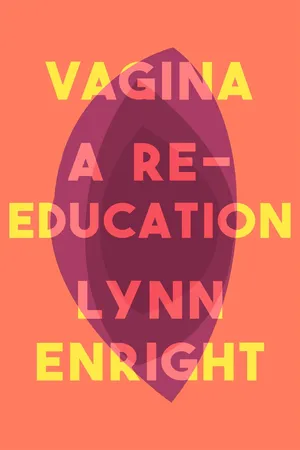
Vagina provides girls and women with information they need about their own bodies - about the vagina, the hymen, the clitoris, the orgasm; about conditions like endometriosis and vulvodynia. It confronts taboos, such as abortion, miscarriage, infertility and masturbation. It tackles vital social issues like period poverty, female genital mutilation and the rights of transgender women. It is honest and moving as Lynn Enright shares her personal stories but this is about more than one woman - this is a book that will provoke thousands of conversations. We urgently need to talk about women's sexual and reproductive health, about our experiences of sex and pregnancy and pain and pleasure.
Vagina: A Re-Education will help us do just that.
- 232 pages
- English
- ePUB (mobile friendly)
- Available on iOS & Android
eBook - ePub
About this book
Information
Subtopic
Feminism & Feminist TheoryIndex
Social SciencesCHAPTER ONE
A Sex Re-education
Rather than teaching young girls about pleasure, we teach them fear and self-hatred. And rather than teaching young boys about responsibility, we teach them suspicion and slut-shaming.
Laurie Penny, Unspeakable Things:
Sex, lies and revolution
Sex, lies and revolution
I grew up in a home that was relaxed about nudity, a home that was safe and open, with parents who encouraged questioning and learning. But still, we didn’t speak of vulvas and vaginas – we spoke of front bottoms. When it came to our own genitalia, we were coy. We were taught to be coy.
My body, throughout childhood and into puberty, was a series of mysteries – some thrilling, some traumatic. I had been told about periods so when blood appeared in my swimsuit one summer at the end of childhood, I knew what it was. But when I saw a white discharge in my pants, I was worried that I was dirty, or sick, or abnormal. No one had ever told me that would happen.
When pubic hair grew, I was prepared, proud even. But when I felt aroused and sensed my clitoris becoming fuller, I was bewildered. I didn’t know I had a clitoris – or, more accurately, I didn’t know the name for it – until I was well into my teens. My awareness of my body, of my genitalia and my sexual and reproductive organs, was patchy.
I was a child before people had the Internet in their homes. When I was curious or confused, I resorted to looking things up in the big dictionary and the set of dusty encyclopaedias that were kept on a bottom shelf in my parents’ bedroom. There was a somewhat informative sex education book in the local library that I never had the courage to officially borrow – but would consult regularly.
By the time my mother sat me down for a sex education talk when I was ten or eleven, I was cognizant of the basics. I knew what menstruation was. I knew how babies were made. I had heard of wet dreams, which fascinated me, even though I had been told they did not apply to me.
I knew little about the intricacies of my own anatomy and almost nothing of the pleasures of which my body was capable. The twenty-minute discussion with my kind but slightly embarrassed mother did not illuminate me in that regard. I implicitly understood that the education pertaining to my own pleasure was more private, an education to be pursued alone.
In the final year of primary school, it was announced that a nurse would be visiting our class for a day. We would have no regular lessons – no long division, no history; there would be no reading aloud, no poems, no learning about mountain ranges. On this allocated day, the nurse would come and tell us about our bodies instead. Attending school on this day was at the discretion of our parents so, if they decided the content of this unusual lesson was unsavoury or unsuitable, we could stay at home and watch daytime TV or catch up on our homework. The nurse’s impending arrival was thrilling to me – a break from the monotony of lessons was always welcome and the prospect of talking about sex excited me – but I had a friend who felt differently. She was nervous, embarrassed; she didn’t want to sit among her classmates and talk about genitalia and menstruation. She begged her mother to excuse her from the lesson but her mother refused: not, I don’t think, because she was especially keen for her daughter to receive a good sex education, but just because of the extra trouble that having a child at home for the day would entail.
On the appointed day, the nurse arrived. My nervous friend coped adequately and all of us girls, even the usually jittery and badly behaved, listened raptly. It felt grown-up, an instruction in adulthood.
It has been more than two decades since that day and I have one particularly clear memory from it. I remember the nurse warning us against the use of tampons – it was healthier, she said, for blood to exit the body; it was wrong, she told us, to capture it inside of ourselves. This image, this propaganda, stayed with me. I even believed it for a while. The rest of the day offered nothing that I hadn’t already gleaned from the book in the library, from discussions with my friends or from my mother.
And that was that – we were deemed ready for secondary school. We were ready to turn twelve. We were ready for bras and sanitary towels. That was our sex education: a single day with a woman who planted mistruths among the facts.
It is more than twenty years since I sat in that classroom getting a sex education, and plenty has changed in those years. The Internet is now freely available – in homes and on children’s phones – and, with the Internet, has come an abundance of pornography. It is also clear to me that little girls growing up today are more likely to know the correct anatomical names for their own body parts. When I visited a friend recently, I told her what I was working on: a book about the vagina. Her curly-haired three-year-old daughter overheard me and ran away, into her room, emerging a minute or so later with a book almost as big as she was. She approached me and opened it, pointing to a page that featured an accurate anatomical diagram of the female genitals. This little girl knew the terms for her own anatomy: she knew about vulvas and vaginas. She felt proud of this knowledge – she wanted to share it with me.
My friend explained that she taught her daughter the correct terms – vulva and vagina – so that she is safer, so that she can tell her parents if she is ever touched there, or if she is ever in pain there. This little girl understands that her vulva is a private place, that it is off limits to others – but the fact that it is private does not mean that it has to remain unknown or private to herself.
And yet, not as much has changed as I had presumed. I had assumed that sex education must have advanced; I had thought that in the era of the smartphone and sexting and Internet porn, the information we give our children about their bodies and their health and their sexuality would be clearer and more sophisticated. I had thought that the sex education I received in Ireland – a place where the education system was still tethered to the Catholic Church – was an anomaly. I had thought that the UK would have a liberal and sensible approach to sex education that ensured every child and teenager would feel prepared for puberty and knowledgeable about their own body. I was, it turns out, wrong.
In 2017, the children’s charity Plan found that one in four girls in the UK felt unprepared for the start of their periods and one in seven did not know what was happening when they began bleeding.1
In 2012, the Office for Standards in Education, Children’s Services and Skills (Ofsted) carried out a series of inspections relating to the standard of sex education in English schools – the resulting report was titled ‘Not yet good enough’.2 The report stated that:
Sex and relationships education required improvement in over a third of schools. In primary schools this was because too much emphasis was placed on friendships and relationships, leaving pupils ill-prepared for physical and emotional changes during puberty, which many begin to experience before they reach secondary school. In secondary schools it was because too much emphasis was placed on ‘the mechanics’ of reproduction and too little on relationships, sexuality, the influence of pornography on students’ understanding of healthy sexual relationships, dealing with emotions and staying safe.
When I speak to Lucy Emmerson, director of the UK’s Sex Education Forum, a group that works to achieve good relationships and sex education (RSE) for British children and teenagers, she confirms that the standard is patchy: ‘I think you would find some examples of schools, where they’re teaching RSE in a sex positive way, where they have good lessons on anatomy, where they are talking about pleasure, female as much as male,’ she says. But those classrooms are rare. Pushed to guess at the proportion of schools providing an excellent standard of sex education, she hesitates: ‘One in ten or one in twenty.’
A new RSE curriculum will be made compulsory in UK schools in September 2020 but, presently, the standard of sex education is random – a lottery. Academies – and schools run by charitable trusts – can, at the time of writing, opt out of teaching sex education completely.
A child who receives a comprehensive and compassionate education about sex and relationships is likely to have done so because of the work and vision of one individual – a teacher, a head teacher, a health worker or someone working in the local council – rather than a joined-up set of countrywide policies. ‘It’s really going to be a teacher who’s made this a specialism, who is confident, who has built up resources for teaching about it, who has looked out for training of their own initiative. It’s not going to be a routine thing,’ says Lucy Emmerson.
Some children might be lucky; they might have a teacher who believes it’s important for them to learn about menstruation, about what a healthy vulva looks like, about masturbation and pleasure. Others might have a teacher who feels awkward or unclear or embarrassed, a teacher who never uses the word ‘vagina’, who never says ‘vulva’ or ‘clitoris’. ‘There are teachers who are unable to utter those words, because they have possibly, in their adult life, never spoken those words out loud,’ points out Emmerson. ‘Because they got rubbish sex education, they don’t use those words in their own personal relationships.’
In Ireland, where I grew up, the Catholic Church is deemed responsible for the dire state of sex education in schools. In Britain, where I live now, there is a sense that some essential Britishness might be to blame. ‘We’re British; we’re not good at talking about sex’ is a received outlook, and one that contributes to depriving children of information pertaining to their health and sexuality. The fact that RSE is set to become compulsory in British schools is a hugely important shift – and there are some vital changes being made to the curriculum guidelines to better reflect the reality of life for children and teenagers today. The recommendations that children and teenagers are taught about consent – what it is and what it is not – is significant, as is the increased focus on non-heterosexual relationships and sex.
For too long, sex education in the UK (like in most of the rest of the world) has ignored LGBTQ+ sexuality. With so much of the focus on explaining – and preventing – pregnancy, the ‘when a man and a woman love each other…’ line has been the most consistent. This is set to change with schools being recommended to include ‘LGBT-specific content’. This move is especially important given the highly controversial Section 28 clause, introduced as part of the Local Government Act in 1988,3 which prohibited local authorities and schools from ‘promoting’ homosexuality. In 1987, Margaret Thatcher told the Conservative party conference: ‘Children who need to be taught to respect traditional moral values are being taught that they have an inalienable right to be gay. All of those children are being cheated of a sound start in life. Yes, cheated.’4 The next year, teachers were banned from talking about same-sex relationships in schools.
Section 28 was repealed in 2000 in Scotland; it took three more years before the Labour government repealed it in the rest of the UK. In the intervening years, some teachers had flouted the rules and taught their students about LGBTQ+ relationships and sex. Many others, however, had given in to the bigotry, with LGBTQ+ children, or those growing up in LGBTQ+ households, feeling alienated and ashamed and confused. Section 28 undoubtedly hampered the progress of gay and trans rights in the UK in the 1980s and 1990s and denied a generation of children access to a compassionate sex education, and so the recommendations that children are given information about LGBTQ+ relationships in all schools after 2020 is an important marker of change and hope.
And yet I don’t find myself overly impressed – because, to be frank, the new guidelines are woefully overdue. And they hardly feel radical. They are catching up with a reality that children and young people live every day, rather than presenting a future where teachers and adults truly lead discussions. There is also a worrying vagueness about the training that will be provided to teachers and a lack of clarity on how it will be funded.
And, tellingly, there is a coyness still present. In some respects, the new guidelines are admirable in their ambition – it is vital that we educate our young people about consent, for example – but the advice on how basic facts about bodies and genitals should be taught still feels hazy. In the guidelines I’ve seen (and it’s possible they will change before the 2020 deadline), there isn’t clear instruction on whether teachers should use anatomically correct terms – so whether a young...
Table of contents
- Cover
- Title
- Copyright
- Contents
- Introduction
- 1 A Sex Re-education
- 2 The Facts (If We Can Call Them That)
- 3 The Hymen, a Useless Symbol
- 4 The Clitoris, and How It’s Ignored
- 5 The Orgasm, and Why Everything’s Normal
- 6 Appearances, and Looking in the Mirror
- 7 Periods, and What Makes Them So Awful
- 8 Pain, As It Applies to Women
- 9 Fertility, Teaching It and Talking About It
- 10 Getting Pregnant, and What Comes Next
- 11 The Vagina and Menopause
- 12 Does My Vagina Define Me?
- Acknowledgements
- Resources
- References
Trusted by 375,005 students
Access to over 1.5 million titles for a fair monthly price.
Study more efficiently using our study tools.
Frequently asked questions
Yes, you can cancel anytime from the Subscription tab in your account settings on the Perlego website. Your subscription will stay active until the end of your current billing period. Learn how to cancel your subscription
No, books cannot be downloaded as external files, such as PDFs, for use outside of Perlego. However, you can download books within the Perlego app for offline reading on mobile or tablet. Learn how to download books offline
Perlego offers two plans: Essential and Complete
- Essential is ideal for learners and professionals who enjoy exploring a wide range of subjects. Access the Essential Library with 800,000+ trusted titles and best-sellers across business, personal growth, and the humanities. Includes unlimited reading time and Standard Read Aloud voice.
- Complete: Perfect for advanced learners and researchers needing full, unrestricted access. Unlock 1.5M+ books across hundreds of subjects, including academic and specialized titles. The Complete Plan also includes advanced features like Premium Read Aloud and Research Assistant.
We are an online textbook subscription service, where you can get access to an entire online library for less than the price of a single book per month. With over 1.5 million books across 990+ topics, we’ve got you covered! Learn about our mission
Look out for the read-aloud symbol on your next book to see if you can listen to it. The read-aloud tool reads text aloud for you, highlighting the text as it is being read. You can pause it, speed it up and slow it down. Learn more about Read Aloud
Yes! You can use the Perlego app on both iOS and Android devices to read anytime, anywhere — even offline. Perfect for commutes or when you’re on the go.
Please note we cannot support devices running on iOS 13 and Android 7 or earlier. Learn more about using the app
Please note we cannot support devices running on iOS 13 and Android 7 or earlier. Learn more about using the app
Yes, you can access Vagina by Lynn Enright in PDF and/or ePUB format, as well as other popular books in Social Sciences & Feminism & Feminist Theory. We have over 1.5 million books available in our catalogue for you to explore.