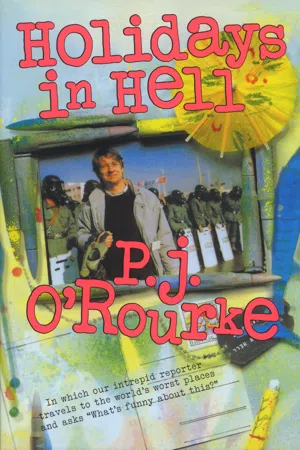
Now available as an ebook, the original classic in which P.J. O'Rourke takes on the role of tour guide with hilarious results
P.J. O'Rourke travels to hellholes around the globe in
Holidays in Hell, looking for trouble, the truth, and a good time. After casually sight-seeing in war-torn Lebanon and being pepper-gassed in Korea, P.J. checks out the night life in communist Poland and spends the Christmas holidays in El Salvador.
Taking a long look at Nicaragua, P.J. asks, "Is Nicaragua a Bulgaria with marimba bands or just a misunderstood Massachusetts with Cuban military advisors?"; has a close encounter with a Philippine army officer he describes as "powerful-looking in a short, compressed way, like an attack hamster"; and concludes, "Some people are worried about the difference between right and wrong. I'm worried about the difference between wrong and fun."
'The first few pages of this book made me laugh so much I dropped it on my month-old baby... Holidays in Hell is a splendid read.'
Evening Standard
eBook - ePub
Holidays in Hell
About this book
Information
Topic
Personal DevelopmentSubtopic
TravelContents

Introduction
The Innocents Abroad, Updated
A Ramble Through Lebanon
Seoul Brothers
Panama Banal
Third World Driving Hints and Tips
What Do They Do for Fun in Warsaw?
Weekend Getaway: Heritage USA
The Post-Marcos Philippines—Life in the Archipelago After One Year of Justice, Democracy and Things Like That
Christmas in El Salvador
At Sea with the America’s Cup
Intellectual Wilderness, Ho—A Visit to Harvard’s 350th Anniversary Celebration
In Whitest Africa
Through Darkest America: Epcot Center
Among the Euro-Weenies
Thirty-six Hours in Managua—An In-depth Report
Through Darkest America, Part II: The 1987 Reagan/Gorbachev Summit
Mexican Border Idyll
The Holyland—God’s Monkey House
Epilogue: What Does the Future Hold In Store for Our Friends in Faraway Lands?
Introduction
I’ve been working as a foreign correspondent for the past few years, although “working” isn’t the right word and “foreign correspondent” is too dignified a title. What I’ve really been is a Trouble Tourist—going to see insurrections, stupidities, political crises, civil disturbances and other human folly because . . . because it’s fun.
Like most people who don’t own Bermuda shorts, I’m bored by ordinary travel. See the Beautiful Grand Canyon. Okay, I see it. Okay, it’s beautiful. Now what? And I have no use for vacation paradises. Take the little true love along to kick back and work on the relationship. She gets her tits sunburned. I wreck the rental car. We’ve got our teeth in each other’s throats before you can say “lost luggage.” Nor do attractions attract me. If I had a chance to visit another planet, I wouldn’t want to go to Six Flags Over Mars or ride through the artificial ammonia lake in a silicone-bottomed boat at Venusian Cypress Gardens. I’d want to see the planet’s principal features—what makes it tick. Well, the planet I’ve got a chance to visit is Earth, and Earth’s principal features are chaos and war. I think I’d be a fool to spend years here and never have a look.
I also became a foreign correspondent because I was tired of making bad jokes. I spent most of the Seventies as an editor at The National Lampoon, and I spent the early Eighties writing comedy scripts for movies and comic articles for magazines. All the while, the world outside seemed a much worse joke than anything I could conjure. “The secret source of humor itself is not joy but sorrow,” said Mark Twain. I wanted to get at that awful source of mirth and make very, very bad jokes.
I thought maybe I could use the techniques of humor to report on real news events. Or, at least, I thought I could use that phrase to convince editors and publishers to pay my way to Lebanon, El Salvador and so forth. Actually, I was just curious. I wanted to know where trouble came from and why the world was such a lousy place. I wasn’t curious about natural disasters—earthquakes, mudslides, floods and droughts. These are nothing but the losing side of the Grand Canyon coin toss. Okay, it’s sad. Now what? I was curious about the trouble man causes himself and which he could presumably quit causing himself at the drop of a hat, or, anyway, a gun. I wanted to know why life, which ought to be an only moderately miserable thing, is such a frightful, disgusting, horrid thing for so many people in so many places.
Because I was curious and wanted a few facts, there are no important people in this book—no interviews with Heads Of State or Major Figures On The International Scene. These people didn’t get where they are by being dumb enough to tell reporters the truth. And, although I admit to most faults, I don’t have the Network Anchor-Creature self-conceit that lets some people believe Mikhail Gorbachev will suddenly take them aside and say, “Strictly between you and me, on Wednesday we invade Finland.” This book is written from the worm’s viewpoint, and the things I’ve asked my fellow blind, spineless members of the phylum Annelida are things like, “What’s for dinner?” and “Please don’t kill me”—the stuff of mankind’s real-life interviews.
There are also no earnest messages in this book. Half the world’s suffering is caused by earnest messages contained in grand theories bearing no relation to reality—Marxism and No-Fault Auto Insurance, to name two. Earnestness is just stupidity sent to college. I’m not sure this book contains any serious content. No matter how serious the events I’ve witnessed, I’ve never noticed that being serious about them did anything to improve the fate of the people involved. Some writers, the young and the dim ones, think being near something important makes them important so they should act and sound important which will, somehow, make their audience important, too. Then, as soon as everybody is filled with a sufficient sense of importance, Something Will Be Done. It’s not the truth. Thirty years of acting and sounding important about the Holocaust did nothing to prevent Cambodia.
Furthermore, there are no answers in this book. Even simple questions do not, with logical necessity, lead to them. I can sum up everything I’ve learned about trouble in a few words, and I will:
Civilization is an enormous improvement on the lack thereof. No reasonable person who has had a look at the East Bloc (or an issue of the Nation) can countenance the barbarities of the Left. And every dorm bull-session anarchist should spend an hour in Beirut. So-called Western Civilization, as practiced in half of Europe, some of Asia and a few parts of North America, is better than anything else available. Western Civilization not only provides a bit of life, a pinch of liberty and the occasional pursuance of a happiness, it’s also the only thing that’s ever tried to. Our civilization is the first in history to show even the slightest concern for average, undistinguished, none-too-commendable people like us.
We are fools when we fail to defend civilization. The ancient Romans might as well have said, “Oh, the Germanic tribes have valid nationalistic and cultural aspirations. Let’s pull the legions off the Rhine, submit our differences to a multilateral peace conference chaired by the Pathan Empire and start a Vandal Studies program at the Academy in Athens.”
To extend civilization, even with guns, isn’t the worst thing in the world. War will exist as long as there’s a food chain. No amount of mushy essaying on the Boston Globe editorial page and no number of noisy, ill-kempt women sitting in at Greenham Common will change this. Better that we study to conduct war as decently as possible and as little as necessary. The trouble in Lebanon, South Africa, Haiti and the occupied territories of Palestine should, simply, be stopped by the military intervention of civilized nations. This won’t stop trouble, of course. Trouble is fun. It will always be more fun to carry a gun around in the hills and sleep with ideologyaddled college girls than to spend life behind a water buffalo or rotting in a slum.
Finally, people are all exactly alike. There’s no such thing as a race and barely such a thing as an ethnic group. If we were dogs, we’d be the same breed. George Bush and an Australian aborigine have fewer differences than a lhasa apso and a toy fox terrier. A Japanese raised in Riyadh would be an Arab. A Zulu raised in New Rochelle would be an orthodonist. I wish I could say I found this out by spending arctic nights on ice floes with Inuit elders and by sitting with tribal medicine men over fires made of human bones in Madagascar. But, actually, I found it out by sleeping around. People are all the same, though their circumstances differ terribly. Trouble doesn’t come from Slopes, Kikes, Niggers, Spies or White Capitalist Pigs; it comes from the heart.
The Innocents Abroad, Updated
On Saturday, June 8, 1867, the steamship Quaker City left New York harbor. On board was a group of Americans making the world’s first package tour. Also on board was Mark Twain making the world’s first fun of package tourism.
In its day The Innocents Abroad itinerary was considered exhaustive. It included Paris, Marseilles, the Rock of Gibraltar, Lake Como, some Alps, the Czar, the pyramids and the Holy Land plus the glory that was Greece, the grandeur that was Rome and the pile of volcanic ash that was Pompeii.
When these prototypical tourists went home they could count themselves traveled. They had shivered with thoughts of lions in the Colosseum, “done” the Louvre, ogled Mont Blanc, stumbled through the ruins of the Parthenon by moonlight and pondered that eternal riddle—where’d its nose go?—of the Sphinx. They had seen the world.
But what if Mark Twain had to come back from the dead and escort 1980’s tourists on a 1980’s tour? Would it be the same? No. I’m afraid Mr. Twain would find there are worse things than innocents abroad in the world today.
In 1988 every country with a middle class to export has gotten into the traveling act. We Yanks, with our hula shirts and funny Kodaks, are no longer in the fore. The earth’s travel destinations are jam-full of littering Venezuelans, peevish Swiss, smelly Norwegian backpackers yodeling in restaurant booths, Saudi Arabian businessmen getting their dresses caught in revolving doors and Bengali remittance men in their twenty-fifth year of graduate school pestering fat blonde Belgian au pair girls.
At least we American tourists understand English when it’s spoken loudly and clearly enough. Australians don’t. Once you’ve been on a plane full of drunken Australians doing wallaby imitations up and down the aisles, you’ll never make fun of Americans visiting the Wailing Wall in short shorts again.
The Japanese don’t wear short shorts (a good thing, considering their legs), but they do wear three-piece suits in the full range of tenement-hall paint colors, with fit to match. The trouser cuffs drag like bridal trains; the jacket collars have an ox yoke drape; and the vests leave six inches of polyester shirt snapping in the breeze. If the Japanese want to be taken seriously as world financial powers, they’d better quit using the same tailor as variety-show chimps.
The Japanese also travel in nacks at a jog trot and get up at six A.M. and sing their company song under your hotel window. They are extraordinary shoplifters. They eschew the usual clothes and trinkets, but automobile plants, steel mills and electronics factories seem to be missing from everywhere they go. And Japs take snapshots of everything, not just everything famous but everything. Back in Tokyo there must be a billion color slides of street corners, turnpike off-ramps, pedestrian crosswalks, phone booths, fire hydrants, manhole covers and overhead electrical wires. What are the Japanese doing with these pictures? It’s probably a question we should have asked before Pearl Harbor.
Worse than the Japanese, at least worse looking, are the Germans, especially at pool-side. The larger the German body, the smaller the German bathing suit and the louder the German voice issuing German demands and German orders to everybody who doesn’t speak German. For this, and several other reasons, Germany is known as “the land where Israelis learned their manners.”
And Germans in a pool cabana (or even Israelis at a discotheque) are nothing compared with French on a tropical shore. A middle-aged, heterosexual, college-educated male wearing a Mickey Mouse T-shirt and a string-bikini bottom and carrying a purse—what else could it be but a vacationing Frenchman? No tropical shore is too stupid for the French. They turn up on the coasts of Angola, Eritrea, Bangladesh and Sri Lanka. For one day they glory in l’atmosphère très primitive then spend two weeks in an ear-splitting snit because the natives won’t make a steak frite out of the family water buffalo.
Also present in Angola, Eritrea and God-Knows-Where are the new breed of yuppie “experience travelers.” You’ll be pinned down by mortar fire in the middle of a genocide atrocity in the Sudan, and right through it all come six law partners and their wives, in Banana Republic bush jackets, taking an inflatable raft trip down the White Nile and having an “experience.”
Mortar fire is to be preferred, of course, to British sports fans. Has anyone checked the passenger list on The Spirit of Free Enterprise? Were there any Liverpool United supporters on board? That channel ferry may have been tipped over for fun. (Fortunately the Brits have to be back at their place of unemployment on Monday so they never get further than Spain.)
Then there are the involuntary tourists. Back in 1867, what with the suppression of the slave trade and all, they probably thought they’d conquered the involuntary tourism problem. Alas, no. Witness the African exchange students—miserable, cold, shivering, grumpy and selling cheap wrist watches from the top of cardboard boxes worldwide. (Moscow’s Patrice Lumumba University has a particularly disgruntled bunch.) And the Pakistani family with twelve children who’ve been camped out in every airport on the globe since 1970—will somebody please do something for these people? Their toddler has got my copy of the Asian Wall Street Journal, and I won’t be responsible if he tries to stuff it down the barrel of the El Al security guard’s Uzi again.
Where will Mr. Clemens take these folks? What is the 1980’s equivalent of the Grand Tour? What are the travel “musts” of today?
All the famous old monuments are still there, of course, but they’re surrounded by scaffolds and green nets and signs saying, “Il pardonne la restoration bitte please.” I don’t know two people who’ve ever seen the same famous old monument. I’ve seen Big Ben. A friend of mine has seen half of the Sistine Chapel ceiling. No one has seen Notre Dame Cathedral for years. It’s probably been sold to a shopping mall developer in Phoenix.
We’ve all, however, seen Dr. Meuller’s Sex Shop in the Frankfurt airport. Dr. Meuller’s has cozy booths where, for one deutsche mark a minute, we modern tourists can watch things hardly thought of in 1867. And there’s nothing on the outside of the booths to indicate whether you’re in there viewing basically healthy Swedish nude volleyball films or videos of naked Dobermans cavorting in food. Dr. Meuller’s is also a reliable way to meet your boss, old Sunday School teacher or ex-wife’s new husband, one of whom is always walking by when you emerge.
Dr. Meuller’s is definitely a “must” of modern travel, as is the Frankfurt airport itself. If Christ came back tomorrow, He’d have to change planes in Frankfurt. Modern air travel means less time spent in transit. That time is now spent in transit lounges.
What else? There are “local points of interest” available until the real monuments are restored. These are small piles of stones about which someone will tell you extravagant lies for five dollars. (“And here, please, the Tomb of the Infant Jesus.”) And there are the great mini-bars of Europe—three paper cartons of aniseflavored soda pop, two bottles of beer with suspended vegetable matter, a triangular candy bar made of chocolate-covered edelweiss and a pack of Marlboros manufactured locally under license. (N.B.: Open that split of Mumm’s ½-star in there, and $200 goes on your hotel bill faster than you can say “service non compris.”)
In place of celebrated palaces, our era has celebrated parking spots, most of them in Rome. Romans will back a Fiat into the middle of your linguine al pesto if you’re sitting too close to the restaurant window.
Instead of cathedrals,...
Table of contents
- Cover
- Title page
- Copyright page
- Dedication page
- Acknowledgments
- Contents
Trusted by 375,005 students
Access to over 1.5 million titles for a fair monthly price.
Study more efficiently using our study tools.
Frequently asked questions
Yes, you can cancel anytime from the Subscription tab in your account settings on the Perlego website. Your subscription will stay active until the end of your current billing period. Learn how to cancel your subscription
No, books cannot be downloaded as external files, such as PDFs, for use outside of Perlego. However, you can download books within the Perlego app for offline reading on mobile or tablet. Learn how to download books offline
Perlego offers two plans: Essential and Complete
- Essential is ideal for learners and professionals who enjoy exploring a wide range of subjects. Access the Essential Library with 800,000+ trusted titles and best-sellers across business, personal growth, and the humanities. Includes unlimited reading time and Standard Read Aloud voice.
- Complete: Perfect for advanced learners and researchers needing full, unrestricted access. Unlock 1.5M+ books across hundreds of subjects, including academic and specialized titles. The Complete Plan also includes advanced features like Premium Read Aloud and Research Assistant.
We are an online textbook subscription service, where you can get access to an entire online library for less than the price of a single book per month. With over 1.5 million books across 990+ topics, we’ve got you covered! Learn about our mission
Look out for the read-aloud symbol on your next book to see if you can listen to it. The read-aloud tool reads text aloud for you, highlighting the text as it is being read. You can pause it, speed it up and slow it down. Learn more about Read Aloud
Yes! You can use the Perlego app on both iOS and Android devices to read anytime, anywhere — even offline. Perfect for commutes or when you’re on the go.
Please note we cannot support devices running on iOS 13 and Android 7 or earlier. Learn more about using the app
Please note we cannot support devices running on iOS 13 and Android 7 or earlier. Learn more about using the app
Yes, you can access Holidays in Hell by P. J. O'Rourke in PDF and/or ePUB format, as well as other popular books in Personal Development & Travel. We have over 1.5 million books available in our catalogue for you to explore.