French women seem inherently more confident in their bodies, able to embrace the sensuality of life and love. What's their secret? Lingerie.
Yet, despite an insatiable curiosity for all things French, most women still find lingerie an enigma, a tangled mélange of silk and lace, and are confused about how, when, and where to wear it. (Hint: it's not just for special occasions.) Many aspire to having a drawer full of silky, lacy undergarments, but have no idea where to start: How should my bra fit? How exactly do I wear a garter belt? Do bras and knickers always have to match?
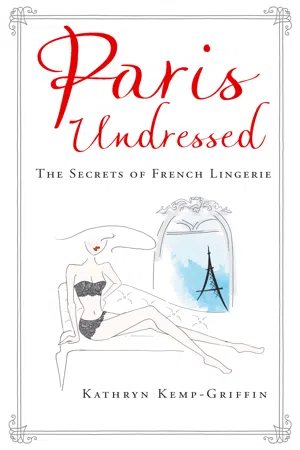
With illustrations by French lingerie designer Paloma Casile,
Paris Undressed: The Secrets of French Lingerie will help women feel at ease with their figures and show them how to integrate a lingerie lifestyle à la française to enhance their own femininity, confidence, and joie de vivre. It will transform the way women perceive their undergarments - and their bodies - and reveal how to co-ordinate a lingerie wardrobe to reflect personality and to meet lifestyle needs with the right dose of reverie. The book also includes a hand-selected guide to the most confidential addresses and lingerie boutiques in Paris, and discloses where to find the perfect bra, couture camisole or cheeky knicker.
Paris Undressed goes behind the seams, combining cultural references, expertise, and practical advice to inspire every woman to reconsider her underwear drawer.
- English
- ePUB (mobile friendly)
- Available on iOS & Android
eBook - ePub
About this book
Information
Topic
Ciencias socialesSubtopic
Diseño de moda
ONE
AN INVITATION TO THE SENSES
Paris. Paris. There is something silken and elegant about that word, something carefree, something made for a dance, something brilliant and festive, like champagne. Everything there is beautiful, gay, and a little drunk, and festooned with lace.
— Nina Berberova
Paris is a city that takes its time — especially when you’re in a hurry.
Tourists blame the Parisians, Parisians blame the tourists, and everybody blames the traffic. Or the strikes. Or the holidays. Despite the finger-wagging, however, there is tolerance — and delight — in the City of Light for those who learn to expect the unexpected. Paris is a celebration of unhurried time, an invitation to discover and tease your senses. Like a kiss at dawn that longs for nightfall, Paris is best lived not by tallying what you pack into a day, but by what you manage to stretch out over the course of it.
Paris is a small big city. Geographically speaking, it occupies only 105 square kilometres of the earth’s surface, which is not much compared to other major cities and popular tourist destinations. New York is eight times larger, and London and Bangkok both sprawl over fifteen times the space. In terms of population, the two million inhabitants in the French capital pales in comparison to the more than eight million in each of those three other cities.
But small numbers add up. Rather, they multiply exponentially, placing Paris high on the population density charts with an average of twenty-one people per square kilometre compared to New York’s ten, or London and Bangkok’s average of five. Building-height restrictions in Paris have prevented people from piling up and encouraged them to spill out onto the streets.
Whether you prefer the company of others or the solitude of anonymity, les rues of Paris invite us to engage. A vibrant café culture encourages conversation and debate while winding cobblestone pathways nestled between broad boulevards give the freedom to wander and lose your way, knowing you’ll never be truly lost. This overlapping of lives and experiences heightens the senses and makes everything feel more intimate and more immediate.

Four weeks after the coin landed, Christian and I had quit our jobs, put our house on the market, broken the news to our stunned yet supportive relatives, and were on a plane to Paris. We stayed temporarily in a boutique hotel where mornings began in a breakfast room overlooking an inner courtyard. There were hardwood floors, teal velvet chairs, ivory damask table linens, hammered metal flatware, along with freshly squeezed orange juice, a basket brimming with hot-from-the-baker’s-oven croissants, and café au lait in wide, vintage bowls. My breakfasts in Canada had been eaten over the sink and washed down with coffee to go. In Paris, I could have lingered over petit déjeuner all day.
But I had work to do. Christian had secured a fashionable job on the European team of Polo Ralph Lauren, which generously included these temporary accommodations until we could find a place of our own. While he worked in their flagship store at place de la Madeleine, I scoured newspapers and bulletin boards in churches and community centres looking for a job and an apartment. Days and weeks passed. Apartments within our budget were as scarce as jobs that included working papers. Not being able to roll my r’s didn’t help either, but I remained optimistic, confident that a combination of luck, effort, and the magic of Paris would help me along.
The best way to get to know a city is to walk it, and I didn’t need much convincing to hit the streets. By day I walked and by night I charted and planned my route to maximize efficiency. One day, I decided to walk across Paris. Literally. At a good pace, I figured I could cover the fourteen-kilometre journey from Porte Maillot to Bois de Vincennes in about three hours. I set out from the hotel in my running shoes, hauling an oversized knapsack packed with a picnic lunch, water, gum, sunscreen, sweater, Plan de Paris, and a leather-bound journal I had received as a going-away present. Looking back, I was more appropriately dressed for trekking in the mountains than a promenade through the birthplace of the little black dress.
It started to drizzle as I made my way around the Arc de Triomphe and started down the Champs-Élysées. I had everything in my backpack except an umbrella, and by the time I reached place de la Concorde, the drizzle had turned to pelting rain. Hurried by an irresistible impulse, I sought refuge in Angelina, a prestigious tearoom steeped — or stuck — in belle époque grandeur. The hostess scowled and I smiled through the water dripping off my bangs. It was only when I sat down and saw my reflection in the opulent wall mirror that I noticed the real source of her disdain. My soaked, clingy, see-through T-shirt exposed the veteran sports bra I wore on days like this — days that didn’t matter, days where nobody was supposed to see it. I pulled the sweater from my knapsack and draped it around my shoulders to conceal my embarrassment and then did what everybody else did chez Angelina: I ordered their famous molten hot chocolate, which arrived in a ceramic pitcher accompanied by a billowing pot of whipped cream.

Real chocolate. Real cream. Real china.
Time unravelled as I sat there, soggy, yet stilled in the moment.
The rain had subsided by the time I was finished. I crossed rue de Rivoli to walk through the Tuileries, a landscape garden built on proportion, symmetry, and grace that stretches from place de la Concorde to the Louvre. Once reserved for royalty and members of the court, the Tuileries became one of the first public gardens in Paris and continues to welcome both locals and tourists wishing to stroll its pathways lined with centuries-old chestnut trees. There is nothing quite like the fresh, earthy fragrance after a rainfall: I inhaled its bounty.
Blue skies gradually appeared and the sun dried the chalky gravel of the pathways. Once I reached the Louvre, my running shoes were coated. I brushed off what I could and walked up to rue Saint-Honoré, one of the most luxurious and fashionable streets in Paris. Women walked by in maxi dresses, crisp linen trousers, nautical stripes, floral prints, and signature bags. Had we been through the same rainstorm? Even the mannequins seemed to furrow their brows at my sodden sartorial look.
Bailing on my original itinerary, I spontaneously headed toward the pedestrian bridge, pont des Arts, and found solace in the sounds of a jazz quartet in rhythm with the late morning sunlight dancing on the Seine. Street artists and musicians are everywhere in Paris. Whether in the metro, under arches, on bridges, steps, or corners, artistic interludes are part of the Parisian landscape. The soft wail of a saxophone faded behind me as I continued my walk along the Seine and through Île de la Cité and Île Saint-Louis, two tiny islands that make up the heart of Paris. Both are charming, but the smaller Île Saint-Louis has the added distinction of being home to Berthillon, the best ice cream parlour in the city.
I had intended to walk right by Berthillon, but the sight of two girls giggling while tasting each other’s sorbet changed my mind. I crossed the bridge behind Notre Dame cathedral and got in line. There is always a line at Berthillon, but it didn’t matter; I needed the time to consider the myriad flavours. I picked sorbet cassis and my tongue tingled from the first lick — a tart and refreshing contrast to the sun warming my face. By now I had completely forgotten about the path I had mapped out for myself and just kept walking east.
At place de la Bastille, I left the crowds on street level and climbed the stairs to the Promenade Plantée, a planted walkway built on top of an abandoned railroad running over a viaduct. Neither a rooftop terrasse nor a ground-level garden, this raised path, approximately the height of a third floor, offered an opportunity to see the city from another dimension. Today the walkway includes footbridges and tunnels and extends four and a half kilometres to Bois de Vincennes, but back in the early nineties, landscaping had only begun. I walked as long as I could and looked out over the vistas along the way.
Back at street level, I continued down avenue Daumesnil until a looming labyrinth of roadways indicated the eastern city limits. Cars roared above me on the Périphérique, the ring road that circles Paris, and echoed and reverberated as I made my way through the concrete corridor to the other side, where I was greeted by the verdant border of Bois de Vincennes.
I’d made it. Triumphant.
And hungry.
I sat under a tree on the bank of lac Daumesnil, a lake in the woods, and took out my jambon-beurre sandwich. Available everywhere, jambon-beurre is the French equivalent to fast food. I had been quick to judge this seemingly lacking sandwich the first time I’d tried it. Ham and butter on baguette — that’s it? Yes, there are only three ingredients, the butter so vital it beats out “baguette” in the name.
While Americans go to great lengths to emphasize that a recipe is made without butter, the French are busy specifying which kind to use: beurre doux (unsalted) or beurre salé (salted). The difference is big. Salted butter enhances taste and brings out the subtlety of flavours. Try it with three pieces of bread. No butter on the first, unsalted on the second, and salted on the third. Add a piece of ham or cheese.
Taste, taste, and taste again.
In France, it’s never too early to learn to appreciate food. Guess where you would find the following menu?
Asperges sauce vinaigrette – Asparagus with vinaigrette
Confitdecanard – Duck confit
Haricotstarbais – Tarbais beans
Tommenoire – Tomme cheese
Fruitdesaison – Seasonal fruit
A world-renowned gastronomic Parisian establishment? Pas du tout. This epicurean experience is a typical lunch menu at a public primary school. These kids don’t get their food from a lunchbox or a greasy grill. Children are served an entrée, plat et dessert (appetizer, main dish, and dessert), and even three-year-olds are required to bring their own serviette de table, cloth napkin, to school along with their crayons. Weekly menus are posted for parents to see and discuss with their children. A national program in primary schools, La Semaine du Goût, dedicates a full week to teaching youngsters how to distinguish among sweet, sour, salty, and bitter.
Tuning the taste buds early is the first step toward learning how to pair foods, which will enhance the enjoyment of food throughout life, but a fine palate isn’t the only thing that gets cultivated early in France. The cultivation of pleasure — recognizing it and knowing what brings delight — isn’t considered self-indulgent but rather as essential to living a full life. Life is richer when experienced through the layers of all five senses — sight, smell, sound, taste, and touch. For the French, enjoying the senses is as natural as breathing, and is imperative to the quality of any experience, large or small. I had only scraped the surface of the senses on my walk. What started as a journey from A to B relaxed into a sensorial experience and discovery of the extent to which senses can trigger and engage our whole body.
I lost track of time in the Bois de Vincennes as I filled my journal with pensées: thoughts, notes, vocabulary, and expressions. It had been a surprising journey of insight, one I wanted to continue and nurture. I resolved to treat each day like a treasure hunt, collecting sights, sounds, smells, tastes, and textures, and to use my journal as a place to record and reflect my new sensory discoveries.
On my way back to the hotel, I took a detour to see an apartment in the heart of the fifteenth arrondissement. It was slightly over our budget, but I decided it wouldn’t hurt to look.
I smelled the cherry blossoms as soon as I exited the Pasteur metro station. I ...
Table of contents
- COVER PAGE
- TITLE PAGE
- COPYRIGHT PAGE
- DEDICATION
- CONTENTS
- A NEW BEGINNING: HEADS OR TAILS?
- PART I A PARISIAN AWAKENING: THE ART OF LIVING
- PART II BEHIND THE SEAMS: THE ART OF FRENCH LINGERIE
- PART III UNDERNEATH IT ALL: THE ART OF WEARING FRENCH LINGERIE
- PART IV A BOUDOIR OF ONE’S OWN: CREATING YOUR LINGERIE WARDROBE
- ET VOILÀ: LIFE, LOVE & LINGERIE
- PART V PARIS UNDRESSED: A GUIDE TO LINGERIE SHOPPING IN THE CITY OF LIGHT
- ACKNOWLEDGEMENTS
- ABOUT THE AUTHOR
- ABOUT THE ILLUSTRATOR
Trusted by 375,005 students
Access to over 1.5 million titles for a fair monthly price.
Study more efficiently using our study tools.
Frequently asked questions
Yes, you can cancel anytime from the Subscription tab in your account settings on the Perlego website. Your subscription will stay active until the end of your current billing period. Learn how to cancel your subscription
No, books cannot be downloaded as external files, such as PDFs, for use outside of Perlego. However, you can download books within the Perlego app for offline reading on mobile or tablet. Learn how to download books offline
Perlego offers two plans: Essential and Complete
- Essential is ideal for learners and professionals who enjoy exploring a wide range of subjects. Access the Essential Library with 800,000+ trusted titles and best-sellers across business, personal growth, and the humanities. Includes unlimited reading time and Standard Read Aloud voice.
- Complete: Perfect for advanced learners and researchers needing full, unrestricted access. Unlock 1.5M+ books across hundreds of subjects, including academic and specialized titles. The Complete Plan also includes advanced features like Premium Read Aloud and Research Assistant.
We are an online textbook subscription service, where you can get access to an entire online library for less than the price of a single book per month. With over 1.5 million books across 990+ topics, we’ve got you covered! Learn about our mission
Look out for the read-aloud symbol on your next book to see if you can listen to it. The read-aloud tool reads text aloud for you, highlighting the text as it is being read. You can pause it, speed it up and slow it down. Learn more about Read Aloud
Yes! You can use the Perlego app on both iOS and Android devices to read anytime, anywhere — even offline. Perfect for commutes or when you’re on the go.
Please note we cannot support devices running on iOS 13 and Android 7 or earlier. Learn more about using the app
Please note we cannot support devices running on iOS 13 and Android 7 or earlier. Learn more about using the app
Yes, you can access Paris Undressed by Kathryn Kemp-Griffin in PDF and/or ePUB format, as well as other popular books in Ciencias sociales & Diseño de moda. We have over 1.5 million books available in our catalogue for you to explore.