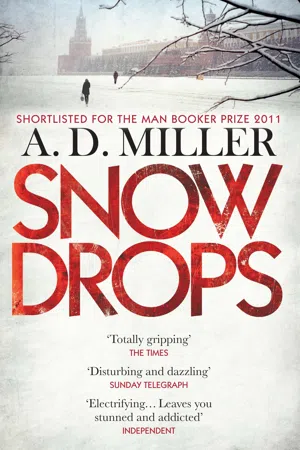
SHORTLISTED FOR THE MAN BOOKER PRIZE 2011
Snowdrops. That's what the Russians call them - the bodies that float up into the light in the thaw. Drunks, most of them, and homeless people who just give up and lie down into the whiteness, and murder victims hidden in the drifts by their killers.
Nick has a confession. When he worked as a high-flying British lawyer in Moscow, he was seduced by Masha, an enigmatic woman who led him through her city: the electric nightclubs and intimate dachas, the human kindnesses and state-wide corruption. Yet as Nick fell for Masha, he found that he fell away from himself; he knew that she was dangerous, but life in Russia was addictive, and it was too easy to bury secrets - and corpses - in the winter snows...
- English
- ePUB (mobile friendly)
- Available on iOS & Android
eBook - ePub
About this book
Information
| FOUR
‘This is it,’ Masha said.
We were standing outside a classic old Moscow building, with a cracked pastel façade and a wide courtyard where the nobility would once have kept their horses and their plotting servants. Now the courtyard contained two unhappy trees with drooping brown leaves and three or four cars, chichi enough to make it clear that money was in residence. We went through the arch from the street, and across to a metal doorway with a vintage intercom in the far left-hand corner of the yard. The air was wet – heavy with something that isn’t sleet and isn’t quite snow, a Russian humidity that tastes of exhaust fumes and seeps into your eyes and mouth. It was the kind of Moscow weather that makes you want the sky to just get on with it, like a condemned prisoner looking up at the blade of the guillotine.
Masha punched in the number of the flat. There was a pause, then a crackly buzz. A woman’s voice said, ‘Da?’
‘It’s us,’ said Masha in Russian. ‘Masha, Katya and Nikolai.’
‘Come up,’ said the voice. ‘Third floor.’
She buzzed us in and we climbed the stained marble stairs.
‘She was once communist,’ said Masha, ‘but now I think she is not.’
‘She is sometimes forgetting things,’ Katya said, ‘but she is very kind.’
‘I think she is not so happy,’ Masha said. ‘But we try.’
She was waiting for us on the landing. She had one of those miniature shot-putter babushka figures, and a face that looked younger than her grey hair, which she’d trimmed into a pragmatic Soviet bowl. She was wearing lace-up black shoes, tan stockings and a neat but worn woollen skirt and cardigan that told you straight off that the money didn’t live with her. She had clever eyes and a nice smile.
‘Dear one,’ said Masha, ‘this is Nikolai…’ I saw her realizing that she didn’t know my surname. It was, I think, only the fourth time we’d seen each other, not including the first day on the Metro. We were strangers, really, perhaps we were always strangers. But at the time it felt right, being introduced to her aunt. It felt like we might last.
‘Platt,’ I said, and then still in Russian as we shook hands, ‘Very pleased to meet you.’
‘Come in,’ she said, smiling.
I am getting ahead of myself, I’m afraid. But I wanted to tell you how I met her – how I met Tatiana Vladimirovna, the old lady.
* * *
In those gold-rush days – when half the buildings in the centre of the city were covered in submarine-sized Rolex adverts, and apartments in Stalin’s wedding-cake skyscrapers were going for Knightsbridge prices – money in Moscow had its own particular habits. Money knew that someone in the Kremlin might decide to take it back at any moment. It didn’t relax over coffee or promenade with three-wheeled buggies in Hyde Park like London money does. Moscow money emigrated to the Cayman Islands, villas on Cap Ferrat or anywhere else that would give it a warm home and ask no questions. Or it combusted itself as conspicuously as possible, poured itself into champagne-filled jacuzzis and took flight in private helicopters. Money especially loved the top-end car dealerships along Kutuzovsky Prospekt, on the way out to the war museum and Victory Park. It decorated its Mercs and fortified Hummers with flashing blue emergency lights, dispensed for thirty thousand dollars or so by obliging officials at the interior ministry, lights that parted the Moscow gridlock like the seas of Egypt. The cars congregated around the must-be-seen-in restaurants and nightclubs like basking predators at watering holes, while money went inside to gorge itself on caviar and Cristal champagne.
On a Friday night at the sharp end of October – two or three weeks before I was introduced to Tatiana Vladimirovna at the door of her apartment, I guess about the same length of time after my first night with Masha – I took the two girls to Rasputin. It was then one of the city’s most elitny nightclubs, on a corner between the Hermitage Gardens and the police station on Petrovka (the station where they film the Russian version of Crimestoppers, embellished with corpses and considerately staged shoot-outs). At least, I tried to take them to Rasputin.
We weaved through the pride of parked, tinted-window automotive monsters to the entrance. It was fortified by agents of what Muscovites call feis kontrol: two or three Himalayan bouncers and a haughty blonde wearing a headset, whose job it was to keep out insufficiently glamorous women and under-salaried men. The blonde looked the girls up and down in the frankly competitive way that Russian women do. Katya was wearing a leopard-print miniskirt above her white boots, and I remember Masha had her long hair in a sort of tousled mane, and a silver bracelet with a miniature watch in the shape of a heart attached. I think it was my fault that they stopped us. I was trying to fit in with the mafia ambience by wearing my dark work suit and a black shirt, but I probably looked like a member of the chorus in some school production of Guys and Dolls. I could see the woman on the door guessing how much pain I could call down if I got angry, estimating the seriousness of my krisha – the protective human ‘roof’ that every Russian needs, preferably in one of the security services, if they want to get off the hook, into a lower tax bracket or into Rasputin on a Friday night. From the market trader with his friendly policeman who looks the other way, to the oligarch with his obliging Kremlin overlord, anyone who wants to prosper needs a krisha: someone to bend an ear or twist an arm, a relative maybe, or an old friend, or just someone powerful whose compromising secrets you are lucky enough to know. The woman whispered something to one of the bouncers, who ushered us around a corner into a roped-off line of rejects. We might be admitted later, he told us, if there was room for us among the A-listers.
It was snowing. It was light, October snow, the type Russians call mokri sneg, damp snow, which settles on kind surfaces like the branches of trees and the roofs of cars, but is obliterated when it hits the unfriendly Moscow pavements. Some of the flakes weren’t making it that far, getting caught in up-gusts as they passed the tops of lampposts, pirouetting up again in the artificial light as if they had reconsidered. It was cold – not seriously cold, not yet, but flirting with zero. The other people in our rejects’ line drew their hands up into their sleeves, making them look like a race of amputees. Assorted gangsters, off-duty colonels from the security service and mid-range officials from the Ministry of Finance were waved through by the bouncers, each trailing a high-heeled personal harem. I was cross and embarrassed, and ready to give up and leave. Then the Cossack arrived.
He was with two or three other men and four tall girls. I called out to him, and he hung back behind his friends as they went through the velvet curtains on the door. It was one of those moments when parts of your life that are supposed to be strangers collide, like running into your boss in the foyer of a cinema or the changing rooms of a swimming pool.
‘Good evening,’ he said. He was talking to me but looking at the girls. ‘Not bad.’
‘Good evening,’ I said.
I’d seen the Cossack again a couple of days before. He came to Paveletskaya to sign papers, make promises and burp. He’d agreed to our appointment of a surveyor, who was to visit the site of the oil terminal every few weeks and confirm that construction was on schedule. That would help to prove that the repayments would eventually be met, and that, as the contract we’d drawn up provided for in lavish detail, there would be something for the banks to repossess if the Cossack and his friends ever defaulted. The surveyor we briefed was a little mole of a man called Vyacheslav Alexandrovich. We’d worked with him before, on the finance for a port development down on the Black Sea coast.
‘Aren’t you going to introduce me?’
‘Excuse me,’ I said. ‘These are my friends, Masha and Katya.’
‘Enchanté,’ said the Cossack. ‘Which one of you is Nicholas’s wife?’
He’d rumbled the little lie I’d told him about being married, but he didn’t seem to mind. I blushed. Katya giggled. Masha shook his hand. It was the only time they met, as far as I know, and in a way I’m pleased they did. It simplifies things for me, somehow, that memory of Masha and the Cossack together.
‘Do you have a problem?’ he asked me.
‘No,’ I said.
‘Yes,’ Masha corrected. She was always calm, determined, self-assured. Always. I liked that about her too.
‘Maybe,’ I said.
‘Just a second,’ said the Cossack.
He walked over to the blonde with the headset. He had his back to us so I couldn’t see his expression. But I saw his shoulder blade twitch in our direction and the woman look over at us. He kept talking and her face fell, then her head dropped, and she spoke into her headset and beckoned towards me.
The Cossack said, ‘Enjoy yourselves!’
You know the way, in action films sometimes, they show how soldiers look when they’re seen through night-vision goggles – edged in a sort of shimmering thermal glow? The Cossack looked like that all the time, I think. He was outlined in violence. It was invisible but everyone could see it.
‘Thanks,’ I said.
‘It’s nothing,’ replied the Cossack.
We shook hands, and he kept hold of me for just a moment too long, a couple of seconds maybe, so I knew he could. ‘Say hi to my friend Paolo,’ he said.
Inside there was a dance floor with three podium dancers – two energetic and topless black girls, and in between them a male dwarf wearing a tiger-stripe thong. Katya pointed up at the ceiling. Two naked girls, sprayed gold to look like cherubs and with wings attached, were flapping above our heads. We headed for the bar. It had a glass floor, and underneath it there was an aquarium filled with sturgeon and a few forlorn sharks. There were a lot of priceless women and dangerous men.
I ordered three mojitos from a barman wearing the underpaid, harassed frown of barmen on a busy night everywhere, plus a round of the risky sushi that was then standard-issue across Moscow nightspots. I felt like a lottery winner, sitting in Rasputin with the high rollers and their surgically enhanced molls – me with my pointless thick hair and pinched English features, and a new mid-thirties pad of flesh around my jaw that I looked for in the mirror every morning, in the hope that it might have gone away of its own accord. I felt like I was somebody, instead of the nobody who could at that moment have been flowing over London Bridge with all the others. I guess that’s how I was supposed to feel.
Katya asked me more about England. The usual questions: Was Sherlock Holmes real? Was it hard to get a visa? Why did Churchill wait until 1944 to open a second front? She was a good kid, I thought, inside the micro-mini, deferential to her sister, keen to get on in an understandably narrow way.
Masha asked me about my job.
‘Kolya,’ she said, ‘do you know only English law or Russian law also?’
I said I was trained in English law but understood Russian law well enough too, especially corporate law.
‘What sort of deals are you doing?’
I said it was mostly loans, and the odd merger or acquisition.
‘It means you are not working on deals for property?’ Her voice was almost smothered by the cardiac beat of the Russki dance music and the cawing of thugs.
I said no, I wasn’t. I knew a little about property law, but not much – only really the parts covering long leases for commercial buildings.
I know I should have thought harder than I did about those questions. But I was busy thinking about Masha, and going back to my place, and whether this was what the famous ‘real thing’ felt like.
* * *
Katya said she had a birthday party to go to. I said we’d escort her, but she said no, she was fine, and hurried off alone in the direction of the Bolshoi Theatre, into the early snow and the unruly Russian night.
I suggested getting a cab, but Masha said she wanted to walk. We walked back up towards Pushkin Square: past the pretty church that the communists had spared, and on the left the strip club at the side of the Pushkin Cinema (where a group of Hungarian businessmen got cremated in the upstairs cubicles a few months later), and opposite that a casino with a sports car outside, in a tilted glass case. Through the damp snow the city seemed to soften, the edges of the buildings fading out like in an Impressionist painting. Ahead of us the neon of the square, with its all-you-can-eat restaurants and statue of the famous poet, glowed like some gaudy Mongol encampment.
Masha told me that night how she worried about Katya, how apart from their aunt it was just the two of them in Moscow, how they’d always dreamed of coming but how difficult it was. She’d had to come up with five hundred dollars to get her job, she said, the normal recruitment bribe for the manager of her shop, and it had taken her six months to pay off the money she’d had to borrow. She said she hoped that maybe one day she would live somewhere safer, somewhere cleaner.
‘Like London,’ I said. ‘Maybe like London.’ I was going too fast, I know, especially compared to how it’s been between me and you. But somehow the idea didn’t seem outlandish, not at the beginning. I am trying to be honest with you. I think that’s the best thing for both of us now.
‘Maybe,’ she said. She took my hand as we went down the slippery steps into the underpass where we’d met and kept holding it after we reached the bottom.
Up on the other side of Tverskaya we walked for a while along the middle of the Bulvar. The city authorities had pulled the flowers out of their beds, as they do every year when the game is up, carting them away in the night like condemned prisoners so they don’t die in public. The Russians had put on their intermediate coats, the women in the wool or leopard-print numbers they mostly wear until it’s time for their mothballed furs. On the benches the tramps lay seasoned with snow, like meat sprinkled with salt on a butcher’s slab. In my street the bonnet of the rusty Zhiguli was freckled with melting snowflakes.
When we got inside Masha put on a CD, took off her coat, then, slowly, and like she’d done it to music before, everything else too.
Afterwards she ran a bath. She squeezed in behind me, her groomed pubic hair bristling against my coccyx, and wrapped her long legs around my loose belly. She had a front-row view of the copses of hairs on...
Table of contents
- Cover
- Blurb
- Author biography
- Title page
- Copyright page
- Glossary
- Dedication
- Epilogue
- | one
- | two
- | three
- | four
- | five
- | six
- | seven
- | eight
- | nine
- | ten
- | eleven
- | twelve
- | thirteen
- | fourteen
- | fifteen
- | sixteen
- | seventeen
Trusted by 375,005 students
Access to over 1.5 million titles for a fair monthly price.
Study more efficiently using our study tools.
Frequently asked questions
Yes, you can cancel anytime from the Subscription tab in your account settings on the Perlego website. Your subscription will stay active until the end of your current billing period. Learn how to cancel your subscription
No, books cannot be downloaded as external files, such as PDFs, for use outside of Perlego. However, you can download books within the Perlego app for offline reading on mobile or tablet. Learn how to download books offline
We are an online textbook subscription service, where you can get access to an entire online library for less than the price of a single book per month. With over 1.5 million books across 990+ topics, we’ve got you covered! Learn about our mission
Look out for the read-aloud symbol on your next book to see if you can listen to it. The read-aloud tool reads text aloud for you, highlighting the text as it is being read. You can pause it, speed it up and slow it down. Learn more about Read Aloud
Yes! You can use the Perlego app on both iOS and Android devices to read anytime, anywhere — even offline. Perfect for commutes or when you’re on the go.
Please note we cannot support devices running on iOS 13 and Android 7 or earlier. Learn more about using the app
Please note we cannot support devices running on iOS 13 and Android 7 or earlier. Learn more about using the app
Yes, you can access Snowdrops by A. D. Miller in PDF and/or ePUB format, as well as other popular books in Literature & Literature General. We have over 1.5 million books available in our catalogue for you to explore.