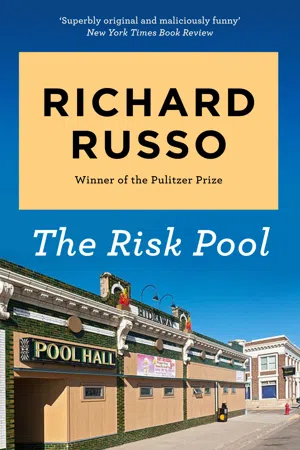
In Mohawk, New York, Ned Hall is doing his best to grow up, even though neither of his estranged parents can properly be called adult.
His father, Sam, cultivates bad habits so assiduously that he is stuck at the bottom of his car insurance risk pool. His mother, Jenny, is slowly going crazy from resentment at a husband who refuses either to stay or to stay away. As Ned veers between allegiances to these grossly inadequate role models, Richard Russo gives us a book that overflows with outsized characters and outlandish predicaments and whose vision of family is at once irreverent and unexpectedly moving.
eBook - ePub
Risk Pool
About this book
Information
Subtopic
Literature General
1
My father, unlike so many of the men he served with, knew just what he wanted to do when the war was over. He wanted to drink and whore and play the horses. “He’ll get tired of it,” my mother said confidently. She tried to keep up with him during those frantic months after the men came home, but she couldn’t, because nobody had been shooting at her for the last three years and when she woke up in the morning it wasn’t with a sense of surprise. For a while it was fun, the late nights, the dry martinis, the photo finishes at the track, but then she was suddenly pregnant with me and she decided it was time the war was over for real. Most everybody she knew was settling down, because you could only celebrate, even victory, so long. I don’t think it occurred to her that my father wasn’t celebrating victory and never had been. He was celebrating life. His. She could tag along if she felt like it, or not if she didn’t, whichever suited her. “He’ll get tired of it,” she told my grandfather, himself recently returned, worn and riddled with malaria, to the modest house in Mohawk he had purchased with a two-hundred-dollar down payment the year after the conclusion of the earlier war he’d been too young to legally enlist for. This second time around he felt no urge to celebrate victory or anything else. His wife had died when he was in the Pacific, but they had fallen out of love anyway, which was one of the reasons he’d enlisted at age forty-two for a war he had little desire to fight. But she had not been a bad woman, and the fact that he felt no loss at her passing depressed and disappointed him. From his hospital bed in New London, Connecticut, he read books and wrote his memoirs while the younger men, all malaria convalescents, played poker and waited for weekend passes from the ward. In their condition it took little enough to get good and drunk, and by early Saturday night most of them had the shakes so bad they had to huddle in the dark corners of cheap hotel rooms to await Monday morning and readmission to the hospital. But they’d lived through worse, or thought they had. My grandfather watched them systematically destroy any chance they had for recovery and so he understood my father. He may even have tried to explain things to his daughter when she told him of the trial separation that would last only until my father could get his priorities straight again, little suspecting he already did. “Trouble with you is,” my father told her, “you think you got the pussy market cornered.” Unfortunately, she took this observation to be merely a reflection of the fact that in her present swollen condition, she was not herself. Perhaps she couldn’t corner the market just then, but she’d cornered it once, and would again. And she must have figured too that when my father got a look at his son it would change him, change them both. Then the war would be over.
The night I was born my grandfather tracked him to a poker game in a dingy room above the Mohawk Grill. My father was holding a well-concealed two pair and waiting for the seventh card in a game of stud. The news that he was a father did not impress him particularly. The service revolver did. My grandfather was wheezing from the steep, narrow flight of stairs, at the top of which he stopped to catch his breath, hands on his knees. Then he took out the revolver and stuck the cold barrel in my father’s ear and said, “Stand up, you son of a bitch.” This from a man who’d gone two wars end to end without uttering a profanity. The men at the table could smell his malaria and they began to sweat.
“I’ll just have a peek at this last card,” my father said. “Then we’ll go.”
The dealer rifled cards around the table and everybody dropped lickety-split, including a man who had three deuces showing.
“Deal me out a couple a hands,” my father said, and got up slowly because he still had a gun in his ear.
At the hospital, my mother had me on her breast and she must have looked pretty, like the girl who’d cornered the pussy market before the war. “Well?” my father said, and when she turned me over, he grinned at my little stem and said, “What do you know?” It must have been a tender moment.
Not that it changed anything. Six months later my grandfather was dead, and the day after the funeral, for which my father arrived late and unshaven, my mother filed for divorce, thereby losing in a matter of days the two men in her life.
They may have departed my mother’s, but my father and grandfather remained the two pivotal figures in my own young life. Of the two, the grandfather I had no recollection of was the more vivid, thanks to my mother. By the time I was six I was full of lore concerning him, and now, at age thirty-five, I can still quote him chapter and verse. “There are four seasons in Mohawk,” he always remarked (in my mother’s voice). “Fourth of July, Mohawk Fair, Eat the Bird, and Winter.” No way around it, Mohawk winters did cling to our town tenaciously. Deep into spring, when tulips were blooming elsewhere, brown crusted snowbanks still rose high from the terraces along our streets, and although yellow water ran along the curbs, forming tunnels beneath the snow, the banks themselves shrank reluctantly, and it had been known to snow cruelly in May. It was late June before the ground was firm enough for baseball, and by Labor Day the sun had already lost its conviction when the Mohawk Fair opened. Then leper-white-skinned men, studies in congenital idiocy, hooked up the thick black snake-cables to a rattling generator that juiced The Tilt-A-Whirl, The Whip, and The Hammer. Down out of the hills they came, these white-skinned men with stubbled chins, to run the machines and leer at the taut blue faces of frightened children, leaning heavily and more heavily still on the metal bar that hurtled us faster and faster. When the garish colored lights of the midway, strung carelessly from one wooden pole to the next came down that first Tuesday morning in September, you could feel winter in the air. Fourth of July, Mohawk Fair, Eat the Bird, and Winter. I was an adult before I realized how cynical my grandfather’s observation was, his summer reduced to a single day; autumn to a third-rate mix of carnival rides, evil-smelling animals, mud and manure; Thanksgiving reduced to an obligatory carnivorous act, a “foul consumption,” he termed it; the rest Winter, capitalized. These became the seasons of my mother’s life after she realized the truth of my father’s observation about the pussy market. She worked for the telephone company and knew all about places with better seasons. At the end of the day she told me about the other operators she’d chatted with in places like Tucson, Arizona; and Albuquerque, New Mexico; and San Diego, California; where they capitalized the word Summer. “Someday …” she said, allowing her voice to trail off. “Someday.” Her inability to find a verb (or a subject, for that matter: I? We?) to give direction to her thought puzzled me then, but I’ve since concluded she didn’t truly believe in the existence of Tucson, Arizona, or perhaps didn’t believe that her personal seasons would be significantly altered by geographical considerations. She had inherited my grandfather’s modest house, and that rooted her to the spot. Its tiny mortgage payments were a blessing, because my mother was not overpaid by the telephone company. But the plumbing and electrical system were antiquated, and she was never able to get far enough ahead to do more than fix a pipe or individual wall socket. And of course the painters, roofers, electricians, and plumbers all saw her coming. So she subscribed to Arizona Highways and we stayed put.
Until I was six I thought of my father the way I thought of “my heavenly father,” whose existence was a matter of record, but who was, practically speaking, absent and therefore irrelevant. My mother had filed for divorce the day after my grandfather’s funeral, but she didn’t end up getting it. When he heard what she was up to, my father went to see her lawyer. He didn’t exactly have an appointment, but then he didn’t need one out in the parking lot where he strolled back and forth, his fists thrust deep into his pockets, his steaming breath visible in the cold, waiting until F. William Peterson, Attorney-At-Law, closed up. It was one of the bleak dead days between Christmas and New Year’s. I don’t think my mother specifically warned F. William there would be serious opposition to her design and that the opposition might conceivably be extralegal in nature. F. William Peterson had been selected by my mother precisely because he was not a Mohawk native and did not know my father. He had moved there just a few months before to join as a junior partner a firm which employed his law school roommate. I imagine he had already begun to doubt his decision to come to Mohawk even before meeting my father in the gray half-light of late afternoon. F. William Peterson was a soft man of some bulk, well dressed in a knee-length overcoat with a fur collar, when he finally appeared in the deserted parking lot at quarter to five. Never an athletic man, he was engaged in pulling on a fine new pair of gloves, a Christmas gift from Mrs. Peterson, while trying at the same time not to lose his footing on the ice. My father never wore gloves and was not wearing any that day. For warmth, he blew into his cupped hands, steam escaping from between his fingers, as he came toward F. William Peterson, who, intent on his footing and his new gloves, hadn’t what a fair-minded man would call much of a chance. Finding himself suddenly seated on the ice, warm blood salty on his lower lip, the attorney’s first conclusion must have been that somehow, despite his care, he had managed to lose his balance. Just as surprisingly, there was somebody standing over him who seemed to be making rather a point of not offering him a hand up. It wasn’t even a hand that dangled in F. William’s peripheral vision, but a fist. A clenched fist. And it struck the lawyer in the face a second time before he could account for its being there.
F. William Peterson was not a fighting man. Indeed, he had not been in the war, and had never offered physical violence to any human. He loathed physical violence in general, and this physical violence in particular. Every time he looked up to see where the fist was, it struck him again in the face, and after this happened several times, he considered it might be better to stop looking up. The snow and ice were pink beneath him, and so were his new gloves. He thought about what his wife, an Italian woman five years his senior and recently grown very large and fierce, would say when she saw them and concluded right then and there, as if it were his most pressing problem, that he would purchase an identical pair on the way home. Had he been able to see his own face, he’d have known that the gloves were not his most pressing problem.
“You do not represent Jenny Hall,” said the man standing in the big work boots with the metal eyelets and leather laces.
He did represent my mother though, and if my father thought that beating F. William Peterson up and leaving him in a snowbank would be the end of the matter he had an imperfect understanding of F. William Peterson and, perhaps, the greater part of the legal profession. My father was arrested half an hour later at the Mohawk Grill in the middle of a hamburg steak. F. William Peterson identified the work boots with the metal eyelets and leather laces, and my father’s right hand was showing the swollen effects of battering F. William Peterson’s skull. None of which was the sort of identification that was sure to hold up in court, and the lawyer knew it, but getting my father tossed in jail, however briefly, seemed like a good idea. When he was released, pending trial, my father was informed that a peace bond had been sworn against him and that if he, Sam Hall, was discovered in the immediate proximity of F. William Peterson, he would be fined five hundred dollars and incarcerated. The cop who told him all this was one of my father’s buddies and was very apologetic when my father wanted to know what the hell kind of free country he’d spent thirty-five months fighting for would allow such a law. It stank, the cop admitted, but if my father wanted F. William Peterson thrashed again, he’d have to get somebody else to do it. That was no major impediment, of course, but my father couldn’t be talked out of the premise that in a truly free country, he’d be allowed to do it himself.
So, instead of going to see F. William Peterson, he went to see my mother. She hadn’t sworn out any peace bond against him that he knew of. Probably she couldn’t, being his wife. It might not be perfect, but it was at least some kind of free country they were living in. Here again, however, F. William Peterson was a step ahead of him, having called my mother from his room at the old Nathan Littler Hospital, so she’d be on the lookout. When my father pulled up in front of the house, she called the cops without waiting for pleasantries, of which there turned out to be none anyway. They shouted at each other through the front door she wouldn’t unlock.
My mother started right out with the main point. “I don’t love you!” she screamed.
“So what?” my father countered. “I don’t love you either.”
Surprised or not, she did not miss a beat. “I want a divorce.”
“Then you can’t have one,” my father said.
“I don’t need your permission.”
“Like hell you don’t,” he said. “And you’ll need more than a candy-ass lawyer and a cheap lock to keep me out of my own house.” By way of punctuation, he put his shoulder into the door, which buckled but did not give.
“This is my father’s house, Sam Hall. You never had anything and you never will.”
“If you aren’t going to open that door,” he warned, “you’d better stand back out of the way.”
My mother did as she was told, but just then a police cruiser pulled up and my father vaulted the porch railing and headed off through the deep snow in back of the house. One of the cops gave chase while the other circled the block in the car, cutting off my father’s escape routes. It must have been quite a spectacle, the one cop chasing, until he was tuckered out, yelling, “We know who you are!” and my father shouting over his shoulder, “So what?” He knew nobody was going to shoot him for what he’d done (what had he done, now that he thought about it?). A man certainly had the right to enter his own house and shout at his own wife, which was exactly what she’d keep being until he decided to divorce her.
It must have looked like a game of tag. All the neighbors came out on their back porches and watched, cheering my father, who dodged and veered expertly beyond the outstretched arms of the pursuing cops, for within minutes, the backyards of our block were lousy with uniformed men who finally succeeded in forming a wide ring and then shrinking it, the neighbors’ boos at this unfair tactic ringing in their ears. My mother watched from the back porch as the tough, wet, angry cops closed in on my father. She pretty much decided right there against the divorce idea.
It dawned on her much later that the best way of ensuring my father’s absence was to demand he shoulder his share of the burden of raising his son. But until then, life was rich in our neighborhood. When he got out of jail, my father would make a beeline for my mother’s house (she’d had his things put in storage and changed the locks, which to her mind pretty much settled the matter of ownership), where he’d be arrested again for disturbing the peace. His visits to the Mohawk County jail got progressively longer, and so each time he got out he was madder than before. Finally, one of...
Table of contents
- Cover
- About the Author
- Titles by Richard Russo
- Title Page
- Copyright
- Dedication
- Epigraph
- Acknowledgments
- Contents
- Part 1 - Fourth of July
- Part 2 - Mohawk Fair
- Part 3 - Eat the Bird
- Part 4 - Winter
- Epilogue
- Also by Richard Russo
Trusted by 375,005 students
Access to over 1.5 million titles for a fair monthly price.
Study more efficiently using our study tools.
Frequently asked questions
Yes, you can cancel anytime from the Subscription tab in your account settings on the Perlego website. Your subscription will stay active until the end of your current billing period. Learn how to cancel your subscription
No, books cannot be downloaded as external files, such as PDFs, for use outside of Perlego. However, you can download books within the Perlego app for offline reading on mobile or tablet. Learn how to download books offline
We are an online textbook subscription service, where you can get access to an entire online library for less than the price of a single book per month. With over 1.5 million books across 990+ topics, we’ve got you covered! Learn about our mission
Look out for the read-aloud symbol on your next book to see if you can listen to it. The read-aloud tool reads text aloud for you, highlighting the text as it is being read. You can pause it, speed it up and slow it down. Learn more about Read Aloud
Yes! You can use the Perlego app on both iOS and Android devices to read anytime, anywhere — even offline. Perfect for commutes or when you’re on the go.
Please note we cannot support devices running on iOS 13 and Android 7 or earlier. Learn more about using the app
Please note we cannot support devices running on iOS 13 and Android 7 or earlier. Learn more about using the app
Yes, you can access Risk Pool by Richard Russo in PDF and/or ePUB format. We have over 1.5 million books available in our catalogue for you to explore.