'
We are despised, yet we grow. We are tortured and crucified and yet we flourish. We are hated and still we multiply. Why is that? You must wonder, how is it we survive?'
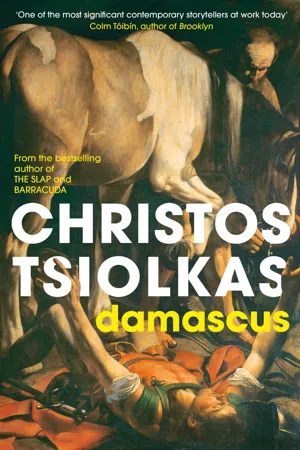
In a far corner of the Roman Empire, a radical sect is growing.
Alone, unloved and battling his sexuality, Saul scrapes together a living exposing these nascent Christians, but on the road to Damascus, everything changes.
Saul - now Paul - becomes drawn into this new religion and its mysterious leader, whose crucifixion leaves followers waiting in limbo for his promised return. As factions splinter and competition to create the definitive version of Christ's life grows violent, he begins to question his new faith and the man at its heart.
Damascus is an unflinching dissection of doubt, faith, tyranny, revolution, cruelty and sacrifice. A vivid and visceral novel with perennial concerns, it is a masterpiece of imagination and transformation.
eBook - ePub
Damascus
About this book
Information
Subtopic
BiblesIndex
LiteratureHope
LYDIA, ANTIOCH
57 A.D.
‘Do you believe in God, Momma?’
‘I don’t know—why doesn’t He help me?’
‘You’re supposed to praise Him whether you’re in pain or not.’
‘That’s unfair.’
‘Well, we’re not supposed to judge Him.’
‘I don’t want a God like that,’ she said.
‘If you believed what the Catholics believed, you could pray to the Virgin Mary.’
‘No woman made this world. I couldn’t pray to a woman.’
—HAROLD BRODKEY, ‘A STORY IN AN ALMOST CLASSICAL MODE’
I know what they call me. Witch. Sorceress. Hag. They fling their shit and they throw their stones and words.
But they cannot hurt me. My son, my brother, my Jesus, he is always with me, he is always beside me. The boys and the old shepherds, the slaves who collect firewood from this hilltop, they curse me, condemn me to Hades and to the obscene tortures of their callous gods. I wipe their shit from my cheeks, brush their dirt off my rags. Nothing they do can hurt me.
None of them dare to touch me, nor even to come close. The degradation of my work takes care of that. Their gods would demand a year-long ablution, their fathers would throw them out of their homes, their spouses banish them from their beds. The city gates would be closed to any who dared touch me. My corruption is absolute.
I need neither house nor company. On this dark side of the mountain, these bleak crags and desolate caves are the rooms I dwell in, and the sparse cypress canopies are all the shelter I need. In the storm seasons I have seen lightning dislodge a tree, cleave it from its roots and shoot it far into distant thickets. The noise is the thunder of the earth splitting. But no lightning has ever touched me. I have no fear. I gave up the world and in that surrender I was made brave. I was released from servitude and I was released from being a woman. The rocks and the trees are my home now. Beyond is the desert and behind me is the world. I have no need for it. I am no longer part of it.
‘Witch, witch!’ they scream, thinking the word will hurt me. I smile and I say, ‘Thank you.’ A stone grazes my cheek. I repeat, ‘Thank you.’ Shit spatters my lips. I wipe them, and again say, ‘Thank you.’
To this mountain they bring their children. On these ledges and in these caves they lay their newly born. Here they leave the blind child, the crippled child, the child born with a purple mark across its face. And here they abandon their girls. They light their offerings if they can afford them, and they chant their prayers to the Mother. Demeter, Isis, Al-at. We have virgins promised to you, Mother, may the next child born be a son. If they see me, they shriek and hiss. Witch. Sorceress. Hag. But they do not dare to come close. They abandon their infants and they flee.
I wait. Till their chanting can no longer be heard. Till their scents have been banished by the wind. Till I can no longer hear their footsteps. Then, only then, do I go to them. To the children they’ve abandoned.
This one has been born with no eyes. I kiss his brow. ‘Child, child,’ I whisper, ‘you I will name Fortitude.’ I tell him of a God who knows mercy and who loves justice. I tell him of a world to come that has a place for him. ‘It could even be tomorrow, child,’ I whisper. ‘Soon, very soon, he is returning.’ I go to the next infant. I kiss her belly, I lay my ear against her still-beating chest. I ask the wind and the birds to stop their songs. Faint is the beat of her heart but I can hear it. ‘You, child,’ I say softly, not to frighten her, ‘you, I will name Devotion. There is a God, child, who will make the last first and the first last. I promise you this, Devotion.’
Night. Dangerous night. I could choose to leave, I could choose to turn my eyes away, flee to the other side of the mountain, where the cypress trees grow taller, where shepherds have seeded bushes of thyme and a wild yellow garden of chamomile. I could sit there, look down at Antioch. If there is a ripe moon I could raise my finger and trace the shadow outline of the city’s walls. Or I could look beyond to the river, winding silver in the moonlight. I could cover my ears, make myself deaf to the wretched cries.
But I don’t. I stay to look. I stay to hear. As the wolf circles the crying infant, as it bares its teeth, growls and bites, as the infant offers one last cry, as the body becomes blood and meat. I crouch in the cave, hearing the slither of the snake, hearing the crunch of bone as the serpent’s jaws engulf the child. I do not look away; I stay, to be witness, to know what it is we do when we forsake our children, when we leave them on the mountainside. How can I bear witness to all of that and not be deranged? Because my son, my brother, my Jesus, he is with me, he is beside me. These are not my sobs, not my lamentations. They are his cries. This is his suffering.
In the mornings I build a fire. The meat that remains, the bones, the hair, the torn clothes that swaddled the infant, I gather and place in the fire. I watch them burn. I recite his words as I watch the fire grow and feed. I recite the words my teacher Paul first taught me. In the kingdom to come, the last will be first and the first will be last. All that remains is burned. But to the charred bones and ash I whisper, ‘This I promise you: the last will be first and the first will be last.’

I was not born a witch. I was born a woman. I was raised a Greek. When I first came to Antioch I said that I was born in Philippi, but my village lies over a day’s journey from there. My father’s blood is Macedonian and it is those mountains and those springs of pure water that are my true home.
My father was a brickmaker and it was to that trade that our family was bonded. All my brothers bake the clay. Of my mother’s clan I know nothing. My father’s first loyalty was to his ancestors and to his gods. Once she was married my mother forsook her allegiance to the spirits of her home and she never saw her family again.
‘You are my oldest daughter,’ she would whisper to me, cradling me so I might fall to sleep, ‘and it is you who are now my family and my life.’ She would quietly sing songs from her mountain home, her fingers weaving through my locks, her kiss on my brow. When she thought me asleep, she would gently unwrap her arms. ‘Don’t leave me!’ I would cry—I was terrified of the dark. ‘Don’t be silly, Lydia,’ she would say. ‘I will never leave you.’ With that promise I could sleep.
We all worked. I was the elder sister and as such the responsibility for my younger siblings fell to me. My father was stern and distant. He barely spoke to me. But he was generous to his two daughters and refused to have us work at the kilns. He was a hard worker, as was my oldest brother, Hercules—well named, for he was strong and fierce. All my brothers had to work. Every day was spent digging and then on the moulding of the clay: hard work—but the worst ordeal by far was working in the kilns. The ferocious heat that burst from them had scorched and prematurely lined their faces. In time my father’s dedication was rewarded by the gods, and he was able to hire two labourers to assist him and also to purchase three slaves. Two of them were men, who worked in the clay quarries and in the kilns. The third, Goodness, was a young maiden who helped us with the chores of the household.
Of all my tasks, the one I enjoyed most was attending to the altars. There were three of them in the house. The first and the grandest was the altar to the Mother just inside the gate that opened to our courtyard. It stood on a dais that my father had built from the first batch of bricks he had ever fired. He had kept them with him through his apprenticeship and into his marriage, through the building of our home, in order to make this dedication to the Goddess. Her form had been sculpted in clay by an artisan priestess bonded to the Great Mother’s temple. The second altar lay just before the hallway to the night chambers, and was dedicated to Hermes, to ensure that He would bring us dreams of peace and dreams of providence in the night, and not punish us with visions of furies and monsters. And the third altar was within my parent’s chamber, in honour of the god Priapus, a likeness of His sex, erect and thick, carved from wood that came from an ancient pine tree on my father’s home mountains.
Every morning, on rising, it was my duty to prepare a meal for each of the deities. The first offering was always to the Mother. Under instructions from the priestesses, my father had planted a pomegranate tree to shade the Goddess. And every morning I would stand under the tree and curse it on behalf of the Mother. The tree that had enslaved Her daughter was now slave to the Goddess. With the end of the winter, and with it the resolution of Her lamentations, I would take a budding fruit from the gnarled branches and bite into it. That hard, shiny skin was often resistant, but there was a blade by the altar that I could use to slice it open. I preferred, however, to bite into the pomegranate if I could, so that the scarlet juice would spurt over my chin and neck. ‘The red juice of the fruit is a blood offering,’ my mother instructed. ‘The Goddess is a woman and Her due is blood. Give the Goddess Her due and She will never abandon you.’ I would smear the pulp across my mouth and lips, and then I’d bow and kiss the brick on which She sat. Once that was done, I’d carefully scoop out six seeds and place them in front of Her. Then I would offer the meal and make my prayers. For Father, for Mother, for my brothers, for my sister, for our household, for our good fortune.
Then I would take what remained of the food I had prepared and share it amongst Hermes and Priapus. Of the first I asked that He chase misery and sadness from our house. Of the second I asked that He protect us from the evil eye. It was drummed into me from my mother’s first instructions that I was never to touch the sex of the God. That honour, of polishing His splendour with a salve of myrtle oil, the perfume sacred to His mother, Aphrodite, was only to be performed by my father, each morning on awakening and each evening on retiring to the marital bed. If he was called away, that duty fell to Hercules. ‘Never, my child, never touch the sex of the God,’ my mother warned repeatedly. ‘For a woman to do so is to bring great misfortune into our home.’
It is strange to think how diligent I was once about those rituals. But as an ignorant child I was bonded in servitude to those idols. They were gods and they had the power to call forth death and poverty, malice and pain. Though I feared rousing their anger, I was also proud that my mother entrusted me with their care.
My sister, Penelope, was jealous that I was the only child allowed this honour. She’d follow behind me, demanding, ‘Why aren’t I allowed to feed them? It isn’t fair.’ One morning, tired of her persistent whining, I let her serve them. Our Goodness was there and reported this to our mother. I received a whipping that drew blood from my back. ‘How dare you insult the gods?’ my mother hissed at me as she brought down the lash. ‘Do you want to bring calamity to our home?’ I was distraught. I had not meant to upset the one I loved most in the world. ‘No, Mother, I promise, Mother. I will always honour the gods.’
And this is how I came to break that promise.
My mot...
Table of contents
- Cover
- Title
- Copyright
- Map
- Saul I: 35 Anno Domini
- Hope: Lydia, Antioch 57 A.D.
- Saul II: 37 Anno Domini
- Faith: Vrasas, Rome 63 A.D.
- Saul III: 45 Anno Domini
- Love: Timothy, Ephesus 87 A.D.
- Saul IV: 57 Anno Domini
- Author’s note
- Acknowledgements
Trusted by 375,005 students
Access to over 1.5 million titles for a fair monthly price.
Study more efficiently using our study tools.
Frequently asked questions
Yes, you can cancel anytime from the Subscription tab in your account settings on the Perlego website. Your subscription will stay active until the end of your current billing period. Learn how to cancel your subscription
No, books cannot be downloaded as external files, such as PDFs, for use outside of Perlego. However, you can download books within the Perlego app for offline reading on mobile or tablet. Learn how to download books offline
Perlego offers two plans: Essential and Complete
- Essential is ideal for learners and professionals who enjoy exploring a wide range of subjects. Access the Essential Library with 800,000+ trusted titles and best-sellers across business, personal growth, and the humanities. Includes unlimited reading time and Standard Read Aloud voice.
- Complete: Perfect for advanced learners and researchers needing full, unrestricted access. Unlock 1.5M+ books across hundreds of subjects, including academic and specialized titles. The Complete Plan also includes advanced features like Premium Read Aloud and Research Assistant.
We are an online textbook subscription service, where you can get access to an entire online library for less than the price of a single book per month. With over 1.5 million books across 990+ topics, we’ve got you covered! Learn about our mission
Look out for the read-aloud symbol on your next book to see if you can listen to it. The read-aloud tool reads text aloud for you, highlighting the text as it is being read. You can pause it, speed it up and slow it down. Learn more about Read Aloud
Yes! You can use the Perlego app on both iOS and Android devices to read anytime, anywhere — even offline. Perfect for commutes or when you’re on the go.
Please note we cannot support devices running on iOS 13 and Android 7 or earlier. Learn more about using the app
Please note we cannot support devices running on iOS 13 and Android 7 or earlier. Learn more about using the app
Yes, you can access Damascus by Christos Tsiolkas in PDF and/or ePUB format, as well as other popular books in Literature & Bibles. We have over 1.5 million books available in our catalogue for you to explore.