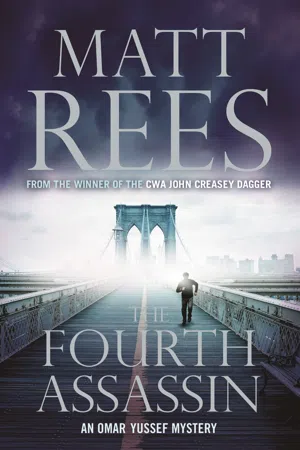
When Omar Yussef travels to New York for a UN conference, he is eager to see his youngest son, Ala. But the discovery of a decapitated corpse in his son's empty apartment lands him in the midst of a police enquiry riddled with contradictions.
Desperate to clear Ala's name, Omar's investigation to uncover the murderer leads him towards a deadly international conspiracy...
eBook - ePub
The Fourth Assassin
About this book
Information
Chapter 1
As he left the R train and came up the narrow, gum-blackened steps from the Fourth Avenue subway in Brooklyn, Omar Yussef glanced
around for armed robbers and smiled. He recalled the secretary of his school in Dehaisha Refugee Camp warning him that New
Yorkers would gun you down for a dollar. The scattered pedestrians stooped, as if beneath some invisible burden, scuttling
over the wide sidewalks of Bay Ridge Avenue. Their heads lowered to the cold wind, they dropped into the subway without looking
at him. He thought of the response he had given his worried co-worker: “I’m a Palestinian. Brooklyn will be a vacation from
the dangers of my life in Bethlehem.”
The sky was a blank, featureless gray above the three-story row houses. To Omar Yussef, the upper half of the landscape appeared
to be missing, as though it had been concreted over. He checked his wristwatch and wondered if he had miscalculated when he
set it to New York time. Its champagne-colored dial told him it was noon, but he couldn’t remember ever having seen the sun
so absolutely obscured at its zenith, even during blinding desert sandstorms.
He came to the corner of Fifth Avenue. From his pocket
he withdrew a slip of paper. With freezing fingers he lifted it close to his face and read the address scrawled across it.
This, it seemed, was the right place. He sniffed and frowned at the tawdry shops along the block. He shambled past a jeweler’s
which bore the name of a famous Ramallah clan in Arabic characters on its purple awning and a café named for Jerusalem, al-Quds, the holy. Across the street, a doctor whose family Omar Yussef knew in Bethlehem had his office and, beside it, a sign proclaimed
the offices of the Arab Community Association.
Omar Yussef shuffled along the broken sidewalk, skirting piles of dirty snow shoveled against battered newspaper-vending boxes.
He squinted against a freezing gust and pulled his thin, fawn windbreaker around the slack skin of his neck. Drops of water
blown from the tainted snow spotted his spectacles. He wrinkled his nose and pursed his lips.
This was his son’s home, the section of Brooklyn where his countrymen lived. Little Palestine.
Except for the Arabic signs above the shopfronts, the avenue appeared archetypally American to Omar Yussef. Pristine cars,
polished to a luminous finish he had only ever seen in Bethlehem on a government minister’s sedan, nuzzled the brown snow
at the curb. The Stars and Stripes rattled against the lampposts in the wind. For some puzzling reason, the gray, leafless
trees along the sidewalk were adorned with large red ribbons tied in bows.
A Muslim woman hurried out of a halal butcher. Her head wrapped in a cream mendil, she puffed out her dark cheeks against the cold and hunched her shoulders beneath a coat
that appeared to have been made for the Arctic. She caught Omar Yussef’s eye and, looking demurely to the ground as she passed,
muttered, “Peace be upon you.”
“Upon you, peace,” Omar Yussef replied. With these words, the first he had uttered in Arabic since his Royal Jordanian Airlines
flight had touched down at JFK, he felt suddenly homesick and filled with regret that he had arrived too lightly clothed for
the New York winter. At home, snow came every two or three years and swiftly melted. Despite his son’s warnings, he had felt
sure that New York’s weather couldn’t be so much worse. With his combination of extreme orderliness and dandiness, he had
brought only a small half-filled suitcase, intending to add a few tasteful purchases of fine clothing before he returned to
Palestine. Anticipating that he would buy a new hat, he had even left behind his favorite tweed cap. As he watched the woman
haul her purchases along the block, Omar Yussef felt the white hair he combed over his bald crown lift on the raw wind.
At a door beside a boutique selling the traditional embroidered robes of the Palestinian villages which, in Arabic, confided
that it was the establishment of someone named Abdelrahim, Omar Yussef checked the address once more. Then he shoved through
the cheap black door and mounted the grubby staircase toward his son’s apartment.
The corridor at the top of the flight of stairs was dark and silent. Omar Yussef paused to catch his breath and to let his
eyes adjust to the dim light filtering up from the ground floor. A bus pulled away on the avenue, and a car briefly sounded
its horn. Someone was cooking in one of the apartments. He
inhaled a smoky undertone of eggplant beneath the thick, fatty odor of lamb and recognized the dish as ma’aluba. No one slow-cooked the meat and eggplant so that their flavors rose through the pot, infusing the rice,quite the way his wife Maryam did. Once again he felt the sense of isolation that had come over him with those first Arabic
words spoken on the strange street, as though the tongue, which tasted and talked, were the natural seat of loneliness. He
pulled himself up straight. He reminded himself that his son, whom he hadn’t seen for more than a year and whom he loved,
was waiting for him in one of these rooms, and he recovered a little of the excitement he had felt as he left the subway.
He smoothed his gray mustache, smiled briskly to be sure that the chill outside hadn’t frozen his features, and scuffed along
the narrow, sticky strip of red linoleum toward the door of apartment number 2A.
It was open.
Omar Yussef halted. An inch of iron-gray light groped past the door into the corridor. He knew little about Brooklyn, but
he knew that it was not a place where people left doors unlocked, let alone ajar. He stilled his breath and listened. Another
car honked on the street. The apartment was quiet. He knocked twice and waited.
“Ala,” he called. “Ala, my son. It’s Dad.”
Above the number, a strip of paper was taped to the door. On it, in a florid Arabic script, were written the words: Castle of the Assassins. Omar Yussef’s lips twitched in a nervous smile. Nizar always had good penmanship, he thought. That’s a nice joke.
He noticed a button in the center of the door. When he
pushed it, a dull bell sounded, but the pressure of his finger also swung the door back on silent hinges. He stepped into
the living room of his son’s apartment.
Once more he called his son’s name and added those of his roommates. “Rashid, Nizar? Greetings. It’s Abu Ramiz.”
The room was shabby, furnished with a dilapidated sofa and three dining chairs, one of which was missing its plastic backrest.
On the far wall hung a cheap, yellow prayer rug woven with the image of the kaba, the black stone at the heart of the Great Mosque in Mecca. Beside it, a page torn from a magazine had been taped to the
wall. It bore a photo of the Dome of the Rock in Jerusalem. On a low table by the door sat a model of the same shrine made
of matchsticks, the size of a football, painted gaudy yellow and turquoise. The kind of art our boys make in Israeli jails, Omar Yussef thought.
He crossed the room, with a wariness born of unfamiliarity and anxiety, and smelled the heavy, vinegary homeliness of foule coming from the tiny kitchen. He looked inside, noticed a grimy pot on the stove and a few brown smears of the fava-bean
mash at its bottom. He held his hand over the pot and felt some warmth. A magnet advertising a Muslim community newspaper
clamped a sheet of paper to the door of the refrigerator. It was a photocopy of the prayer times at a mosque called the Masjid al-Alamut.
Omar Yussef raised his eyebrows. Alamut, he thought. The real castle of the Assassins. These boys didn’t forget my history lessons.
He knocked at a bedroom door and looked in. The shades were closed. He reached for a light switch. The bed was unmade. In
the small room, a free-standing closet obscured most of
the window. A calligraphic rendering of the opening lines of the Koran in gold on black hung above the bed. On the windowsill,
there were two framed pictures of Rashid. The first showed him with his parents. The second had been taken when he was a high-school
student, posing with his three closest friends and his history teacher, a grinning Omar Yussef. He shook his head. The photograph
reminded him of how quickly he had aged. Maybe it was only that the smile seemed out of place in his current life, so full
of misery and death had his hometown become since the days when he had taught the boys who now lived in this apartment.
He went to the next room. One curtain was open. The window cast a dim light, enough only for Omar Yussef to make out that
someone was there, lying in the shadows on the bed furthest from the door.
“Ala, my son? Wake up.” He knocked lightly on the door-jamb. “Nizar?”
The form on the bed didn’t stir. In the sickly light from the window, Omar Yussef could see a pair of legs clothed in well-pressed
black slacks and shiny black ankle boots. He approached, squinting into the shadows. He reached out to shake the sleeper’s
arm, touched the sleeve of a silk shirt, and found it was wet. He recoiled and yanked back the second curtain.
Omar Yussef stumbled, dropping onto the other bed. His pulse was suddenly overpowering. He pressed his hand to his heart as
though to keep it from beating right through his rib cage and fleeing the apartment.
The man on the bed was dead. Where his head should have been, the darkness of blood soaked the pillow. A light
gauzy piece of fabric had been laid above the ragged flesh of the neck. Blood covered the man’s shirt and was splattered across
the wall. The corpse’s hands were bloodied too. Omar Yussef’s cheek twitched. His eyes blinked and teared up.
Is this my son? he thought. His shoulders shook and he went down onto his knees, crawling toward the bed. His hands slopped through the blood
on the floor by the nightstand. He whimpered and a burst of acid vomit burned out of his mouth. It can’t be him. He wiped his sniffling nose and his lips with his wrist, staring at the body. The dead man had been short and slight, with
a slim waist and delicate hands. He has Ala’s build. Do I recognize this shirt? Is it Ala’s?
On the nightstand, he saw a letter in his own careful hand. It lay unfolded beside the alarm clock, on top of a book of poetry
by Taha Muhammad Ali. He picked it up. My dear son, Your dear mother sends her love, and your niece Nadia encloses a short story she wrote about something mysterious
that happened in Nablus. Here are my travel details: If Allah wills it, I shall arrive for the UN conference on the morning
of February 11 and shall come immediately to see you in Brooklyn. As we have discussed so many times and with such anticipation,
you will show me around Little Palestine. . . .
He crumpled the pages in a bloodied fist and laid his shaking hand on the corpse’s chest. His pulse palpitated so strongly
in his palm that his hand seemed to rise and fall, as though the dead man’s ribs still lifted with breath. The pooled blood
seeped into his trousers, chilling his knees. May the King of the Day of Judgment forgive me for all my transgressions, he thought, and find it displeasing that this should be my boy
before me. As his joints stiffened in the cold gore, he knew that he lacked the faith that might will this body back to life. He was
not a believer. His prayer only made him feel more desperate and isolated. He shuffled backward, away from the bed, and wept.
Chapter 2
In his shock, Omar Yussef sat with the terrified, expectant stillness of a hunted animal. Eventually he wondered how long he had been on the floor of the bedroom. He watched his wrist lift like a corpse floating up through water. There was blood on the face of his watch. He rubbed it away with his thumb. Beneath the brown smear that remained, the dial showed one o’clock.
He heard a footstep in the living room. He waited. Three more steps, soft yet decisive. He sensed someone was just beyond the open door of the bedroom.
Maybe it’s Ala, he thought. He’s alive. He opened his mouth to call the name of his son, but then he glanced at the body on the bed. Or the murderer has returned.
He shoved himself to his feet, feeling as though all his muscles were encased in plaster. He was unsure if he intended to confront the killer or find a place to hide. His knees shook. His brain seemed to lurch into the backs of his eyeballs. He braced himself against the door frame as he stepped into the living room.
The front door was swinging and Omar Yussef glimpsed the back of a man clad in a black padded coat, black pants and shoes, and a black woolen cap. The man had bumped the edge of the matchstick model as he passed, and it toppled to the floor. Omar Yussef made for the door, but by the time he reached it the man was down the stairs and gone.
His neck spasmed with adrenaline. It could’ve been a thief who happened to see an open door and decided to try his luck, he told himself. But he was sure he had seen the killer. He felt isolated and vulnerable. What if the murderer realized that he had no need to flee from the feeble old man trembling in the bedroom?
On the floor by the sofa, he noticed the telephone. I have to get the police, he thought. He picked up the receiver, then halted. What’s the number for the emergency services in this country? He recalled reading an article which had explained why the deadly date had been so evocative for Americans, and he dialed.
A woman’s voice answered. “Nine-one-one emergency.”
Omar Yussef cleared his throat and spoke in his precise English. “I wish to report a death.”
“What is the mode of death, sir?”
Omar Yussef strained to comprehend the woman on the other end of the line. The operator’s voice had the impenetrability of poor diction forced to cope with a pre-scripted, elevated grammar. “I mean to say, it’s a murder.”
“How do you know it’s a murder, sir?”
The phone shook in Omar Yussef’s hand. “He has no head.”
“You have a dead person there with no head, sir?”
Omar Yussef nodded at the ...
Table of contents
- Cover
- Also by Matt Rees
- Copyright
- Dedication
- Chapter 1
- Chapter 2
- Chapter 3
- Chapter 4
- Chapter 5
- Chapter 6
- Chapter 7
- Chapter 8
- Chapter 9
- Chapter 10
- Chapter 11
- Chapter 12
- Chapter 13
- Chapter 14
- Chapter 15
- Chapter 16
- Chapter 17
- Chapter 18
- Chapter 19
- Chapter 20
- Chapter 21
- Chapter 22
- Chapter 23
- Chapter 24
- Chapter 25
- Chapter 26
- Chapter 27
- Chapter 28
- Chapter 29
- Chapter 30
- Chapter 31
- Chapter 32
- Chapter 33
Trusted by 375,005 students
Access to over 1.5 million titles for a fair monthly price.
Study more efficiently using our study tools.
Frequently asked questions
Yes, you can cancel anytime from the Subscription tab in your account settings on the Perlego website. Your subscription will stay active until the end of your current billing period. Learn how to cancel your subscription
No, books cannot be downloaded as external files, such as PDFs, for use outside of Perlego. However, you can download books within the Perlego app for offline reading on mobile or tablet. Learn how to download books offline
Perlego offers two plans: Essential and Complete
- Essential is ideal for learners and professionals who enjoy exploring a wide range of subjects. Access the Essential Library with 800,000+ trusted titles and best-sellers across business, personal growth, and the humanities. Includes unlimited reading time and Standard Read Aloud voice.
- Complete: Perfect for advanced learners and researchers needing full, unrestricted access. Unlock 1.5M+ books across hundreds of subjects, including academic and specialized titles. The Complete Plan also includes advanced features like Premium Read Aloud and Research Assistant.
We are an online textbook subscription service, where you can get access to an entire online library for less than the price of a single book per month. With over 1.5 million books across 990+ topics, we’ve got you covered! Learn about our mission
Look out for the read-aloud symbol on your next book to see if you can listen to it. The read-aloud tool reads text aloud for you, highlighting the text as it is being read. You can pause it, speed it up and slow it down. Learn more about Read Aloud
Yes! You can use the Perlego app on both iOS and Android devices to read anytime, anywhere — even offline. Perfect for commutes or when you’re on the go.
Please note we cannot support devices running on iOS 13 and Android 7 or earlier. Learn more about using the app
Please note we cannot support devices running on iOS 13 and Android 7 or earlier. Learn more about using the app
Yes, you can access The Fourth Assassin by Matt Rees in PDF and/or ePUB format, as well as other popular books in Literature & Literature General. We have over 1.5 million books available in our catalogue for you to explore.