eBook - ePub
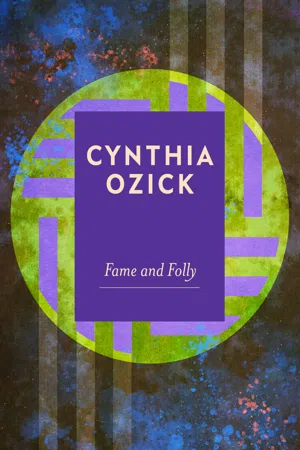
Fame and Folly
About this book
From one of America's great literary figures, a collection of essays on eminent writers and their work, and on the war between art and life. The perilous intersection of writers' lives with public and private dooms is the fertile subject of many of these remarkable essays from such literary giants as T.S. Eliot, Isaac Babel, Salman Rushdie and Henry James.
Information
T. S. ELIOT AT 101
“The Man Who
Suffers and the Mind
Which Creates”
Suffers and the Mind
Which Creates”
THOMAS STEARNS ELIOT, poet and preëminent modernist, was born one hundred and one years ago.1 His centennial in 1988 was suitably marked by commemorative reporting, literary celebrations in New York and London, and the publication of a couple of lavishly reviewed volumes: a new biography and a collection of the poet’s youthful letters. Probably not much more could have been done to distinguish the occasion; still, there was something subdued and bloodless, even superannuated, about these memorial stirrings. They had the quality of a slightly tedious reunion of aging alumni, mostly spiritless by now, spurred to animation by old exultation recollected in tranquility. The only really fresh excitement took place in London, where representatives of the usually docile community of British Jews, including at least one prominent publisher, condemned Eliot for antisemitism and protested the public fuss. Elsewhere, the moment passed modestly, hardly noticed at all by the bookish young—who, whether absorbed by recondite theorizing in the academy, or scampering after newfangled writing careers, have long had their wagons hitched to other stars.
In the early Seventies it was still possible to uncover, here and there, a tenacious English department offering a vestigial graduate seminar given over to the study of Eliot. But by the close of the Eighties, only “The Love Song of J. Alfred Prufrock” appears to have survived the indifference of the schools—two or three pages in the anthologies, a fleeting assignment for high school seniors and college freshmen. “Prufrock,” and “Prufrock” alone, is what the latest generations know—barely know: not “The Hollow Men,” not “La Figlia che Piange,” not “Ash-Wednesday,” not even The Waste Land. Never Four Quartets. And the mammoth prophetic presence of T. S. Eliot himself—that immortal sovereign rock—the latest generations do not know at all.
To anyone who was an undergraduate in the Forties and Fifties (and possibly even into the first years of the Sixties), all that is inconceivable—as if a part of the horizon had crumbled away. When, four decades ago, in a literary period that resembled eternity, T. S. Eliot won the Nobel Prize for literature, he seemed pure zenith, a colossus, nothing less than a permanent luminary fixed in the firmament like the sun and the moon—or like the New Criticism itself, the vanished movement Eliot once magisterially dominated. It was a time that, for the literary young, mixed authority with innovation: authority was innovation, an idea that reads now, in the wake of the anti-establishment Sixties, like the simplest contradiction. But modernism then was an absolute ruler—it had no effective intellectual competition and had routed all its predecessors; and it was modernism that famously carried the “new.”
The new—as embodied in Eliot—was difficult, preoccupied by parody and pastiche, exactingly allusive and complex, saturated in manifold ironies and inflections, composed of “layers,” and pointedly inaccessible to anybody expecting run-of-the-mill coherence. The doors to Eliot’s poetry were not easily opened. His lines and themes were not readily understood. But the young who flung themselves through those portals were lured by unfamiliar enchantments and bound by pleasurable ribbons of ennui. “April is the cruel-lest month,” Eliot’s voice, with its sepulchral cadences, came spiralling out of 78 r.p.m. phonographs, “breeding / Lilacs out of the dead land, mixing / Memory and desire . . .” That toney British accent—flat, precise, steady, unemotive, surprisingly high-pitched, bleakly passive—coiled through awed English departments and worshipful dormitories, rooms where the walls had pin-up Picassos, and Pound and Eliot and Ulysses and Proust shouldered one another higgledy-piggledy in the rapt late-adolescent breast. The voice was, like the poet himself, nearly sacerdotal, impersonal, winding and winding across the country’s campuses like a spool of blank robotic woe. “Shantih shantih shantih,” “not with a bang but a whimper,” “an old man in a dry month,” “I shall wear the bottoms of my trousers rolled”—these were the devout chants of the literarily passionate in the Forties and Fifties, who in their own first verses piously copied Eliot’s tone: its restraint, gravity, mystery; its invasive remoteness and immobilized disjointed despair.
There was rapture in that despair. Wordsworth’s nostalgic cry over the start of the French Revolution—“Bliss was it in that dawn to be alive, / But to be young was very heaven!”—belongs no doubt to every new generation; youth’s heaven lies in its quitting, or sometimes spiting, the past, with or without a historical crisis. And though Eliot’s impress—the bliss he evoked—had little to do with political rupture, it was revolutionary enough in its own way. The young who gave homage to Eliot were engaged in a self-contradictory double maneuver: they were willingly authoritarian even as they jubilantly rebelled. On the one hand, taking on the puzzlements of modernism, they were out to tear down the Wordsworthian tradition itself, and on the other they were ready to fall on their knees to a god. A god, moreover, who despised free-thinking, democracy, and secularism: the very conditions of anti-authoritarianism.
How T. S. Eliot became that god—or, to put it less extravagantly, how he became a commanding literary figure who had no successful rivals and whose formulations were in fact revered—is almost as mysterious a proposition as how, in the flash of half a lifetime, an immutable majesty was dismantled, an immutable glory dissipated. It is almost impossible nowadays to imagine such authority accruing to a poet. No writer today—Nobel winner or no—holds it or can hold it. The four2 most recent American Nobel laureates in literature—Czeslaw Milosz, Saul Bellow, Isaac Bashevis Singer, and Joseph Brodsky (three of whom, though citizens of long standing, do not write primarily in English)—are much honored, but they are not looked to for manifestos or pronouncements, and their comments are not studied as if by a haruspex. They are as far from being cultural dictators as they are from filling football stadiums.
Eliot did once fill a football stadium. On April 30, 1956, fourteen thousand people came to hear him lecture on “The Frontiers of Criticism” at the University of Minnesota, in Minneapolis. By then he was solidly confirmed as “the Pope of Russell Square,” as his London admirer Mary Trevelyan began to call him in 1949. It was a far-reaching papacy, effective even among students in the American Midwest; but if the young flocked to genuflect before the papal throne, it was not they who had enthroned Eliot, nor their teachers. In the Age of Criticism (as the donnish “little” magazines of the time dubbed the Forties and Fifties), Eliot was ceded power, and accorded veneration, by critics who were themselves minor luminaries. “He has a very penetrating influence, perhaps not unlike an east wind,” wrote William Empson, one of whose titles, Seven Types of Ambiguity, became an academic catchphrase alongside Eliot’s famous “objective correlative.” R. P. Blackmur said of “Prufrock” that its “obscurity is like that of the womb”; Eliot’s critical essays, he claimed, bear a “vital relation” to Aristotle’s Poetics. Hugh Kenner’s comparison is with still another monument: “Eliot’s work, as he once noted of Shakespeare, is in important respects one continuous poem,” and for Kenner the shape of Eliot’s own monument turns out to be “the Arch which stands when the last marcher has left, and endures when the last centurion or sergeant-major is dust.” F. R. Leavis, declaring Eliot “among the greatest poets of the English language,” remarked that “to have gone seriously into the poetry is to have had a quickening insight into the nature of thought and language.” And in Eliot’s hands, F. O. Matthiessen explained, the use of the symbol can “create the illusion that it is giving expression to the very mystery of life.”
These evocations of wind, womb, thought and language, the dust of the ages, the very mystery of life, not to mention the ghosts of Aristotle and Shakespeare: not since Dr. Johnson has a man of letters writing in English been received with so much adulation, or seemed so formidable—almost a marvel of nature itself—within his own society.
Nevertheless there was an occasional dissenter. As early as 1929, Edmund Wilson was complaining that he couldn’t stomach Eliot’s celebrated conversion to “classicism, royalism, and Anglo-Catholicism.” While granting that Eliot’s essays “will be read by everybody interested in literature,” that Eliot “has now become the most important literary critic in the English-speaking world,” and finally that “one can find no figure of comparable authority,” it was exactly the force of this influence that made Wilson “fear that we must give up hope.” For Wilson, the argument of Eliot’s followers “that, because our society at the present time is badly off without religion, we should make an heroic effort to swallow medieval theology, seems . . . utterly futile as well as fundamentally dishonest.” Twenty-five years later, when the American intellectual center had completed its shift from freelance literary work like Wilson’s—and Eliot’s—to the near-uniformity of university English departments, almost no one in those departments would dare to think such unfastidious thoughts about Eliot out loud. A glaze of orthodoxy (not too different from the preoccupation with deconstructive theory currently orthodox in English departments) settled over academe. Given the normal eagerness of succeeding literary generations to examine new sets of entrails, it was inevitable that so unbroken a dedication would in time falter and decline. But until that happened, decades on, Eliot studies were an unopposable ocean; an unstoppable torrent; a lava of libraries.
It may be embarrassing for us now to look back at that nearly universal obeisance to an autocratic, inhibited, depressed, rather narrow-minded and considerably bigoted fake Englishman—especially if we are old enough (as I surely am) to have been part of the wave of adoration. In his person, if not in his poetry, Eliot was, after all, false coinage. Born in St. Louis, he became indistinguishable (though not to shrewd native English eyes), in his dress, his manners, his loyalties, from a proper British Tory. Scion of un-doctrinaire rationalist New England Unitarianism (his grandfather had moved from Boston to Missouri to found Washington University), he was possessed by guilty notions of sinfulness and martyrdom and by the monkish disciplines of asceticism, which he pursued in the unlikely embrace of the established English church. No doubt Eliot’s extreme self-alterations should not be dismissed as ordinary humbug, particularly not on the religious side; there is a difference between impersonation and conversion. Still, self-alteration so unalloyed suggests a hatred of the original design. And certainly Eliot condemned the optimism of democratic American meliorism; certainly he despised Unitarianism, centered less on personal salvation than on the social good; certainly he had contempt for Jews as marginal if not inimical to his notions of Christian community. But most of all, he came to loathe himself, a hollow man in a twilight kingdom.
In my undergraduate years, between seventeen and twenty-one, and long after as well, I had no inkling of any of this. The overt flaws—the handful of insults in the poetry—I swallowed down without protest. No one I knew protested—at any rate, no professor ever did. If Eliot included lines like “The rats are underneath the piles. / The jew [sic] is underneath the lot,” if he had his Bleistein, “Chicago Semite Viennese,” stare “from the protozoic slime” while elsewhere “The jew squats on the windowsill, the owner” and “Rachel née Rabinovitch / Tears at the grapes with murderous paws”—well, that, sadly, was the way of the world and to be expected, even in the most resplendent poet of the age. The sting of those phrases—the shock that sickened—passed, and the reader’s heart pressed on to be stirred by other lines. What was Eliot to me? He was not the crack about “Money in furs,” or “Spawned in some estaminet in Antwerp.” No, Eliot was “The Lady is withdrawn / In a white gown, to contemplation, in a white gown” and “Then spoke the thunder/ DA / Datta: what have we given?” and “Afternoon grey and smoky, evening yellow and rose”; he was incantation, mournfulness, elegance; he was liquescence, he was staccato, he was quickstep and oar, the hushed moan and the sudden clap. He was lyric shudder and rose-burst. He was, in brief, poetry incarnate; and poetry was what one lived for.
And he was something else beside. He was, to say it quickly, absolute art: high art, when art was at its most serious and elitist. The knowledge of that particular splendor—priestly, sacral, a golden cape for the initiate—has by now ebbed out of the world, and many do not regret it. Literary high art turned its back on egalitarianism and prized what is nowadays scorned as “the canon”: that body of anciently esteemed texts, most of them difficult and aristocratic in origin, which has been designated Western culture. Modernism—and Eliot—teased the canon, bruised it, and even sought to astonish it by mocking and fragmenting it, and also by introducing Eastern infusions, such as Eliot’s phrases from the Upanishads in The Waste Land and Pound’s Chinese imitations. But all these shatterings, dislocations, and idiosyncratic juxtapositions of the old literary legacies were never intended to abolish the honor in which they were held, and only confirmed their centrality. Undoing the canon is the work of a later time—of our own, in fact, when universal assent to a central cultural standard is almost everywhere decried. For the moderns, and for Eliot especially, the denial of permanently agreed-on masterworks—what Matthew Arnold, in a currency now obsolete beyond imagining, called “touchstones”—would have been unthinkable. What one learned from Eliot, whose poetry skittered toward disintegration, was the power of consolidation: the understanding that literature could genuinely reign.
One learned also that a poem could actually be penetrated to its marrow—which was not quite the same as comprehending its meaning. In shunting aside or giving up certain goals of ordinary reading, the New Criticism installed Eliot as both teacher and subject. For instance, following Eliot, the New Criticism would not allow a poem to be read in the light of either biography or psychology. The poem was to be regarded as a thing-in-itself; nothing environmental or causal, including its own maker, was permitted to illuminate or explain it. In that sense it was as impersonal as a jar or any other shapely artifact that must be judged purely by its externals. This objective approach to a poem, deriving from Eliot’s celebrated “objective correlative” formulation, did not dismiss emotion; rather, it kept it at a distance, and precluded any speculation about the poet’s own life, or any other likely influence on the poem. “The progress of an artist is a continual self-sacrifice, a continual extinction of personality,” Eliot wrote in his landmark essay, “Tradition and the Individual Talent.” “Emotion . . . has its life in the poem and not in the history of the poet.” And, most memorably: “The more perfect the artist, the more completely separate in him will be the man who suffers and the mind which creates.” This was a theory designed to prevent old-fashioned attempts to read private events into the lines on the page. Artistic inevitability, Eliot instructed, “lies in this complete adequacy of the external to the emotion” and suggested a series of externals that might supply the “exact equivalence” of any particular emotion: “a set of objects, a situation, a chain of events.” Such correlatives—or “objective equivalences”—provided, he insisted, the “only way of expressing emotion in the form of art.” The New Criticism took him at his word, and declined to admit any other way. Not that the aesthetic scheme behind Eliot’s formulation was altogether new. Henry James, too, had demanded—“Dramatize, dramatize!”—that the work of art resist construing itself in public. When Eliot, in offering his objective correlative, stopped to speak of the “données of the problem”—donnée was one of James’s pet Gallicisms—he was tipping off his source. No literary figure among James’s contemporaries had paid any attention to this modernist dictum, often not even James himself. Emerging in far more abstruse language from Eliot, it became a papal bull. He was thirty-five at the time.
The method used in digging out the objective correlative had a Gallic name of its own: explication de texte. The sloughing off of what the New Criticism considered to be extraneous had the effect of freeing the poem utterly—freeing it for the otherwise undistracted mind of the reader, who was released from “psychology” and similar blind alleys in order to master the poem’s components. The New Criticism held the view that a poem could indeed be mastered: this was an act of trust, as it were, between poem and reader. The poem could be relied on to yield itself up to the reader—if the reader, on the other side of the bargain, would agree to a minutely close “explication,” phrase by phrase: a process far more meticulous than “interpretation” or the search for any identifiable meaning or definitive commentary. The search was rather for architecture and texture—or call it resonance and intricacy, the responsive web-work between the words. Explication de texte, as practiced by the New Critics and their graduate-student disciples, was something like watching an ant maneuver a bit of leaf. One notes first the fine veins in the leaf, then the light speckled along the veins, then the tiny glimmers charging off the ant’s various surfaces, the movements of the ant’s legs and other body parts, the lifting and balancing of the leaf, all the while scrupulously aware that ant and leaf, though separate structures, become—when linked in this way—a freshly imagined structure.
A generation or more was initiated into this concentrated scrutiny of a poem’s structure and movement. High art in literature—which had ...
Table of contents
- Cover
- Title
- Copyright
- Contents
- Foreword
- 1. T. S. Eliot At 101: “The Man Who Suffers and the Mind Which Creates”
- 2. Alfred Chester’s Wig: Images Standing Fast
- 3. Our Kinsman, Mr. Trollope
- 4. What Henry James Knew
- 5. Isaac Babel and the Identity Question
- 6. George Steiner and the Errata of History
- 7. Mark Twain’s Vienna
- 8. Saul Bellow’s Broadway
- 9. Rushdie in the Louvre
- 10. Of Christian Heroism
- 11. Existing Things
- 12. The Break
- 13. Old Hand as Novice
- 14. Seymour: Homage to a Bibliophile
- 15. Helping T. S. Eliot Write Better (Notes Toward a Definitive Bibliography)
- 16. Against Modernity: Annals of the Temple, 1918–1927
- 17. “It Takes a Great Deal of History to Produce a Little Literature”
- Permissions Acknowledgments
Trusted by 375,005 students
Access to over 1.5 million titles for a fair monthly price.
Study more efficiently using our study tools.
Frequently asked questions
Yes, you can cancel anytime from the Subscription tab in your account settings on the Perlego website. Your subscription will stay active until the end of your current billing period. Learn how to cancel your subscription
No, books cannot be downloaded as external files, such as PDFs, for use outside of Perlego. However, you can download books within the Perlego app for offline reading on mobile or tablet. Learn how to download books offline
Perlego offers two plans: Essential and Complete
- Essential is ideal for learners and professionals who enjoy exploring a wide range of subjects. Access the Essential Library with 800,000+ trusted titles and best-sellers across business, personal growth, and the humanities. Includes unlimited reading time and Standard Read Aloud voice.
- Complete: Perfect for advanced learners and researchers needing full, unrestricted access. Unlock 1.5M+ books across hundreds of subjects, including academic and specialized titles. The Complete Plan also includes advanced features like Premium Read Aloud and Research Assistant.
We are an online textbook subscription service, where you can get access to an entire online library for less than the price of a single book per month. With over 1.5 million books across 990+ topics, we’ve got you covered! Learn about our mission
Look out for the read-aloud symbol on your next book to see if you can listen to it. The read-aloud tool reads text aloud for you, highlighting the text as it is being read. You can pause it, speed it up and slow it down. Learn more about Read Aloud
Yes! You can use the Perlego app on both iOS and Android devices to read anytime, anywhere — even offline. Perfect for commutes or when you’re on the go.
Please note we cannot support devices running on iOS 13 and Android 7 or earlier. Learn more about using the app
Please note we cannot support devices running on iOS 13 and Android 7 or earlier. Learn more about using the app
Yes, you can access Fame and Folly by Cynthia Ozick in PDF and/or ePUB format, as well as other popular books in Scienze sociali & Biografie nell'ambito delle scienze sociali. We have over 1.5 million books available in our catalogue for you to explore.